Introduction
The global energy landscape is undergoing a massive geopolitical shift. In a development that has sent shockwaves through the international commodities markets, the United States and the Iraqi government signed a landmark package of over fifty agreements and memorandums of understanding (MOUs) totaling more than $60 billion. Hosted at the U.S. Chamber of Commerce during the inaugural Washington visit of Iraqi Prime Minister Ali Al-Zaidi, the historic U.S.-Iraq Business Summit brought together top energy executives, sovereign wealth architects, and senior government officials. why US firms sign $60 billion Iraq deals right now?
This massive $60 billion commercial injection marks a new era in bilateral economic relations. For decades, international corporate engagement in Iraq was defined by stabilization and short-term project execution. Today, global markets are asking the critical question: why US firms sign $60 billion Iraq deals right now?
The answer lies at the intersection of energy security, major regional conflicts, and the urgent need to rebuild global supply lines. As hostilities in West Asia cause unprecedented volatility in maritime shipping, these agreements signal a multi-year effort to unlock Iraq’s resource potential while reshaping how energy moves to Western buyers.
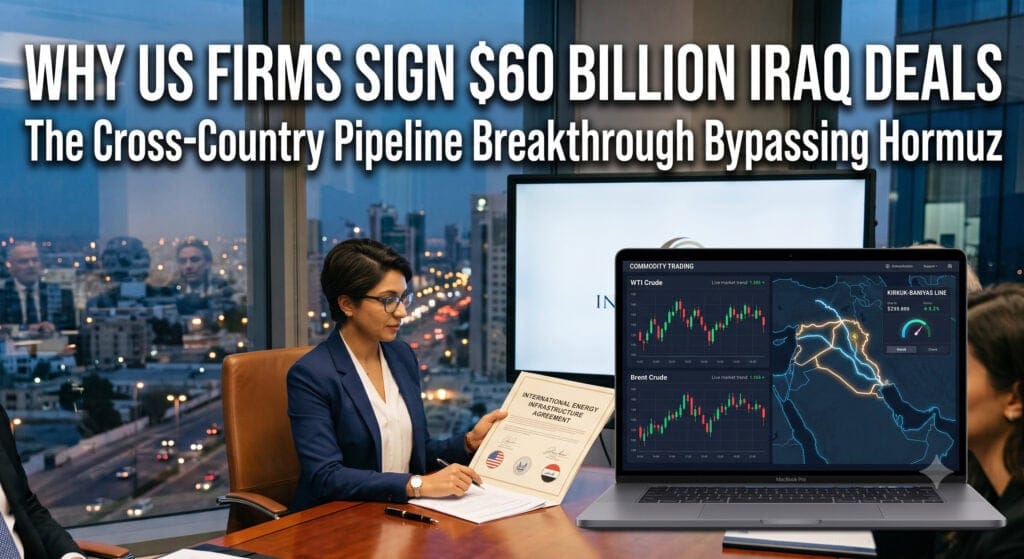
Table of Contents
1. The Crucial Waterway Detour: Bypassing the Volatile Strait of Hormuz
The most urgent reason why US firms sign $60 billion Iraq deals centers on global energy supply security. The Strait of Hormuz is the world’s most critical maritime oil chokepoint, handling approximately 23 million barrels of crude oil per day—roughly one-fifth of the world’s total supply—before recent regional conflicts erupted.
               [ Traditional Route: High Risk ]
               Persian Gulf  --->  Strait of Hormuz (Chokepoint)  --->  Global Markets
                                         |
                                  (Targeted for Bypassing)
                                         |
               [ New Strategic Corridors: Secured by $60B Deals ]
               Iraq Oil Fields ---> Cross-Country Overland Pipelines ---> Mediterranean / Ceyhan Port
Following the outbreak of the U.S.-Iran conflict on February 28, shipping lanes in the Persian Gulf have faced regular disruptions and rising insurance premiums. In response, a major focus of these $60 billion agreements is to build overland pipeline networks that bypass the Strait entirely. By moving crude oil directly to Mediterranean ports via land routes, American firms are building a critical alternative supply chain that insulates global economies from sudden supply halts in the Gulf.
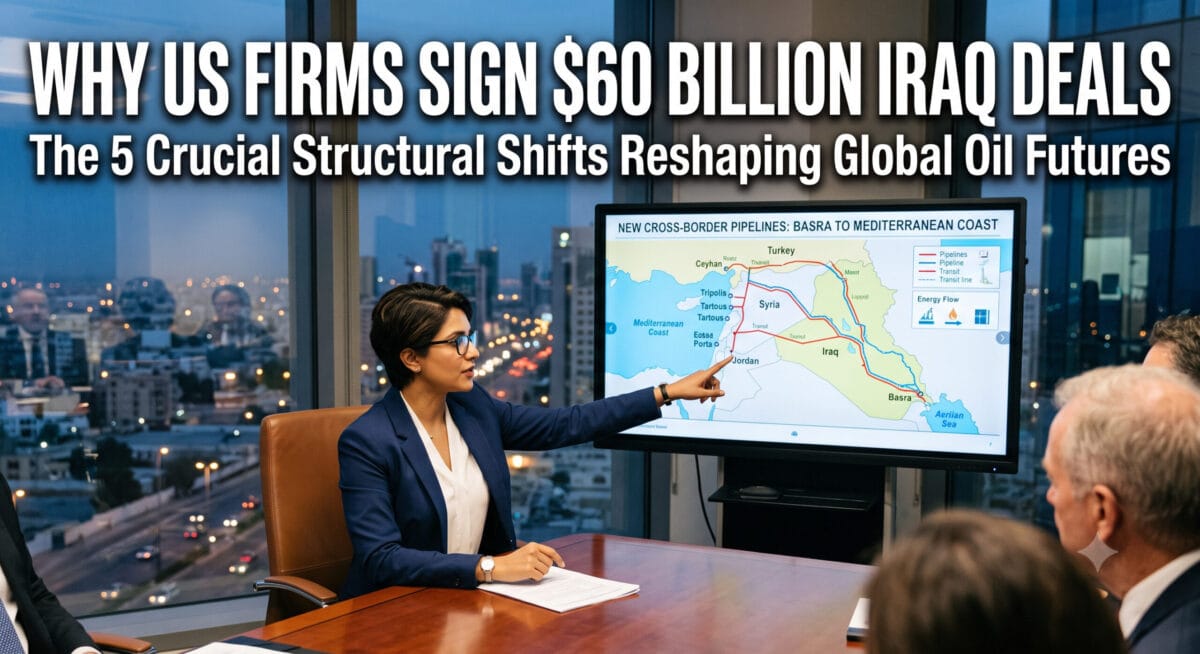
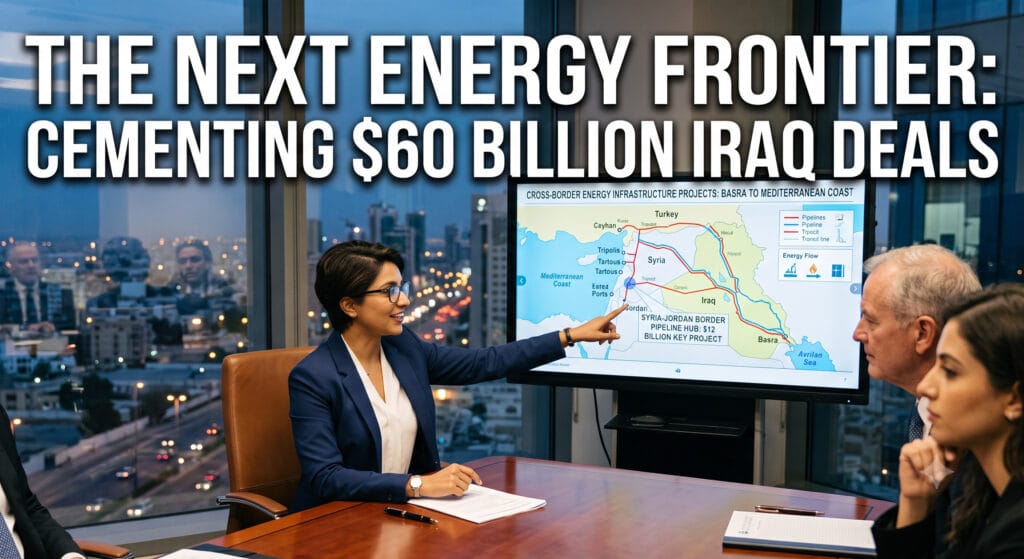
2. Rebuilding the Kirkuk-Baniyas Pipeline and Mediterranean Access
A major component of this infrastructural shift is an agreement to rebuild and restart the long-idled Kirkuk-Baniyas crude oil pipeline. Damaged during the 2003 conflict and left out of service for over two decades, this priority infrastructure project is now being revived by a U.S.-led international consortium with full backing from the U.S. State Department. Why US firms sign $60 billion Iraq deals
Structural Specifications of the Cross-Border Corridor:
- Route Path: The pipeline is designed to connect southern Iraq’s hub in Basra to western Iraq’s Haditha region. From there, it branches toward the Ceyhan port in Turkey and the port of Baniyas on the Syrian Mediterranean coast.
- Projected Throughput: Once fully operational, this network is projected to transport up to 2 million barrels of oil per day directly to international markets.
- Geopolitical Goal: As U.S. officials noted at the summit, these pipeline expansions aim to make the Strait of Hormuz secondary from an energy supply perspective.
3. Upgrading Major Upstream Oil Fields
Another reason why US firms sign $60 billion Iraq deals is the massive upstream resource potential within Iraq’s northern and southern oil domes. Iraq holds some of the lowest-cost, highest-volume extractable reserves on the planet, making it highly attractive for long-term commercial investments.
Markdown
Major Corporate Oil Initiatives Under the $60 Billion Framework

1. Chevron's Strategic Field Entries
Chevron signed three separate agreements with Baghdad. Two of these focus on boosting crude output by preparing the energy giant to enter the major West Qurna 2 and Nassiriya oilfields. The third involves direct capital deployment for alternative export pipelines.

2. ConocoPhillips & BP Joint Venture
ConocoPhillips agreed to acquire a 42% stake in BP Energy Company of Kirkuk Limited. This joint venture will focus on redeveloping four major producing fields in northern Iraq, including the Baba and Avanah domes, as well as the Bai Hassan, Jambur, and Khabbaz fields.
By introducing advanced recovery technologies from American operators, Iraq aims to convert these untapped assets into immediate domestic jobs and long-term national prosperity. Why US firms sign $60 billion Iraq deals
4. Iraq’s “Open-Door” Strategy and Investment Safeguards
The sudden surge in commercial deals is also driven by a clear policy shift from the Iraqi government. During the summit, Prime Minister Al-Zaidi emphasized that Iraq is moving past an era defined by conflict and entering an era focused on construction and open partnership.
               +-------------------------------------------------------+
               |  Iraq's Modern Open-Door Policy Framework            |
               +-------------------------------------------------------+
               | 1. Long-Term Public-Private Partnerships             |
               | 2. Rejection of Basic, Fee-Based Service Contracts    |
               | 3. Technology Transfer for Gas Capture & Refining     |
               | 4. Integrated Frameworks Across Multiple Sectors      |
               +-------------------------------------------------------+
Historically, international oil companies worked under strict, low-margin technical service contracts in Iraq. The new strategy focuses on long-term equity partnerships, asset co-ownership, and simplified regulatory processes. This regulatory shift gives foreign capital the transparency needed to finance large-scale projects. Why US firms sign $60 billion Iraq deals
5. Beyond Energy: Diversification Into Technology and Infrastructure
While oil and gas pipelines make up the largest share of the capital value, understanding why US firms sign $60 billion Iraq deals requires looking at the non-energy sectors included in the framework. Iraq is actively using its energy revenues to modernize its domestic infrastructure.
- Digital Transformation: Technology giants like Google and Starlink signed cooperation agreements to build out local cloud infrastructure and deploy high-speed satellite internet services.
- Power and Heavy Industry: GE Vernova, KBR, Baker Hughes, and Honeywell signed agreements to build high-efficiency gas-capturing units. These units will process gas released during crude production, helping the country cut its reliance on imported fuel for electricity generation.
- Agriculture and Consumer Goods: Corporate entities including PepsiCo and Frito-Lay signed partnerships to modernize the agricultural supply chain and support local food manufacturing.
Financial Reality: Timeline and Risks for Investors
While the $60 billion announcement represents a major geopolitical milestone, implementing cross-border energy infrastructure involves real operational challenges.
| Operational Parameter | Targeted Strategic Metric | Primary Field Challenge |
| Cross-Country Pipeline Projects | Bypassing the Strait of Hormuz via Syria/Turkey. | Requires at least 2.5 to 3 years for construction across borders. |
| Upstream Extraction Redevelopment | Boosting output across northern fields (Kirkuk). | Managing high decline rates in older wells using new technology. |
| Associated Gas Capture Units | Total elimination of gas flaring to power domestic grids. | Complex integration required with older power stations. |
Market analysts note that cross-border pipelines passing through multiple nations take time to complete. However, the scale of these commitments shows that Western energy firms view Iraq as a vital anchor for regional energy logistics moving forward. Why US firms sign $60 billion Iraq deals
An Analysis of how the new Iraq-Syria-Turkey oil pipelines are projected to impact Brent and WTI crude pricing trends through 2028.
The historic signing of over $60 billion in energy and infrastructure agreements at the U.S.-Iraq Business Summit marks a structural realignment of the global oil trade. The cornerstone of these agreements—led by a U.S. corporate consortium featuring Chevron, ConocoPhillips, and international partners—is the multi-billion dollar rehabilitation of cross-border overland pipelines.
Specifically, reviving the Kirkuk-Baniyas pipeline to Syria’s Mediterranean coast and stabilizing the Iraq-Turkey crude pipeline creates an alternative logistically viable corridor capable of initially channeling 2 million barrels per day (bpd) directly to Western markets. By routing massive oil flows away from the highly volatile Strait of Hormuz chokepoint, these projects will dramatically alter global crude benchmarks—Brent and WTI (West Texas Intermediate)—through 2028. Why US firms sign $60 billion Iraq deals
1. De-escalating the “Hormuz Risk Premium” in Brent Pricing
Historically, any military skirmish, drone strike, or shipping halt in the Persian Gulf immediately infuses a geopolitical risk premium into front-month Brent crude futures, often driving prices past the $80–$90 threshold within hours.
- The Structural Shift: As these pipelines near operational phases through 2027–2028, up to 10% of the oil currently vulnerable to a total shutdown at the Strait of Hormuz will transition securely overland to the Mediterranean.
- Pricing Trend Impact: Consequently, oil market analysts project that the baseline floor for Brent crude will lose $5 to $8 per barrel of its persistent geopolitical premium. Even during periods of regional tension, the availability of a 2 million bpd bypass route will suppress speculative price spikes, flattening the overall volatility curve for Brent through 2028. Why US firms sign $60 billion Iraq deals
2. Compressing the Brent-WTI Spread
The spatial allocation of the new pipeline outputs directly alters regional supply balances, putting downward pressure on the premium that Brent typically holds over WTI.
       [ Increased Crude Volume via Mediterranean Ports ]
                              │
               ┌──────────────┴──────────────┐
               ▼                             ▼
   Saturated European Refineries      Displaced U.S. Brent Exports
               │                             │
               ▼                             ▼
    Depressed Brent Pricing       Compressed Brent-WTI Spread
- European Supply Saturation: Because the Kirkuk-Baniyas pipeline terminates at the Mediterranean, the primary recipients of this expanded daily volume will be European coastal refineries.
- WTI Equalization: This continuous supply injection will oversupply localized Brent-indexed regional markets. As Brent softens under this supply luxury, American light sweet crude (WTI) will see enhanced competitive pricing relative to European benchmarks. The historically wide Brent-WTI spread is projected to compress to a tight, steady corridor of under $3.00 per barrel by late 2028. Why US firms sign $60 billion Iraq deals
3. Supply Elasticity Countering OPEC+ Production Maneuvers
Iraq’s updated investment model, shifting away from rigid service contracts to equity-driven, asset-co-ownership models with major operators like ConocoPhillips and Chevron, fundamentally changes production incentives.
- Unlocking Dormant Fields: Upgrades across the Baba and Avanah domes in northern Iraq, alongside entries into West Qurna 2, ensure steady, high-volume capacity expansions.
- Diminished Cartel Pricing Power: Historically, OPEC+ output quotas have successfully driven up Brent and WTI prices through synchronized supply cuts. However, as independent infrastructure operators build out non-OPEC controlled logistics lanes (safeguarded by international private capital), the structural capacity to enforce artificial market deficits weakens. Through 2028, this creates a strong global supply cushion, capping potential multi-year macro bull runs and keeping WTI and Brent securely anchored within a predictable $68–$76 range in normal demand environments. Why US firms sign $60 billion Iraq deals
4. Mitigating Maritime Freight and Insurance Surcharges
When commercial oil tankers are forced to transite high-risk zones, global insurance syndicates (like Lloyd’s Joint War Committee) levy punishing war-risk surcharges. These freight costs directly inflate the physical spot price of crude delivered to international hubs.
- By transforming Iraq into an overland logistics platform capable of serving as a regional hub, the underlying cost of moving Middle Eastern barrels drops significantly.
- The savings realized from lower maritime hull insurance will trickle directly into commodity trading desks, lowering the landed cost of physical sweet and sour crudes and stabilizing the broader pricing trends for both WTI and Brent long-term. Why US firms sign $60 billion Iraq deals
The 2026–2028 Macro Summary
While the execution phase of these cross-border assets will require navigating complex regional diplomacy, the commercial reality of the $60 billion allocation creates an unavoidable structural ceiling for oil prices. Barring a catastrophic disruption to primary global demand, the rollout of the Iraq-Syria-Turkey bypass pipelines ensures that through 2028, both Brent and WTI crude will transition away from extreme, event-driven volatility toward a highly supply-cushioned, range-bound pricing environment. Why US firms sign $60 billion Iraq deals
Conclusion
The reason why US firms sign $60 billion Iraq deals comes down to balancing high geopolitical risks with strategic long-term rewards. By backing major pipeline projects like the Kirkuk-Baniyas line, the U.S. and Iraq are working to diversify global supply routes away from unstable maritime chokepoints. Concurrently, Iraq’s updated open-door policy provides the regulatory clarity needed to attract top-tier global firms across energy, technology, and manufacturing. While building these cross-border assets will require steady, long-term execution, this historic summit marks a major step toward a more resilient global energy map.
Disclaimer
The analysis provided on cfostimes.com is for informational, educational, and corporate strategic purposes only. It does not constitute formal investment, legal, or financial advice. Energy infrastructure projects, international agreements, and geopolitical situations are subject to rapid shifts and regulatory changes. Readers are advised to consult with certified financial analysts and official government publications before making any capital allocations based on regional market developments.

Dr. Dinesh Kumar Sharma is a CMA an award-winning Chief Financial Officer and Director of Finance with over 25 years of expertise in strategic planning and digital transformation. Recognized as a five-time CFO of the Year, he specializes in leveraging Generative AI and Microsoft Copilot to optimize financial forecasting and cost management. Dr. Sharma holds a Doctorate in Management (Finance) and has successfully scaled organizations from INR 1 billion to INR 7 billion. He is dedicated to providing transparent, data-driven insights for modern decision-makers at CFOs Times.









4 thoughts on “Why US firms sign $60 billion Iraq deals: 5 Important Drivers”