Introduction
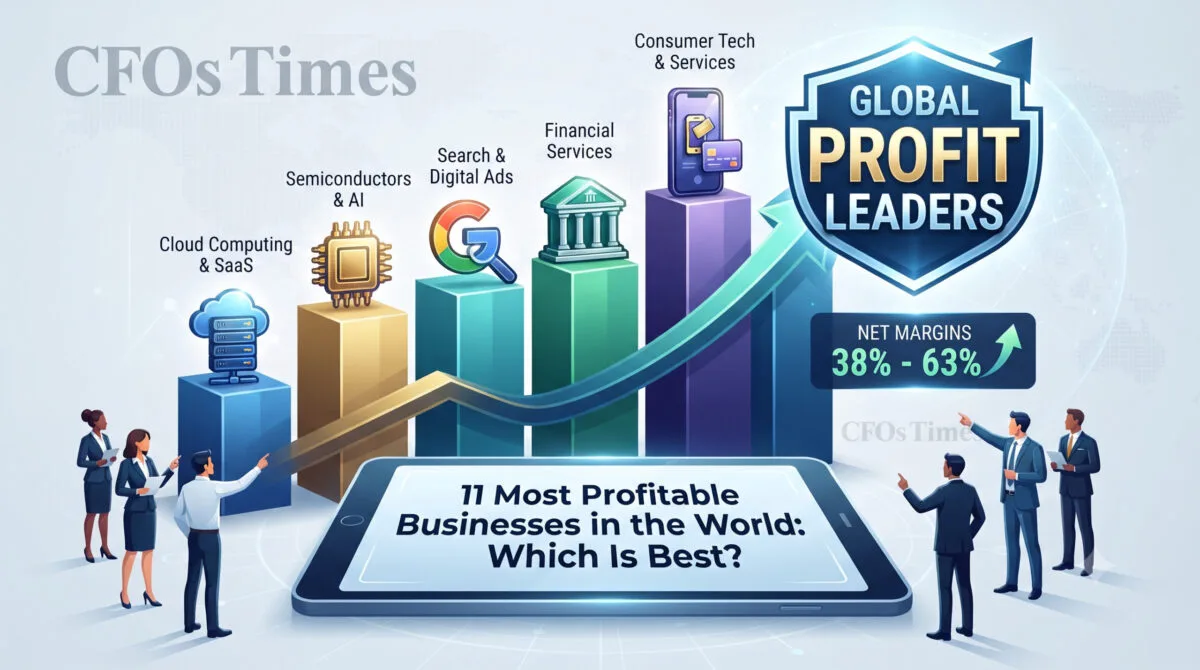
Most profitable businesses across the globe dictate the flow of international capital, technological innovation, and economic power. In today’s fast-paced corporate environment, high revenue does not always guarantee high returns; net profit margins are the ultimate metric of enterprise efficiency. Grounded in up-to-date market data and financial reporting, corporate giants like Alphabet and NVIDIA lead global net income charts with staggering profit margins exceeding 38% to 60%. Whether evaluating tech conglomerates, specialized software-as-a-service (SaaS) providers, or financial institutions, understanding what makes these business models exceptionally lucrative provides vital insights for entrepreneurs, investors, and industry analysts.
Table of Contents
The Metrics of Global Profitability
Before breaking down individual sectors, it is essential to distinguish between gross revenue and true net profitability. Historically, capital-intensive industries like oil extraction and heavy manufacturing generated the highest raw cash flows. However, structural shifts in the global economy have tilted the scales decisively toward asset-light, scalable business models.
Modern enterprises with high intellectual property (IP) leverage, recurring subscription revenues, and low marginal costs of reproduction consistently capture the highest net profit margins. According to recent market analysis, tech and semiconductor powerhouses dominate net income metrics, outperforming traditional commodity models in compound growth efficiency. Most Profitable Businesses in the World

The 11 Most Profitable Business Models Globally
1. Technology Conglomerates & Search Engines
- Net Profit Margin: ~35% to 40%
- Key Example: Alphabet (Google)Leading the global corporate leaderboard with trailing-12-month net incomes exceeding $160 billion, digital ecosystem giants monetize advertising, cloud infrastructure, and software apps at scale. Once core platforms are built, scaling to millions of additional users incurs near-zero marginal cost. Most Profitable Businesses in the World
2. Artificial Intelligence & Semiconductor Manufacturing
- Net Profit Margin: ~50% to 63%
- Key Example: NVIDIADriven by explosive global demand for specialized graphics processing units (GPUs) powering AI infrastructure, semiconductor innovators have experienced one of the fastest profit expansions in corporate history, boasting margins well above 55%.
3. Cloud Computing & Enterprise Software (SaaS)
- Net Profit Margin: ~35% to 42%
- Key Example: MicrosoftSubscription-based enterprise software and cloud services provide predictable, recurring cash flows. Because software can be replicated infinitely without physical manufacturing overhead, net margins remain exceptionally robust.
4. Consumer Technology Ecosystems
- Net Profit Margin: ~25% to 30%
- Key Example: AppleCombining high-end hardware manufacturing with high-margin digital services (app stores, cloud storage, payment platforms), premium consumer tech brands command immense customer loyalty and pricing power. Most Profitable Businesses in the World
5. Social Media & Digital Advertising Networks
- Net Profit Margin: ~30% to 36%
- Key Example: Meta PlatformsOperating global social networks with billions of active users, advertising platforms generate massive cash reserves with minimal physical infrastructure relative to their user reach.
6. Investment Management & Holding Conglomerates
- Net Profit Margin: ~20% to 30%
- Key Example: Berkshire HathawayBy pooling capital across diverse operating subsidiaries, insurance floats, and public equity portfolios, premier holding companies generate multi-billion-dollar annual returns with lean administrative overhead. Most Profitable Businesses in the World
7. Global Investment Banking & Financial Services
- Net Profit Margin: ~30% to 35%
- Key Example: JPMorgan ChaseFinancial institutions derive substantial profits from net interest margins, advisory fees, underwriting, and payment processing networks, serving as the financial circulatory system of global commerce.
8. Semiconductor Foundry Fabrication
- Net Profit Margin: ~40% to 45%
- Key Example: TSMC (Taiwan Semiconductor Manufacturing Company)Specialized advanced foundries hold critical technological monopolies over high-end chip production, allowing them to maintain high pricing power and exceptional manufacturing margins. Most Profitable Businesses in the World
9. Digital E-Commerce & Cloud Marketplaces
- Net Profit Margin: ~10% to 15%
- Key Example: AmazonWhile retail operations feature tight margins, high-volume logistics combined with high-margin cloud computing (AWS) divisions create a highly lucrative blended business model.
10. Energy Extraction & Hydrocarbon Production
- Net Profit Margin: ~15% to 22%
- Key Example: Saudi AramcoDespite lower valuation multiples compared to software due to commodity cycle exposure, low-cost extraction reserves allow major state and multinational energy companies to generate massive absolute net income. Most Profitable Businesses in the World
11. Specialized Healthcare & Pharmaceutical R&D
- Net Profit Margin: ~15% to 25%
- Key Example: UnitedHealth Group / Major PharmaBacked by strong patent protections, specialized medical technology and healthcare service providers secure steady, inelastic demand across economic cycles. Most Profitable Businesses in the World

Comprehensive Comparison of Top Profit Sectors
| Sector Category | Average Net Profit Margin | Primary Profit Driver | Capital Intensity |
| Semiconductors & AI Hardware | 50% – 63% | Proprietary chip design & high demand | High |
| Enterprise SaaS & Cloud | 35% – 42% | Recurring subscriptions & low marginal cost | Low to Moderate |
| Search & Digital Ads | 35% – 40% | Targeted global advertising inventory | Moderate |
| Financial Services & Banking | 30% – 35% | Interest spreads, transaction fees, lending | High (Capital reserves) |
| Energy & Hydrocarbons | 15% – 22% | Volume extraction and global commodity pricing | Extremely High |
Which One Is the Best Business Model?
Determining the “best” business among these high-performing models depends heavily on an organization’s scale, capital access, and strategic objectives. However, from a pure economic standpoint, Enterprise SaaS and AI-driven Software/Semiconductor models stand out as superior for several reasons: Most Profitable Businesses in the World
- Scalability Without Friction: Unlike energy extraction or retail, digital and semiconductor enterprises can scale revenue exponentially without a linear increase in physical infrastructure or headcount.
- Pricing Power: Intellectual property creates a protective economic moat, allowing top-tier technology firms to dictate market prices.
- Resilient Cash Flow: Subscription models insulate businesses from sudden macroeconomic downturns, ensuring predictable annual recurring revenue (ARR).
For independent analysis and ongoing macroeconomic tracking, exploring institutional resources like the CRFB Reports and official market data via the US Securities and Exchange Commission offers deeper financial transparency. Most Profitable Businesses in the World
Conclusion
Evaluating the most profitable businesses reveals a decisive shift away from traditional heavy industry toward agile, tech-driven enterprises that leverage data, intellectual property, and recurring revenue. While energy and finance continue to command immense aggregate revenue, software, AI infrastructure, and digital platforms offer the highest net margins and long-term compounding potential. Whether launching a startup or analyzing global equities, understanding these high-margin structures remains the cornerstone of sound financial strategy.
Frequently Asked Questions (FAQs)-Most Profitable Businesses in the World
What is the single most profitable company in the world?
Based on trailing-12-month net income, technology conglomerates like Alphabet and semiconductor leaders like NVIDIA lead global profitability charts, generating upwards of $150 billion in net earnings.
Why do tech companies have higher profit margins than manufacturing?
Technology and software companies benefit from near-zero marginal costs of reproduction. Once a software product or digital platform is built, serving an additional million users requires minimal incremental capital compared to building physical goods.
Is high revenue the same as high profitability?
No. Many retail giants generate massive gross revenues, but low net margins reduce their overall bottom-line profitability compared to asset-light software or specialized semiconductor firms.
Disclaimer:
The information provided on Most Profitable Businesses in the World on CFOs Times (cfostimes.com) is for general informational, educational, and analytical purposes only. It is not intended to be, and should not be construed as, professional financial, investment, legal, or tax advice.
- Not Financial Advice: CFOs Times is not a registered investment advisor, broker-dealer, or financial planner. The content shared on this site reflects market research, historical data, and macroeconomic analyses, but does not take into account your individual financial situation, risk tolerance, or specific objectives.
- Investment Risks: All financial decisions, investments, and business strategies involve inherent risks, including the potential loss of principal. Past performance of any company, asset class, or strategy discussed is never a guarantee of future results.
- Independent Research: Readers are strongly encouraged to conduct their own due diligence or consult with a qualified, licensed financial professional or certified public accountant (CPA) before making any major financial or investment decisions.
- External Links: This website may contain outbound links to third-party websites or regulatory resources for reference purposes. CFOs Times assumes no responsibility or liability for the accuracy, completeness, or reliability of content hosted on external platforms.

Dr. Dinesh Kumar Sharma is a CMA an award-winning Chief Financial Officer and Director of Finance with over 25 years of expertise in strategic planning and digital transformation. Recognized as a five-time CFO of the Year, he specializes in leveraging Generative AI and Microsoft Copilot to optimize financial forecasting and cost management. Dr. Sharma holds a Doctorate in Management (Finance) and has successfully scaled organizations from INR 1 billion to INR 7 billion. He is dedicated to providing transparent, data-driven insights for modern decision-makers at CFOs Times.










2 thoughts on “11 Most Profitable Businesses in the World and Which One Is the Best?”