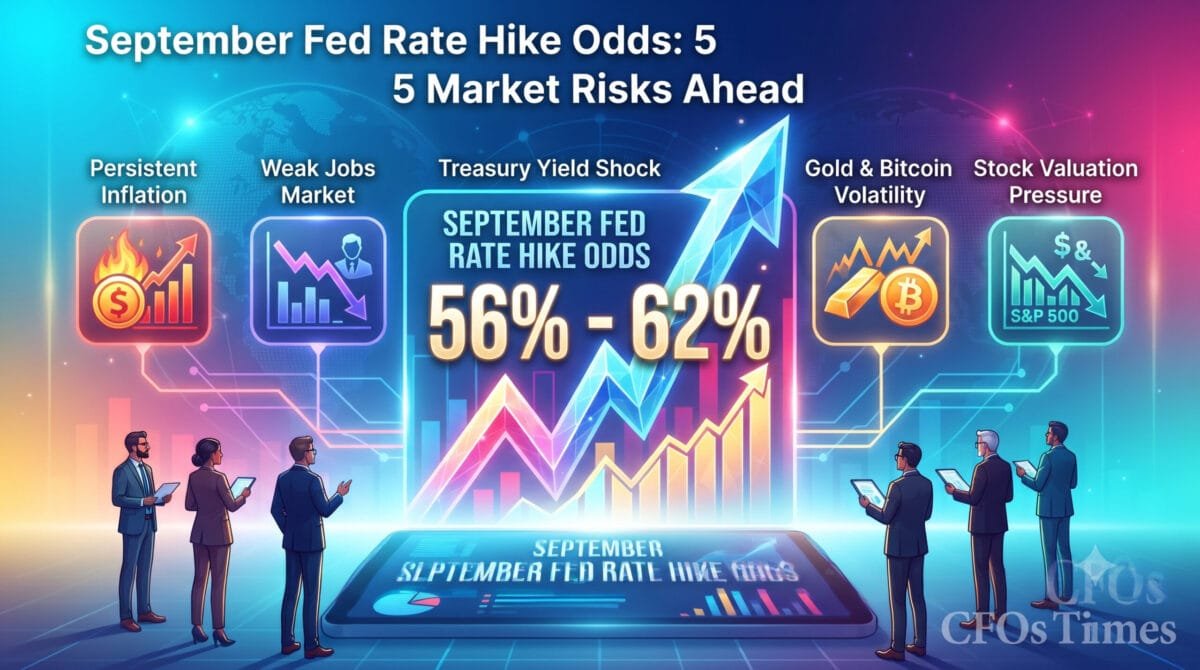
September Fed Rate Hike Odds have become one of the most closely watched signals in global markets after Federal Reserve Chair Kevin Warsh delivered a much more consequential Jackson Hole speech than investors had anticipated.
The immediate reaction was striking. Before Warsh spoke, markets were assigning roughly a one-in-three probability to a September increase. Following his remarks, pricing moved sharply higher, with CME-based estimates reported around the high-50% range and other market snapshots above 60%. The exact percentage is moving because it is derived from market prices, but the direction is unmistakable: traders are taking the possibility of a September hike much more seriously.
That repricing matters because the Federal Reserve is facing an uncomfortable combination of risks.
Inflation is still above the central bank’s 2% objective. At the same time, parts of the labor market are losing momentum. Financial markets had previously leaned toward the idea that the next major policy move could eventually be easier rather than tighter.
Warsh has complicated that narrative.
In his August 28 Jackson Hole remarks, the Fed chair stressed that persistently high inflation would require further work from the central bank and argued that price stability and maximum employment should not be viewed as fundamentally conflicting objectives.
The result is a market that must now reconsider the possibility of higher-for-longer interest rates.
For investors, businesses and CFOs, five risks deserve particular attention.
Table of Contents
What Are September Fed Rate Hike Odds?
September Fed Rate Hike Odds are market-implied probabilities indicating how likely traders believe the Federal Reserve is to raise its benchmark interest rate at its September meeting.
They are not an official Fed forecast.
Instead, they are derived from interest-rate futures and can change whenever investors reassess inflation, employment, economic growth or Federal Reserve communication.
That distinction is important.
A market-implied probability of 58% does not mean the Fed has decided to raise rates. It means that, at that moment, market pricing assigns a greater probability to a hike than to no hike.
And those probabilities can move dramatically after major economic releases.
The next few weeks are therefore unusually important.
The August employment report is scheduled for September 4, producer-price inflation for September 10 and the August consumer-price index for September 11. The Federal Open Market Committee then meets September 15–16.
In other words, markets will receive several potentially decisive pieces of information just days before the Fed has to make its decision.
1. Persistent Inflation Could Force the Fed to Hike
The most obvious risk is also the one that triggered the latest market reaction: inflation may simply not be cooling quickly enough.
The Federal Reserve’s long-run inflation objective is 2%. When inflation remains materially above that level, policymakers have limited room to ease policy without risking another inflationary wave.
Warsh’s Jackson Hole speech put this issue squarely back at the center of the debate.
The Fed chair emphasized that high inflation is itself damaging to economic prosperity and argued that the central bank needs confidence that underlying inflation is moving toward its objective.
That is an important message for markets.
Investors had become increasingly comfortable with the idea that weaker employment could eventually outweigh inflation concerns. Warsh’s comments suggest that policymakers may not be prepared to make that trade-off so easily.
Why inflation matters for September
Suppose employment weakens modestly but inflation remains stubborn.
The Fed could decide that cutting or holding rates too early would risk allowing inflation expectations to become embedded.
Now consider the opposite.
If inflation accelerates again while economic activity remains reasonably resilient, the argument for another rate increase becomes considerably stronger.
That is why the August CPI report could be critical.
The Bureau of Labor Statistics has scheduled the August CPI release for September 11, only days before the FOMC meeting.
A hot inflation report could push September Fed Rate Hike Odds higher again.
A soft report could do the opposite.
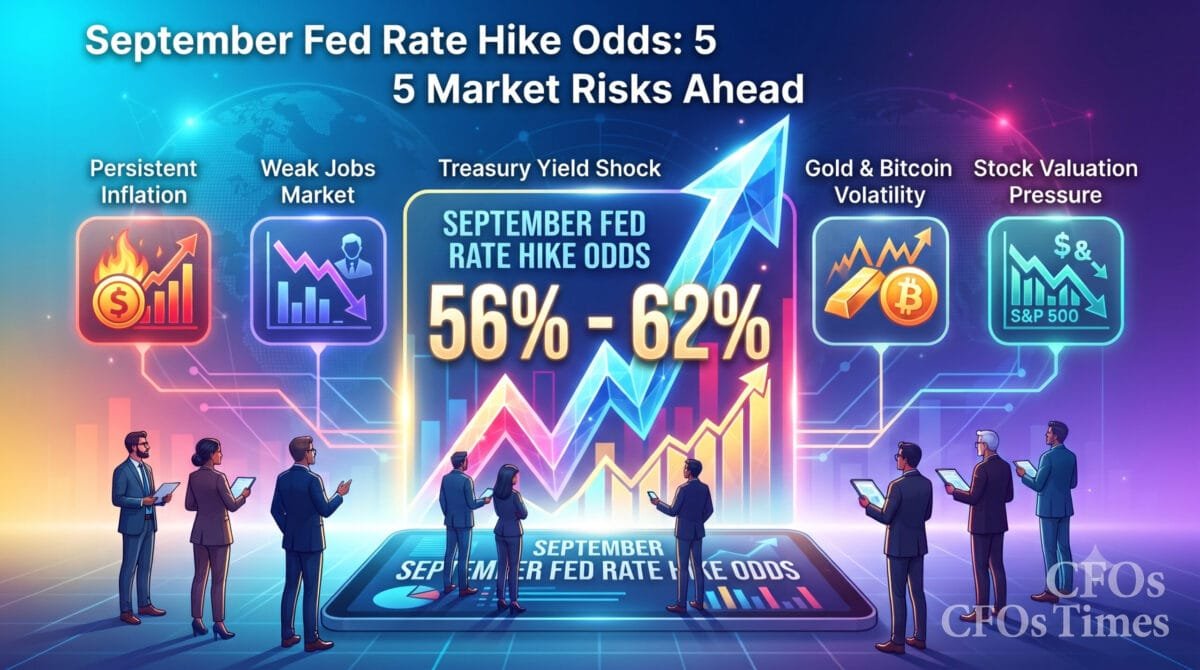
2. A Weak Jobs Market Could Stop the Hike
The second risk points in the opposite direction.
The Federal Reserve does not target inflation alone. Its mandate also includes maximum employment.
That means policymakers cannot ignore a significant deterioration in labor-market conditions simply because inflation remains above target.
The August employment report, due September 4, will therefore be one of the most important releases of the month.
The market will be looking beyond the headline payroll number.
Unemployment, wage growth, participation and revisions to previous employment estimates could all influence the Fed’s assessment.
A surprisingly weak labor-market report could undermine the recent rise in September Fed Rate Hike Odds.
That would create an unusual policy situation.
The Fed could have inflation that is still too high for comfort but an employment market that is deteriorating too quickly to justify another increase.
This is where monetary policy becomes less mechanical.
Central banks do not operate according to one economic indicator. They weigh the overall balance of risks.
The jobs-inflation dilemma
For markets, the most dangerous combination may be:
sticky inflation + rapidly weakening employment.
That could leave the Fed with no attractive option.
Raise rates, and policymakers risk worsening the labor-market slowdown.
Hold rates, and they risk allowing inflation to remain entrenched.
The September meeting could therefore be less about finding a perfect answer and more about deciding which risk the Fed considers more urgent.
3. Treasury Yields Could Become the Next Shock
The third risk is already visible in the bond market.
Short-term Treasury yields moved sharply higher following Warsh’s Jackson Hole remarks. The two-year Treasury yield was reported to have risen about 0.118 percentage point in one session to around 4.348%, its largest one-day increase since March.
That move is important because the two-year yield is particularly sensitive to expectations for Federal Reserve policy.
If traders believe the Fed is more likely to raise rates—or keep them high for longer—short-term yields generally adjust first.
But the consequences do not stop with government bonds.
Treasury yields influence:
- Corporate borrowing costs
- Mortgage rates
- Equity valuations
- Credit-market pricing
- Currency markets
- Emerging-market capital flows
- Business investment decisions
This is why September Fed Rate Hike Odds are much more than a technical futures-market statistic.
They are increasingly a signal about the cost of capital.
For companies carrying floating-rate debt, refinancing obligations or short-duration funding requirements, even a modest shift in expected rates can materially affect financial planning.
For CFOs, this is where the Fed story becomes a balance-sheet story.
4. Gold and Bitcoin Could Face More Volatility
The fourth risk is concentrated in assets that have benefited from expectations of easier financial conditions or concerns about currency and inflation.
Gold reacted sharply after Warsh’s remarks, with reports showing a decline of roughly 3% as the dollar and Treasury yields moved higher.
The logic is straightforward.
Gold does not pay interest.
When Treasury yields rise, the opportunity cost of holding a non-yielding asset increases.
A stronger dollar can add another headwind because gold is priced in dollars internationally.
Bitcoin is different, but the reaction was similar.
The cryptocurrency market also weakened as traders reassessed the possibility of tighter U.S. monetary policy. Investors increasingly treated the Fed’s message as a warning that liquidity conditions may not become as supportive as previously expected.
That distinction is worth emphasizing.
Gold has a much longer history as a reserve asset and store of value. Bitcoin remains a significantly more volatile risk asset whose price can respond dramatically to changes in liquidity, institutional positioning and investor sentiment.
Still, both markets demonstrate the same underlying principle:
Changes in interest-rate expectations can quickly change the relative attractiveness of financial assets.
If September Fed Rate Hike Odds continue rising, gold and Bitcoin could remain vulnerable to additional volatility.
If the probability falls because inflation and employment data turn more favorable, both could recover quickly.
5. Stock Valuations Could Come Under Pressure
The fifth risk is equities.
The stock market does not necessarily need a recession to experience a correction.
Sometimes, the problem is simply that the discount rate changes.
Stock valuations depend partly on the present value investors assign to future corporate earnings. When risk-free interest rates rise, those future cash flows become less valuable in today’s terms.
The effect is particularly relevant for expensive growth stocks.
Companies whose expected profits lie far into the future can be more sensitive to higher discount rates than mature businesses generating substantial cash today.
That does not mean every stock will fall if the Fed hikes.
Markets are more complicated than that.
A rate increase accompanied by strong economic growth could be interpreted differently from a rate increase caused by unexpectedly persistent inflation.
The reason behind the hike matters.
The real equity risk
The biggest risk may therefore be an unexpected change in the market’s assumptions.
If investors have already priced a September hike, the actual decision may produce only a modest reaction.
But if markets begin pricing several additional hikes, valuations could adjust much more aggressively.
That is why investors should watch the entire interest-rate path rather than focusing exclusively on the September meeting.
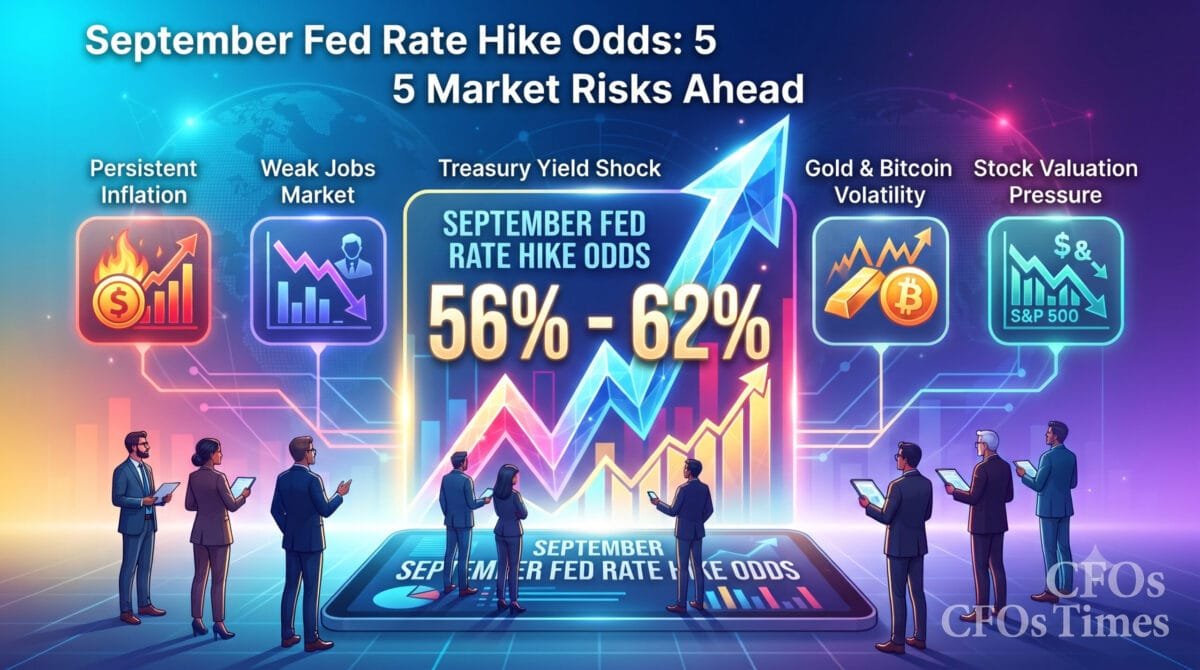
Why Kevin Warsh’s Jackson Hole Speech Matters
The significance of Warsh’s speech extends beyond the September meeting.
This was an important opportunity for the new Fed chair to establish how he intends to approach monetary policy.
Warsh emphasized price stability, the Fed’s dual mandate and the importance of maintaining credibility around inflation. He also argued for a less predictable communication style, signaling a preference for giving markets less detailed forward guidance.
That approach could change how investors interpret future Fed communication.
If policymakers provide less explicit guidance, markets may become more dependent on economic data.
That could mean larger moves after CPI, employment and other major releases.
For investors, this creates a new environment:
less guidance + more data dependence = potentially greater volatility.
The market’s reaction to Warsh’s speech suggests investors are already adjusting to that possibility.
The September Data Calendar Could Decide Everything
The sequence of economic releases is unusually important.
September 1 — Job Openings and Labor Turnover Survey
The JOLTS report will provide additional information about labor demand.
September 4 — August Employment Report
This will be the first major test of whether the labor market is weakening enough to offset inflation concerns.
September 10 — August PPI
Producer prices can provide clues about pipeline inflationary pressures.
September 11 — August CPI
This is arguably the most important inflation release before the FOMC meeting.
September 15–16 — FOMC Meeting
The Fed will finally decide whether the data justify a change in policy.
This compressed calendar means market expectations could change several times before policymakers even sit down.
Three Possible September Outcomes
Scenario 1: A 25-Basis-Point Hike
This becomes more likely if inflation remains stubborn and employment proves resilient.
Such an outcome could push short-term yields higher and support the dollar.
Stocks, gold and Bitcoin could experience additional volatility.
However, the size of the market reaction would depend heavily on whether the hike had already been priced in.
Scenario 2: Rates Stay Unchanged
A weak employment report or convincing evidence of disinflation could persuade policymakers to wait.
This would probably reduce September Fed Rate Hike Odds before the meeting.
But investors should not automatically interpret a hold as a dovish pivot.
The Fed could leave rates unchanged while maintaining a firm warning about inflation.
Scenario 3: The Fed Holds but Signals More Tightening
This may be the most complicated scenario.
The Fed could decide that immediate action is unnecessary while making it clear that another increase remains possible.
Markets would then focus on the future path of rates rather than the September decision alone.
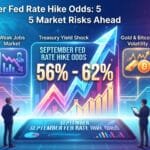
For investors, that could be just as important as an actual hike. September Fed Rate Hike Odds: 5 Market Risks Ahead
What Should Investors and CFOs Watch?
The most useful response to rising September Fed Rate Hike Odds is not to make an all-or-nothing prediction.
It is to test financial decisions against multiple interest-rate scenarios.
Investors
Review portfolio exposure to expensive growth stocks, long-duration bonds and highly leveraged companies.
Bond investors
Monitor duration risk and the relationship between short- and long-term Treasury yields.
Gold investors
Watch real yields, the dollar and inflation expectations rather than interpreting every daily price move as a change in the long-term gold story.
Bitcoin investors
Expect higher volatility if monetary-policy expectations continue shifting.
CFOs
Review floating-rate debt, refinancing dates, interest coverage, cash requirements and investment hurdle rates.
A 25-basis-point change can appear small at the macro level.
For a highly leveraged business, however, the cumulative effect can be significant.
What Could Push September Fed Rate Hike Odds Back Down?
The market’s current repricing should not be treated as a foregone conclusion.
Three developments could reverse it quickly.
First, weaker employment.
If August payroll growth disappoints substantially and unemployment rises, the Fed could become more cautious.
Second, softer inflation.
A clear decline in underlying inflation would weaken the argument for immediate tightening.
Third, deteriorating financial conditions.
A significant market or credit shock could make policymakers more reluctant to tighten policy even if inflation remains uncomfortable.
This is why the next few weeks could be volatile.
The market is effectively waiting for evidence to determine whether Warsh’s hawkish message represents a lasting policy shift or simply a warning that the Fed remains prepared to act if necessary. September Fed Rate Hike Odds: 5 Market Risks Ahead
What This Means for the U.S. Economy
The broader economic question is whether the United States can tolerate tighter monetary policy without creating a significant slowdown.
If business investment remains strong and productivity improves, the economy may be able to withstand higher rates better than investors fear.
Warsh himself pointed to business investment and profitability as evidence of economic resilience in his Jackson Hole remarks. Market coverage of the speech highlighted his emphasis on the economy’s underlying strength.
But monetary policy works with a lag.
Today’s higher rates can affect tomorrow’s investment decisions, hiring plans and household borrowing.
That is why the Fed has to look beyond current conditions.
It is trying to estimate where inflation and employment are heading—not merely where they are today.
The Bottom Line- September Fed Rate Hike Odds
The sharp rise in September Fed Rate Hike Odds is not simply another market headline.
It represents a significant change in the policy debate.
Before Jackson Hole, investors were increasingly focused on the possibility of easier monetary policy. Warsh’s speech forced markets to reconsider that assumption.
Now the Fed faces a difficult balancing act.
Inflation remains too high for comfort.
Employment could be losing momentum.
Treasury yields are responding to changing expectations.
Gold and Bitcoin have become more volatile.
Equity valuations remain sensitive to discount rates.
And the most important economic releases are still ahead.
The September decision will ultimately depend on the data.
The August employment report on September 4 and August CPI on September 11 are particularly important because they arrive immediately before the September 15–16 FOMC meeting.
For now, the most reasonable conclusion is not that a September rate hike is certain.
It is that the market has moved from treating a hike as a relatively remote possibility to treating it as a serious risk.
That change alone can influence asset prices, borrowing costs and corporate financial decisions.
For investors and CFOs, the smartest approach is therefore not to bet everything on one Fed outcome.
It is to prepare for a range of outcomes—and pay very close attention to the data that will determine which one becomes reality.
Frequently Asked Questions
What are September Fed Rate Hike Odds?
September Fed Rate Hike Odds are market-implied probabilities derived from interest-rate futures that indicate how likely traders believe the Federal Reserve is to raise its policy rate at the September 2026 FOMC meeting.
Why did September Fed Rate Hike Odds rise?
Expectations increased sharply following Kevin Warsh’s Jackson Hole speech, in which he emphasized the importance of bringing inflation back toward the Fed’s objective and indicated that further work could be required if inflation remains elevated.
What is the Federal Reserve’s current policy rate?
The federal funds target range remains 3.50% to 3.75%, following the July 2026 meeting.
When is the September 2026 Fed meeting?
The FOMC is scheduled to meet on September 15–16, 2026.
What is the most important data before the meeting?
The August employment report on September 4 and August CPI report on September 11 are among the most important releases immediately preceding the meeting.
Could the Fed still leave rates unchanged?
Yes. Market-implied probabilities are not guarantees. A weak labor market, softer inflation or a deterioration in financial conditions could reduce the case for a September increase.
How would a Fed hike affect gold?
Higher interest rates and Treasury yields can increase the opportunity cost of holding gold. A stronger dollar can also place downward pressure on dollar-denominated gold prices.
How could a rate hike affect Bitcoin?
Tighter monetary policy can reduce liquidity and risk appetite, potentially increasing Bitcoin volatility. However, Bitcoin is influenced by several other factors, including institutional flows and cryptocurrency-specific developments.
Why do Treasury yields matter?
Treasury yields influence borrowing costs, asset valuations and global capital flows. Short-term yields are particularly sensitive to expectations about Federal Reserve policy.
Are September Fed Rate Hike Odds guaranteed to predict the Fed’s decision?
No. They are market-based probabilities, not official forecasts. They can change significantly following economic data or Federal Reserve communication.
Disclaimer
This article is intended solely for educational and informational purposes. It does not constitute investment, financial, accounting, tax or legal advice. Market prices, economic data, interest-rate expectations and Federal Reserve policy can change rapidly.
Market-implied probabilities are not guaranteed outcomes, and readers should not make investment decisions solely on the basis of this article. Investors and businesses should consider their individual circumstances and consult appropriately qualified professional advisers where necessary.
CFO Times does not guarantee any particular investment return, market outcome or future forecast.

Dr. Dinesh Kumar Sharma is a CMA an award-winning Chief Financial Officer and Director of Finance with over 25 years of expertise in strategic planning and digital transformation. Recognized as a five-time CFO of the Year, he specializes in leveraging Generative AI and Microsoft Copilot to optimize financial forecasting and cost management. Dr. Sharma holds a Doctorate in Management (Finance) and has successfully scaled organizations from INR 1 billion to INR 7 billion. He is dedicated to providing transparent, data-driven insights for modern decision-makers at CFOs Times.





2 thoughts on “September Fed Rate Hike Odds: 5 Market Risks Ahead”