Introduction
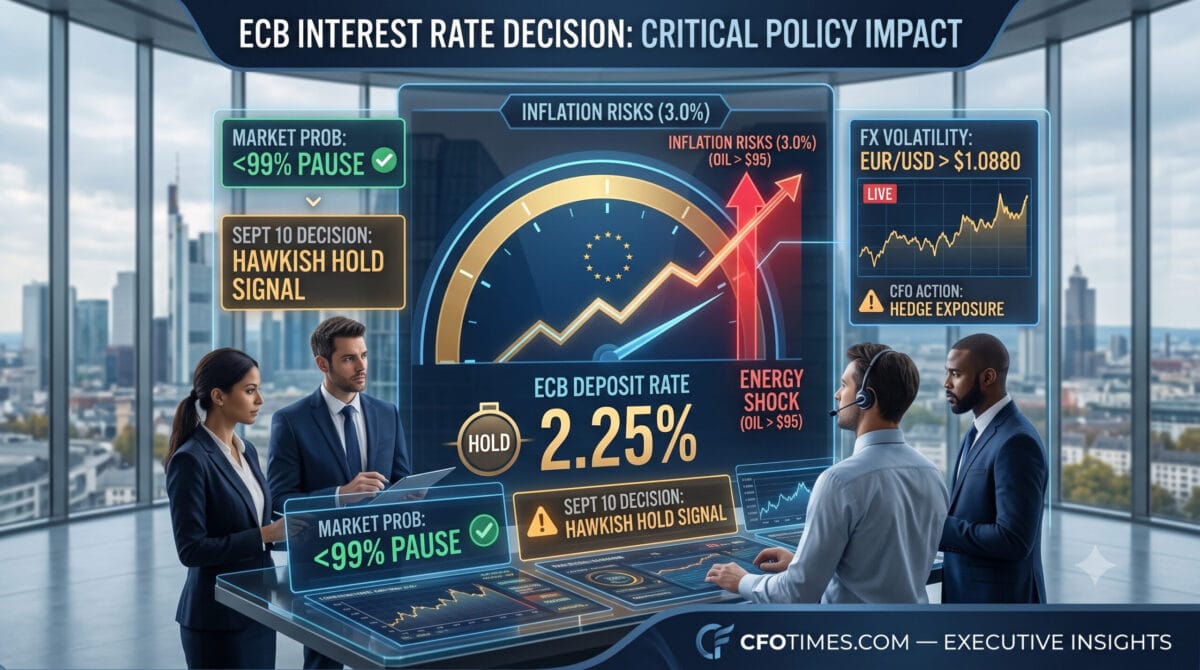
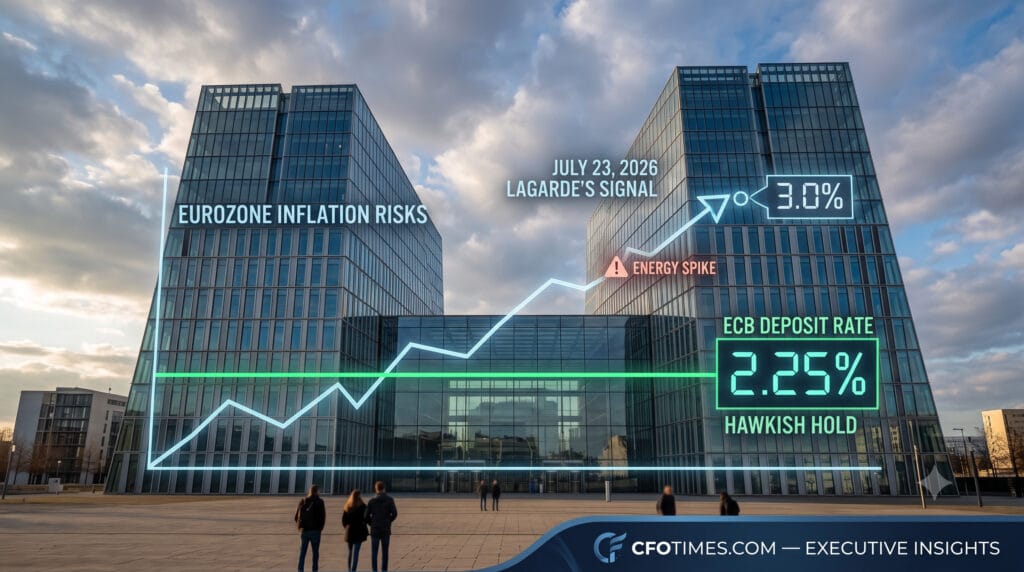
The ECB interest rate decision today brought a clear pause to European monetary adjustments, yet it signaled that central bankers remain on high alert. Meeting on July 23, 2026, the European Central Bank (ECB) Governing Council voted to hold its key policy benchmark steady at 2.25%. While financial markets widely anticipated this pause, the underlying tone from Frankfurt was far from passive.
While financial markets expected this outcome, the policy statement and subsequent press conference delivered an unmistakably firm tone. ECB President Christine Lagarde emphasized that today’s hold should not be interpreted as the end of monetary tightening.
With Middle East geopolitical tensions driving Brent crude oil back above $95 per barrel, ECB President Christine Lagarde delivered an unmistakably firm message during her press conference: today’s hold is a tactical pause, not an end to rate increases. In this breaking analysis, we break down what the ECB interest rate decision means for foreign exchange markets, sovereign bond yields, and corporate treasury planning ahead of the critical September meeting.

Table of Contents
Key Numbers from Today’s Meeting
To understand the ECB interest rate decision in context, here is how the primary policy rates stand following the July announcement:
| ECB Policy Instrument | Current Level | June 2026 Action | Market Expectation |
| Deposit Facility Rate | 2.25% | Raised 25 bps | Held (Over 90% priced) |
| Main Refinancing Rate | 2.40% | Raised 25 bps | Held |
| Marginal Lending Facility | 2.65% | Raised 25 bps | Held |
For official historical statements, review the European Central Bank Official Press Releases.
Why Central Bankers Paused Policy Rates
Today’s ECB interest rate decision reflects a balance between cooling domestic wage trends and persistent external geopolitical uncertainty.
  Domestic Inflation & Moderating Wages
                   │
                   ▼
       [ ECB Policy Hold at 2.25% ]
                   ▲
                   │
    Middle East Conflict & Oil Spikes
1. Moderating Domestic Wage Pressures
A main factor supporting the hold was steadying price data across key sectors. Collective bargaining agreements in major European economies revealed muted salary expansion in the second quarter.
Core price growth, which excludes volatile energy and food prices, remained stable at 2.5%. Services inflation also showed slight easing, providing policymakers room to observe incoming economic data before deciding on further rate adjustments. ECB interest rate decision
2. Sluggish Manufacturing and Economic Growth
Economic activity across the single-currency bloc remains modest. Manufacturing output in major member states continues to face structural headwinds, elevated electricity costs, and high funding charges.
Euro area economic output grew by just 0.3% in the first quarter, with second-quarter estimates tracking near 0.2%. Tightening policy further at this moment risked putting unnecessary strain on industrial production. ECB interest rate decision
The Wildcard: Middle East Tensions and Oil Volatility
Despite soft domestic demand, the path to lower inflation faces obstacles from global commodity markets. Recent escalation in Middle East geopolitical conflict has disrupted maritime shipping lanes in the Persian Gulf.
Brent crude oil prices climbed rapidly over recent weeks, topping $95 per barrel. Rising energy prices threaten to pass through into transportation costs and household utilities across Europe. ECB interest rate decision
[Persian Gulf Disruptions] ──> [Brent Crude > $95] ──> [Higher Eurozone Import Costs] ──> [September Rate Hike Risk]
During her press conference, Christine Lagarde reinforced that central bankers are watching energy prices closely:
“While domestic price indicators have behaved in line with expectations, global energy risks cannot be ignored. We remain strictly data-dependent, meeting by meeting. If energy cost surges begin threatening medium-term price stability, we stand ready to act.”
Market analysts estimate that every sustained $10 increase in crude oil prices adds roughly 0.2 percentage points to headline consumer inflation over twelve months. ECB interest rate decision
Market Reaction across Forex and Bonds
Following the ECB interest rate decision, financial markets responded across currencies and fixed-income assets:
- Euro Foreign Exchange (EUR/USD): The euro strengthened toward a weekly high against the US dollar near $1.0880. Currency traders viewed the central bank’s firm language as a signal that European rates may rise further if conditions demand.
- Government Bond Yields: German 2-year sovereign yields rose 5 basis points to 2.82%, reflecting higher market probabilities of a policy rate hike at the upcoming September 10 meeting.
For detailed historical data on Eurozone inflation metrics, see Eurostat Macroeconomic Indicators.
Core Takeaways for Business Leaders and Planning
For corporate treasurers, financial officers, and business planners, today’s ECB interest rate decision brings several key considerations for the second half of the year:
- Plan for Prolonged Borrowing Costs: Money markets reflect limited room for rate cuts through the end of the year. Businesses with debt refinancing requirements should secure funding windows rather than assuming lower interest rates ahead.
- Manage Foreign Exchange Risks: Fluctuating policy rate expectations between major central banks can create currency swings. Exporting and importing businesses should evaluate layered FX forward contracts to stabilize profit margins.
- Monitor Energy Input Costs: Manufacturing and logistics firms must keep close track of fuel surcharges and energy purchasing agreements as global supply lines remain vulnerable to geopolitical events.
Frequently Asked Questions (FAQs)
What was the outcome of today’s ECB interest rate decision?
The European Central Bank decided to keep all three key interest rates unchanged. The deposit facility rate remains at 2.25%, the main refinancing operations rate stays at 2.40%, and the marginal lending facility remains at 2.65%.
Why did the ECB hold interest rates steady in July 2026?
The hold was driven by stabilizing core inflation and moderating wage growth across eurozone member states, balancing out economic stagnation in manufacturing with surging energy prices.
Will the ECB raise or lower rates in September 2026?
The central bank has maintained a data-dependent, meeting-by-meeting approach. However, given the energy price spikes driven by Middle East conflicts, market participants are pricing in an increased probability of a 25-basis-point rate hike in September.
Looking Ahead: Important Upcoming Dates
Future monetary policy choices will depend on upcoming economic data releases, particularly regional inflation figures and updated economic projections.
- August 31, 2026: Eurozone Preliminary CPI Release
- September 10, 2026: Governing Council Policy Meeting and Updated Projections
- October 29, 2026: Governing Council Policy Meeting
- December 17, 2026: Final Policy Meeting of the Year
As policy guidance shifts to a meeting-by-meeting approach, business leaders must keep liquidity plans flexible and adapt to evolving macroeconomic conditions. ECB interest rate decision
Conclusion: Navigating the ECB’s Unpredictable Horizon
Today’s ECB interest rate decision confirms that while domestic price pressures and wage growth are steadying across Europe, external energy shocks have reopened clear inflation risks. By opting for a hawkish hold at 2.25%, central bankers have effectively preserved their flexibility to hike rates by 25 basis points at their next meeting on September 10, 2026.
For business leaders and financial strategists, the message is clear: do not expect aggressive monetary easing in late 2026. Maintaining liquidity buffers, securing debt refinancing early, and active FX hedging against euro volatility will remain essential strategies as global macroeconomic conditions evolve.
Disclaimer:
The macroeconomic analysis, market commentary, and executive insights published on CFOTimes.com are provided solely for informational, educational, and editorial purposes. This content does not constitute formal financial, investment, legal, tax, or corporate treasury advice. While our editorial team strives to ensure the accuracy and timeliness of data regarding central bank announcements and market trends, readers should not rely solely on this information for making capital allocation or financial risk management decisions. Always consult with qualified financial advisors, licensed professional accountants, or certified corporate treasurers before executing strategic financial moves.

Dr. Dinesh Kumar Sharma is a CMA an award-winning Chief Financial Officer and Director of Finance with over 25 years of expertise in strategic planning and digital transformation. Recognized as a five-time CFO of the Year, he specializes in leveraging Generative AI and Microsoft Copilot to optimize financial forecasting and cost management. Dr. Sharma holds a Doctorate in Management (Finance) and has successfully scaled organizations from INR 1 billion to INR 7 billion. He is dedicated to providing transparent, data-driven insights for modern decision-makers at CFOs Times.









3 thoughts on “ECB Interest Rate Decision: Bold Hawkish Pause July 2026”