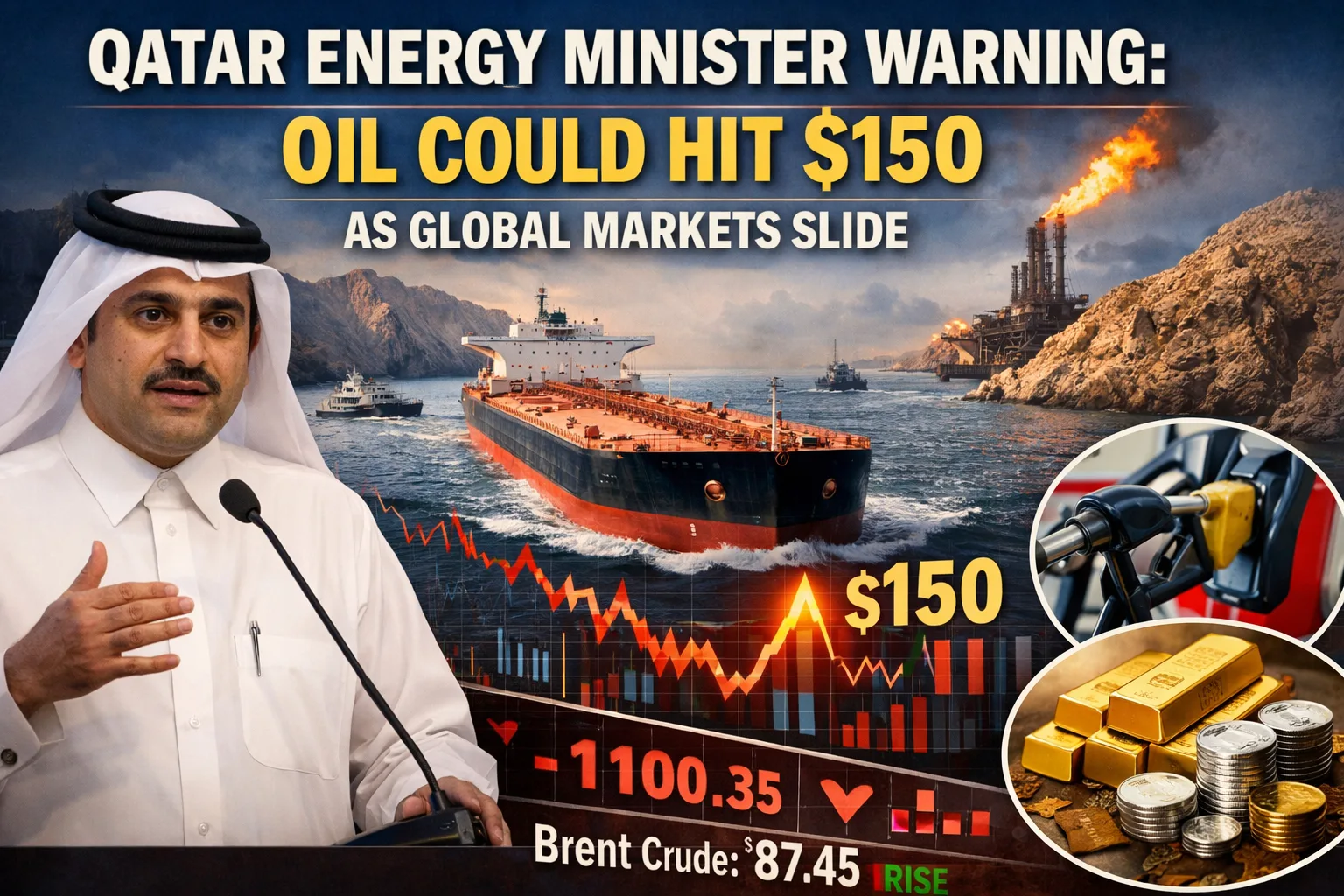
The Qatar Energy Minister Global Market Warning, delivered by Saad al-Kaabi on March 6 and intensifying throughout this weekend (March 8, 2026), is no longer just a headline—it is a structural re-rating of global risk. As Brent crude tests $94 and Minister al-Kaabi warns of a $150 ceiling, the “Crude Gridlock” in the Strait of Hormuz has evolved from a geopolitical friction point into an immediate corporate liability.
Introduction: Assessing the Strategic Market Correction
The world woke up to a “structural volatility” shock as the Qatar Energy Minister Global Market Warning sent ripples through every major exchange. While markets were already fragile due to the ongoing US-Iran tensions, Kaabi’s statement acted as a catalyst for a massive sell-off. In India, the equity markets mirrored this global caution. The BSE Sensex adjusted by nearly 1,100 points, closing at 78,918.90, while the Nifty 50 tested support levels below 24,500. Financial analysts suggest that this movement reflects a broader repricing of risk rather than a localized panic, as the $4 trillion trade shock begins to materialize.
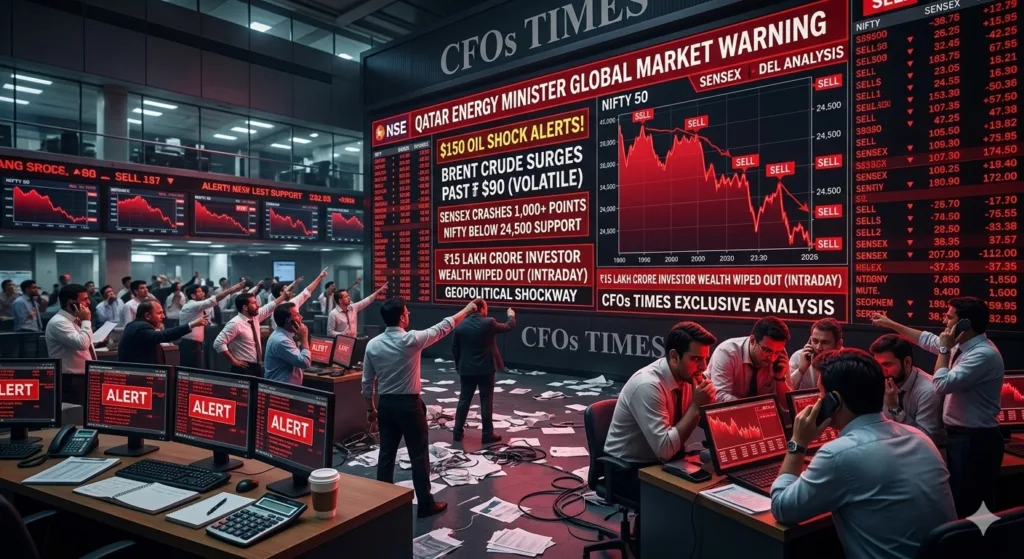
Table of Contents
1. Deconstructing the “Force Majeure” at Ras Laffan
The catalyst for this crisis is the official declaration of force majeure at Qatar’s Ras Laffan LNG complex. For the global market, this is a “black swan” event. Qatar supplies nearly 20% of global LNG; with production now halted due to regional strikes, the energy parity that sustained the post-2025 recovery has vanished.
The “Lag Time” Trap–Qatar Energy Minister Global Market Warning
Minister al-Kaabi’s warning emphasizes a critical operational reality: the restoration lag. Even if a ceasefire were signed tonight, the specialized nature of LNG liquefaction and logistics means it would take “weeks to months” to return to normal delivery cycles. For Indian industries relying on “just-in-time” energy imports, this creates a catastrophic inventory gap that cannot be bridged by spot purchases.
2. Macro-Economic Impact: The $150 Oil and $40 Gas Nightmare
The Minister’s projection of $150 Brent Crude and $40/MMBtu Natural Gas is based on the reality that 20% of the world’s energy supply is currently “stranded” or blocked.
The Transmission to India: A ₹15 Lakh Crore Wealth Wipeout
India’s dependency on the Strait of Hormuz is the “Achilles’ heel” of our FY2026-27 growth story.
- Import Exposure: India imports roughly 2.6 million barrels per day via this channel.
- The Currency Crisis: As of March 8, the USD/INR is trading at 91.94, dangerously close to the 92.00 psychological barrier.
- Market Reaction: The BSE Sensex settled down 1,097 points to close at 78,918.90 this week, while the Nifty 50 is struggling to hold the 24,450 support level.
3. CFO Strategy: Navigating Corporate Liquidity in 2026
As a finance leader with over 25 years of experience, I am advising my peers to treat this warning as a signal to move into “War-Time Finance” mode immediately.
A. Working Capital and the 2.5x Stress Test
With energy costs tripling (as seen with Mahanagar Gas and Petronet LNG facing supply shocks), your working capital requirements are exploding. I recommend a 2.5x stress test on your cash reserves. If your supply chain relies on petrochemical derivatives or specialized chemicals, expect your Cost of Goods Sold (COGS) to rise by 15-20% by April.
B. Logistics and the “War-Risk” Premium
The Qatar Energy Minister Global Market Warning has caused maritime insurance premiums for Gulf-bound vessels to skyrocket to 1% of hull value—roughly $1.34 million for a VLCC (Very Large Crude Carrier).
- Inventory Carry Costs: Increase your “Safety Stock” from 3 months to 5 months.
- Freight Rerouting: Prepare for the “Cape of Good Hope” tax, adding 12–15 days to your export cycles.
4. Sector-Specific Analysis: Identifying the “Fragile” vs. the “Resilient”
The energy shock will hit the Nifty 50 with uneven force. Using data from the NSE India, here is our risk-reward map:
5. Strategic Portfolio Rebalancing for March 2026
In a 30-VIX environment, the market abandons “Growth” for “Tangible Value.”
- The Safe-Haven Pivot: MCX Gold is testing ₹1,61,000, while Silver has gained 2% to reach ₹2,63,310. These are no longer just hedges; they are the primary liquidity providers in a currency crisis.
- The “Dry Powder” Principle: Do not “buy the dip” in IT or FMCG yet. Wait for the RBI’s next Financial Stability Report update. With the government likely to increase the subsidy burden to protect the fertilizer sector, fiscal deficit targets are the next domino to watch.
The Core Catalyst: Deconstructing the $150 Crude Projection
The significance of the Qatar Energy Minister Global Market Warning lies in the intersection of physical energy logistics and geopolitical tension. Minister al-Kaabi highlighted three primary risk factors currently facing the energy sector, which are being closely monitored by the Ministry of Petroleum and Natural Gas (MoPNG):
- Supply Continuity Risks: The Minister indicated that if regional instability persists, Gulf energy exporters might face operational challenges in maintaining standard production levels.
- Operational Force Majeure: Highlighting the gravity of the situation, Qatar’s Ras Laffan plant—a cornerstone of global LNG supply—has reportedly initiated force majeure protocols following logistical impediments.
- The Restoration Timeline: Critically, al-Kaabi noted that energy delivery cycles are not instantaneous. Even upon the resolution of tensions, the “lag time” to restore global supply chains to 100% capacity could span several months, potentially sustaining elevated price floors.
Market Performance Summary (March 6, 2026)
| Asset Class | Closing Price / Rate | Day Change (%) | Investor Sentiment |
| BSE Sensex | 78,918.90 | -1.37% | Risk-Averse |
| Nifty 50 | 24,450.45 | -1.27% | Cautionary |
| Brent Crude | $87.50+ | +1.15% | High Volatility |
| MCX Gold | ₹1,61,000+ | +0.53% | Strategic Hedging |
| MCX Silver | ₹2,63,310+ | +2.00% | Industrial Demand |
| USD/INR | 91.69 | -0.10% | Currency Pressure |
Sector-Specific Analysis: Identifying Resilient Corridors
The Qatar Energy Minister Global Market Warning did not impact all sectors uniformly. A nuanced look at data from the National Stock Exchange of India reveals a complex internal market rotation:
- Banking & Financial Services: The Nifty Private Bank index saw a 2.27% correction. Analysts attribute this to a preemptive move by institutional investors managing liquidity amid global uncertainty, a trend often addressed in RBI Financial Stability Reports.
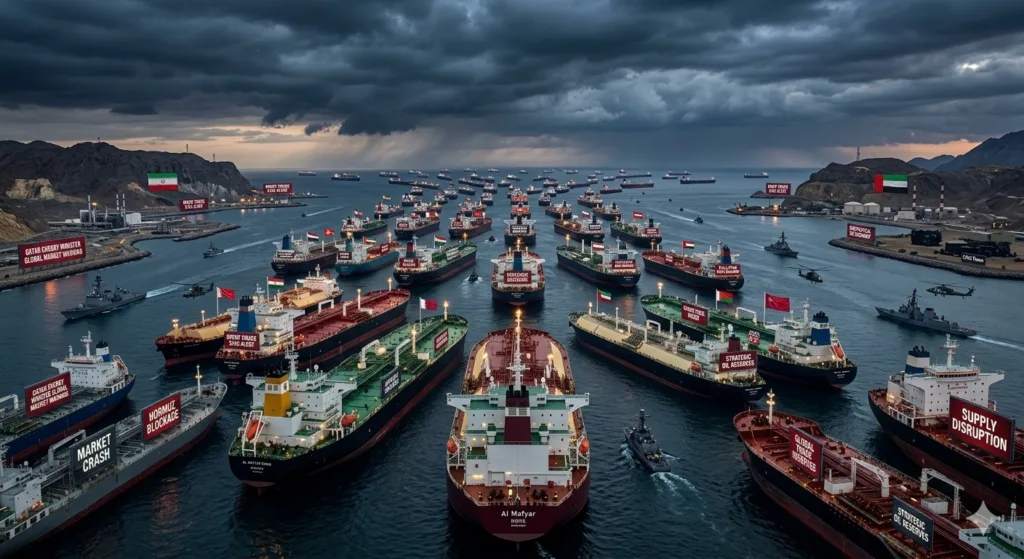
- Logistics & Maritime Trade: Shipping activity through the Strait of Hormuz is under intense scrutiny. As a vital artery for 20% of global oil, any perceived slowing in transit directly correlates with the “risk premium” added to Brent crude prices.
- The Safe Haven Pivot: In line with historical patterns of “Flight to Quality,” precious metals like Gold and Silver saw consistent bids, with Silver gaining 2% on the MCX India.
- The Defence Sector Outlier: Counter-cyclically, the Defence Index rose 3%. This is largely attributed to the acceleration of domestic “Atmanirbhar” procurement cycles as global supply chains face scrutiny, supported by the Ministry of Defence.
Strategic Financial Planning: Managing Volatility in FY26
For professional investors and CFOs, the Qatar Energy Minister Global Market Warning serves as a catalyst for portfolio rebalancing. Adopting a data-driven approach is essential during such cycles:
- Bullion as a Diversifier: With the decade-long appreciation of gold, many institutions are re-evaluating its weight in a balanced portfolio to hedge against currency depreciation and energy-led inflation.
- Exposure to Oil-Sensitive Equities: Industries with high petroleum inputs—such as specialized chemicals, paints, and aviation—require closer fundamental monitoring as margin compression becomes a risk factor at $150 oil levels.
- Liquidity Management: Maintaining a “dry powder” cash position allows for strategic entry into high-quality blue-chip assets that may be undervalued during broader market corrections.
Conclusion: Navigating the 2026 Economic Landscape
Qatar Energy Minister Global Market Warning– The warnings issued by Saad al-Kaabi represent a shift toward “structural volatility” in the 2026 trade cycle. While India’s strategic oil reserves and unique diplomatic trade windows offer a buffer, the global trade shock cannot be ignored. In this environment, portfolio resilience and proactive risk management remain the most effective tools for navigating the March 2026 energy shock.
Frequently Asked Questions (FAQs)–Qatar Energy Minister Global Market Warning
1. What triggered the Qatar Energy Minister Global Market Warning?
Saad al-Kaabi emphasized that regional tensions in West Asia pose a direct risk to the safety and continuity of Gulf energy production, which could lead to a global supply-demand imbalance.
2. How did the Indian markets conclude the session today?
The Sensex and Nifty 50 closed lower by approximately 1.3%, reflecting a global “risk-off” sentiment following the energy minister’s price forecasts. Data can be verified on the official BSE India portal.
3. Why is Gold considered a strategic asset right now?
Historically, gold acts as a store of value during periods of geopolitical uncertainty and high energy-led inflation, making it a preferred hedge for many market participants.
4. What is the current status of global energy transit routes?
Market reports indicate increased security protocols in the Strait of Hormuz, leading to higher insurance premiums and slower transit times for energy tankers. Qatar Energy Minister Global Market Warning
Disclaimer:
The report titled “Qatar Energy Minister Global Market Warning: $150 Oil Alert” is for informational and educational purposes only. The content, including analysis of the BSE Sensex, Nifty 50, and global energy markets as of March 6, 2026, does not constitute financial, investment, or legal advice.
CFOs Times is not a SEBI-registered investment advisor. While we strive for technical accuracy, market conditions are subject to rapid change due to geopolitical volatility. Readers are strongly encouraged to consult with a certified financial professional before making any investment decisions.
CFOs Times shall not be held liable for any financial losses or damages resulting from the use of this information. All external links to government portals (RBI, NSE, BSE, MoPNG) are provided for reference and do not imply endorsement.

Dr. Dinesh Kumar Sharma is a CMA an award-winning Chief Financial Officer and Director of Finance with over 25 years of expertise in strategic planning and digital transformation. Recognized as a five-time CFO of the Year, he specializes in leveraging Generative AI and Microsoft Copilot to optimize financial forecasting and cost management. Dr. Sharma holds a Doctorate in Management (Finance) and has successfully scaled organizations from INR 1 billion to INR 7 billion. He is dedicated to providing transparent, data-driven insights for modern decision-makers at CFOs Times.