Executive Summary: Beyond the Oil Barrel
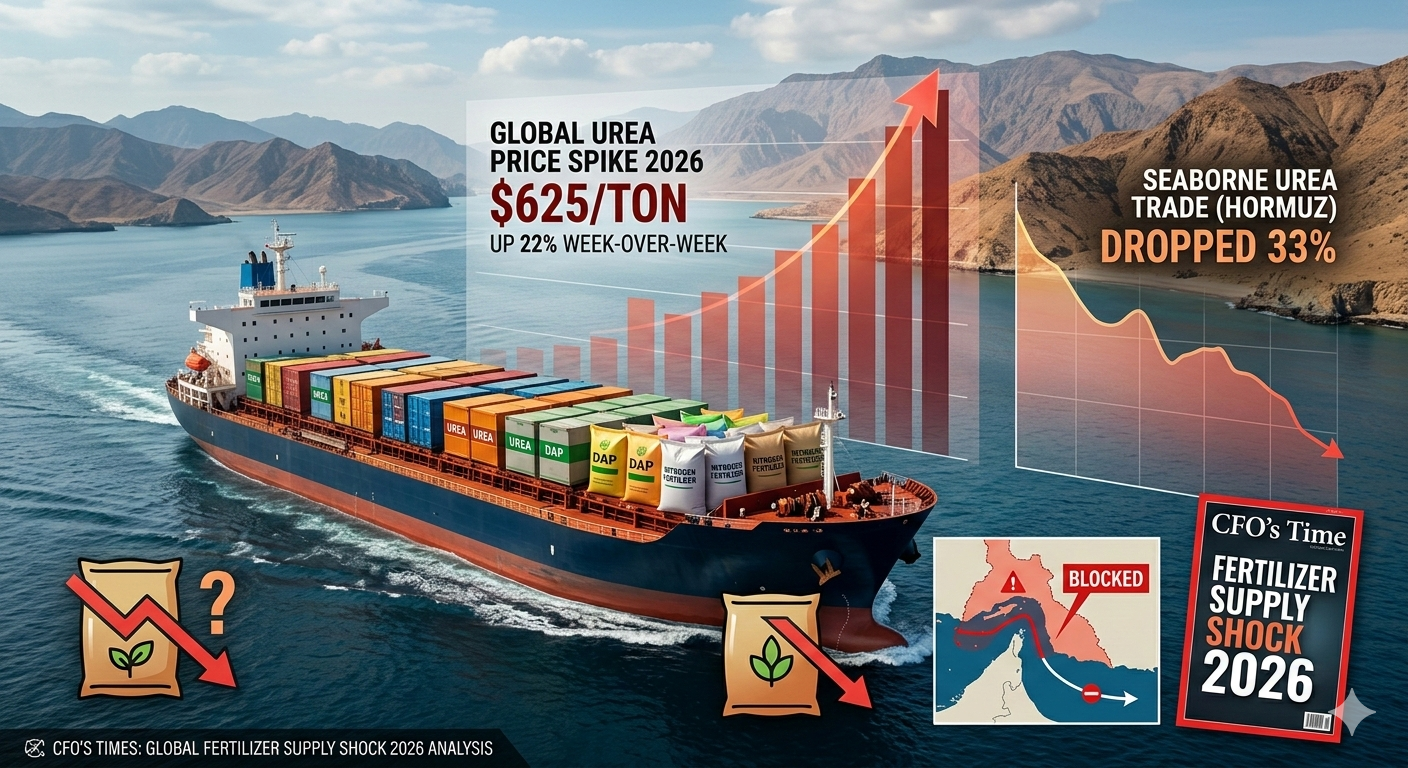
While global headlines are fixated on high energy prices, Global Fertilizer Supply Shock 2026, the real systemic threat to the 2026 fiscal year is not fuel—it is soil. As of March 8, 2026, the effective closure of the Strait of Hormuz has paralyzed roughly 33% of the world’s seaborne urea and ammonia trade.
For the global CFO, this is not just an agricultural problem; it is a direct hit to trade balances, fiscal subsidies, and consumer price indices (CPI). This report breaks down the mechanics of the Global Fertilizer Supply Shock 2026 and provides a roadmap for navigating the incoming volatility.
1. Introduction: The Geopolitical Decoupling of Soil and Oil
While the mainstream media obsesses over $90+ Brent Crude and the immediate impact of the March 2026 strikes in the Persian Gulf, a more insidious crisis is brewing beneath the surface of the global economy. As of March 8, 2026, the effective closure of the Strait of Hormuz has not just disrupted energy; it has severed the primary artery for the world’s agricultural productivity.
The Global Fertilizer Supply Shock 2026 represents a fundamental “de-syncing” of global trade. We are witnessing the weaponization of the “Food-Fuel-Fertilizer Nexus.” For the global CFO, this isn’t just a supply chain hiccup—it is a structural shift that will redefine fiscal deficits and corporate margins for the next 24 months.

2. The Mechanics of Disruption: Why Hormuz Matters
The Strait of Hormuz is the world’s premier fertilizer bottleneck. Unlike the crude oil market, which has matured via the Strategic Petroleum Reserve (SPR) in the US and IEA-mandated stocks in Europe, the nitrogen fertilizer market operates on a razor-thin, “just-in-time” basis.
A. The Production Halt-Global Fertilizer Supply Shock 2026
The Middle East Gulf accounts for roughly 16-18% of global seaborne fertilizer exports, but when focusing strictly on Urea and Ammonia, that number jumps to nearly 33%.
- Qatar’s Ras Laffan: Currently offline following the drone strikes of early March. This single facility is a cornerstone of global urea supply.
- The Feedstock Squeeze: Natural gas represents 60% to 80% of the production cost of nitrogen fertilizer. With local gas being diverted for emergency power and LNG exports being throttled, regional fertilizer plants in Saudi Arabia and the UAE have begun “proactive curtailments.”
B. The Shipping Exodus
According to latest Kpler data, dry bulk transits through the Strait are down 91%. Approximately 280 bulkers—mostly smaller Panamax and Supramax classes used for fertilizer—are currently trapped or at anchor in the region.
3. The Financial Impact: Insurance and “Unviable” Trade
As a finance executive, the most critical number isn’t the price of urea, but the cost of the War Risk Premium.
Effective March 5, 2026, leading marine insurers (including Gard, Skuld, and the London P&I Club) officially cancelled war risk cover for ships operating in the Gulf.
- Cost Escalation: For the vessels that do choose to sail, premiums have spiked by 50% to 100%.
- The “Unviable” Threshold: At current rates, shipping a tonne of urea from the Middle East to Brazil or Australia has become “commercially deterrent.” Many contracts are now invoking Force Majeure clauses, citing the impossibility of securing required insurance under standard charterparty agreements. Global Fertilizer Supply Shock 2026
4. India’s Strategic Position: The 177 LMT “Kharif Cushion”
Global Fertilizer Supply Shock 2026- For our audience in New Delhi, the focus is on domestic resilience. On March 6, 2026, the Ministry of Chemicals & Fertilizers issued a critical update via the Press Information Bureau (PIB).
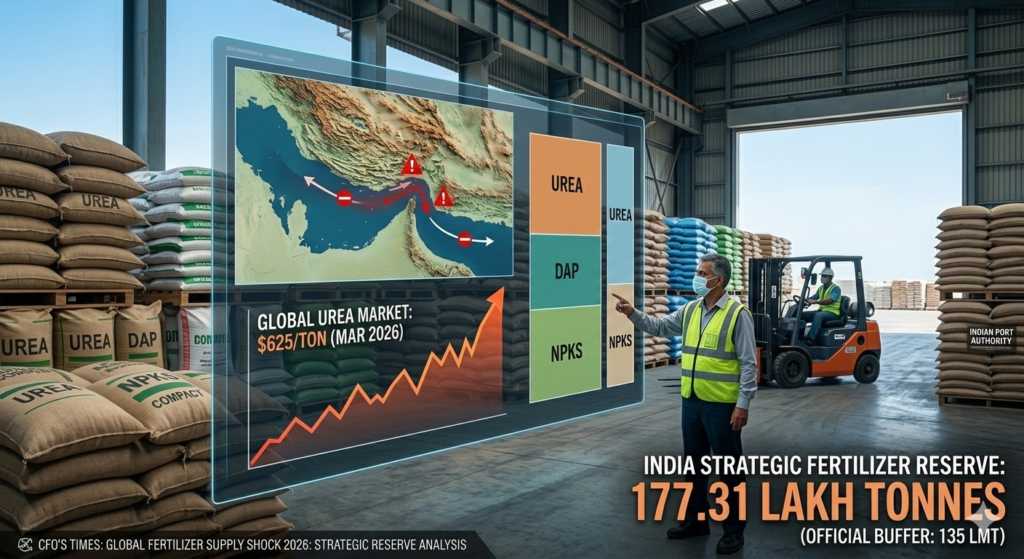
Current Inventory Status (March 8, 2026)
| Product | Stock (Lakh Metric Tonnes) | Requirement for Season |
| Urea | 59.30 | 48.50 |
| DAP | 25.13 | 19.20 |
| NPKS | 55.87 | 42.00 |
| Total Inventory | 177.31 | ~135.00 |
The CFO Verdict: Global Fertilizer Supply Shock 2026- India is in a strong position for the immediate sowing season. However, the fiscal risk is massive. The 2026-27 Urea Subsidy was budgeted at ₹1.265 trillion based on $450/ton urea. With Egyptian benchmarks now hitting $625/ton, the government faces a potential ₹30,000 crore budget overshoot.
5. Global Transmission Channels-Global Fertilizer Supply Shock 2026
The damage spreads through three specific channels:
A. The Maritime Insurance Crisis
War risk premiums for vessels entering the Persian Gulf have surged. This makes trade “economically unviable” for many smaller distributors, centralizing power into a few major players.
B. T+1 Settlement & Logistics Friction
As trade routes shift to the Cape of Good Hope, transit times have doubled to 32 days. This “floating inventory” ties up billions in working capital and contributes to a 12% rise in cross-border settlement fails.
C. The Food-Fuel-Fertilizer Nexus
Natural gas is the primary cost driver for nitrogen. With EU gas prices up 45% this week, domestic production in Europe is stalling, forcing them to compete for the remaining supply in the global market.
6. Frequently Asked Questions (FAQ)-Global Fertilizer Supply Shock 2026
Q: Is there a strategic fertilizer reserve like the SPR for oil?
A: No. Nitrogen fertilizers have a limited shelf life and require specialized storage. Most countries, including the US and UK, rely on “afloat” inventory and seasonal imports.
Q: Why are fertilizer prices rising if oil production is still happening?
A: Nitrogen fertilizer is made from Natural Gas, not oil. The drone attacks on Qatar’s LNG infrastructure have hit the feedstock supply, while the blockade of the Strait of Hormuz has physically stopped the movement of the finished product.
Q: Which sectors are most vulnerable to this shock?
A: Outside of Agriculture, the Automotive (DEF/AdBlue) and Chemical (Resins/Adhesives) sectors are at high risk. Industrial-grade urea is essential for modern emissions scrubbing in diesel engines.
Q: How will the 2026 fertilizer shock affect food prices?
A: Historically, there is a 3-6 month lag. We expect a 5-8% increase in global grain prices (wheat, corn, rice) by Q3 2026 as higher input costs reach the consumer.
Q: Is India at risk of a fertilizer shortage in March 2026?
A: No. Per the latest PIB report, India has 177.31 LMT of stock, ensuring a smooth supply for the upcoming Kharif preparations.
Q: What are the best government resources to track this?
A: You should monitor the FAOSTAT for global trends and the Ministry of Chemicals & Fertilizers for Indian inventory updates.
7. The CFO Action Plan for 2026
To maintain organizational agility, firms must move beyond “wait and see”:
- Audit Tier-2 Suppliers: Does your food-processing or chemical partner rely on Middle Eastern urea?
- Increase Liquidity Buffers: Rerouting around Africa adds $933,000 in fuel costs per voyage. Expect freight surcharges to become permanent in 2026 contracts.
- Monitor PIB Updates: For Indian operations, the PIB Delhi Newsroom is the only reliable source for real-time inventory and subsidy policy changes.
⚖️ Financial & Geopolitical Disclosure
Disclaimer: The information provided in this report, “Global Fertilizer Supply Shock 2026,” is for informational and educational purposes only. While every effort has been made to ensure the accuracy of the data—including the use of official PIB Delhi inventory reports and FAO global statistics—the geopolitical situation in the Strait of Hormuz is rapidly evolving.
This content does not constitute financial, investment, or legal advice. Market predictions, including projected price spikes in urea and grain, are based on current 2026 technical analysis and are subject to change. CFOs Times and its authors are not liable for any financial decisions made based on this content. Readers are encouraged to consult with their own financial advisors and monitor official government portals for real-time regulatory changes.

Dr. Dinesh Kumar Sharma is a CMA an award-winning Chief Financial Officer and Director of Finance with over 25 years of expertise in strategic planning and digital transformation. Recognized as a five-time CFO of the Year, he specializes in leveraging Generative AI and Microsoft Copilot to optimize financial forecasting and cost management. Dr. Sharma holds a Doctorate in Management (Finance) and has successfully scaled organizations from INR 1 billion to INR 7 billion. He is dedicated to providing transparent, data-driven insights for modern decision-makers at CFOs Times.