Introduction
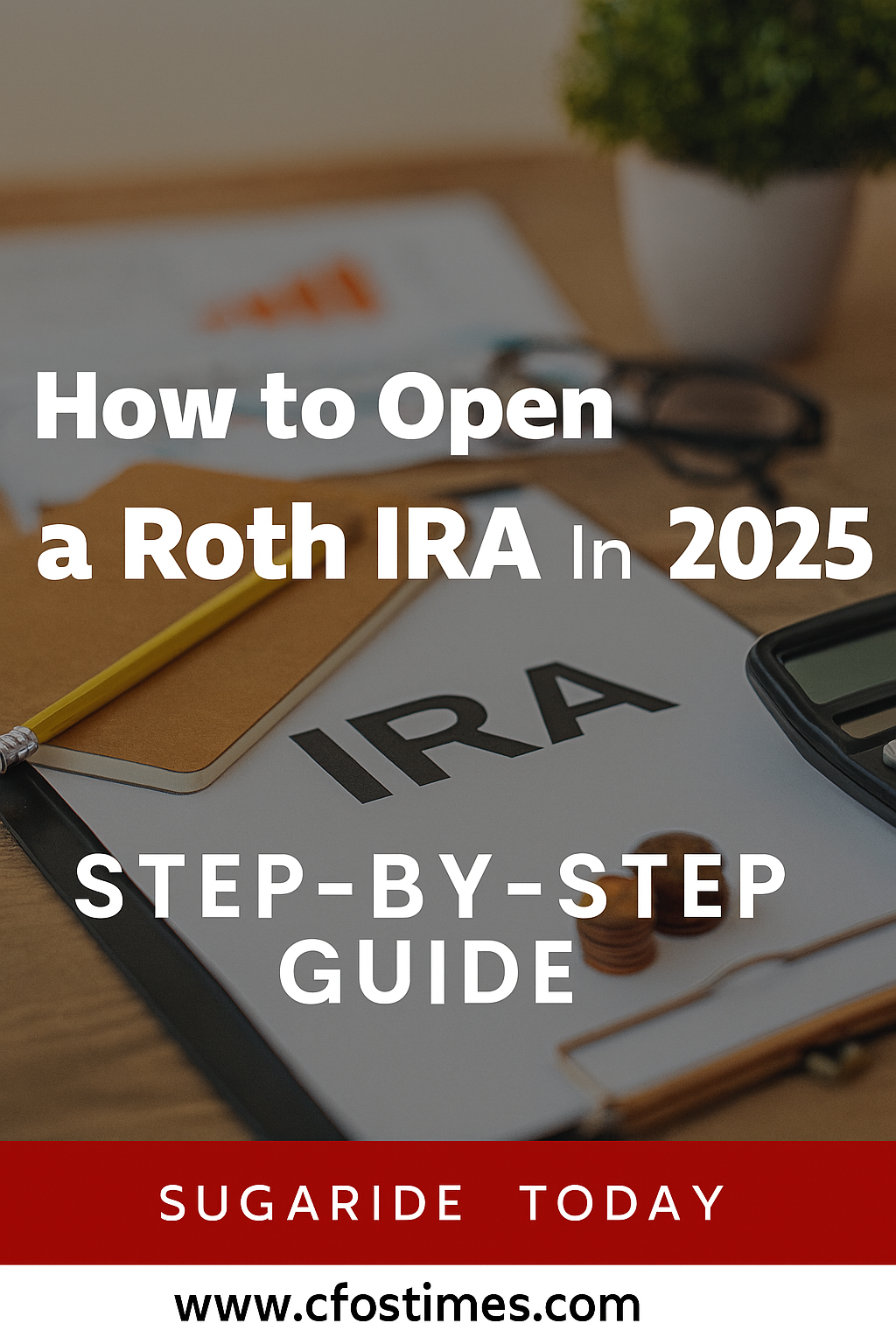
If you’re a finance professional, executive, or investor looking to maximize tax-efficient retirement savings, understanding how to open a Roth IRA in 2025 is essential.
This guide breaks down the eligibility criteria, income limits, provider selection, investment choices, and advanced strategies (like the backdoor Roth) to help you make the most of 2025’s retirement landscape.

Table of Contents
💡 Why Opening a Roth IRA in 2025 Matters for Executives and Finance Professionals
For a high-income earner, a Roth IRA is more than just another retirement account — it’s a strategic tax tool.
- Tax-free growth and withdrawals: Pay taxes now, enjoy tax-free distributions in retirement.
- No required minimum distributions (RMDs): You control when to withdraw, unlike Traditional IRAs.
- Estate planning advantage: Heirs can inherit tax-free assets.
- Diversified tax exposure: Helps you balance pre-tax (Traditional 401(k)) and after-tax (Roth IRA) income streams.
With inflation pressures and potential future tax changes, locking in a Roth in 2025 may be one of the smartest long-term financial decisions for professionals in higher brackets.
⚖️ Eligibility Criteria for a Roth IRA in 2025
Before you open a Roth, check the IRS guidelines for income and contribution limits.
Earned Income Requirement
You (or your spouse) must have taxable compensation—wages, salary, or self-employment income.
Passive income (dividends, rent, capital gains) doesn’t qualify.
📚 Source: IRS: Roth IRA Rules

Updated 2026 Contribution & Income Limits
For high earners, the IRS has increased the limits for the 2026 tax year. You should add this table to your guide to show “Current vs. Previous” year data.
| Filing Status | 2025 Phase-Out (MAGI) | 2026 Phase-Out (MAGI) |
| Single / Head of Household | $150,000 – $165,000 | **$153,000 – $168,000** |
| Married Filing Jointly | $236,000 – $246,000 | **$242,000 – $252,000** |
| Contribution Limit (<50) | $7,000 | **$7,500** |
| Contribution Limit (50+ / Catch-up) | $8,000 | **$8,600** ($1,100 catch-up) |
Critical 2026 Update: Mandatory Roth Catch-ups
Under SECURE 2.0, a major change began on January 1, 2026:
High-Earner Catch-up Rule: If you earned more than $150,000 in FICA wages in 2025, any catch-up contributions to your employer-sponsored 401(k) or 403(b) must now be made on a Roth (after-tax) basis. They can no longer be pre-tax. Out Limits (MAGI)
If your income exceeds these thresholds, you can still contribute indirectly via a Backdoor Roth IRA (explained below).
💰 Contribution Limits & Tax-Planning Differences for 2025
2025 Contribution Limits
- Under 50: $7,000
- Age 50 +: $8,000 (includes $1,000 catch-up)
These limits apply across all IRAs (Roth + Traditional).
You cannot contribute more than your taxable earned income for the year.
Roth IRA vs Traditional IRA — Tax Planning
| Feature | Roth IRA | Traditional IRA |
|---|---|---|
| Tax on Contributions | Paid now | Deferred |
| Tax on Withdrawals | None (qualified) | Ordinary income |
| RMDs | None | Required starting age 73 |
| Income Limits | Yes | None (for contributions; deduction may phase out) |
| Best for | Expect higher future tax rates | Expect lower retirement tax rates |
For CFO-level earners, the Roth’s tax-free growth and estate advantages can outweigh the immediate deduction of a Traditional IRA.
🏦 Choosing the Right Provider & Opening Your Account Online
Learning how to open a Roth IRA in 2025 online is simple — but choosing a trusted provider matters.
Top-Rated Roth IRA Providers (2025)
- Fidelity — best all-around, strong research tools.
- Charles Schwab — robust investment options.
- Vanguard — low-fee index funds.
- Betterment — automated investing.
Step-by-Step: How to Open Your Roth IRA in 2025
- Select your provider (based on fees, fund selection, digital tools).
- Gather documents: SSN, ID, bank info.
- Open the account: Choose “Roth IRA.”
- Designate beneficiaries: For estate planning.
- Fund the account: Lump sum or monthly auto-deposit.
- Choose investments: Index funds, ETFs, or a target-date fund.
- Track contributions: Ensure you stay within 2025 limits.
If you prefer to study retirement planning further, you can also check books such as

📈 Investment Strategy After You Open a Roth IRA in 2025
Because Roth gains are tax-free, consider allocating high-growth assets inside it.
Smart Allocation Framework
- 60–80%: equities (U.S. + global)
- 10–20%: bonds / fixed income
- 5–10%: alternatives (REITs, commodities, etc.)
Advanced Tips
- Rebalance annually.
- Keep dividend-heavy investments here since they compound tax-free.
- Coordinate asset allocation across all accounts to optimize after-tax growth.
🧭 Advanced Strategy: Backdoor Roth IRA in 2025
If your MAGI exceeds eligibility limits, use the Backdoor Roth IRA.
How It Works
- Contribute to a non-deductible Traditional IRA (up to $7,000 / $8,000).
- Wait briefly (often a few days).
- Convert the balance to your Roth IRA.
You’ll owe taxes on any pre-tax portion, but not on after-tax contributions.
Pro-Rata Rule Warning
If you have other pre-tax IRA balances, the IRS treats all accounts as one for tax purposes. This can complicate conversion taxes, so consult a CPA.
👨💼 Interaction with Employer Retirement Plans
If you already have a Roth 401(k) at work:
- Contribution limits are much higher ($23,000 + $7,500 catch-up in 2025).
- You can still contribute to a Roth IRA separately, subject to MAGI limits.
- Roth IRA gives you more investment flexibility than employer plans.
Executives and CFOs often use both vehicles for tax diversification.
🏠 Estate Planning Benefits of a Roth IRA in 2025
A Roth IRA is a stealth estate-planning tool.
- No RMDs for original owner.
- Tax-free inheritance: Beneficiaries can withdraw tax-free under current 10-year distribution rules.
- Inter-generational planning: Spouses can treat inherited Roths as their own, extending tax-free growth.
✅ Next Steps: Your Roth IRA Opening Checklist for 2025
- Verify 2025 income eligibility.
- Choose a brokerage or robo-advisor.
- Open & fund your Roth IRA before April 15, 2026 (for tax year 2025).
- Choose an investment mix aligned with your goals.
- Re-evaluate annually and adjust contributions.
- Keep documentation of all contributions and conversions.
🧾 FAQs – How to Open a Roth IRA in 2025
Q1. Can I open a Roth IRA if I make over $236,000 in 2025?
No — not directly. But you can use the Backdoor Roth IRA method to convert after-tax Traditional IRA contributions.
Q2. What’s the deadline to open or fund a Roth IRA for 2025?
You can contribute until April 15, 2026 (the tax filing deadline for 2025).
Q3. Is there an age limit to open a Roth IRA?
No. As long as you have earned income, you can contribute at any age.
Q4. Can I have both a Roth IRA and a 401(k)?
Yes. You can contribute to both as long as you meet Roth income limits.
Q5. Are withdrawals really tax-free?
Yes—if you’re over 59½ and your account is at least 5 years old. Non-qualified withdrawals may incur taxes or penalties.
Q6. How do I roll over a Traditional IRA into a Roth?
Request a Roth conversion from your brokerage. You’ll owe taxes on the converted pre-tax balance, but future growth will be tax-free.
🔚 Conclusion
Opening a Roth IRA in 2025 remains one of the smartest tax-advantaged steps for high-income earners and executives.
It offers tax-free growth, flexibility, and estate-planning leverage unmatched by other retirement vehicles.
Even if you exceed the income thresholds, the Backdoor Roth and employer Roth options make it possible to capture its benefits.
Start early, contribute consistently, and coordinate with a financial advisor to maximize your 2025 Roth IRA potential.
DISCLOSURES & FINANCIAL ADVICE NOTICE
For Educational Purposes Only: The content provided on worldvirtualcfos.com, including this guide on “How to Open a Roth IRA in 2026,” is for informational and educational purposes only. It is not, and should not be construed as, personal financial, investment, tax, or legal advice.
No Fiduciary Relationship: Your use of this website does not create a fiduciary or advisor-client relationship between you and CFOs Times. Every individual’s financial situation is unique; therefore, the strategies discussed (such as the “Backdoor Roth” or “Super Catch-ups”) may not be suitable for your specific circumstances.
Accuracy & Market Risk: While we strive for absolute accuracy using current 2026 IRS guidelines and SECURE 2.0 updates, tax laws are subject to change without notice. Investing involves risk, including the potential loss of principal. Past performance is not indicative of future results.
Professional Consultation Recommended: Before making any significant financial decisions or executing a Roth conversion, we strongly recommend consulting with a certified financial planner (CFP), licensed tax professional (CPA), or legal counsel.
AdSense Compliance: This site may be compensated through third-party advertisers. However, our editorial content remains independent and is not influenced by advertiser relationships.

Dr. Dinesh Kumar Sharma is an award-winning Chief Financial Officer and Director of Finance with over 25 years of expertise in strategic planning and digital transformation. Recognized as a five-time CFO of the Year, he specializes in leveraging Generative AI and Microsoft Copilot to optimize financial forecasting and cost management. Dr. Sharma holds a Doctorate in Management (Finance) and has successfully scaled organizations from INR 1 billion to INR 7 billion. He is dedicated to providing transparent, data-driven insights for modern decision-makers at CFOs Times.