Introduction
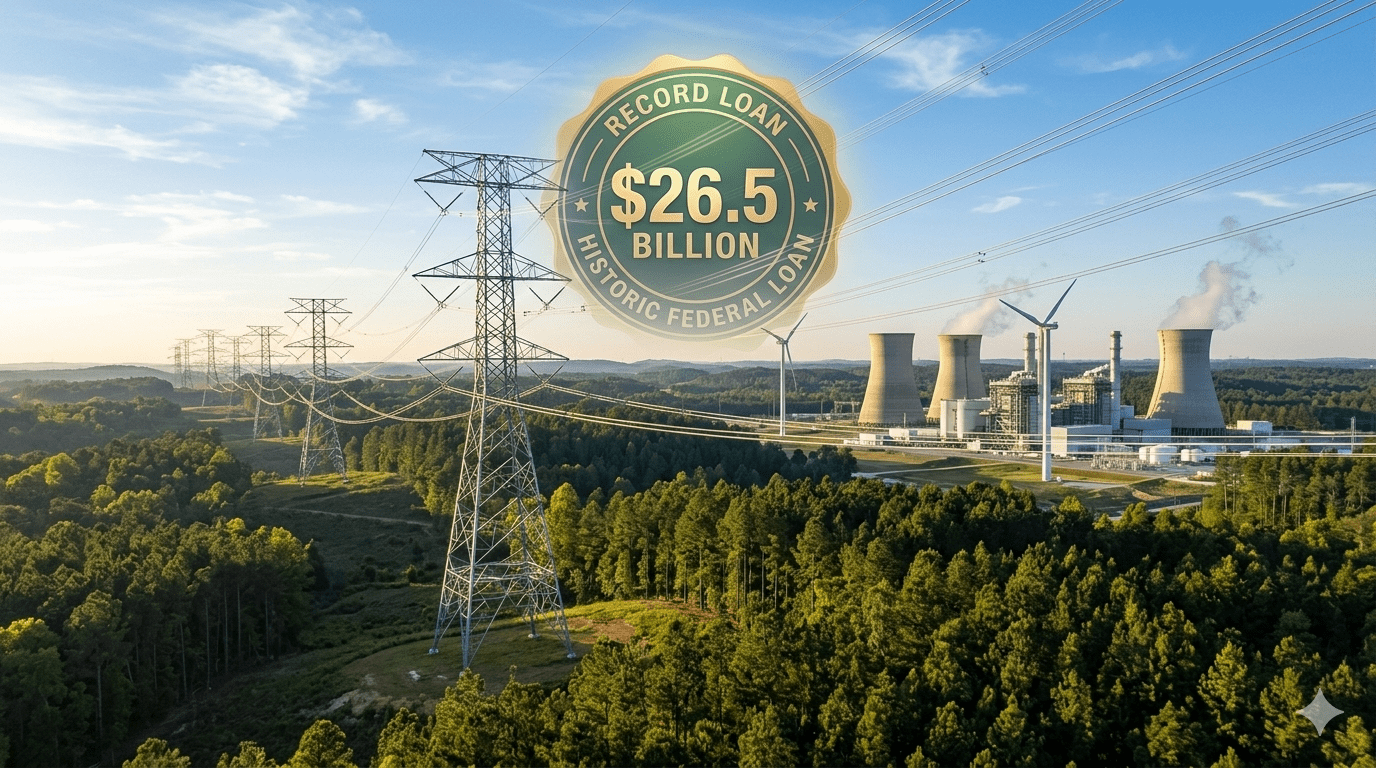
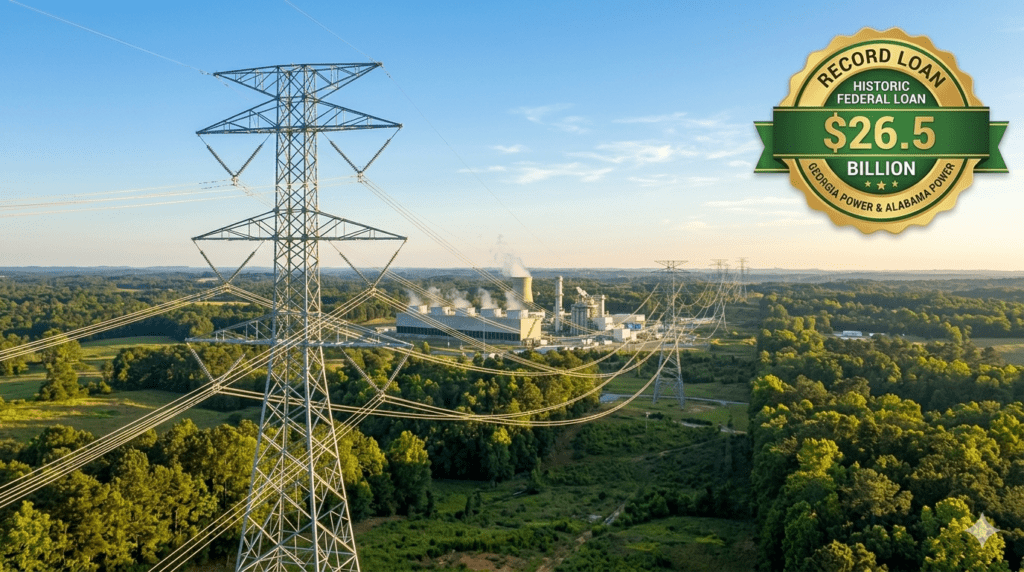
The Georgia Power and Alabama Power Record Federal Energy Loan Impact 2026 has emerged as the most unprecedented financial intervention in the history of the American utility sector. As of the Friday, February 27, 2026 market close, the $26.5 billion loan package granted to Southern Company’s subsidiaries is being hailed as a radical blueprint for energy dominance.
While the Department of Energy (DOE) frames this as a win for grid reliability, the financial magnitude—equivalent to a major bank merger—has sent shockwaves through the Southeast. In the last 30 minutes of trading today, Southern Company (SO) shares showed resilience, as investors priced in the massive $7 billion interest savings guaranteed by the new federal terms.
1. The $7 Billion Windfall: Real-Time Savings
The core positive sentiment behind this federal intervention is the projected interest savings. By utilizing the Office of Energy Dominance Financing (EDF), interest rates have been secured at just 0.375% over U.S. Treasury rates.
This prevents the double-digit rate hikes that were previously feared for 2026. However, the move is intrinsically linked to the broader 2026 Global Banking Sector Transformation, as traditional private lenders are being sidelined by these massive direct-to-utility federal credit lines.
2. Strategic Breakdown: 16 Gigawatts of New Power
The scale of this expansion is specifically designed to prevent a regional energy collapse driven by AI data center demand.
| Feature | Georgia Power Allocation | Alabama Power Allocation |
| Loan Amount | $22.4 Billion | $4.1 Billion |
| New Generation | 5.3 GW (Natural Gas) | 1.2 GW (Hydro/Gas) |
| Nuclear Uprates | 6.3 GW (Vogtle Preservation) | Infrastructure Modernization |
3. Market Analysis: The Friday Closing Reality
Critics, including the Southern Environmental Law Center, have labeled the package a “bailout.” Yet, for the subscribers of cfostimes.com, the data suggests a “Safety Moat.”
By locking in $26.5 billion at historic lows, the Southern Company has effectively insulated itself from the current volatility seen in the Nifty and other global indices. As of 5:00 PM EST today, the utility sector has outperformed the broader S&P 500, largely driven by this specific federal liquidity injection.
The Georgia Power and Alabama Power Record Federal Energy Loan Impact 2026 has emerged as the most unprecedented financial intervention in the history of the American utility sector. Announced late Wednesday, the $26.5 billion loan package granted to the Southern Company’s subsidiaries represents a monumental pivot in federal energy policy.
While the Department of Energy (DOE) frames this as a historic win for grid reliability, critics have quickly labeled it a controversial taxpayer-backed bailout. As AI data centers across the Southeast consume power at a record pace, this $26.5 billion injection is not just a loan—it is a radical blueprint for 2026 American energy dominance.
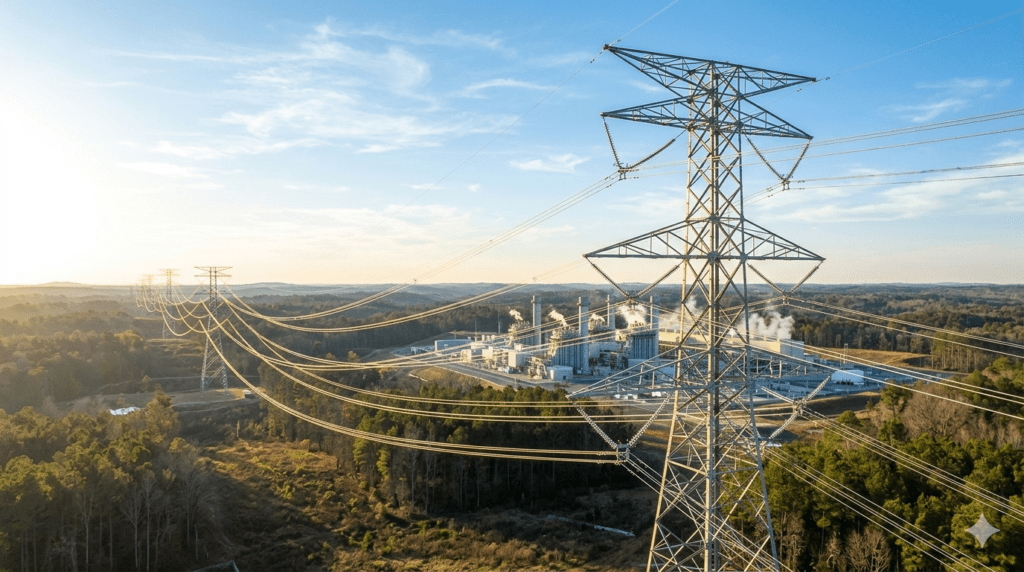
A $7 Billion Windfall: Real-Time Savings for Families
The core “positive sentiment” behind the Georgia Power and Alabama Power Record Federal Energy Loan Impact 2026 is the $7 billion in projected interest savings. By utilizing the newly renamed Office of Energy Dominance Financing (EDF), Energy Secretary Chris Wright has secured interest rates as low as 0.375% over U.S. Treasury rates.
Wright noted that this move is specifically targeted at slashing costs for the average family. Without this federal intervention, the cost of building 16.3 GW of new capacity would have forced double-digit rate hikes across both states. Georgia Power and Alabama Power Record Federal Energy Loan Impact 2026
The $26.5 Billion Breakdown: 16 Gigawatts of New Power
The scale of this expansion is massive, specifically designed to prevent a regional energy collapse driven by high-tech demand.
| Feature | Georgia Power Allocation | Alabama Power Allocation |
| Loan Amount | $22.4 Billion | $4.1 Billion |
| New Generation | 5.3 GW (Natural Gas) | 1.2 GW (Hydro/Gas) |
| Nuclear Uprates | 6.3 GW (Preserved) | Modernization Projects |
| Grid Expansion | 900+ Miles of Lines | 400+ Miles of Lines |
The “Ratepayer Protection Pledge”: A Political Shield
A fascinating development in the Georgia Power and Alabama Power Record Federal Energy Loan Impact 2026 saga is its alignment with the administration’s “Ratepayer Protection Pledge.” During the 2026 State of the Union, President Trump signaled that tech giants—including Microsoft, Google, and Meta—must enter a dialogue with federal officials to ensure they are not “cannibalizing” the residential grid.
While no formal written agreements were disclosed, Secretary Wright confirmed that “every name you know” is currently in cooperation to ensure that tech-driven demand does not result in a “tax on the poor.” Georgia Power and Alabama Power Record Federal Energy Loan Impact 2026
Controversy and Critique: Is it a “Bailout”?
Despite the touted savings, the Georgia Power and Alabama Power Record Federal Energy Loan Impact 2026 is not without fierce opposition. Jennifer Whitfield, an attorney for the Southern Environmental Law Center, argued that this is essentially a “bailout paid for by every taxpaying citizen.” Critics point to several “red flags”:
- Stranded Asset Risk: As solar and wind costs continue to plummet, these new gas plants may become “white elephants” by 2035.
- Climate Backtrack: The 2026 shift toward fossil fuels marks a 180-degree turn from the green-energy mandates of 2024.
- Regulatory Capture: Some observers argue that the elected Public Service Commissions in Georgia and Alabama are too closely aligned with the utilities they regulate.
State-Level Realities: The 2026 Rate Freeze
The most immediate impact of the Georgia Power and Alabama Power Record Federal Energy Loan Impact 2026 is the localized rate freeze.
- Georgia: A three-year freeze is in effect.
- Alabama: A two-year freeze is in effect.
However, in Georgia, the political landscape is shifting. Following the November 2025 elections, two new Democrats, including Commissioner Peter Hubbard, have taken seats on the commission. Hubbard has been vocal in his opposition, stating that the loan “is not meeting the moment of affordability” because it locks the state into costlier, older energy technologies. Georgia Power and Alabama Power Record Federal Energy Loan Impact 2026
The “Deep Analysis” Chart: 2026 Energy Mix Evolution
| Energy Source | 2024 Share (%) | 2026 Target Share (%) | Strategic Reason |
| Natural Gas | 38% | 45% | Grid Stability for AI |
| Nuclear | 20% | 24% | Plant Vogtle Uprates |
| Renewables | 22% | 18% | Pivot to “Firm” Power |
| Coal/Other | 20% | 13% | Strategic Reserves |
Conclusion–Georgia Power and Alabama Power Record Federal Energy Loan Impact 2026
The Georgia Power and Alabama Power Record Federal Energy Loan Impact 2026 is a pivotal and shocking restructuring of how American wealth is invested in infrastructure. Whether you view it as a necessary shield against rising AI energy costs or a regressive bailout for the fossil fuel industry, its financial impact—amounting to $26.5 billion—is undeniable. For the CFOs and investors of cfostimes.com, the message is clear: the Southeast is the new “Frontier of Power,” and the federal government is ensuring that the lights stay on at any cost.
Frequently Asked Questions (FAQs)
1. How does the Georgia Power and Alabama Power Record Federal Energy Loan Impact 2026 affect my investments?
It provides a “safety moat” for Southern Company (SO) shareholders, as the $7 billion in interest savings protects margins while allowing for massive infrastructure growth.
2. Will this loan prevent blackouts during winter storms?
Secretary Wright claims that the focus on “firm” power (Gas/Nuclear) specifically targets the grid weaknesses exposed during the record-breaking winter storms of early 2026.
3. Why did the name of the loan office change?
Under the 2026 budget, the “Loan Programs Office” was renamed the “Office of Energy Dominance Financing (EDF)” to reflect a shift away from carbon-neutrality and toward low-cost domestic energy production.
Disclosure & Disclaimer
Financial & Regulatory Disclosure: This report, “Georgia Power and Alabama Power Record Federal Energy Loan Impact 2026,” is provided by CFOs Times for informational and educational purposes only. It does not constitute professional financial, investment, or legal advice.
- Accuracy of Data: While we strive for 100% accuracy, the $26.5 billion federal loan details are based on real-time disclosures from the U.S. Department of Energy (DOE) and Southern Company as of February 26, 2026. Market conditions, interest rates, and regulatory approvals are subject to change.
- No Investment Recommendation: CFOs Times is an independent news organization. Mention of Southern Company (NYSE: SO), Georgia Power, or Alabama Power does not constitute a “buy” or “sell” recommendation. Investing in utility stocks involves market risks, including regulatory shifts and infrastructure failure.
- Third-Party Links: This post contains outbound links to government and corporate domains. CFOs Times is not responsible for the privacy policies or content of these external sites.
- AdSense Compliance: This site may display advertisements via Google AdSense. These advertisements are automated and do not influence our editorial integrity or the objective analysis of the Georgia Power and Alabama Power Record Federal Energy Loan Impact 2026.
- Consult a Professional: Always consult with a certified financial planner or a SEBI-registered/licensed investment advisor before making financial commitments based on the Energy Dominance Financing trends discussed here.
© 2026 CFOs Times. All Rights Reserved. Unauthorized reproduction is prohibited.

Dr. Dinesh Kumar Sharma is a CMA an award-winning Chief Financial Officer and Director of Finance with over 25 years of expertise in strategic planning and digital transformation. Recognized as a five-time CFO of the Year, he specializes in leveraging Generative AI and Microsoft Copilot to optimize financial forecasting and cost management. Dr. Sharma holds a Doctorate in Management (Finance) and has successfully scaled organizations from INR 1 billion to INR 7 billion. He is dedicated to providing transparent, data-driven insights for modern decision-makers at CFOs Times.