Introduction: The High-Stakes Reality of the August Reporting Window
In the landscape of Australasian capital markets, few milestones command as much scrutiny as the annual corporate reporting window. ASX 200 reporting season August 2026 has delivered a stark reminder that even blue-chip equities are not immune to macroeconomic friction, operational missteps, and shifting cost structures. As the benchmark index navigates volatile trading sessions—testing key technical supports after flirting with record highs—investors are being forced to re-evaluate the true resilience of corporate earnings.
Rather than a uniform wave of expansion, this reporting period has highlighted a fragmented economic reality. While certain sectors benefit from structural tailwinds, high-profile stalwarts have stumbled, sending shockwaves through retail and institutional portfolios alike. This comprehensive analysis dissects the specific earnings disclosures of telecommunications leader Telstra and insurance giant Insurance Australia Group (IAG), evaluating the underlying drivers behind their market corrections and outlining strategic implications for equity allocators.

Table of Contents
1. Macroeconomic Backdrop and Market Sentiment
To properly contextualize the recent equity pullbacks, one must analyze the broader economic conditions framing the August reporting cycle. The Reserve Bank of Australia’s monetary stance, persistent domestic inflation, and compressed household budgets have combined to create a challenging operating environment for industrial and service-oriented businesses. ASX 200 Reporting Season
Although resource counters and select energy players have provided pockets of stability, industrial earnings ex-mining continue to face margin compression. When companies report numbers that merely match muted expectations or reveal unexpected operational headwinds, market reactions are ruthlessly swift. For comprehensive tracking of domestic monetary policy frameworks and economic indicators, market participants routinely consult data published by the Reserve Bank of Australia (RBA) and corporate compliance standards via the Australian Securities and Investments Commission (ASIC). ASX 200 Reporting Season
| Market Dynamic | Description & Trend |
| Headline Index Volatility | Profit-taking near record highs |
| Sector Disparities | Mining resilience vs. industrial lag |
| Consumer & Cost Pressures | Margin friction across service firms |
2. Telstra’s FY26 Earnings: Modest Growth Overshadowed by Investor Caution
Telstra Corporation Limited (ASX: TLS) presented its full-year financial results for fiscal year 2026 (FY26), revealing a complex picture of stable top-line metrics paired with underlying cost pressures that triggered a sharp equity sell-off.
Financial Performance Overview
For the fiscal year, Telstra reported total income slipping approximately 0.9%, while underlying earnings before interest, taxes, depreciation, amortisation, and leases (EBITDAaL) rose a modest 4% to $8.3 billion. Reported net profit after tax reached $2.4 billion, reflecting a minor 3% increase that fell slightly short of aggressive consensus expectations. On the capital management front, the board resolved to increase total fully or partially franked dividends and announced a fresh on-market share buyback of up to $1 billion. ASX 200 Reporting Season
Operational Headwinds and Executive Accountability
Despite solid cash earnings growth—with cash EPS rising 14% to 25.5 cents—market sentiment turned cautious. The earnings release landed closely on the heels of a major network outage that disrupted services for millions of customers, prompting visible accountability measures, including significant reductions in executive short-term incentives. Furthermore, heavy strategic investments into fiber infrastructure and the Aura Network have expanded capital expenditure requirements, forcing analysts to weigh long-term network benefits against near-term cash flow constraints.
For broader insights into global telecommunication trends and regulatory shifts, financial analysts frequently reference reports by the International Telecommunication Union (ITU). ASX 200 Reporting Season
3. IAG’s Profit Slump: Natural Perils and Insurance Margin Pressures
The financial sector experienced additional downward pressure as Insurance Australia Group (ASX: IAG) released its FY26 figures, resulting in an immediate dive in its share price.
The Cost of Severe Weather Events
IAG reported a 25% plunge in reported net profit after tax (NPAT) down to $1.02 billion. This substantial profit contraction occurred despite positive top-line indicators: gross written premium (GWP) expanded by 7.6% and underlying insurance profit managed a modest 2.3% gain. The primary catalyst behind the earnings miss was an escalation in natural perils costs driven by a severe frequency of extreme weather events throughout the underwriting year. ASX 200 Reporting Season
Underwriting Discipline and Reinsurance Costs
As climate volatility continues to challenge property and casualty insurers, the cost of securing adequate reinsurance protection has risen globally. IAG’s results underscore the delicate balance general insurers must maintain between passing premium price increases onto consumers and managing retention rates without sacrificing underwriting profitability. For international insurance standards and systemic risk tracking, professionals regularly review updates from the International Association of Insurance Supervisors (IAIS). ASX 200 Reporting Season
4. Comparative Earnings Breakdown Table
The following table summarizes the key financial metrics, year-op-year performance variations, and immediate market reactions for the major reporting entities:
| Company Name & Ticker | Reported Revenue / Sales Trend | Key Earnings Metric & Result | Primary Operational Headwind / Driver | Immediate Market Reaction |
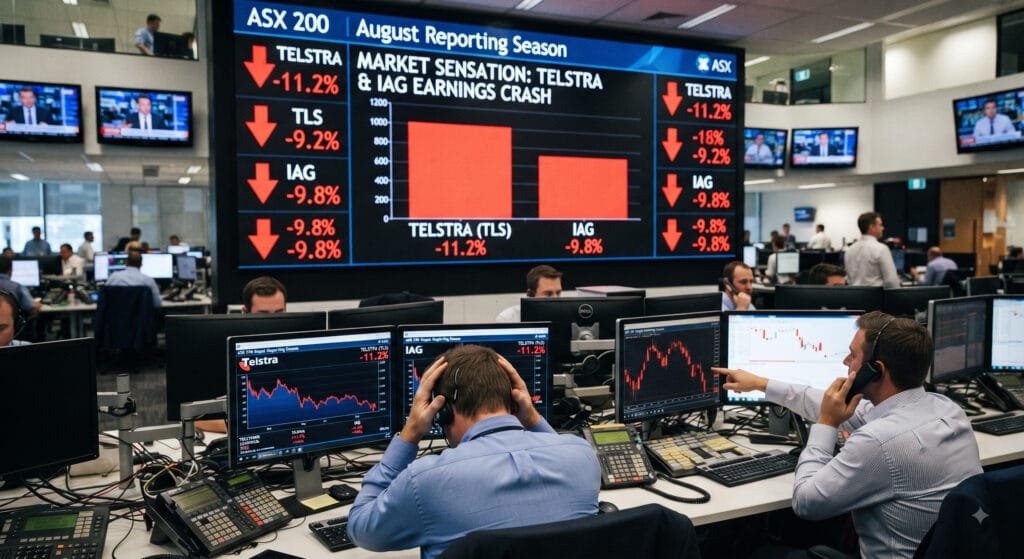
| Telstra (ASX: TLS) | Total income slipped ~0.9% | Underlying EBITDAaL up 4% to $8.3B; NPAT up ~3% to $2.4B | Network outage fallout, executive bonus cuts, and heavy infrastructure capital expenditure | Shares fell ~5.20% on open to $4.74 |
| IAG (ASX: IAG) | GWP expanded 7.6% | NPAT fell 25% to $1.02B; underlying insurance profit up 2.3% | Surging natural perils costs and severe weather weather claims | Share price dived ~7.30% to $7.63 |
5. Frequently Asked Questions (FAQs)-ASX 200 Reporting Season
What caused the sharp share price drop for Telstra during the August reporting season?
While Telstra reported solid underlying EBITDAaL of $8.3 billion and announced a $1 billion share buyback, its headline revenue slipped slightly, and profit growth came in softer than aggressive market expectations. This caution was amplified by recent network disruptions and increased capital expenditure requirements.
Why did IAG’s net profit fall significantly despite growing premiums?
IAG’s reported net profit after tax fell 25% to $1.02 billion because a surge in natural perils and severe weather events drove up claims expenses, offsetting a 7.6% growth in gross written premiums.
How are broader ASX 200 companies performing in August 2026?
The reporting season has been characterized by a multi-speed economy where strong results from mining and select energy companies have contrasted with margin pressures and cautious guidance across industrial, consumer, and telecommunication sectors.
Conclusion: Lessons for Long-Term Portfolio Allocators
The earnings reports delivered by Telstra and IAG offer crucial insights for navigating the current equity cycle. In a market where valuations have recently pressed toward record highs, companies that fail to exceed consensus forecasts or experience temporary operational friction face immediate punitive repricing. For long-term investors and corporate treasurers, these developments underscore the importance of prioritizing balance sheet strength, robust cash conversion, and disciplined cost management in an inflationary macro environment. ASX 200 Reporting Season
Disclaimer
The information provided in this article ASX 200 Reporting Season —including financial figures, corporate earnings metrics, stock price reactions, and macroeconomic commentaries—is published strictly for informational, educational, and analytical purposes. It does not constitute financial, investment, legal, or professional trading advice.
- Not Financial Advice: The content should not be construed as a recommendation or solicitation to buy, sell, or hold any securities or financial instruments mentioned. Readers and investors must conduct their own independent research and consult with a certified financial advisor or registered investment professional before executing any investment decisions.
- Market Volatility: Corporate earnings results and equity valuations are subject to rapid market fluctuations, economic uncertainties, and unforeseen operational risks. cfostimes.com assumes no liability for any financial losses or damages resulting from the use of or reliance on the information contained in this publication.

Dr. Dinesh Kumar Sharma is a CMA an award-winning Chief Financial Officer and Director of Finance with over 25 years of expertise in strategic planning and digital transformation. Recognized as a five-time CFO of the Year, he specializes in leveraging Generative AI and Microsoft Copilot to optimize financial forecasting and cost management. Dr. Sharma holds a Doctorate in Management (Finance) and has successfully scaled organizations from INR 1 billion to INR 7 billion. He is dedicated to providing transparent, data-driven insights for modern decision-makers at CFOs Times.