Introduction
The AI Trade Shifts that has dominated financial markets since late 2022 is undergoing a fundamental transformation. What was once a unified narrative—buy everything AI—has fractured into distinct segments with divergent performance and risk profiles. For investors, this evolution presents both warning signs and unprecedented opportunities.
The “Magnificent Seven” trade is no longer moving as one basket. Average pairwise correlation among these AI giants has fallen from a peak of 0.78 in mid-2025 to just 0.27 on a three-month rolling basis. Meanwhile, performance dispersion has widened dramatically: Alphabet and Apple have delivered gains of 12.4% and 14.8%, respectively, while Microsoft has declined 21.4%.
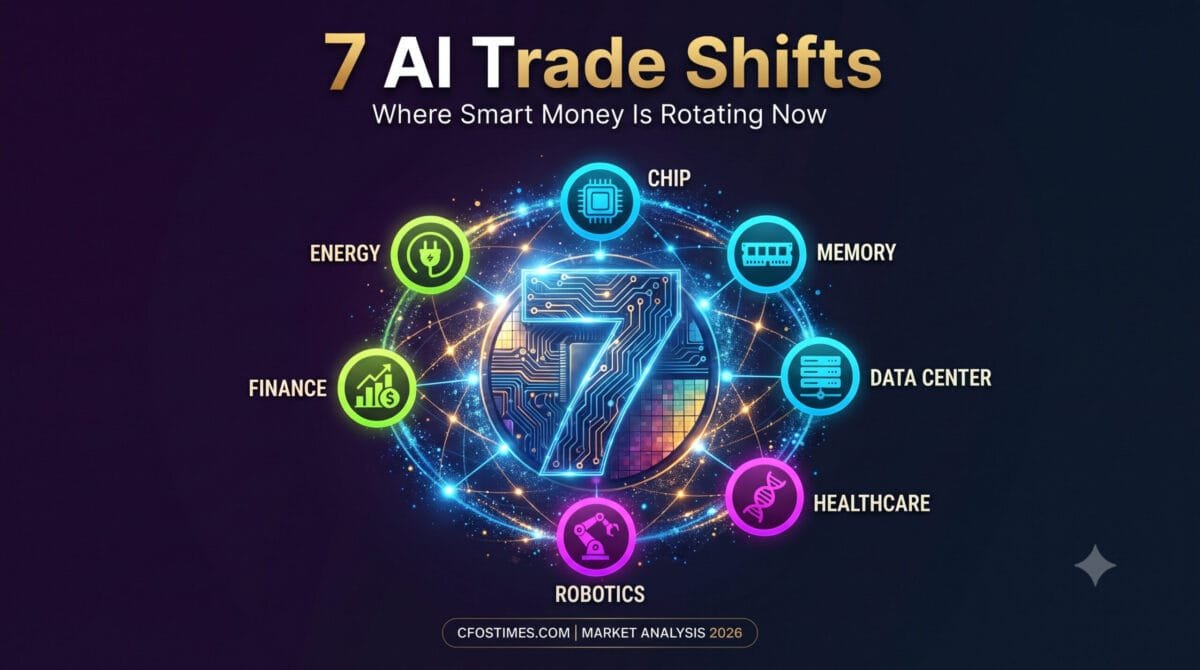
This fragmentation signals a critical inflection point. The AI trade hasn’t collapsed—it has matured. And smart money is rotating toward different parts of the ecosystem. This article explores 7 critical shifts in the AI trade landscape and where the next wave of investment is heading.
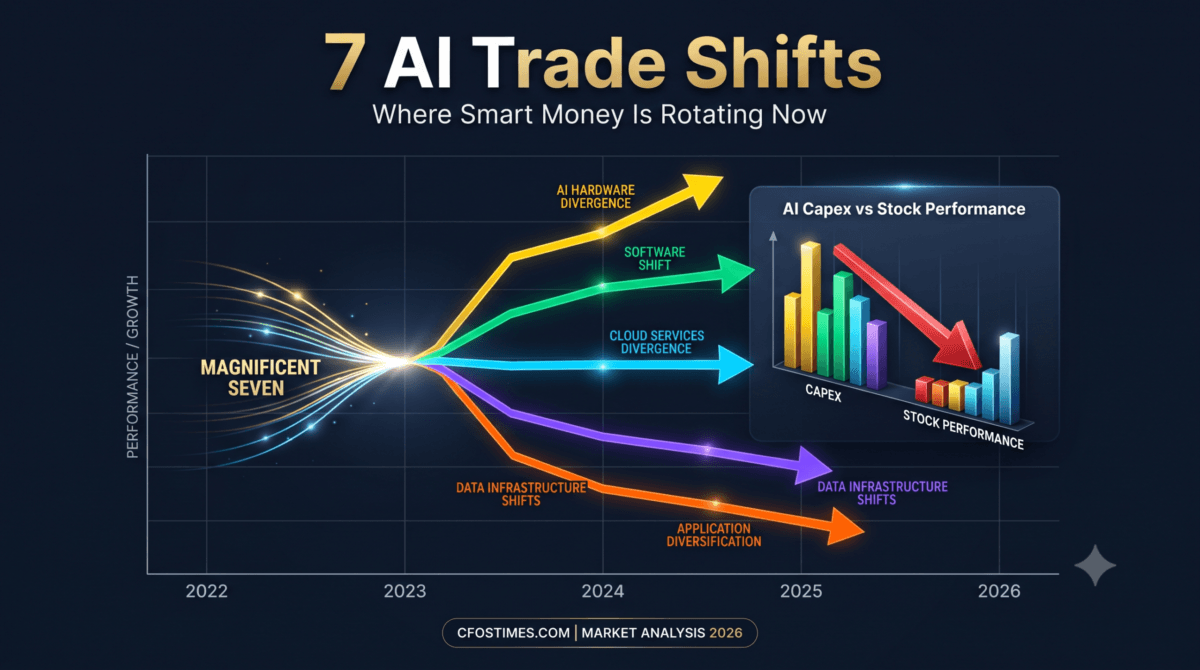
Table of Contents
Shift 1: The Great Unbundling of the Magnificent Seven
Why These Stocks Are No Longer a Single Bet
For years, investors treated the Magnificent Seven as a proxy for AI exposure. That shortcut no longer works. State Street Investment Management’s analysis reveals that these companies now fall into distinct risk profiles: a high-beta cohort (NVIDIA at 2.25x beta, Tesla at 1.76x), a growth-cyclical middle (Amazon, Meta, Alphabet at 1.2-1.5x), and a market-like cohort (Microsoft, Apple at around 1.1x).
The underlying fundamentals tell the same story. Forward P/E multiples now span from 19.7x to a staggering 184.8x, and earnings growth expectations for fiscal 2026 range from 14% to 85%. This level of heterogeneity makes a basket approach increasingly indefensible.
“The market is pricing these companies differently, but the divergence in performance is ultimately grounded in their fundamentals,” State Street notes. “AI-related spending, monetization prospects, and capital allocation decisions are increasingly driving performance dispersion.” AI Trade Shifts
The Capex Correlation That Broke
Perhaps the most significant development has been the breakdown in the relationship between hyperscaler capital spending and AI stock performance. David Woo, founder of David Woo Unbound and former Bank of America strategist, identified this as a potential “watershed moment.”
“For the first time in three years, the stocks of the hyperscalers went down, and not up, on the guidance of increased capex spending,” Woo observed. The market no longer trusts higher capital spending to reflect higher returns on investment. Instead, rising capex is increasingly seen as a cost problem rather than a return signal.
This shift is driven by the massive scale of required investment. The four largest hyperscalers—Alphabet, Microsoft, Meta, and Amazon—will spend more than 2% of U.S. GDP on AI-related capital expenditure this year. By comparison, total U.S. advertising spending equals about 1.5% of GDP. AI Trade Shifts
Shift 2: Supply Chain Chokepoints Becoming Investment Opportunities
Where the Real Bottlenecks Are
While hyperscalers face scrutiny over their spending, the physical infrastructure enabling AI continues to experience severe constraints. The AI supply chain is operating at full capacity, with lead times for critical components stretching beyond 40 weeks.
The bottlenecks have been shifting dynamically. Two years ago, the choke point was TSMC’s CoWoS advanced packaging. Now, TSMC controls roughly 90% of the global AI chip manufacturing market, but packaging capacity remains the binding constraint, with CEO C.C. Wei acknowledging that capacity limits customer growth.
TSMC is scaling CoWoS from approximately 35,000 wafer starts per month in late 2024 to a projected 130,000 by year-end 2026—a near-fourfold increase. Yet analysts estimate the 2026 supply-demand gap at roughly 20%, meaning one in five orders cannot be filled on schedule.
From Packaging to Memory to Photonics
As packaging capacity expands, the squeeze relocates upstream. High-bandwidth memory (HBM), which only three companies manufacture, has become the next critical constraint. NVIDIA’s CFO has stated that customer forecasts point to demand roughly doubling while supply caps growth well short of that.
Behind the memory sits the photonics layer. LightCounting’s April 2026 forecast reports transceiver demand running approximately 30% above supply, with growth limited by indium phosphide (InP) laser-chip production. Lumentum’s CEO stated the company is undershipping customer demand by around 30%—and that even after adding 20% more capacity, the imbalance widened.
This creates what analysts describe as a “convoy” effect. As StockAlpha.ai‘s analysis notes, “An AI cluster is not a pile of independent parts. It is a convoy that moves at the speed of its slowest truck. GPUs without transceivers are expensive paperweights.”
The Picks and Shovels Opportunity
PIMCO’s Balanced Income and Growth Fund, which has outperformed 97% of its peers over the past three years, has been rotating toward supply chain beneficiaries. Portfolio manager Emmanuel Sharef explained the logic: investors “do not need to own the market’s most expensive stocks to capture a major structural trend.”
The fund gained exposure last year through companies including Samsung Electronics, SK Hynix, and Taiwan Semiconductor Manufacturing. These businesses provide critical pieces of the AI production stack, from advanced foundry capacity to the memory required to keep accelerators moving data at industrial speed.
PIMCO remains overweight Asia because Sharef sees “a combination of stronger earnings growth, more forgiving valuations and deeper exposure to the companies actually building the data centre ecosystem.”
Shift 3: The Rise of Vertical AI in Boring Industries
From Horizontal to Vertical
While the market fixates on hyperscalers, venture capital is flowing toward vertical AI applications in traditionally “boring” industries. In February 2026, Basis—an AI agent platform built only for accountants—raised $100 million at a $1.15 billion valuation, led by Accel with GV and Khosla Ventures doubling down. Roughly 30% of the top 25 accounting firms already use it.
This pattern is replicating across essential sectors. CreativeCo Capital’s Ashley Gautreaux explains the philosophy: “Some might call them boring industries, but I think that’s exactly where the opportunity is right now. AI and automation in sectors like construction, property operations, and government has always been our focus. Now the timing is catching up to the thesis.” AI Trade Shifts
Why Regulated Industries Are Prime Targets
Vertical AI agents in regulated industries offer several structural advantages:
- Real budgets and real pain: The work is repetitive and the cost of errors is high
- Regulation creates a moat: If an agent must understand tax code or HIPAA rules, a weekend hacker cannot clone it
- Incumbents are slow: A 40-year-old billing vendor is not shipping AI agents next quarter
The opportunities span insurance claims processing, medical prior authorization, construction estimating, municipal permitting, freight documentation, and clinical trial data entry.
Google’s Vertical Bet
Google Cloud recently launched Gemini Enterprise for Legal and Gemini Enterprise for Financial Services, developed alongside design partners including Cleary Gottlieb, Freshfields, Deutsche Bank, and CME Group. Both offerings connect to industry-standard applications including iManage, DocuSign, FactSet, S&P Global, and Moody’s.
The real differentiator is the governance layer. Google Cloud’s pitch centers on “a governed way to point a competent model at privileged, permissioned data that those firms already trust, layered with the skills and citations that make the output defensible.”
This reflects a broader trend identified by analysts: “The next generation of billion-dollar AI companies will come from essential sectors like housing, healthcare, transportation, and education—not novelty chatbots or photo apps.” AI Trade Shifts
Shift 4: The Peace Dividend Trade Reshaping Markets
Geopolitics Meets AI Markets
Nomura cross-asset strategist Charlie McElligott has identified the market’s extreme consensus positioning as a vulnerability. Since March 30, the S&P 500 has risen 19%, with only 10 stocks contributing 69% of the gain. The skew for S&P 500 and Nasdaq 100 call options has climbed to the 100th percentile, while downside skew has fallen to the 0th percentile.
McElligott characterizes this as “the only real tail risk is a right-tail blow-off in AI trading.” He explicitly lists three catalysts that could trigger a crowded reversal:
- Breakdown in U.S.-Iran negotiations: An oil and energy supply shock, spiking inflation expectations, and hawkish central bank repricing
- A genuine U.S.-Iran deal: Conventional wisdom says this is risk-on, but McElligott increasingly leans toward the view that a real deal would trigger an opposite reaction
- Derivative demand drying up: The reflexive path where the market self-corrects without any external event AI Trade Shifts
The Peace Dividend in Action
Markets are currently repricing lower geopolitical risk as diplomacy between Washington and Tehran gains traction. Falling oil prices have acted as “the master key unlocking rallies across equities, bonds, and high-duration AI trades.” Brent crude has slipped back toward $108 per barrel as President Trump signaled progress toward a broader agreement with Iran. AI Trade Shifts
The peace dividend trade manifests across asset classes:
- Asian equities rallied to records, with South Korea rising more than 5%
- Samsung briefly crossed the $1 trillion valuation threshold
- Bond yields backed off as inflation anxiety eased
- The dollar lost altitude as its war premium evaporated
PIMCO’s Broader Contrarian View
Beyond Asia and supply chains, PIMCO has been building positions in biotechnology and life sciences, where Sharef believes AI could accelerate drug discovery. In China, the fund’s largest sector exposure is financials, where lower volatility provides ballast.
Most intriguingly, PIMCO has been accumulating materials exposure. “Copper, rare earths and other critical inputs are becoming the bridge between the digital AI narrative and the hard constraints of the physical world,” the analysis notes. “The digital revolution is starting to collide with the stubborn realities of concrete, electricity and dirt.” AI Trade Shifts
Shift 5: Europe’s Unexpected AI Role
The €572 Billion Trade Footprint
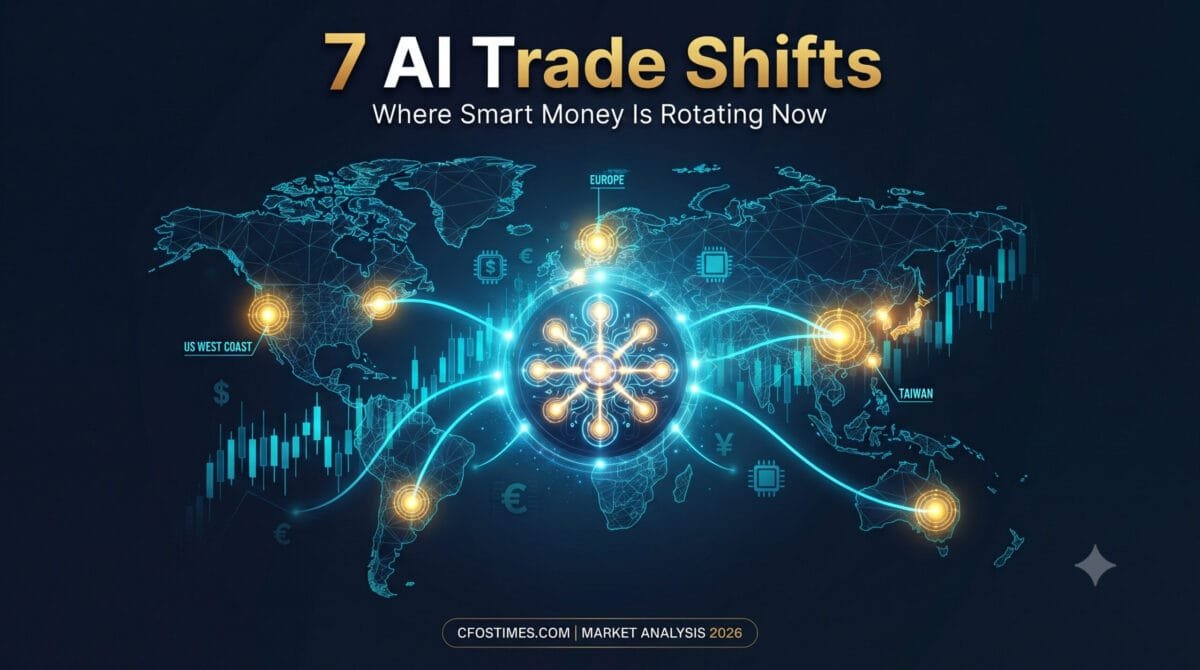
Contrary to the narrative that Europe is a bystander in the AI revolution, S&P Global Ratings analysis reveals a sizable €572 billion trade footprint. Europe is reshaping its role as a specialized provider of intermediate goods.
Economist and Nobel laureate Philippe Aghion’s July 2026 comment that “Europe needs to wake up” misses the full picture. While the U.S. drives investment in AI infrastructure and Asia supplies AI-enabling goods, Europe maintains critical positions in specialized components and regulatory frameworks. AI Trade Shifts
The European Edge
Europe’s strengths lie in:
- Semiconductor equipment: ASML’s lithography systems are essential for advanced chip production
- Industrial automation: Siemens and Schneider Electric provide factory automation for electronics manufacturing
- Specialty chemicals: BASF and others supply materials for chip production
- Regulatory frameworks: The EU AI Act is becoming a global benchmark for AI governance
Shift 6: India’s GIFT IFSC Transition from Pilots to Performance
AI Adoption Accelerating in Regulated Finance
The International Financial Services Centre Authority (IFSCA) in India’s GIFT City has signaled a transition from AI experimentation to operational deployment across regulated entities. Key findings from the AI in IFSC Survey Report 2026 include:
- 65% of entities are exploring or implementing Generative AI solutions
- 82% cite operational efficiency as the primary driver
- 60% have invested, are scaling, or plan to invest in AI
- Formal AI audits increased from 10% to 35% year-over-year
Risk, compliance, and internal operations lead AI use cases, especially in anti-money laundering, KYC, fraud detection, and workflow automation. AI Trade Shifts
Why GIFT City Matters Globally
GIFT City represents a controlled experiment in AI-enabled finance. As one of the world’s first International Financial Services Centres with a formal AI framework, its adoption patterns offer a preview of how regulated financial institutions globally may deploy AI.
The IFSCA’s approach emphasizes responsible AI deployment, with governance and risk management receiving significant attention from respondents. The survey found that “governance and risk management emerged as top priorities,” suggesting a maturing approach to AI implementation. AI Trade Shifts
Shift 7: The Contrarian Playbook for 2026
Where the Smart Money Is Actually Going
The AI trade is fragmenting, and institutional investors are positioning for the next phase. Based on analysis from PIMCO, Nomura, State Street, and other major institutions, several contrarian plays are emerging: AI Trade Shifts
1. Supply Chain Criticality
- Advanced packaging (CoWoS providers)
- High-bandwidth memory manufacturers
- Photonics and transceiver suppliers
- Industrial materials (copper, rare earths)
2. Vertical AI Applications
- AI for accounting, legal, insurance, healthcare
- Industry-specific agents with regulatory moats
- Workflow automation in traditionally “boring” sectors
3. The Peace Dividend Trade
- Asian equities (Korea, Japan, Taiwan)
- Chinese financials
- Biotechnology and life sciences
- Industrial materials
4. European Intermediate Goods
- Semiconductor equipment
- Industrial automation
- Specialty chemicals
5. The Chokepoint Thesis
- Companies that control physical bottlenecks
- Infrastructure with no alternative supply
What to Watch Next
The AI trade is not ending—it is evolving. The era of treating AI as a monolithic investment theme is over. Winners will be found in three distinct areas: AI Trade Shifts
- Supply chain criticality: Companies providing essential components where bottlenecks exist—advanced packaging, HBM memory, photonics, and industrial materials
- Vertical execution: AI applications that solve complete workflows in regulated industries rather than providing half-solutions
- Contrarian positioning: The peace dividend trade, undervalued Asian markets, and overlooked European intermediate goods
As PIMCO’s Sharef noted, “The market has spent several years treating AI capital expenditure as an automatic conveyor belt to higher earnings. But the bill is becoming difficult to ignore.” The next phase of the AI trade rewards selectivity, patience, and a willingness to look where others aren’t. AI Trade Shifts
Conclusion- AI Trade Shifts
The AI trade has entered a new phase characterized by fragmentation, specialization, and physical constraints. The 7 shifts identified in this article represent the most significant changes reshaping investment opportunities:
- The unbundling of the Magnificent Seven
- Supply chain chokepoints creating investment opportunities
- The rise of vertical AI in regulated industries
- The peace dividend trade
- Europe’s unexpected AI role
- India’s GIFT City AI adoption
- The contrarian playbook for 2026
For investors, the message is clear: broad AI exposure is no longer sufficient. The next phase of the AI trade requires understanding the specific dynamics of each segment, identifying genuine chokepoints, and being willing to look where others aren’t.
The companies that will deliver the greatest returns in the next phase are not necessarily the ones with the most AI hype—they are the ones solving the most difficult problems in the most overlooked corners of the AI ecosystem. AI Trade Shifts
FAQs- AI Trade Shifts
Q: Is the AI trade over?
A: No, but it is evolving. The unified “buy all AI” approach is being replaced by selectivity. Alpha is shifting to supply chain components and vertical AI applications.
Q: What are the main bottlenecks in AI infrastructure?
A: Lead times for 800G and 1.6T transceivers exceed 40 weeks. Advanced packaging (CoWoS) is sold out through 2027. HBM memory and InP laser chips are similarly constrained.
Q: Which Asian companies are benefiting from AI infrastructure buildout?
A: Samsung, SK Hynix, TSMC, and suppliers of cooling systems, optical equipment, and industrial metals are gaining from AI-related orders.
Q: What is vertical AI?
A: Industry-specific AI applications that solve complete workflows rather than providing general-purpose tools. Examples include AI for accounting, legal, insurance claims, and medical billing.
Q: Why are regulated industries attractive for AI startups?
A: They have budgets, real pain points, regulation creates moats, and incumbents are slow to innovate.
Q: Could geopolitical events disrupt the AI trade?
A: Yes. A breakdown in U.S.-Iran negotiations could trigger oil shocks. Conversely, a genuine deal could shake up consensus positioning. Markets are priced for extremes.
Q: What is the peace dividend trade?
A: Investments that benefit from reduced geopolitical risk, particularly Asian equities, Chinese financials, biotechnology, and industrial materials.
Q: How is Europe involved in the AI trade?
A: Europe provides specialized intermediate goods including semiconductor equipment, industrial automation, and specialty chemicals, representing a €572 billion trade footprint.
Q: What is GIFT City and why does it matter?
A: India’s GIFT IFSC is an International Financial Services Centre where AI adoption in regulated finance is accelerating, with 65% of entities exploring Generative AI solutions.
Q: What should investors watch in 2026?
A: The relationship between hyperscaler capex and stock performance, supply chain bottlenecks, geopolitical developments, and vertical AI adoption in regulated industries.
A: Yes. A breakdown in U.S.-Iran negotiations could trigger oil shocks. Conversely, a genuine deal could shake up consensus positioning. Markets are priced for extremes.
Disclaimer
The content AI Trade Shifts on cfostimes.com is provided for informational and educational purposes only. We are not SEBI-registered investment advisors, licensed brokers, or financial planners. None of the content on this website constitutes—or should be understood as constituting—a recommendation to enter into any securities transactions or to engage in any of the investment strategies presented here.
We do not provide personalized financial advice. The financial situations of our readers vary, and what may be appropriate for one person may not be appropriate for another. You should always perform your own due diligence and consult with a qualified financial professional before making any investment decisions .
While we strive to provide the most up-to-date and accurate financial news and market analysis, markets move rapidly . cfostimes.com makes no representations as to the accuracy, completeness, or suitability of any information on this site and will not be liable for any errors, omissions, or delays in this information or any losses, injuries, or damages arising from its display or use .
All calculations, projections, and market outlooks presented are estimates based on available data and assumptions that may not reflect actual market conditions, fees, or personal circumstances . Past performance or projected figures do not guarantee future results .
In no event will cfostimes.com or its owners be liable for any loss or damage including without limitation, indirect or consequential loss or damage, or any loss or damage whatsoever arising from loss of data or profits arising out of, or in connection with, the use of this website .
By using our website, you hereby consent to this disclaimer and agree to its terms .
Reporting Inaccuracies: Readers are encouraged to report inaccuracies by providing the story link and specific correction details. Submit corrections via email to info@cfostimes.com or use the “Suggest A Correction” section located at the end of each web story .

Dr. Dinesh Kumar Sharma is a CMA an award-winning Chief Financial Officer and Director of Finance with over 25 years of expertise in strategic planning and digital transformation. Recognized as a five-time CFO of the Year, he specializes in leveraging Generative AI and Microsoft Copilot to optimize financial forecasting and cost management. Dr. Sharma holds a Doctorate in Management (Finance) and has successfully scaled organizations from INR 1 billion to INR 7 billion. He is dedicated to providing transparent, data-driven insights for modern decision-makers at CFOs Times.






2 thoughts on “7 AI Trade Shifts: Where Smart Money Is Rotating Now”