
Introduction-Social Security COLA 2027
As financial planning horizons expand into the coming year, navigating macro-inflation and fixed-income budgeting remains a top priority for millions of beneficiaries. The Cost-of-Living Adjustment (COLA) serves as the primary financial lifeline for retirees relying on government-backed pensions to counteract macroeconomic price pressures. Projections for the upcoming 2027 adjustment cycle indicate a favorable rebound compared to previous years, sparking essential discussions across corporate finance, wealth management, and retirement planning desks.
Understanding how these adjustments are calculated, projected, and implemented provides critical clarity for households and financial analysts tracking consumer price metrics.
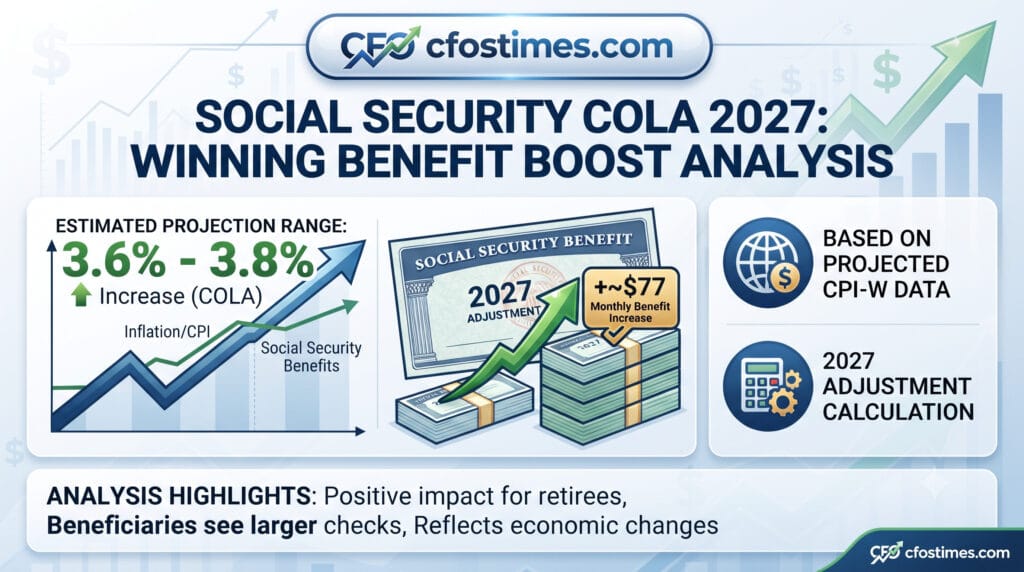
Table of Contents
1. Deconstructing the Social Security COLA 2027 Projections
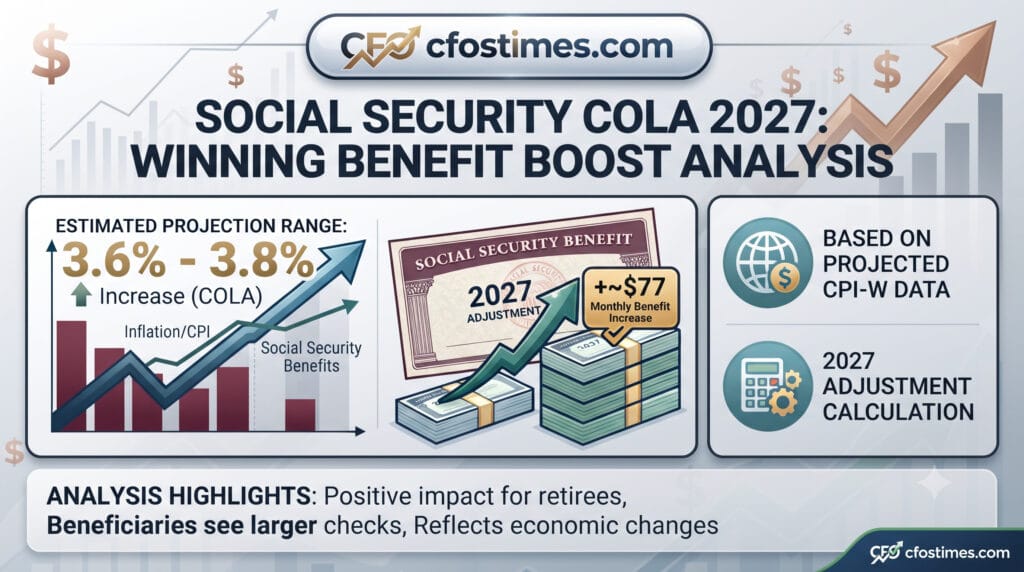
Current economic forecasts from major policy and advocacy groups—including The Senior Citizens League and the AARP Public Policy Institute—place the projected 2027 Social Security COLA within a range of 3.6% to 3.8%. This anticipated adjustment marks a noticeable uptick from the 2.8% COLA distributed in 2026.
- The Senior Citizens League (TSCL) Estimate: TSCL’s ongoing COLA tracking maintains a steady projection of 3.8%, which would lift average monthly retirement checks by approximately $77, shifting baseline receipts from roughly $2,026 to over $2,103 per month.
- AARP Forecast: AARP analysts project a conservative baseline adjustment of 3.6%, corresponding to an average monthly increase of roughly $75 for retired workers.
- Independent Analyst Adjustments: Independent evaluations have similarly clustered within the mid-3% range following recent Consumer Price Index reports, reflecting stabilizing energy metrics and broader cooling trends across key urban expenditure categories. Social Security COLA 2027
2. Comprehensive Comparison: 2026 vs. Projected 2027 Metrics
| Metric / Parameter | 2026 Baseline | Projected 2027 Adjustment | Macroeconomic Influence |
| COLA Percentage Increase | 2.8% | 3.6% to 3.8% | Driven by third-quarter Consumer Price Index tracking. |
| Average Monthly Benefit Impact | Modest baseline growth | +$73 to $77 per month | Direct relief for fixed-income household budgeting. |
| Underlying Inflation Index | CPI-W | CPI-W (Third Quarter Average) | Measures price movements across urban wage earners and clerical workers. |
| Official Finalization Date | October 2025 | October 14, 2026 | Calculated following September BLS data releases. |
3. Financial Analysis: Calculation Mechanics and Emerging Debates
The CPI-W Calculation Framework
The official Social Security COLA is legally tied to the Consumer Price Index for Urban Wage Earners and Clerical Workers (CPI-W), compiled monthly by the U.S. Bureau of Labor Statistics (BLS). Each autumn, the Social Security Administration compares the average CPI-W index reading across the third-quarter months of July, August, and September against the exact same period from the previous year. Any percentage increase discovered becomes the official COLA applied to monthly payments starting the following January. Social Security COLA 2027
The Ongoing CPI-W vs. CPI-E Debate
A persistent friction point among economists and senior advocacy groups is whether the CPI-W accurately captures the spending habits of retirees. Because the CPI-W reflects consumption patterns of younger urban wage earners, it often underestimates cost burdens unique to older Americans—specifically higher allocations toward out-of-pocket healthcare and residential upkeep.
Advocates frequently point to the experimental Consumer Price Index for the Elderly (CPI-E), which heavily weights healthcare and housing expenditures. Historical analysis indicates that a CPI-E-based formula would have yielded higher annual adjustments in the majority of decades past, intensifying legislative debates surrounding long-term solvency and benefit adequacy. Social Security COLA 2027
Frequently Asked Questions (FAQs)
1. What is the projected Social Security COLA for 2027?
Current forecasts from organizations like The Senior Citizens League and AARP estimate the 2027 Cost-of-Living Adjustment will fall between 3.6% and 3.8%.
2. When will the official 2027 COLA percentage be finalized?
The official COLA figure is finalized every October by the Social Security Administration once the Bureau of Labor Statistics releases September inflation data.
3. When do the adjusted benefit payments take effect?
Once announced in October, the new COLA percentage automatically applies to monthly benefit checks distributed starting in January.
4. How does the government calculate the annual adjustment?
The calculation is derived by comparing the average CPI-W inflation index across the third quarter (July, August, and September) with the corresponding quarter from the prior year.
5. Will benefit payments ever decrease if inflation drops?
No. By law, if inflation remains flat or consumer prices fall, Social Security payments do not decrease; they remain unchanged. Social Security COLA 2027
Conclusion
As projections firm up for the upcoming adjustment cycle, the expected 3.6% to 3.8% increase offers a welcoming financial cushion for retirees navigating modern economic volatility. While debates concerning inflation metrics and formula modernization continue in policy circles, staying informed on official third-quarter BLS data releases remains essential for precise household budgeting and long-term wealth planning. Social Security COLA 2027
Disclaimer for CFOs Times
The information contained in this article published on cfostimes.com is provided for general informational, educational, and analytical purposes only and should not be construed as professional financial, legal, or retirement planning advice. While every effort has been made to ensure accuracy regarding projected Social Security adjustments and macroeconomic indicators, government calculations and inflation metrics are subject to official revision. Readers and financial planners should consult official agency releases from the Social Security Administration before finalizing long-term benefit strategies. CFOs Times, its editors, and authors assume no legal liability for financial outcomes derived from reliance on this content.

Dr. Dinesh Kumar Sharma is a CMA an award-winning Chief Financial Officer and Director of Finance with over 25 years of expertise in strategic planning and digital transformation. Recognized as a five-time CFO of the Year, he specializes in leveraging Generative AI and Microsoft Copilot to optimize financial forecasting and cost management. Dr. Sharma holds a Doctorate in Management (Finance) and has successfully scaled organizations from INR 1 billion to INR 7 billion. He is dedicated to providing transparent, data-driven insights for modern decision-makers at CFOs Times.









4 thoughts on “Social Security COLA 2027: Winning Benefit Boost Analysis”