Introduction
The debate over whether the US economy would be even stronger if Donald Trump got out of the way highlights a central paradox of modern fiscal life. To critics, administration policies introduce unnecessary volatility, while supporters point to booming equities and deep structural resilience. Yet, underneath the political rhetoric, American enterprise demonstrates extraordinary endurance.
As gross domestic product (GDP) registers moderate expansion, labor markets stay historically tight, and entrepreneurship flourishes, a core question remains: Is America’s economic machine soaring because of, or in spite of, presidential policy interventions? This analysis explores macroeconomic data, the friction caused by trade barriers, and the underlying forces driving modern American wealth generation. For broader economic tracking, review updates directly via the U.S. Bureau of Economic Analysis.
This article provides a data-driven, unbiased analysis of economic performance indicators, wealth creation trends, policy impacts, and global comparisons. It also evaluates whether current growth is sustainable or vulnerable to policy disruptions. US Economy 2026
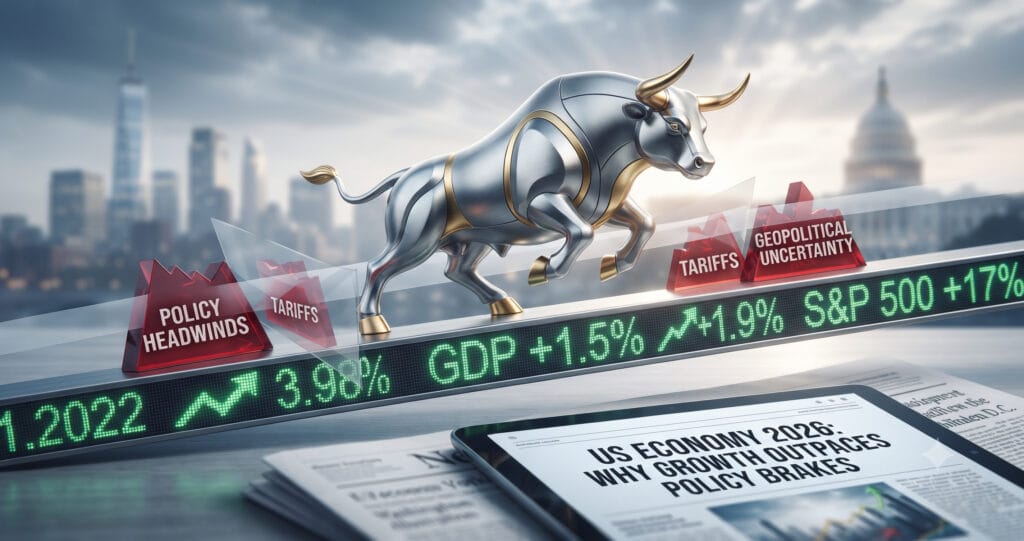
Table of Contents
Key Economic Indicators Snapshot
| Indicator | 2024 | 2025 | 2026 (Forecast) |
|---|---|---|---|
| GDP Growth Rate | 2.1% | 1.8% | 1.5% |
| Unemployment Rate | 3.7% | 3.5% | 3.6% |
| Salary Growth | 3.2% | 3.5% | 3.5% |
| Inflation Rate | 4.1% | 3.2% | 2.8% |
| S&P 500 Growth | 14% | 17% | 10–12% (est.) |
| New Businesses (Monthly Avg.) | 420,000 | 480,000 | ~500,000 |
Economic Resilience vs. Policy Headwinds
When evaluating current financial data, the U.S. economic engine continues to display remarkable momentum. Jobless claims hover near historic lows, matching eras of substantial cultural milestones like the late 1960s. Meanwhile, average salaries maintain a healthy growth trajectory of roughly 3.5%, helping typical households keep pace with inflation.
However, this growth unfolds alongside distinct policy friction points. Protectionist trade measures and ongoing overseas entanglements, such as the persistent conflict involving Iran, introduce marketplace uncertainty. These factors tend to keep consumer prices and borrowing costs elevated compared to optimal baseline conditions, creating unnecessary strain on automotive and housing loans. Additional economic data analyses can be found via the Brookings Institution. US Economy 2026
Wealth Generation, Poverty Reduction, and Income Dynamics
Critics frequently invoke arguments surrounding wealth inequality or K-shaped recoveries, yet official tracking highlights broad-based improvements across multiple demographic strata.
- Poverty Decline: Recent Census data underscores a structural drop in national poverty rates, shrinking significantly over the decade from roughly 1 in 8 Americans down to approximately 1 in 10. This shift represents a major gain driven by extended periods of robust job creation. Further background on longitudinal income statistics can be accessed via the U.S. Census Bureau.
- The Rise of New Millionaires: Wealth accumulation continues at an accelerated pace. Reports indicate that hundreds of thousands of Americans cross the seven-figure net worth threshold annually, anchoring families firmly in the upper-middle class and securing generational transfer opportunities.
- Small Business Expansion: Entrepreneurship serves as a core pillar of modern mobility. Independent tracking from publications like The Economist highlights that close to half a million new businesses have launched on a monthly basis, expanding middle-class foundations. Detailed global economic assessments can also be reviewed through the World Bank.
Comparative Global Performance
While domestic growth metrics have faced occasional deceleration—such as the advance estimate of a 1.5% annualized real GDP growth rate for the second quarter—the United States continues to outperform major international economic blocs. US Economy 2026
| Region / Country | 2026 Growth Outlook / Context |
| United States | Resilient expansion (+1.5% Q2 GDP) despite policy headwinds. |
| European Union | Persistently subdued expansion and structural regulatory stagnation. |
| Japan | Slower comparative domestic output and demographic pressures. |
Comparing these trajectories illustrates why alternative economic models, sometimes promoted by progressive political wings, fail to match the wealth-generating velocity of the American marketplace.
Wealth Creation: A Defining Feature
The US continues to act as a wealth-generation powerhouse.
- Around 1,200 new millionaires are created daily (2025 data)
- Over 440,000 individuals crossed into seven-figure wealth annually
- Strong capital markets and entrepreneurship fuel upward mobility
This trend reinforces the idea that long-term participation in the US economy often rewards individuals, even those starting with limited resources. US Economy 2026
Chart: Wealth Growth Trend (2016–2026)
Year      Millionaires Added
2016      250,000
2018      300,000
2020      350,000
2023      410,000
2025      440,000
2026*     460,000 (Projected)
Conclusion-US Economy 2026
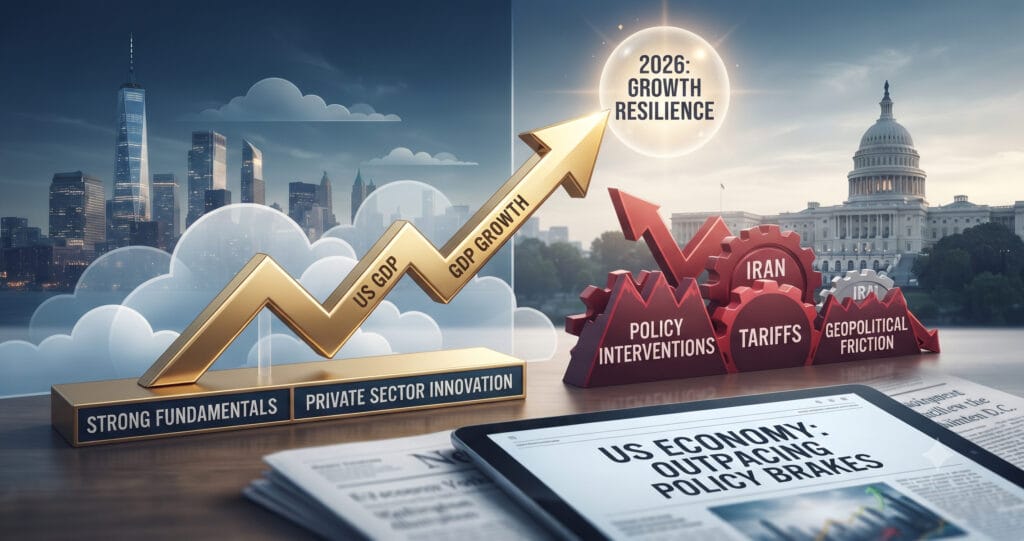
Ultimately, the American economy ( US Economy 2026) functions as a long-term wealth-generating powerhouse. While protectionist tariffs and extended foreign policy conflicts act as brakes on optimal output, the underlying fundamentals—driven by private sector innovation, low unemployment, and steady income gains—ensure continued momentum. If leadership minimises self-inflicted market friction, the nation’s economic potential can reach even greater heights.
Frequently Asked Questions (FAQs)
1. Is the US economy growing in 2026?
Yes, the U.S. economy continues to expand at a steady, resilient pace. According to recent advance estimates, second-quarter real GDP recorded a 1.5% annualized growth rate, outperforming several major global economies like the European Union and Japan.
2. How are employment and wages performing?
Labor markets remain exceptionally strong. Jobless claims hover near historic lows, and average salaries are forecast to grow by approximately 3.5%, helping typical American workers keep pace with inflation.
3. What impact do tariffs and geopolitical conflicts have on the economy?
Protectionist trade tariffs and ongoing foreign policy conflicts (such as the persistent war with Iran) act as policy headwinds. Economists note that while the private sector is driving robust growth, these factors keep consumer prices, energy costs, and borrowing rates higher than optimal baseline conditions. US Economy 2026
4. What are the key trends in poverty and household wealth?
Recent Census data highlights a significant drop in national poverty rates over the past decade—falling from roughly 1 in 8 Americans down to about 1 in 10. Additionally, wealth creation remains strong, with hundreds of thousands of Americans crossing the million-dollar net worth threshold annually.
5. Why is entrepreneurship important to current economic growth?
Independent tracking from sources like The Economist shows that nearly 500,000 new businesses have been launched monthly since 2024. This wave of entrepreneurship is expanding the middle class and driving long-term economic dynamism. US Economy 2026
Disclaimer :
The views, thoughts, and opinions expressed in the text belong solely to the author, and do not necessarily reflect the official policy, position, or endorsement of cfostimes.com. This content is provided for informational and analytical purposes only and does not constitute formal financial, economic, or investment advice. Readers are advised to conduct their own independent research before making any financial decisions.

Dr. Dinesh Kumar Sharma is a CMA an award-winning Chief Financial Officer and Director of Finance with over 25 years of expertise in strategic planning and digital transformation. Recognized as a five-time CFO of the Year, he specializes in leveraging Generative AI and Microsoft Copilot to optimize financial forecasting and cost management. Dr. Sharma holds a Doctorate in Management (Finance) and has successfully scaled organizations from INR 1 billion to INR 7 billion. He is dedicated to providing transparent, data-driven insights for modern decision-makers at CFOs Times.









1 thought on “US Economy 2026: Why Growth Outpaces Trump Tariffs”