Introduction-Stablecoin Remittances 2026
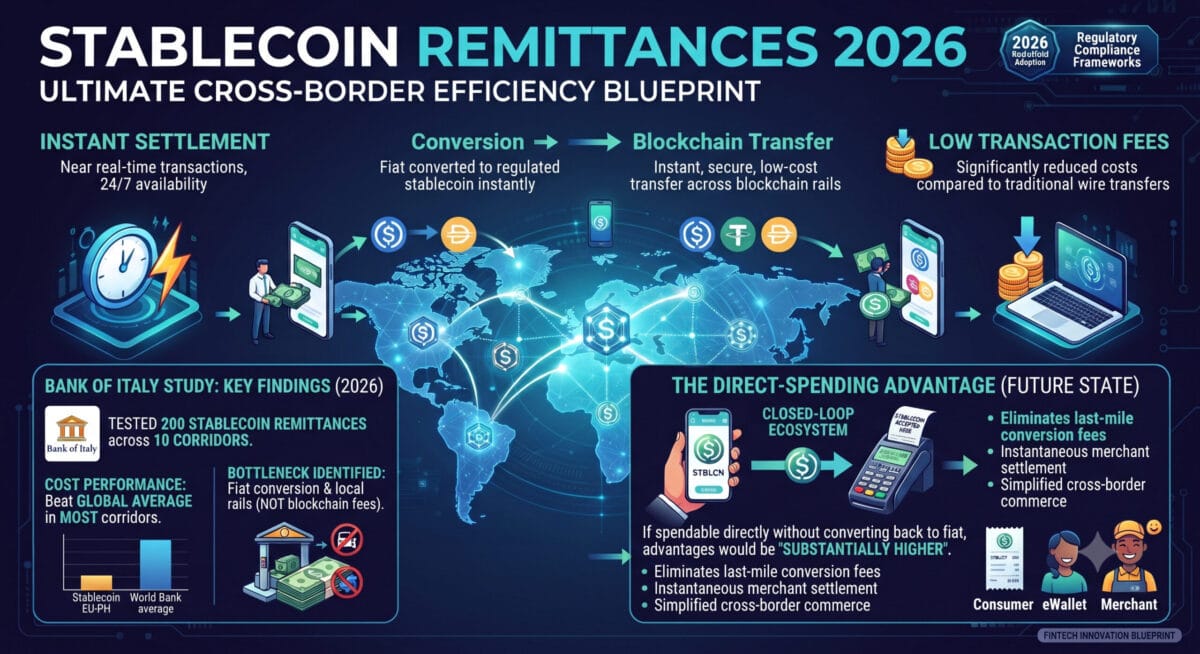
As global financial markets navigate macro-volatility, regulatory frameworks continue to evolve to safeguard market integrity while cross-border payment architectures modernize. A landmark study published by the Bank of Italy in August 2026 has provided critical empirical clarity on the actual performance of digital assets in international money transfers. By testing 200 stablecoin remittances across 10 international corridors, researchers uncovered surprising realities regarding transaction fees, settlement speeds, and structural market bottlenecks.
While digital assets are frequently promoted as an immediate panacea for high cross-border expenses, this comprehensive evaluation demonstrates that the true friction points lie outside the blockchain layer. For corporate finance teams, fintech operators, and treasury professionals, analyzing these findings offers a blueprint for maximizing efficiency and optimizing global capital allocation. Stablecoin Remittances 2026
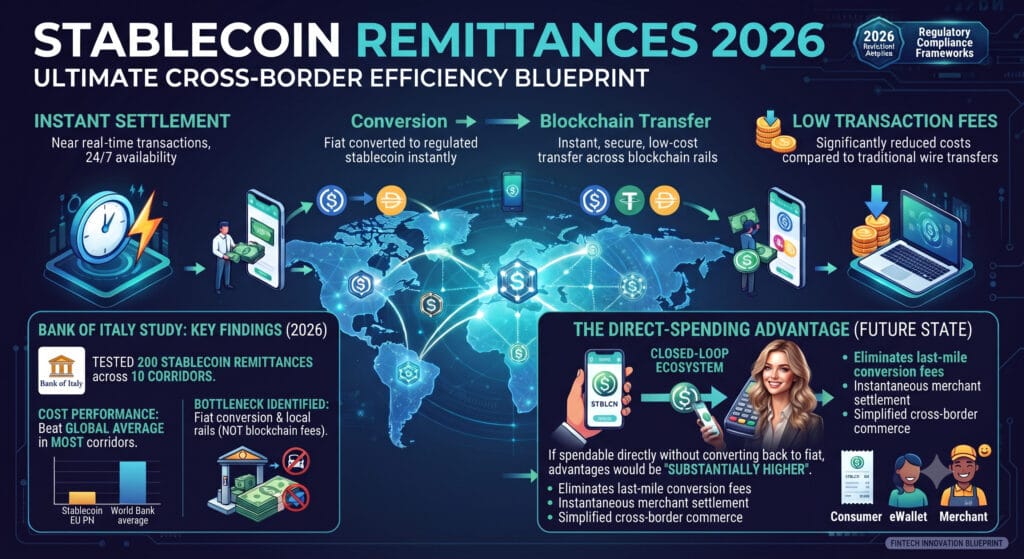
Table of Contents
1. Deconstructing the Bank of Italy Remittance Study
The empirical research conducted by the Bank of Italy utilized a rigorous mystery-shopping methodology, tracking real transfers of 200 USDC across 10 bidirectional payment corridors connecting Italy with emerging and advanced economies, including Brazil, Argentina, Japan, the United Arab Emirates (UAE), and South Africa.
The primary objective was to compare end-to-end costs and settlement timelines against legacy channels and established fintech alternatives like Wise. The findings challenge the conventional assumption that blockchain-based transfers are universally and systematically cheaper than traditional banking rails. Across the tested routes, total end-to-end transaction costs varied dramatically, spanning from a low of 0.3% to nearly 9%, depending heavily on the specific corridor and service provider utilized. Stablecoin Remittances 2026
2. Comprehensive Performance Metrics: Cost and Speed Analysis
The study revealed a stark dichotomy between the cost of on-chain network execution and the ancillary expenses incurred during fiat conversion.
- Blockchain Fees vs. Ramp Frictions: Blockchain transaction (gas) fees accounted for only a negligible fraction of the total expense (averaging around 0.4% of total transfer value). Conversely, fiat on- and off-ramp frictions—comprising exchange spreads, funding methods, currency conversion charges, and cash-out withdrawals—accounted for the overwhelming majority of total costs.
- Global Benchmark Comparison: Evaluated against the World Bank’s reported global average remittance cost benchmark of 6.65%, stablecoin transfers successfully beat the global average in the majority of the examined corridors. However, when benchmarked directly against optimized fintech providers like Wise across comparable routes, stablecoins proved less expensive in only three out of seven comparable corridors.
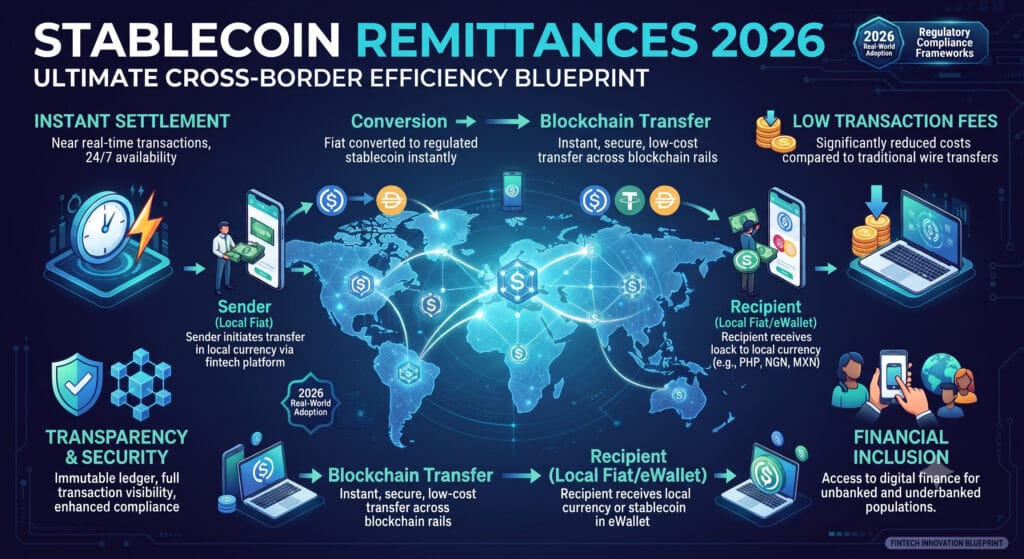
- The Speed Bottleneck: Settlement velocities were dictated entirely by the presence or absence of domestic instant payment infrastructure. In corridors supported by real-time payment rails (such as Italy’s TIPS, Brazil’s Pix, and Argentina’s Transferencias 3.0), end-to-end settlement completed in under 20 minutes. Conversely, routes relying on conventional bank transfers at the fiat endpoints (such as South Africa) dragged settlement times out to one to two business days. Stablecoin Remittances 2026
3. Comprehensive Comparison Table: Corridor Efficiency
| Payment Corridor | Total Cost Range (%) | Primary Cost Driver | End-to-End Settlement Time | Local Payment Rail Dependency |
| Italy $\rightarrow$ Argentina | 0.30% | Direct digital exchange spreads | Under 20 minutes | Transferencias 3.0 |
| Argentina $\rightarrow$ Italy | Up to 8.96% | Off-ramp cash-out and FX fees | 20 minutes to 1 business day | Mixed banking networks |
| Brazil $\leftrightarrow$ Italy | 2.21% – 2.70% | On/off-ramp conversion spreads | Under 20 minutes | Pix instant system |
| South Africa $\leftrightarrow$ Italy | 4.58% – 5.44% | Legacy banking withdrawal fees | 1 to 2 business days | Conventional SWIFT / EFT |
| UAE $\leftrightarrow$ Italy | 7.20% – 8.95% | Card funding and currency conversion | 1 business day | Regional banking rails |
4. Strategic Financial Analysis: The Fiat Reconversion Barrier
The core takeaway from the Bank of Italy’s analysis highlights a fundamental structural limitation in modern digital asset utility: the forced round-trip conversion between fiat currency and stablecoins.
[ Fiat Currency (EUR) ]
       │
       ▼ (On-Ramp Conversion Friction & Exchange Fees)
[ Stablecoin Transfer (USDC) ] ──► (Negligible Blockchain Gas Fee: ~0.4%)
       │
       ▼ (Off-Ramp Conversion, Spread & Withdrawal Charges)
[ Local Fiat Currency (Destination) ]
As articulated by the study’s researchers, the maximum economic potential of digital settlement rails remains stifled as long as value must be repeatedly translated back into local fiat currency. The authors emphasized that if stablecoins could be spent directly in the real economy—for commercial goods, services, corporate rents, or fees—without reconversion into local fiat currency, the economic advantages of stablecoin-based transfers would be substantially higher. Stablecoin Remittances 2026
Furthermore, regulatory environments play a decisive role in shaping operational efficiency. Prohibitionist or overly restrictive regulatory regimes fail to suppress organic economic demand; instead, they inadvertently push retail and institutional users toward fragmented offshore platforms and unregulated channels, increasing operational complexity and compliance risk. This empirical reality arrives alongside major regulatory milestones, including the European Union’s Markets in Crypto-Assets (MiCA) framework and the broader maturation of global stablecoin supervision, as the total market capitalization of payment stablecoins approaches record heights. Stablecoin Remittances 2026
Frequently Asked Questions (FAQs)-Stablecoin Remittances 2026
1. Did the Bank of Italy study find that stablecoin remittances are always cheaper than traditional banks?
No. The study revealed that stablecoin transfers are not systematically cheaper once full fiat on- and off-ramp conversion costs, exchange spreads, and cash-out fees are factored into the equation.
2. What was the primary driver of cost in stablecoin remittances?
The blockchain network fee (gas) accounted for only a negligible fraction of the total expense (averaging around 0.4%). The vast majority of expenses stemmed from fiat conversion spreads and banking withdrawal fees.
3. How fast do stablecoin remittances settle in practice?
Settlement speed depends heavily on local payment rails. In corridors supported by domestic instant payment systems (such as Brazil’s Pix or Italy’s TIPS), transfers completed in under 20 minutes. Where recipients relied on standard bank withdrawals, settlement took one to two business days.
4. How do stablecoin transfer costs compare to global averages?
Using the World Bank’s global average remittance cost benchmark of 6.65%, stablecoin transfers proved cheaper in most of the evaluated corridors, though they only undercut specialized fintech providers like Wise in a minority of tested routes.
5. What is required to unlock the true economic advantages of stablecoins?
According to researchers, the greatest efficiency gains will materialize when stablecoins can be utilized directly in the real economy for commercial transactions and settlements without requiring reconversion back into local fiat currency. Stablecoin Remittances 2026
Conclusion
The Bank of Italy’s 2026 remittance analysis serves as an essential reality check for corporate treasurers, fintech builders, and financial analysts. While blockchain networks provide lightning-fast value transfer layers, the surrounding fiat on- and off-ramp infrastructure dictates overall cost and efficiency. By acknowledging these conversion barriers and pushing toward direct digital asset utility, market participants can better design resilient, cost-effective cross-border payment architectures for the future. Stablecoin Remittances 2026
Disclaimer for CFOs Times
The information contained in this article published on cfostimes.com is provided for general informational, educational, and analytical purposes only and should not be construed as professional financial, legal, or investment advice. While every effort has been made to ensure accuracy regarding empirical studies, macroeconomic indicators, and cross-border payment structures, financial markets and digital asset regulations remain dynamic and subject to sudden change.
Readers and corporate finance professionals should conduct independent due diligence and consult qualified legal advisors before executing digital asset payment strategies. CFOs Times, its editors, and authors assume no legal liability for financial outcomes derived from reliance on this content. Stablecoin Remittances 2026

Dr. Dinesh Kumar Sharma is a CMA an award-winning Chief Financial Officer and Director of Finance with over 25 years of expertise in strategic planning and digital transformation. Recognized as a five-time CFO of the Year, he specializes in leveraging Generative AI and Microsoft Copilot to optimize financial forecasting and cost management. Dr. Sharma holds a Doctorate in Management (Finance) and has successfully scaled organizations from INR 1 billion to INR 7 billion. He is dedicated to providing transparent, data-driven insights for modern decision-makers at CFOs Times.