Introduction-SEBI CAS Rules 2026
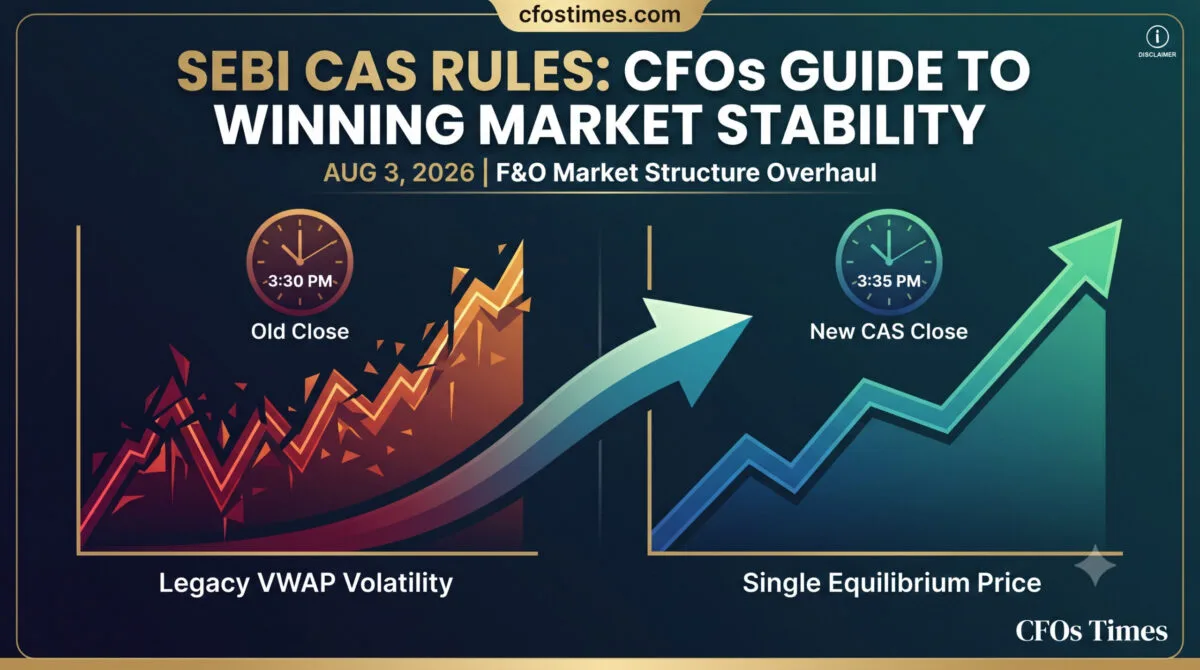
As global financial markets navigate complex macro-volatility, regulatory frameworks continue to evolve to safeguard market integrity. Beginning August 3, 2026, the Indian capital markets have implemented one of their most significant structural overhauls in years. The Securities and Exchange Board of India (SEBI), alongside major stock exchanges like the NSE and BSE, has officially rolled out the Closing Auction Session (CAS) for all equity shares featuring active Futures & Options (F&O) contracts.
This regulatory shift replaces the legacy Volume Weighted Average Price (VWAP) calculation method used during the final 30 minutes of trading with a structured, blind-pool auction mechanism. Designed to curb end-of-day price manipulation, reduce benchmark tracking errors for passive funds, and align Indian market mechanics with international powerhouses like the London Stock Exchange and NYSE, CAS reshapes how institutional desks, retail participants, and automated algorithms execute their end-of-day strategies. SEBI CAS Rules 2026
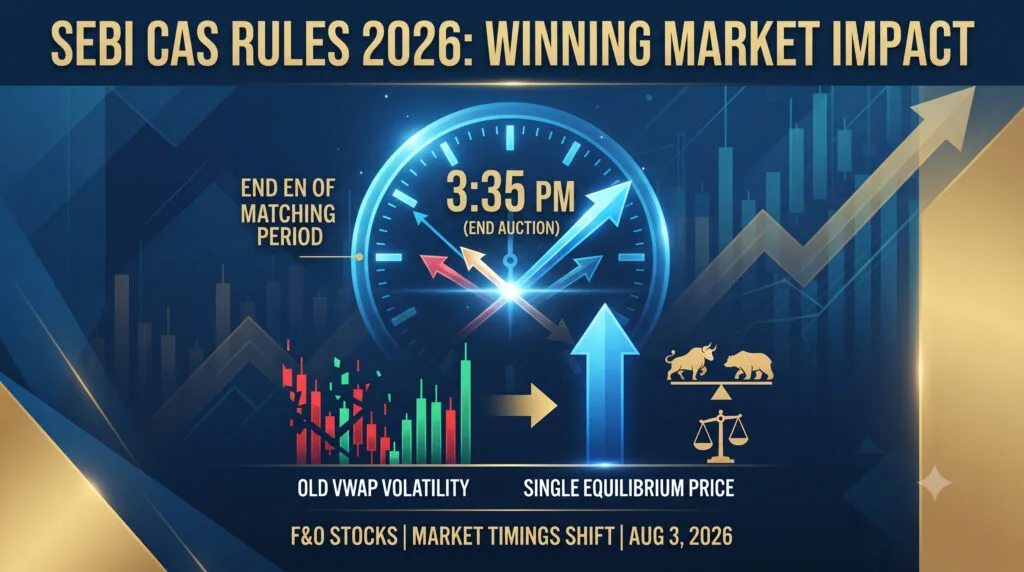
Table of Contents
1. Deconstructing the Closing Auction Session (CAS) Framework
Under the legacy framework, a stock’s official closing price was determined by calculating the volume-weighted average price of all trades executed between 3:00 PM and 3:30 PM. While functional, this method left volatile index components vulnerable to localized, last-minute execution spikes. A single large block order or intentional end-of-day push could artificially distort mutual fund Net Asset Values (NAVs), daily P&L statements, and derivatives settlement prices. SEBI CAS Rules 2026
The new CAS framework restructures the closing timeline strictly for F&O-enabled cash stocks (Category I) through a sequential, transparent call-auction model:
- 3:00 PM – 3:15 PM (Reference Window): Continuous trading continues as normal. The exchange simultaneously calculates the 15-minute VWAP, establishing the official Reference Price and setting a strict ±3% price band for the auction.
- 3:15 PM – 3:20 PM (Transition Period): Continuous trading for F&O-eligible cash stocks stops completely. No new orders can be entered. The exchange shifts eligible pending limit orders to the auction book while purging stop-loss orders, iceberg orders, and orders lying outside the ±3% band.
- 3:20 PM – 3:25 PM (Order Entry Session I): Both market orders and limit orders can be freely placed, modified, or canceled. Indicative equilibrium prices and order imbalances are broadcasted to guide participants.
- 3:25 PM – Random Close (Order Entry Session II): Only limit orders are accepted, modified, or canceled. Market orders become locked. To prevent last-second order manipulation or system flooding, order matching terminates randomly between 3:28 PM and 3:30 PM.
- 3:30 PM – 3:35 PM (Auction Matching): All valid orders pool together. The matching engine calculates a single equilibrium price—the exact threshold where the maximum volume of shares changes hands—locking it as the official closing price.
2. Comprehensive Schedule & Timing Adjustments-SEBI CAS Rules 2026
The introduction of CAS has triggered mandatory operational adjustments across multiple trading segments, altering risk management schedules for brokers and intraday desks.
| Segment / Category | Legacy Timings | Revised Timings (Effective August 3, 2026) | Operational Significance |
| F&O-Enabled Cash Stocks | 9:15 AM – 3:30 PM | 9:15 AM – 3:15 PM (Followed by CAS up to 3:35 PM) | Continuous trading terminates 15 minutes earlier to feed the auction pool. |
| Non-F&O Cash Stocks | 9:15 AM – 3:30 PM | No Change (9:15 AM – 3:30 PM) | Continues utilizing the legacy 30-minute VWAP calculation model. |
| Equity Derivatives (F&O) | 9:15 AM – 3:30 PM | 9:15 AM – 3:40 PM (Extended by 10-25 minutes) | Aligns derivative execution loops with the final cash market auction settlement. |
| MIS Intraday Square-Off (CAS) | ~3:20 PM | 3:00 PM – 3:10 PM (Broker Dependent) | Shifted earlier to protect intraday traders from automated default risks. |
3. Market Analysis: Institutional Efficiency vs. Intraday Friction
Mitigating Passive Tracking Error
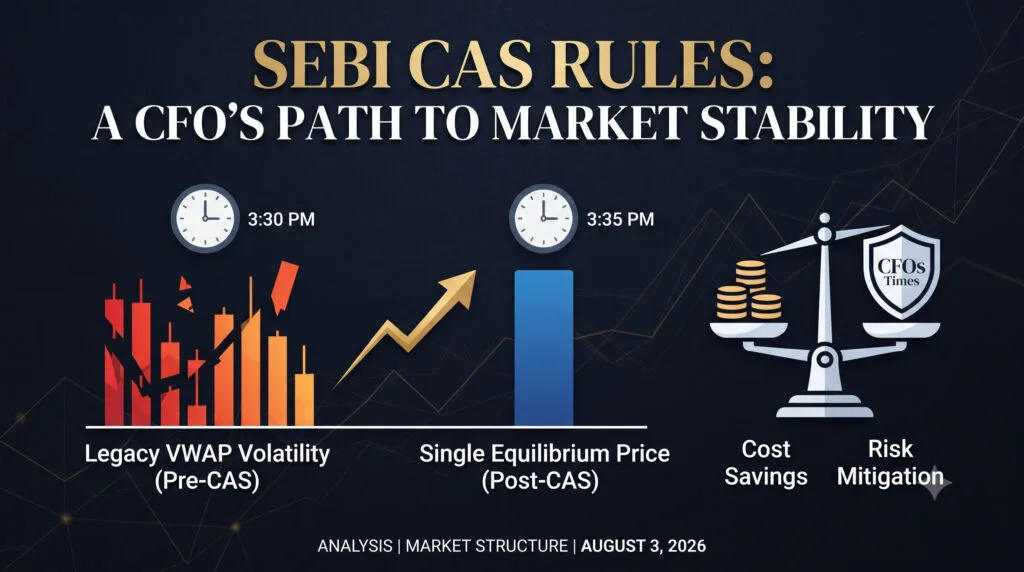
For institutional asset managers, exchange-traded fund (ETF) providers, and index funds tracking benchmarks like the Nifty 50 or BSE Sensex, the shift to a centralized equilibrium auction offers structural relief. Executing massive portfolio rebalancing blocks into a single blind auction pool significantly minimizes market impact costs and tracking errors, ensuring funds secure fair benchmark valuations without driving artificial price volatility. SEBI CAS Rules 2026
Operational Challenges for Intraday Desks
Conversely, retail and professional intraday traders face immediate workflow adjustments. Because continuous cash trading for F&O securities concludes sharply at 3:15 PM, retail brokerages have pulled forward their automated Margin Intraday Square-Off (MIS) timings to between 3:00 PM and 3:10 PM. Waiting until the final minutes of the session to square off intraday positions is no longer viable, forcing traders to tighten risk controls earlier in the afternoon. SEBI CAS Rules 2026
Frequently Asked Questions (FAQs)-SEBI CAS Rules 2026
1. What is the Closing Auction Session (CAS) introduced by SEBI?
The Closing Auction Session (CAS) is a structured, blind-pool auction mechanism implemented by SEBI for F&O-eligible cash stocks. It replaces the legacy Volume Weighted Average Price (VWAP) calculation model during the final minutes of trading to determine a single, transparent equilibrium closing price.
2. When did the SEBI Closing Auction Session (CAS) go into effect?
The structural framework and revised trading timings went into official effect on August 3, 2026.
3. How does CAS impact standard trading hours for F&O-enabled cash stocks?
Continuous trading for F&O-enabled cash stocks concludes 15 minutes earlier at 3:15 PM. The session then transitions into the CAS order entry and matching window, concluding fully at 3:35 PM.
4. Are non-F&O cash stocks affected by the new auction rules?
No. Non-F&O cash stocks maintain their standard trading hours (9:15 AM to 3:30 PM) and continue to utilize the legacy 30-minute VWAP calculation model for closing prices.
5. Why did regulators implement the Closing Auction Session?
The primary goals are to eliminate end-of-day price manipulation, reduce benchmark tracking errors for passive funds and exchange-traded funds (ETFs), and align Indian market closing mechanics with global major exchanges like the LSE and NYSE.
Conclusion
SEBI’s implementation of the Closing Auction Session marks a mature, progressive milestone for Indian capital markets. By replacing a vulnerable time-weighted average with a transparent, single-price equilibrium auction, the regulatory framework successfully shields benchmark indices, mutual fund NAVs, and derivative settlements from localized manipulation. While market participants must adapt their algorithmic execution scripts and intraday risk parameters to accommodate the revised 3:15 PM cutoff, the long-term dividend is a cleaner, more resilient, and globally harmonized trading ecosystem. SEBI CAS Rules 2026
Disclaimer
The information contained in this article published on cfostimes.com is provided for general informational, educational, and analytical purposes only and should not be construed as professional financial, legal, or investment advice. While every effort has been made to ensure the accuracy and timeliness of the details regarding regulatory updates, market timings, and structural trading frameworks (including the SEBI CAS Rules 2026 guidelines effective August 3, 2026), financial markets are inherently dynamic and subject to sudden changes.
Readers, institutional allocators, and individual traders should independently verify all regulatory circulars directly with official authorities such as the Securities and Exchange Board of India (SEBI), the National Stock Exchange (NSE), or the Bombay Stock Exchange (BSE) before executing any trading strategies, portfolio rebalancing, or financial commitments. CFOs Times, its editors, and authors assume no legal liability or responsibility for any direct or indirect financial losses arising from the use of or reliance on the information provided herein.

Dr. Dinesh Kumar Sharma is a CMA an award-winning Chief Financial Officer and Director of Finance with over 25 years of expertise in strategic planning and digital transformation. Recognized as a five-time CFO of the Year, he specializes in leveraging Generative AI and Microsoft Copilot to optimize financial forecasting and cost management. Dr. Sharma holds a Doctorate in Management (Finance) and has successfully scaled organizations from INR 1 billion to INR 7 billion. He is dedicated to providing transparent, data-driven insights for modern decision-makers at CFOs Times.








2 thoughts on “SEBI CAS Rules 2026: Winning Market Impact”