Introduction
US treasury yields hit multi-decade highs as a turbulent macroeconomic environment reshapes global financial markets. For investors, borrowers, and corporate leaders alike, the fixed-income landscape has undergone a profound transformation. Gone are the days of ultra-low borrowing costs that defined much of the previous decade; instead, persistent price pressures, fiscal deficits, and shifting central bank dynamics have driven government bond yields to levels not seen in a generation.
The ramifications of this fixed-income re-pricing extend far beyond Wall Street trading desks. When sovereign debt yields surge, they act as the benchmark gravitational pull for all other borrowing costs across the economy. From 30-year fixed mortgages and commercial real estate loans to corporate debt issuances and consumer credit cards, every financial instrument feels the ripple effects.
Understanding why sovereign debt returns have escalated requires a deep dive into the complex web of domestic and international catalysts. Sticky core inflation numbers, resilient labor market data, escalating geopolitical tensions influencing global energy commodities, and hawkish policy stances from the Federal Open Market Committee (FOMC) have all converged. This comprehensive guide explores the structural drivers behind the current bond market environment, the historical context of these movements, and actionable strategies for navigating a high-yield economic regime.
Table of Contents
The Current Landscape of Sovereign Debt Markets
To fully grasp the magnitude of recent market movements, one must examine the actual figures dictating trading sessions. Benchmark yields, particularly on intermediate and long-term government bonds, have pushed toward upper resistance levels. The 10-year Treasury note—frequently utilized as the foundational risk-free rate for global asset valuation—has hovered significantly higher than its historical post-financial-crisis averages, testing boundaries near key psychological thresholds.
Meanwhile, shorter-dated maturities have reacted sensitively to immediate central bank posture. As the Federal Reserve maintains a cautious, data-dependent stance, keeping its benchmark federal funds rate elevated, short-term debt instruments have remained anchored at restrictive levels.
Market participants tracking daily yield curve developments note that the traditional relationship between short and long duration bonds has experienced repeated bouts of volatility. Periods of curve inversion, where short-term yields outpaced long-term returns, have given way to dynamic steepening phases as investors demand higher term premiums to hold long-term government paper. These shifts reflect deep-seated anxiety regarding long-term fiscal stability, structural debt expansion, and the persistent threat of resurgent price growth. US Treasury Yields Hit Multi-Decade Highs
Primary Catalysts Driving the Yield Surge
Why have government debt returns climbed so aggressively? Financial analysts, macroeconomists, and institutional strategists point to a confluence of structural and cyclical catalysts that have reshaped the supply-and-demand dynamics of the bond market.
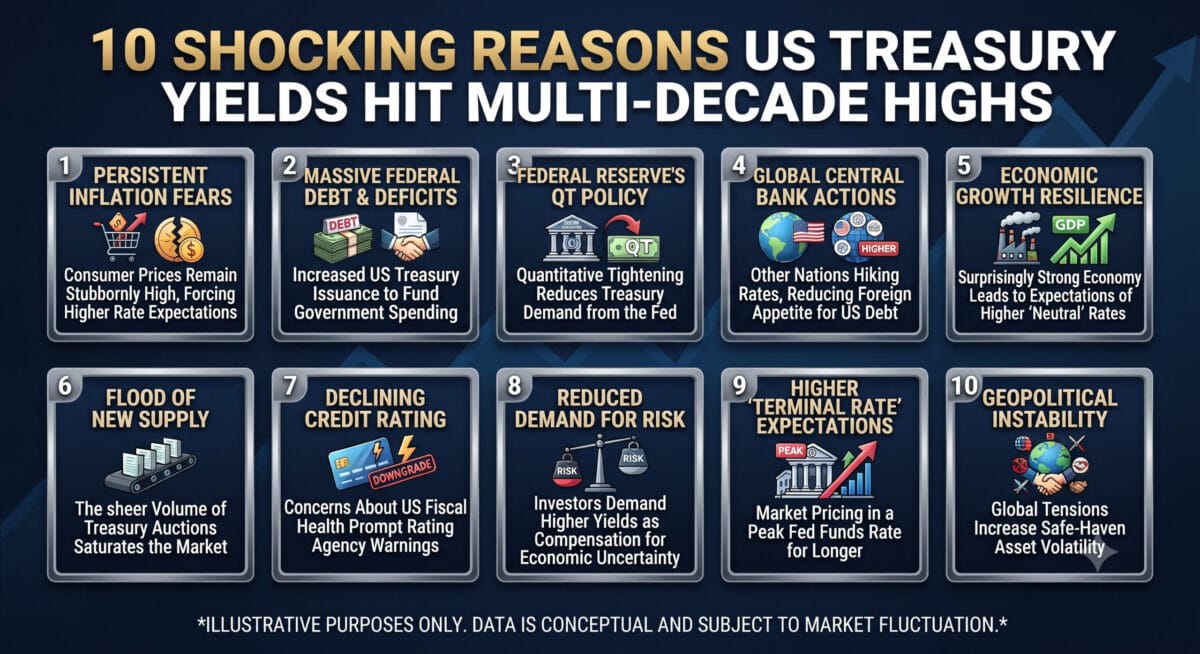
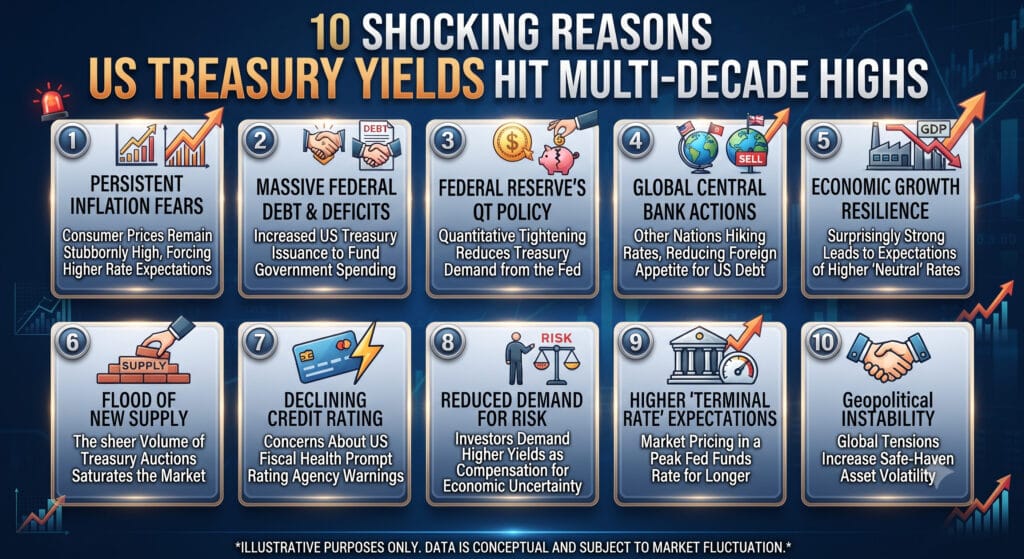
1. Persistent Inflationary Pressures and Sticky Core Metrics
Inflation has proven far more stubborn than initially projected by central bank models. Even as headline numbers fluctuate, core consumer metrics—such as the personal consumption expenditures (PCE) price index—have refused to descend cleanly back to the central bank’s target objective. Because inflation erodes the purchasing power of fixed-income payments over time, bondholders demand higher nominal yields to compensate for this devaluation risk. This required inflation premium has kept upward pressure on all maturities. US Treasury Yields Hit Multi-Decade Highs
2. Geopolitical Shocks and Energy Commodity Volatility
Global commodity markets have added an extra layer of complexity to monetary policy. Geopolitical instabilities, particularly recurring hostilities and shipping disruptions in key energy corridors like the Middle East, have sparked sharp rallies in crude oil prices. Because energy costs permeate every sector of the industrial economy—from manufacturing transport to agricultural production—surging oil prices act as an immediate warning flare for future inflation spikes, triggering immediate sell-offs in government bonds. US Treasury Yields Hit Multi-Decade Highs
3. Hawkish Federal Reserve Guidance and Higher-For-Longer Rates
The Federal Reserve has faced immense pressure to maintain restrictive monetary policy. Despite intermittent market hopes for an aggressive easing cycle, central bank officials have consistently signaled a “higher-for-longer” philosophy. Hawkish dissents within policy meetings and firm public commitments from leadership to combat lingering price growth have convinced traders that quick, deep rate cuts are off the table. Consequently, fixed-income pricing has adjusted to reflect a prolonged restrictive policy stance. US Treasury Yields Hit Multi-Decade Highs
4. Massive Sovereign Debt Issuance and Supply Dynamics
Beyond monetary policy, basic supply and demand economics play a vital role. The federal government continues to run substantial fiscal deficits, requiring continuous, massive auctions of Treasury bills, notes, and bonds to fund ongoing operations. When the sheer volume of newly issued government debt floods the market faster than private and institutional demand can absorb it, primary dealers and investors demand higher yields to clear the surplus.
Historical Context: Comparing Today’s Environment to Past Eras
Putting current fixed-income conditions into proper perspective requires looking back through economic history. The ultra-low yield environment experienced during the 2010s—characterized by quantitative easing and zero-interest-rate policies—was an historical anomaly rather than a permanent baseline.
- The Pre-GFC Normal: Prior to the 2008 financial crisis, a 10-year Treasury yield ranging between 4% and 6% was considered entirely standard for a growing, healthy economy experiencing normal productivity gains and moderate inflation.
- The Volcker Era Extremes: In stark contrast, the early 1980s saw benchmark yields surge into double digits (peaking near 15.84% in 1981) as then-Fed Chair Paul Volcker enacted aggressively high benchmark rates to break the back of runaway stagflation.
- The Post-Pandemic Pivot: Today’s environment represents a middle ground—a return to historical normality after more than a decade of artificial suppression, forcing investors and corporations to relearn how to operate in a positive real-interest-rate ecosystem. US Treasury Yields Hit Multi-Decade Highs
Economic Ripple Effects Across Sectors
The upward march of government bond returns does not occur in a vacuum; it dictates the cost of capital across every pillar of domestic and global commerce.
[ Federal Reserve Restrictive Policy ]
                ↓
[ Sovereign Debt Yields Rise ]
                ↓
[ Benchmark Borrowing Costs Increase (Mortgages, Corporate Debt) ]
                ↓
[ Corporate Capital Expenditure & Consumer Spending Slow ]
Housing and Real Estate Markets
The 30-year fixed-rate mortgage is heavily influenced by the movement of long-term sovereign debt benchmarks. As bond yields climb, mortgage lenders adjust their financing terms upward. This dynamic cools housing market velocity, dampens refinancing activity, and strains affordability for prospective home buyers.
Corporate Financing and Equity Valuations
For corporations, issuing new bonds or securing commercial loans becomes significantly more expensive. Higher interest expenses eat into profit margins, particularly for capital-intensive industries or firms carrying heavy floating-rate debt loads. Furthermore, higher risk-free rates alter equity valuation models by increasing the discount rate applied to future corporate earnings, which frequently puts downward pressure on stock market valuations—particularly in high-growth technology sectors. US Treasury Yields Hit Multi-Decade Highs
Strategic Portfolio Positioning for Investors
Navigating an elevated yield environment requires a pivot from the investment strategies that succeeded during the era of cheap money. Financial planners and institutional managers emphasize several key principles:
- Embrace Intermediate and Short Durations: Rather than locking capital into long-duration bonds vulnerable to further price depreciation if yields spike, many advisors recommend focusing on short- to intermediate-term maturities to capture high income with lower capital volatility.
- Reevaluate Fixed-Income Quality: With yields elevated across all credit tiers, investors can secure attractive returns in high-grade corporate bonds and municipal securities without reaching excessively down the credit spectrum.
- Diversify Across Asset Classes: Combining quality fixed-income yield with dividend-paying equities and alternative assets helps hedge against the dual threats of inflation and market volatility. US Treasury Yields Hit Multi-Decade Highs
Conclusion
The reality that US treasury yields hit multi-decade highs marks the definitive conclusion of the post-financial-crisis era of artificially cheap money. Driven by sticky inflation, persistent structural deficits, energy market volatility, and a steadfast Federal Reserve, elevated borrowing costs have become the new baseline for the global economy.
While these elevated returns present distinct challenges for borrowers, housing markets, and corporate balance sheets, they simultaneously offer a long-awaited lifeline for savers, retirees, and fixed-income investors seeking genuine returns on cash and conservative assets. As financial markets continue to adapt to this high-yield regime, disciplined portfolio management and a clear understanding of macroeconomic signals remain the ultimate keys to long-term financial resilience. US Treasury Yields Hit Multi-Decade Highs
Disclaimer
The information provided on cfostimes.com is for informational and educational purposes only and does not constitute legal, financial, or tax advice. Fixed-income markets are complex, macroeconomic conditions fluctuate rapidly, and individual financial circumstances vary significantly. For complete details on our publishing standards, please review our official Legal Disclaimer page. For official regulatory tracking, readers may also consult the U.S. Department of the Treasury guidelines and data releases. Readers should consult a licensed financial advisor or certified planner before executing major investment decisions or altering portfolio allocations. US Treasury Yields Hit Multi-Decade Highs
Frequently Asked Questions (FAQs)
1. What causes US Treasury yields to rise?
Treasury yields rise when bond prices fall, which typically happens when investors expect higher inflation, stronger economic growth, increased government borrowing, or tighter monetary policy (interest rate hikes) from the Federal Reserve.
2. How do rising Treasury yields affect everyday consumers?
When government bond yields increase, banks and lenders raise interest rates on consumer credit products, including mortgages, auto loans, HELOCs, and credit card variable APRs, making everyday borrowing more expensive. US Treasury Yields Hit Multi-Decade Highs
3. Are high Treasury yields good for investors?
Yes, for savers and fixed-income investors, higher yields mean they can earn significantly better risk-free returns on government bonds, certificates of deposit (CDs), and high-yield savings vehicles compared to the near-zero rate environment of the previous decade.
4. Why is the 10-year Treasury yield so important?
The 10-year Treasury yield serves as the benchmark “risk-free rate” globally. Financial institutions use it as the foundational reference point to price mortgages, corporate debt, student loans, and various other consumer and commercial financial products. US Treasury Yields Hit Multi-Decade Highs

Dr. Dinesh Kumar Sharma is a CMA an award-winning Chief Financial Officer and Director of Finance with over 25 years of expertise in strategic planning and digital transformation. Recognized as a five-time CFO of the Year, he specializes in leveraging Generative AI and Microsoft Copilot to optimize financial forecasting and cost management. Dr. Sharma holds a Doctorate in Management (Finance) and has successfully scaled organizations from INR 1 billion to INR 7 billion. He is dedicated to providing transparent, data-driven insights for modern decision-makers at CFOs Times.