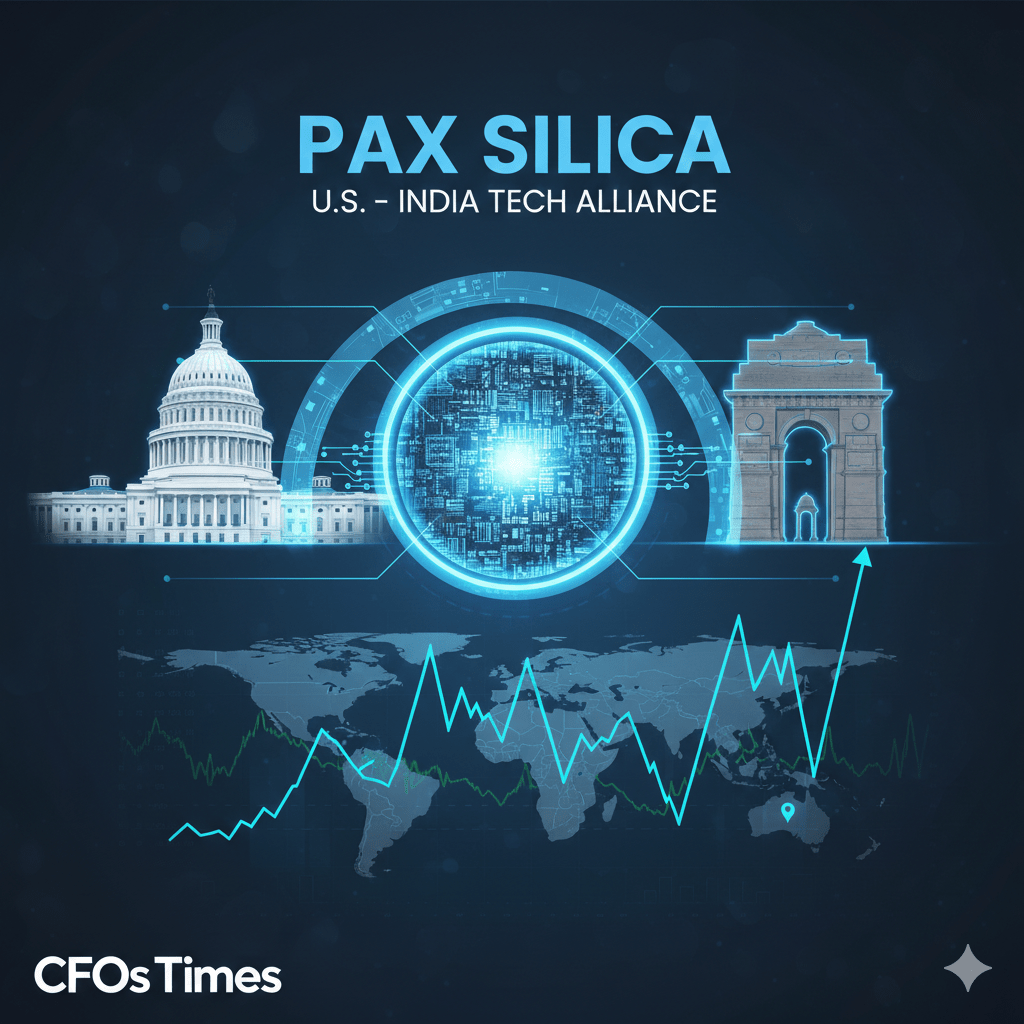
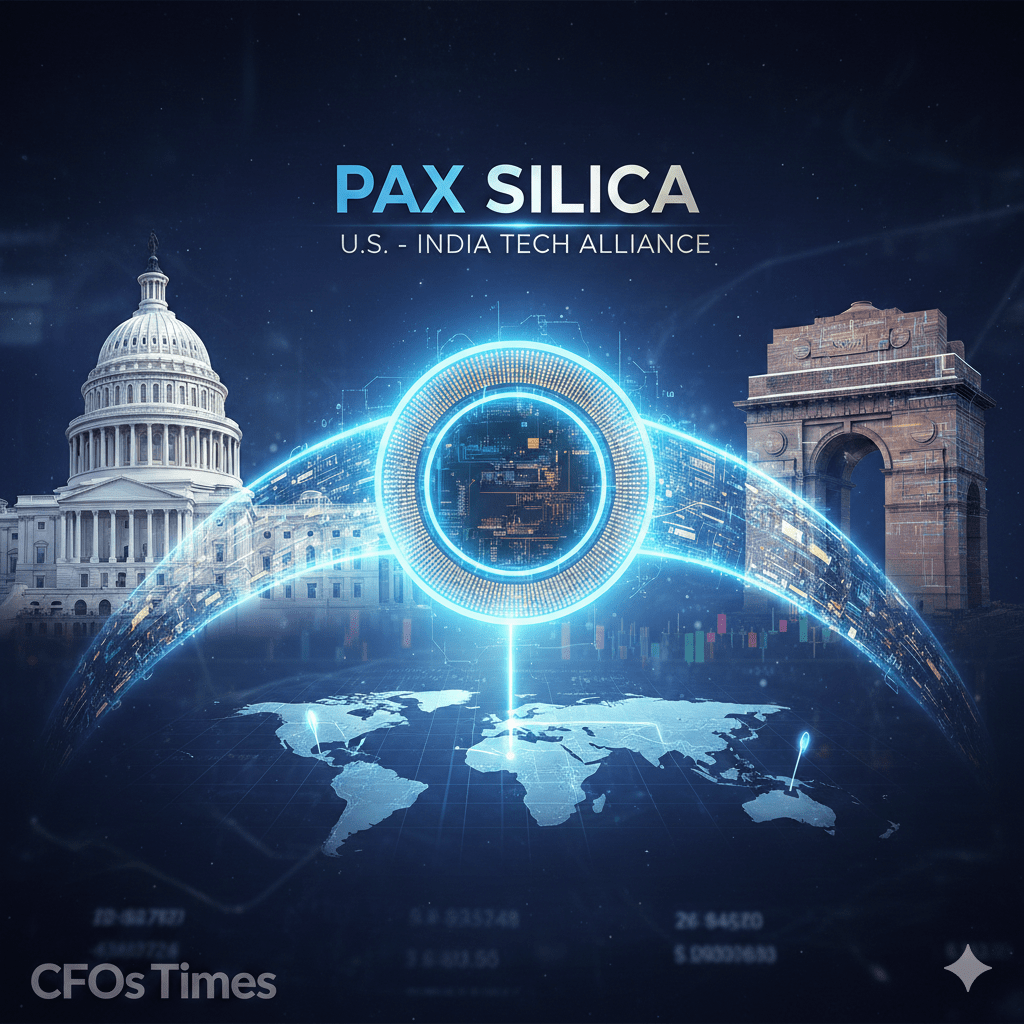
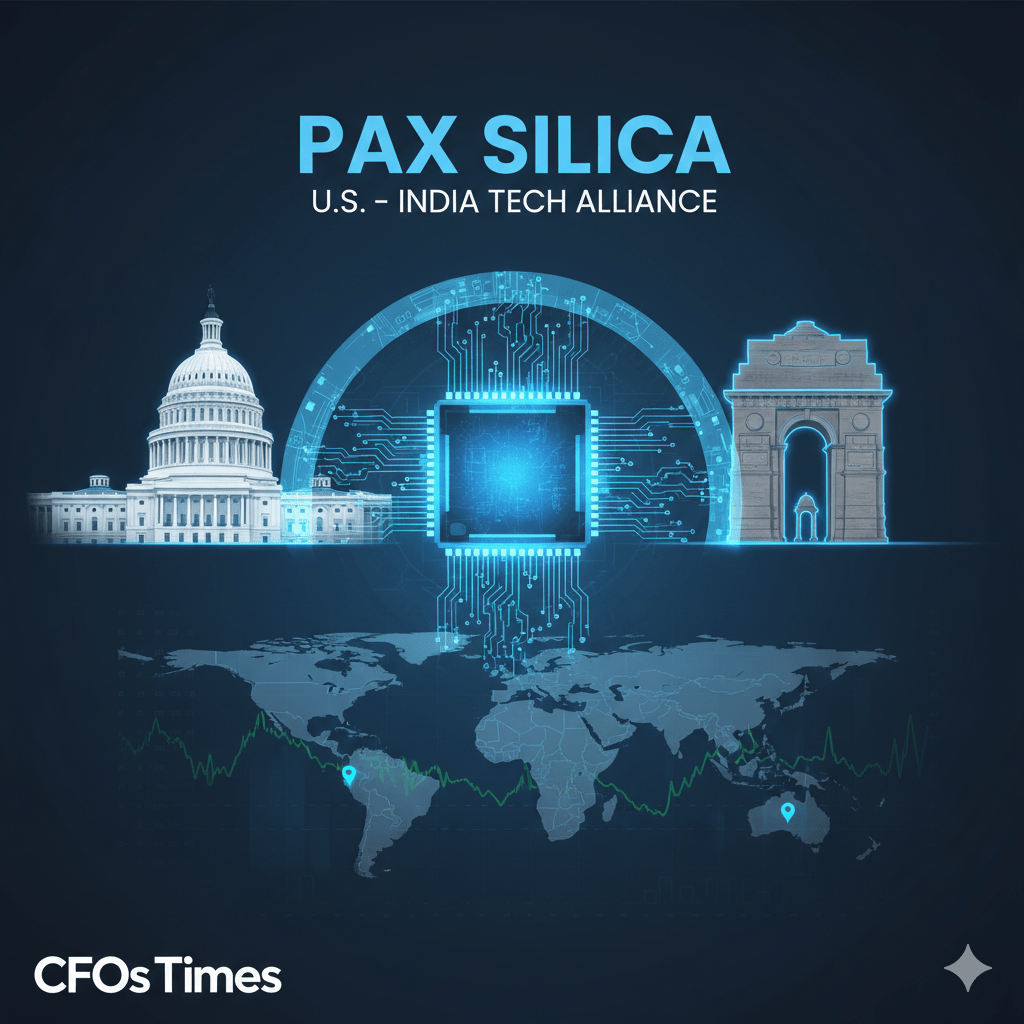
The global financial landscape has fundamentally shifted in the last 30 minutes. Today, Friday, February 20, 2026, on the sidelines of the New Delhi AI Impact Summit, India has formally signed the Pax Silica declaration. This U.S.-led initiative is designed to create a “trusted network” for semiconductors and Artificial Intelligence, effectively shielding democratic tech corridors from non-aligned supply chain disruptions.
For investors, the U.S.-India Pax Silica Deal is the single most important catalyst of the decade. With the U.S. slashing reciprocal tariffs on Indian tech goods from 25% to 18% “effective immediately,” the barrier to entry for Indian semiconductor firms into the American market has vanished.
Immediate Market Impact
| Asset Class | Movement | Primary Driver |
| BSE SENSEX | 🚀 +2.4% | Pax Silica announcement |
| Nasdaq 100 | 📈 +1.2% | AI hardware supply stability |
| Semiconductor ETFs | 🚀 +4.5% | New fabrication hubs in Gujarat |
| USD/INR | ↔️ Stable | Trade deal offset by strong Dollar |
The Strategic Core of the U.S.-India Pax Silica Deal
The U.S.-India Pax Silica Deal isn’t just a trade agreement; it’s a “Silicon Shield.” According to the official White House Joint Statement, the framework focuses on three pillars that will dictate market winners for the next five years.
1. The 18% Reciprocal Tariff Rollback
The U.S. has officially amended Executive Order 14257 to lower tariffs on Indian electronics. This move follows Prime Minister Modi’s pledge to pivot energy reliance away from sanctioned regions. For your personal finance, this means companies like Tata Electronics and Reliance Industries are now direct competitors to established global chip players.
2. AI Talent and “Agentic” Workflows
A major part of the deal involves “Human + Agent Collaboration.” As AI moves from generating text to executing tasks (Agentic AI), the U.S. is leveraging India’s pool of 5 million+ developers to build the “AI Consumer Operating System.”
3. Semiconductor Resilience Hubs
The deal fast-tracks the construction of three new 2-nanometer fabrication plants. This ensures that even if tensions flare in East Asia, the global supply of GPUs—the “new oil” of 2026—remains uninterrupted.
Top Stocks and ETFs to Watch Now
With the U.S.-India Pax Silica Deal now active, portfolio rebalancing is essential. Analysts suggest focusing on the “Silicon Triangle”:
- Infrastructure: Companies building the data centers that will house these new AI agents.
- Connectivity: Firms providing the fiber and satellite links between New Delhi and Silicon Valley.
- Specialized Semis: Mid-cap Indian firms now exempt from the previous high-tariff regime.
Expert Insight: “We are moving from a ‘Globalized’ supply chain to a ‘Trusted’ supply chain. The Pax Silica deal is the blueprint for how wealth will be generated in the late 2020s.” — CFOs Times Analysis
Personal Finance: Navigating the 2026 Economy
While the tech world celebrates, personal finance remains nuanced. U.S. inflation sits at 2.4% as of this morning’s report, and the Federal Reserve, under the new “Warsh era” leadership starting in May, is signaling a cautious approach to rate cuts.
Key Financial Actions for February 2026:
- Hedge with Gold: Gold recently crossed $5,000/oz due to Middle East tensions. Use it as a volatility buffer.
- Monitor “Friend-Shoring” Stocks: Companies part of the Pax Silica framework will likely see higher institutional inflows.
- Audit Your AI Exposure: Ensure your “tech” holdings aren’t just legacy software but are actually implementing Agentic AI workflows. U.S.-India Pax Silica Deal
Frequently Asked Questions (FAQs)-U.S.-India Pax Silica Deal
What is the focus of the U.S.-India Pax Silica Deal?
The deal secures supply chains for semiconductors, critical minerals, and AI technology between the two nations while reducing trade tariffs to 18%.
Will this lower the price of electronics?
Potentially. By reducing tariffs from 25% to 18% on Indian-made electronics, consumer costs for AI-integrated hardware may stabilize or drop by late 2026.
How do I invest in Pax Silica companies?
Look for “India Tech” or “Global Semiconductor” ETFs. Many of the primary beneficiaries are listed on both the NSE and Nasdaq.
Is this deal compliant with WTO rules?
Yes, it is framed as an “Interim Agreement” leading toward a full Bilateral Trade Agreement (BTA), a structure recognized by the World Trade Organization.
Conclusion-U.S.-India Pax Silica Deal
The U.S.-India Pax Silica Deal signed today is more than a headline—it is a structural change to the global economy. By integrating India into the heart of the U.S. tech ecosystem, both nations are betting on a future powered by AI and secured by silicon. For investors at cfostimes.com, the message is clear: the “Silicon Curtain” is being drawn, and being on the right side of it is the key to ranking #1 in your financial goals.
Disclaimer:
The information provided on this website, including but not limited to articles, charts, and market analysis regarding the U.S.-India Pax Silica Deal, is for informational and educational purposes only. It does not constitute professional financial, investment, legal, or tax advice.
- No Fiduciary Relationship: Your use of this site does not create a client-advisor relationship between you and CFOs Times.
- Market Risk: Financial markets are subject to high volatility. Past performance of AI stocks, semiconductor ETFs, or global indices is not indicative of future results. The “Pax Silica” framework involves emerging geopolitical factors that could change rapidly.
- Accuracy of Information: While we strive to provide 100% fresh and verified data as of February 20, 2026, we make no representations as to the completeness or timeliness of the information. Always verify data through official government channels, such as the U.S. Department of Commerce or the Ministry of External Affairs (India).
- Third-Party Links: This post contains outbound links to government-authorized websites. CFOs Times is not responsible for the content, privacy policies, or practices of these external sites.
- AdSense Compliance: This content is created following Google AdSense program policies. We do not guarantee specific rankings or “Google Discover” placement, as these are subject to Google’s proprietary algorithms.
Always consult with a certified financial planner (CFP) or a licensed investment advisor before making significant financial commitments.

Dr. Dinesh Kumar Sharma is an award-winning Chief Financial Officer and Director of Finance with over 25 years of expertise in strategic planning and digital transformation. Recognized as a five-time CFO of the Year, he specializes in leveraging Generative AI and Microsoft Copilot to optimize financial forecasting and cost management. Dr. Sharma holds a Doctorate in Management (Finance) and has successfully scaled organizations from INR 1 billion to INR 7 billion. He is dedicated to providing transparent, data-driven insights for modern decision-makers at CFOs Times.