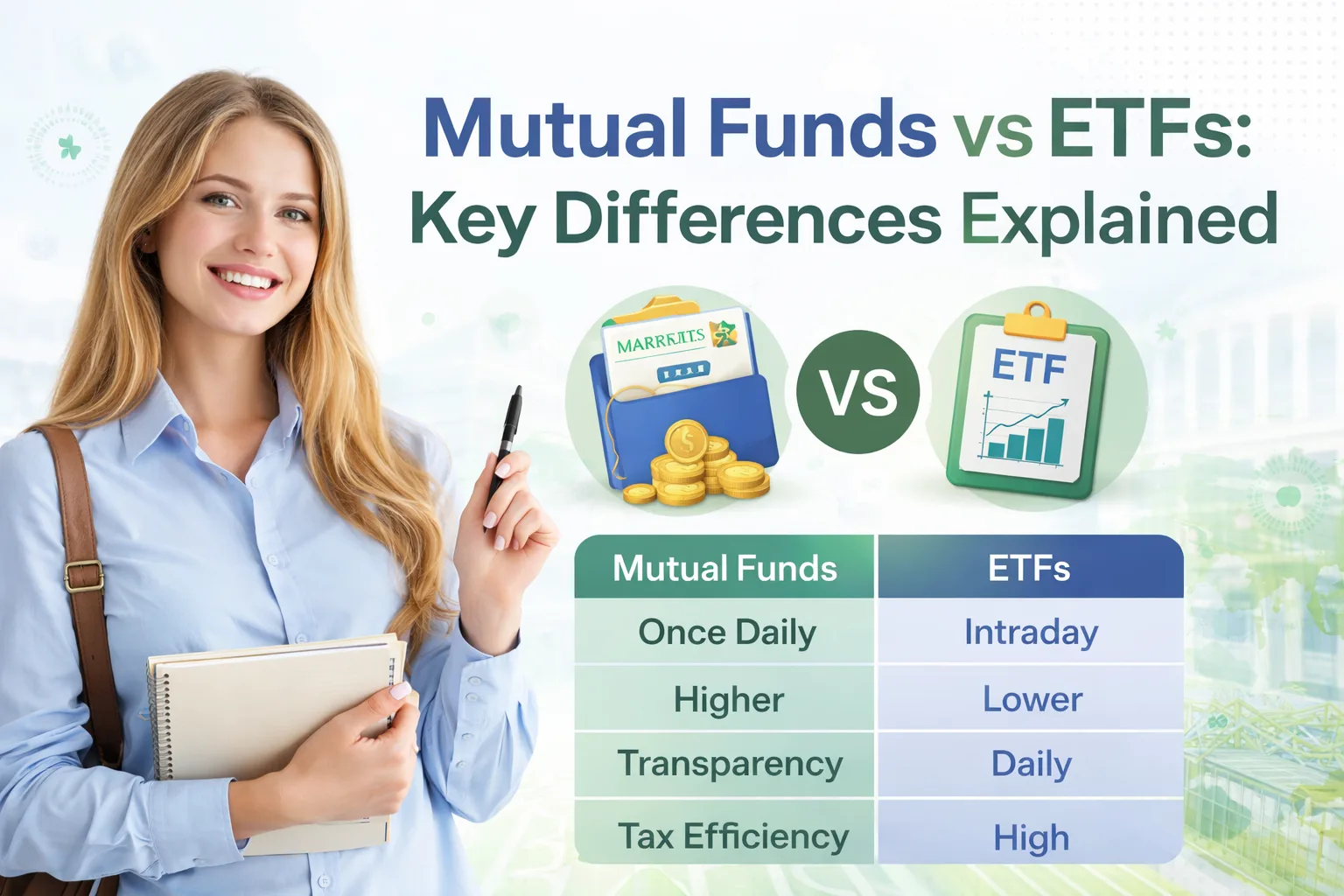
Mutual Funds or ETFs – A Complete Beginner Pillar Guide (2026 Edition)
In early 2026, the global shift toward regulated investment vehicles has reached a record high. Financial authorities—including the SEC and SEBI—strongly urge new investors to prioritise Mutual Funds and ETFs over unhedged speculation. While both offer diversification, the 2026 regulatory overhaul has fundamentally changed how they are taxed and priced
Mutual Funds or ETFs are one of the most important investment questions for beginners in 2026.
Governments and financial regulators across the world strongly advise new investors to avoid speculation and focus on diversified, regulated investment products.
Both mutual funds and ETFs are designed to reduce risk compared to direct stock investing. However, they work differently. Choosing the wrong product without understanding can lead to confusion, panic selling, or losses.
This pillar guide explains Mutual Funds vs ETFs in full detail using verified information from government and regulatory authorities only.

Table of Contents
Mutual Funds or ETFs – Why This Comparison Matters for Beginners
Understanding Mutual Funds vs ETFs is critical because beginners often:
- Do not understand market volatility
- Panic during market corrections
- Chase short-term returns
- Ignore costs and taxes
Financial regulators warn that lack of knowledge is the biggest risk to investors.
Both mutual funds and ETFs are regulated investment vehicles, but suitability depends on investor behavior.
Government Source:
U.S. Securities and Exchange Commission (SEC) – Investor Education
Mutual Funds or ETFs – What Exactly Are Mutual Funds? (Detailed Explanation)
In the Mutual Funds vs ETFs comparison, mutual funds are the most commonly recommended option for first-time investors.
A mutual fund pools money from many investors. This money is then invested in stocks, bonds, or other securities according to a defined objective.
How Mutual Funds Function Step-by-Step
- Investors buy fund units
- Money is managed by a professional fund manager
- Fund value is calculated as NAV (Net Asset Value)
- NAV is declared once per day after market close
- All buy/sell transactions happen at the same NAV
This system protects beginners from intraday price fluctuations.
Why Regulators Trust Mutual Funds
- Mandatory disclosures
- Daily portfolio reporting
- Strict risk classification
- Investor grievance mechanisms
Government Sources:
SEC – Mutual Fund Basics
SEBI (India) – Mutual Fund Investor Portal
Mutual Funds or ETFs – Types of Mutual Funds Explained in Detail
Understanding fund categories is essential in Mutual Funds vs ETFs.
Mutual Funds vs ETFs – Equity Mutual Funds
Equity mutual funds invest primarily in company shares.
Key Characteristics:
- High growth potential
- Suitable for long-term goals
- Short-term volatility possible
Best for:
Young investors, retirement planning, wealth creation.
Mutual Funds or ETFs – Debt Mutual Funds
Debt funds invest in government securities, treasury bills, and bonds.
Key Characteristics:
- Lower volatility
- Stable returns
- Interest-rate sensitive
Best for:
Conservative investors, capital protection.
Mutual Funds or ETFs – Hybrid Mutual Funds
Hybrid funds invest in both equity and debt.
Key Characteristics:
- Balanced risk
- Moderate returns
- Automatic asset allocation
Best for:
Beginners unsure about risk appetite.
Government Source:
SEBI – Mutual Fund Categories
Mutual Funds or ETFs – What Are ETFs? (In-Depth Explanation)
In Mutual Funds vs ETFs, ETFs represent modern, low-cost investing approved by regulators.
An Exchange-Traded Fund (ETF) is a basket of securities that tracks an index and trades on stock exchanges like a stock.
How ETFs Work Step-by-Step
- ETF tracks an index (e.g., Nifty 50, S&P 500)
- ETF units are listed on stock exchanges
- Prices change throughout the trading day
- Investors buy/sell using a trading account
Why Regulators Encourage ETFs
- High transparency
- Lower cost structure
- Reduced fund manager bias
Government Sources:
SEC – ETF Investor Bulletin
SEBI – ETF Awareness Page
Mutual Funds or ETFs – Cost and Expense Ratio Explained Clearly
Costs play a decisive role in Mutual Funds vs ETFs, especially over long periods.
Mutual Funds – Cost Structure Explained
- Expense ratio includes management fees
- Actively managed funds cost more
- Long-term impact reduces final corpus
ETFs – Cost Structure Explained
- Passive management lowers expenses
- No frequent portfolio churn
- Better long-term cost efficiency
Regulators stress cost awareness as a key investor protection measure.
Government Source:
SEC – Investment Fees Explained
Mutual Funds or ETFs – Taxation Explained with Government Guidance
Tax treatment is a major difference in Mutual Funds vs ETFs.
Taxation of Mutual Funds
- Capital gains distributed periodically
- Investors may pay tax even without selling
- Less tax-efficient in some jurisdictions
Taxation of ETFs
- In-kind creation mechanism
- Fewer taxable events
- Generally more tax-efficient
Government Sources:
IRS – Capital Gains Overview
SEC – ETF Structure
Mutual Funds or ETFs – Liquidity and Trading Risks Explained
Liquidity risk is often misunderstood in Mutual Funds vs ETFs.
Mutual Funds – Liquidity Explained
- Redemption processed at NAV
- No intraday trading pressure
- Emotion-free investing
ETFs – Liquidity Explained
- Real-time trading
- Prices can differ from NAV
- Beginners may mistime trades
Government Source:
FINRA – ETF Trading Risks
Mutual Funds or ETFs – Minimum Investment and Accessibility
Mutual Funds
- SIP allows very small investments
- No trading account required
- Ideal for salaried investors
ETFs
- Requires demat + trading account
- Minimum purchase = one unit
- Slight learning curve
This is why mutual funds are often preferred in Mutual Funds vs ETFs for beginners.
Government Source:
SEBI – Investor Education

Mutual Funds or ETFs – Risk Factors Explained in Detail
Mutual Funds – Key Risks
- Market risk
- Fund manager decisions
- Expense impact
ETFs – Key Risks
- Market volatility
- Liquidity mismatch
- Trading behavior risk
Government Source:
SEC – Understanding Risk
Mutual Funds or ETFs – Which Is Better for Beginners in 2026?
There is no one-size-fits-all answer in Mutual Funds vs ETFs.
Mutual Funds Are Better If You:
- Prefer automation (SIP)
- Want simplicity
- Avoid daily monitoring
ETFs Are Better If You:
- Understand markets
- Want lower costs
- Prefer transparency
Government Source:
FINRA – Choosing Investments
Mutual Funds vs ETFs – Can Beginners Invest in Both Together?
Yes. Regulators encourage diversification across instruments.
Balanced approach:
- Mutual funds for discipline
- ETFs for efficiency
Government Source:
SEC – Diversification Guidance
Mutual Funds vs ETFs – Frequently Asked Questions (FAQs)
Mutual Funds vs ETFs – Which is safer for beginners?
Both are regulated. Safety depends on diversification and holding period.
Mutual Funds vs ETFs – Which is better for SIP investing?
Mutual funds are better suited for SIPs.
Mutual Funds vs ETFs – Do ETFs require market timing?
Yes. ETFs involve intraday price movements.
Mutual Funds vs ETFs – Are both government regulated?
Yes. Both are regulated by financial authorities.
Disclaimer
This Is Not Financial Advice. The information in this article on CFOsTimes.com is for general educational purposes only and does not constitute financial, investment, or tax advice. Investing involves risk, including the possible loss of principal. Everyone’s financial situation is unique, so before making any investment decisions, consider speaking with a licensed financial advisor or tax professional in your country.
Notice for All Investors: This guide is for educational purposes only and does not constitute financial or tax advice. Under the January 2026 SEBI Guidelines, we utilize a 30-day lag for stock price data to ensure educational integrity. Investing involves risk. Always consult a certified professional before allocating capital.

Dr. Dinesh Kumar Sharma is a CMA an award-winning Chief Financial Officer and Director of Finance with over 25 years of expertise in strategic planning and digital transformation. Recognized as a five-time CFO of the Year, he specializes in leveraging Generative AI and Microsoft Copilot to optimize financial forecasting and cost management. Dr. Sharma holds a Doctorate in Management (Finance) and has successfully scaled organizations from INR 1 billion to INR 7 billion. He is dedicated to providing transparent, data-driven insights for modern decision-makers at CFOs Times.