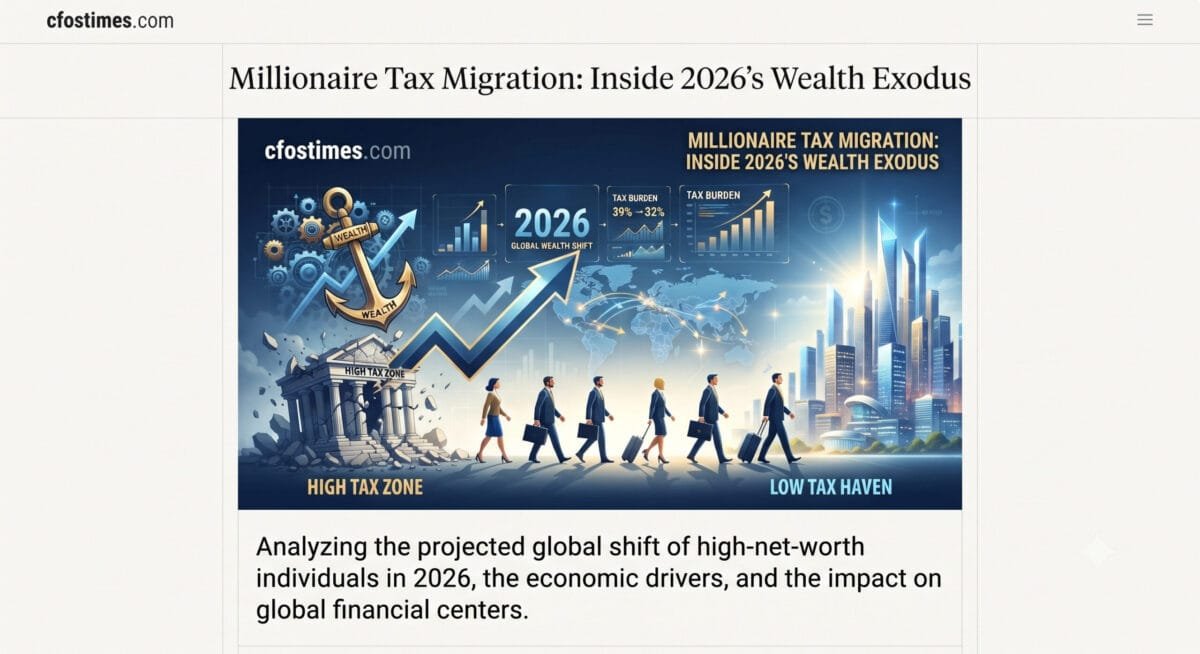
Millionaire tax migration has quietly become one of the defining economic stories of 2026 — and most people have no idea it’s happening at the scale it is. This week alone, reports surfaced that UK-based hedge fund billionaire Chris Rokos, who reportedly contributed roughly £330 million to the UK Treasury last year, is planning to leave the country. Economists are already warning that departures like his could leave a visible dent in government tax receipts once the next round of self-assessment payments comes due.
Rokos isn’t an isolated case. He’s one data point in a much larger, accelerating pattern: the wealthy are on the move, and they’re taking their capital with them. This isn’t a niche concern for accountants and private bankers anymore. Millionaire tax migration now touches public budgets, housing markets, tax policy debates, and even where the next wave of business investment will land. Understanding it matters whether you’re a business owner, an investor, or simply someone who relies on public services funded by tax revenue. Millionaire Tax Migration

Table of Contents
What Is Driving the Millionaire Tax Migration Trend
At its core, this trend happens when high-net-worth individuals move their tax residency — and often their citizenship or long-term legal base — away from countries with high taxes, tightening regulations, or growing economic uncertainty, toward jurisdictions that offer lighter tax burdens and more predictable rules.
Several forces are converging to accelerate this in 2026: Millionaire Tax Migration
- Tax policy shifts in traditionally wealthy nations. The UK’s decision to abolish its long-standing non-domiciled tax status has removed one of the last major incentives for global wealth to base itself in London. Similar tightening has occurred in parts of Western Europe.
- Rising government borrowing costs. As reported this week, UK government borrowing costs have climbed to some of their highest levels in years, adding pressure on policymakers to raise revenue — often from the same wealthy residents now eyeing the exit.
- Geopolitical instability. Ongoing conflicts and trade tensions have made some regions feel riskier for long-term wealth storage, pushing families toward jurisdictions seen as more neutral or stable.
- A generational shift in mindset. Younger heirs to family wealth are far more willing than their parents to treat citizenship and residency as flexible, strategic choices rather than fixed identities tied to a single homeland.
The Numbers Behind the Movement
According to the Henley Private Wealth Migration Report, millionaire relocations hit a record 142,000 in 2025, with forecasts pointing toward as many as 165,000 moves in 2026 — which would make it the largest documented wealth migration on record. The report frames this as a structural, multi-year shift rather than a temporary fluctuation, driven by a generational change in how wealthy families think about where they live, invest, and hold citizenship. Notably, nearly half of billionaires under the age of 55 reportedly changed their country of residence within the past year alone, underscoring just how fluid national loyalty has become for the ultra-wealthy.
It’s worth pausing here for an important caveat, because responsible analysis demands it: these specific migration figures come from a private wealth advisory firm with a commercial interest in promoting citizenship-by-investment services, and independent researchers have raised serious concerns about the report’s methodology, including inconsistent definitions of wealth and a lack of statistical controls. That doesn’t mean the underlying trend is fake — multiple independent sources, from European tax authorities to financial journalists, confirm real outflows are happening. But precise headline numbers should be treated as directional estimates, not hard scientific data. Millionaire Tax Migration
Where the Wealthy Are Going — and Who’s Losing Them
The clearest losers in this shift are the UK, Germany, and France. A 2026 study found that wealthy migrants are increasingly turning away from these traditional European favorites, while Henley & Partners recorded a 16% jump in enquiries from German nationals between late 2025 and early 2026, and France’s applicant numbers climbed from outside the firm’s top 40 source countries in 2024 into its top 15 by 2026.
On the winning side, the United Arab Emirates continues to dominate as the top relocation destination, alongside Italy, Switzerland, Greece, and Singapore. Enquiries from UAE-based individuals rose 41% between late 2025 and early 2026, alongside a 29% increase in applications for alternative residence or citizenship over the same period. These destinations tend to share common traits: favorable tax treatment for foreign residents, political stability, and streamlined residency-by-investment programs that make relocation administratively simple for people with significant assets.
Meanwhile, back in the UK, the immediate fallout is visible in smaller ways too — a nearly six-decade-old haulage company recently entered liquidation after struggling under rising operating costs and difficult market conditions, with all seven jobs lost. It’s a small example, but it illustrates how tightening economic conditions ripple down from macro tax policy to Main Street businesses, even if the connection isn’t always direct or immediate. Millionaire Tax Migration
Why This Matters Beyond the Ultra-Rich
It’s tempting to dismiss this wealth exodus as a “rich people problem” that doesn’t affect ordinary households. That would be a mistake, for a few concrete reasons.
Tax base concentration. In most developed economies, a small percentage of top earners contributes a disproportionately large share of total income tax revenue. When even a handful of the wealthiest taxpayers leave, the shortfall doesn’t just vanish — it typically gets redistributed across everyone else through higher taxes elsewhere, reduced public spending, or increased government borrowing.
Investment and job creation effects. Wealthy individuals aren’t just taxpayers; many are also active investors, business founders, and employers. When they relocate, some portion of their business activity, hiring, and local investment often follows them, even if slowly. Millionaire Tax Migration
Real estate and local economic impact. High-net-worth departures can cool luxury property markets in the countries they leave and heat them up in the destinations they choose, with knock-on effects for construction, services, and local employment in both places.
Policy feedback loops. Governments watching wealth migrate abroad face pressure to either double down on taxing what remains, or to reverse course and compete for wealthy residents with tax incentives — a dynamic already playing out as some nations position themselves as new destinations of choice. Millionaire Tax Migration
The Skeptic’s Case: Is This Overblown?
To offer a fair and balanced view, it’s worth acknowledging the skeptics. Some economists argue the scale of this reported wealth flight is regularly exaggerated in media coverage, partly because the loudest data sources have a financial incentive to make the phenomenon look large and urgent.
Official government statistics in some countries have, at times, shown far smaller outflows than private wealth reports suggest, and measuring who counts as a “millionaire” or what counts as “leaving” varies wildly between studies — sometimes by an order of magnitude, according to independent academic reviews of the methodology. Currency swings, dual residency arrangements, and part-year relocations further complicate any attempt to pin down a single reliable figure, which is part of why so many competing estimates exist side by side without ever fully reconciling.
There’s also a behavioral argument: many wealthy individuals who technically shift tax residency continue spending significant time, and money, in their country of origin, blurring the line between a genuine departure and a paper relocation designed purely for tax efficiency. This nuance rarely makes it into the more dramatic headlines.
The honest takeaway sits in the middle: millionaire tax migration is a real and accelerating trend backed by multiple independent sources, but the precise numbers thrown around in reports and news coverage deserve healthy skepticism rather than blind acceptance. Millionaire Tax Migration
What It Means for You
Even if you’re not a millionaire weighing a move to Dubai or Geneva, this trend carries practical lessons:
- Diversification isn’t just for portfolios. The same logic wealthy families apply to spreading citizenship and residency across jurisdictions applies at a smaller scale to diversifying your income sources, savings locations, and even career skills across less tax- or policy-dependent paths.
- Watch tax policy shifts closely. Countries losing wealthy residents often respond by adjusting tax brackets, closing loopholes, or introducing new levies that can eventually affect middle-income earners too.
- Emerging wealth hubs can signal opportunity. Regions attracting significant capital inflows — like the UAE or parts of Southern Europe — often see corresponding growth in real estate, financial services, and skilled job markets, which can matter for career or investment decisions.
- Public service funding is genuinely at risk in some regions. If you live in a country experiencing notable wealth outflows, it’s worth paying attention to how local and national governments plan to fill funding gaps, since those decisions eventually reach everyone’s tax bill.
It’s also worth remembering that this dynamic isn’t new — wealthy individuals and families have relocated for tax and lifestyle reasons for generations, from Monaco’s longstanding appeal to European aristocracy to the more recent rise of Caribbean citizenship-by-investment programs. What’s changed is the speed and visibility of the process. Digital banking, remote work infrastructure, and streamlined residency applications have made relocating capital and legal residence dramatically faster and easier than it was even a decade ago, which is precisely why governments are struggling to design tax policy that keeps pace. Millionaire Tax Migration
Conclusion- Millionaire Tax Migration
Millionaire tax migration isn’t a passing news cycle story — it’s a structural shift reshaping where global capital, talent, and tax revenue land in 2026 and likely for years beyond. The departure of high-profile figures like Chris Rokos from the UK is a visible symptom of a much larger, harder-to-see pattern: wealthy families increasingly treating citizenship and residency as flexible, strategic choices rather than fixed identities. Whether the precise migration figures reported by advisory firms are entirely accurate remains genuinely debated, but the underlying direction of travel is confirmed by multiple independent sources, government policy responses, and real economic ripple effects already visible in housing markets, tax debates, and business closures.
For everyday readers, the real value in following this story isn’t envy or outrage at the ultra-wealthy — it’s the early warning it offers about where tax policy, investment opportunity, and public funding pressures are likely headed next. Millionaire Tax Migration
Frequently Asked Questions
What is millionaire tax migration? Millionaire tax migration refers to wealthy individuals relocating their tax residency, and often their citizenship, away from high-tax countries toward jurisdictions offering lower taxes, more favorable investment conditions, or greater stability.
Why are millionaires leaving the UK in 2026? Changes to the UK’s non-domiciled tax status, rising capital gains and inheritance tax exposure, higher government borrowing costs, and broader economic uncertainty have pushed many high-net-worth residents toward lower-tax jurisdictions.
Which countries are gaining the most millionaires? The UAE remains the leading destination, followed by Italy, Switzerland, Greece, and Singapore, each offering favorable tax treatment and streamlined residency programs for wealthy newcomers.
Does millionaire migration actually hurt government tax revenue? It can, since top earners often contribute a disproportionate share of tax revenue, but the scale of impact is debated, and migration statistics from private advisory firms have faced credible methodological criticism.
Should everyday investors care about wealth migration trends? Yes — these shifts influence tax policy, public service funding, real estate markets, and investment flows in both the countries losing wealth and those gaining it, which can shape opportunities and risks for ordinary investors too. Millionaire Tax Migration
Disclaimer & Editorial Disclosure
- Nature of Content: The information, figures, and data projections discussed in relation to wealth migration trends (Millionaire Tax Migration) and cross-border tax forecasts are published on cfostimes.com for general informational and analytical purposes only.
- Third-Party Data: Global high-net-worth individual (HNWI) relocation metrics and capital flight reports are derived from private wealth intelligence trackers and macro estimates. These figures are directional indicators rather than definitive official audits.
- No Professional Advice: The contents of this post do not constitute formal financial, tax, legal, or investment advice. Cross-border asset restructuring and tax planning involve complex regulatory environments. Readers should consult with a certified financial planner, tax consultant, or legal counsel before making major financial or relocation decisions.
- Limitation of Liability: cfostimes.com and its contributors assume no responsibility or liability for any financial losses or operational outcomes resulting directly or indirectly from the use of this information.

Dr. Dinesh Kumar Sharma is a CMA an award-winning Chief Financial Officer and Director of Finance with over 25 years of expertise in strategic planning and digital transformation. Recognized as a five-time CFO of the Year, he specializes in leveraging Generative AI and Microsoft Copilot to optimize financial forecasting and cost management. Dr. Sharma holds a Doctorate in Management (Finance) and has successfully scaled organizations from INR 1 billion to INR 7 billion. He is dedicated to providing transparent, data-driven insights for modern decision-makers at CFOs Times.