Introduction-NSE IPO 2026 SEBI Approval
September 4, 2026 will go down as the day India’s most-awaited IPO finally cleared its last real hurdle. After nearly ten years of delays, a colocation scandal, and repeated false starts, the Securities and Exchange Board of India (SEBI) has issued its observation letter approving the initial public offering of the National Stock Exchange of India (NSE) — the exchange that runs the Nifty 50 and handles the vast majority of India’s equity derivatives volume.
If this listing goes through as planned, it will be the largest IPO in Indian history, ahead of Hyundai Motor India’s ₹27,870 crore issue in 2024. Here’s everything investors, founders, and finance professionals need to know — and why the CFO’s perspective on this one matters more than the headlines suggest.
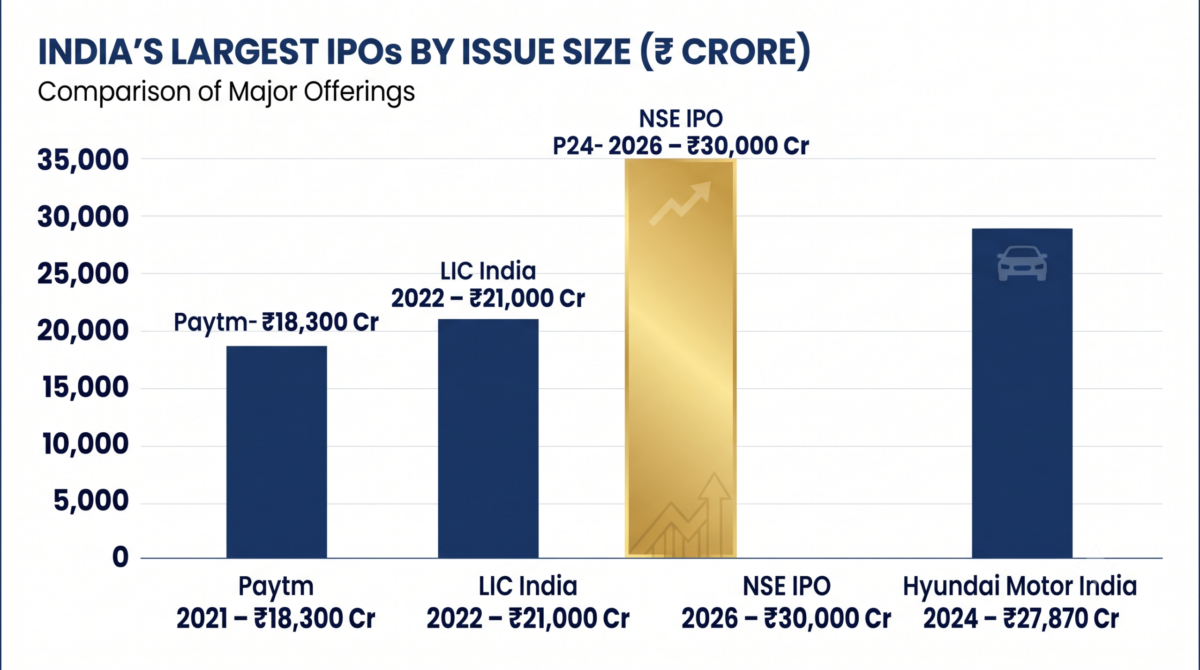
Table of Contents
The Backstory: Why This IPO Took a Decade
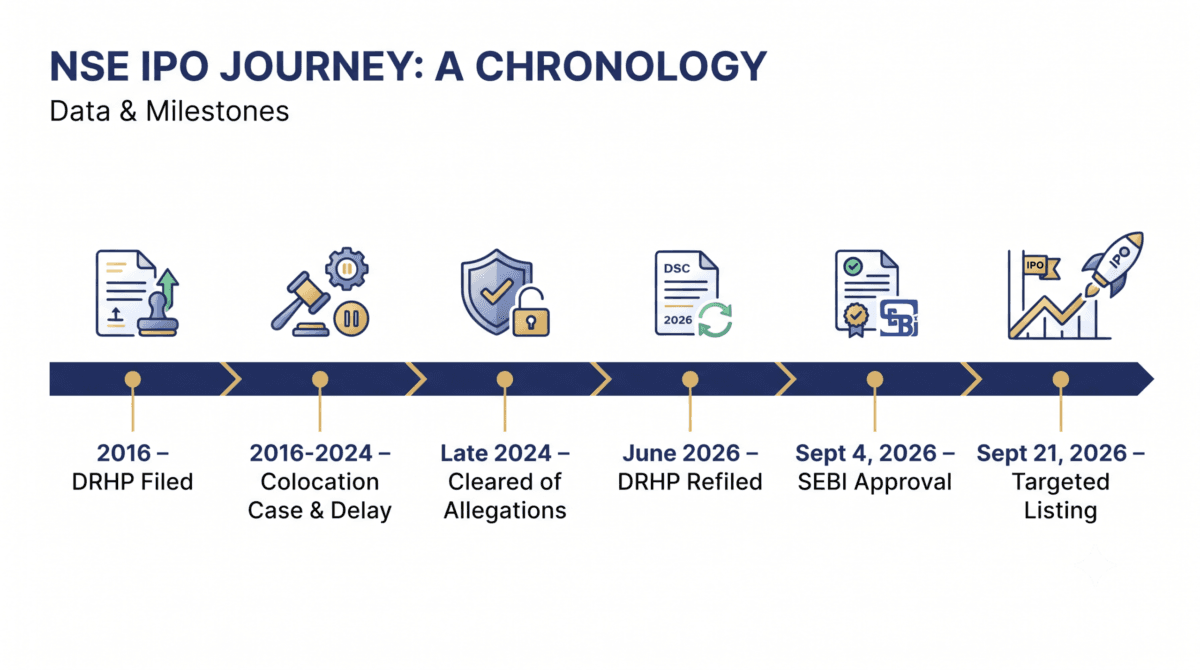
NSE first filed its draft red herring prospectus (DRHP) all the way back in 2016, targeting a ₹10,000 crore issue. That plan collapsed almost immediately after regulators began probing allegations that the exchange had given a handful of high-frequency trading firms unfair, preferential access to its co-location servers — an edge worth fractions of a second, but worth millions of dollars to the traders exploiting it.
The investigation dragged on for years. NSE was effectively frozen out of the IPO pipeline while SEBI worked through the colocation case and a related governance overhaul. The exchange was finally cleared of the core allegations of collusion in late 2024, which immediately triggered a scramble for its shares in the unlisted market — valuations reportedly doubled in a matter of months on pure IPO speculation.
NSE refiled its DRHP on June 17, 2026. Roughly eleven weeks later, SEBI’s observation letter arrived. NSE IPO 2026 SEBI Approval
What SEBI Actually Approved
A SEBI observation letter isn’t a rubber stamp — it’s the regulator formally signing off that an issuer’s disclosures meet its standards, clearing the way for the exchange to finalize pricing and open the issue to the public. Here’s the shape of the deal as it currently stands:
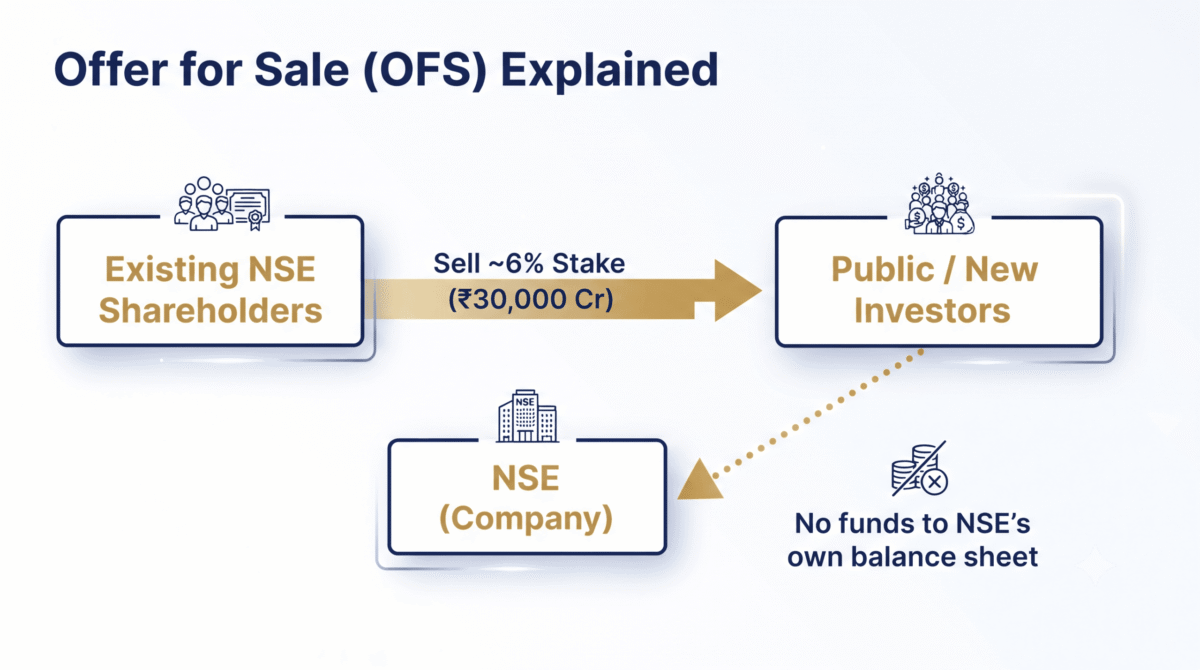
- Structure: The IPO will be entirely an Offer for Sale (OFS) — existing shareholders selling roughly 14.89 crore equity shares, close to 6% of NSE’s paid-up capital. No fresh capital is being raised for NSE’s own operations; every rupee goes to the shareholders selling down.
- Issue size: Estimated at approximately ₹30,000–31,500 crore (roughly $3.6 billion).
- Valuation: NSE’s unlisted-market valuation sits around ₹5–5.26 lakh crore (roughly $55–60 billion), with the actual IPO pricing expected closer to $47 billion once the price band is finalized.
- Price band: Reportedly ₹2,000–₹2,100 per share, implying a price-to-earnings multiple near 35x.
- Target listing: The week of September 21, 2026 — on the BSE, since NSE cannot list on its own exchange.
At the top end of that valuation range, NSE would rank among the most valuable exchange operators on earth, in the same conversation as the London Stock Exchange Group and Intercontinental Exchange. NSE IPO 2026 SEBI Approval
Why an “Offer for Sale” Structure Matters to You
This is the detail retail investors most often skim past — and it changes how you should think about the listing.
Because this is a pure OFS, NSE itself receives none of the ₹30,000 crore. The proceeds go directly to the existing shareholders reducing their stake — a mix of private equity investors, domestic banks, and financial institutions that have held NSE shares for years, some since well before the original 2016 filing. That means:
- The IPO doesn’t fund any expansion, technology upgrade, or debt reduction at NSE — it’s purely a change of ownership.
- The float will be genuinely large from day one, which historically means less of the extreme first-day volatility seen in smaller, fresh-capital IPOs.
- Long-time private shareholders finally get a liquidity event after a decade of waiting — which is part of why this approval has been cheered so loudly inside India’s investing community. NSE IPO 2026 SEBI Approval
Why This Is Bigger Than “Just Another IPO”
A few reasons this listing deserves more attention than the average large-cap debut:
- It’s a bet on the market itself. Buying NSE shares isn’t a bet on one company’s product — it’s a direct bet on the growth of Indian equity and derivatives trading volumes over the next decade.
- It could reshape near-term IPO flow. Absorbing ₹30,000+ crore of investor capital in one window can create short-term pressure on other mid-cap and large-cap issues scheduled around the same period — worth watching if you’re tracking the broader September–October IPO calendar.
- It’s a governance story as much as a market story. A regulator approving the listing of the exchange it directly oversees is, by design, a heavily scrutinized process — and the resolution of the colocation case is arguably as important to India’s capital-markets credibility as the listing itself.
- The timing lines up with a bigger macro window. This approval lands in the same week as SEBI’s new mandatory nomination framework for demat accounts, the closure of the RBI’s special FCNR(B) swap window for NRIs, and rising global bond yields — all pieces of a broader “capital markets under transition” story in India this September. NSE IPO 2026 SEBI Approval
What Happens Next-NSE IPO 2026 SEBI Approval
- Price band finalization is expected in the coming days, ahead of the public issue opening.
- Anchor investor allocation typically happens one working day before the issue opens to the public — watch for the marquee names that come in here, since it’s often a signal of institutional confidence.
- Listing week: currently targeted for the week of September 21, 2026, on the BSE.
- Retail allocation: as with any large OFS-structured IPO, expect a defined retail quota — details will firm up once the Red Herring Prospectus (RHP) is filed with final pricing. NSE IPO 2026 SEBI Approval
The CFO’s Take- NSE IPO 2026 SEBI Approval
For corporate finance leaders and serious investors, the real story here isn’t the listing-day pop everyone will be watching for on September 21. It’s what this approval signals about India’s market infrastructure maturing past a decade-long governance overhang. A ₹5 lakh crore-plus valuation for the entity that runs the Nifty 50 is a statement about how far India’s capital markets have scaled since that stalled 2016 filing — and it sets a real benchmark for how the next generation of market-infrastructure companies (depositories, clearing corporations, exchanges) will eventually be priced when they come to market. NSE IPO 2026 SEBI Approval
Frequently Asked Questions- NSE IPO 2026 SEBI Approval
Is the NSE IPO confirmed to list this month? SEBI’s approval clears the regulatory path, and the current target is the week of September 21, 2026 — but the final date depends on price-band finalization and standard IPO-process timelines, which can shift.
Will NSE raise fresh money from this IPO? No. The issue is structured entirely as an Offer for Sale, meaning all proceeds go to existing shareholders selling their stake, not to NSE’s own balance sheet.
How large will the NSE IPO be compared to other Indian IPOs? At an estimated ₹30,000–31,500 crore, it would be the largest IPO in Indian history, surpassing Hyundai Motor India’s ₹27,870 crore issue from 2024.
Where will NSE shares list, since NSE is itself a stock exchange? NSE’s shares are expected to list on the BSE, since a company generally cannot list its own shares on the exchange it operates.
Disclaimer:
The content NSE IPO 2026 SEBI Approval provided on cfostimes.com is for informational, educational, and analytical purposes only and should not be construed as professional financial, legal, or investment advice. While every effort is made to ensure that the data and macroeconomic insights presented are accurate and up-to-date, financial markets and corporate environments are inherently dynamic. Readers, C-suite executives, and business owners should conduct their own independent research and consult with qualified licensed professionals before making any strategic financial, operational, or capital allocation decisions. CFOs Times and its contributors assume no liability for any financial losses or business outcomes resulting from the use of information published on this platform.

Dr. Dinesh Kumar Sharma is a CMA an award-winning Chief Financial Officer and Director of Finance with over 25 years of expertise in strategic planning and digital transformation. Recognized as a five-time CFO of the Year, he specializes in leveraging Generative AI and Microsoft Copilot to optimize financial forecasting and cost management. Dr. Sharma holds a Doctorate in Management (Finance) and has successfully scaled organizations from INR 1 billion to INR 7 billion. He is dedicated to providing transparent, data-driven insights for modern decision-makers at CFOs Times.