Introduction
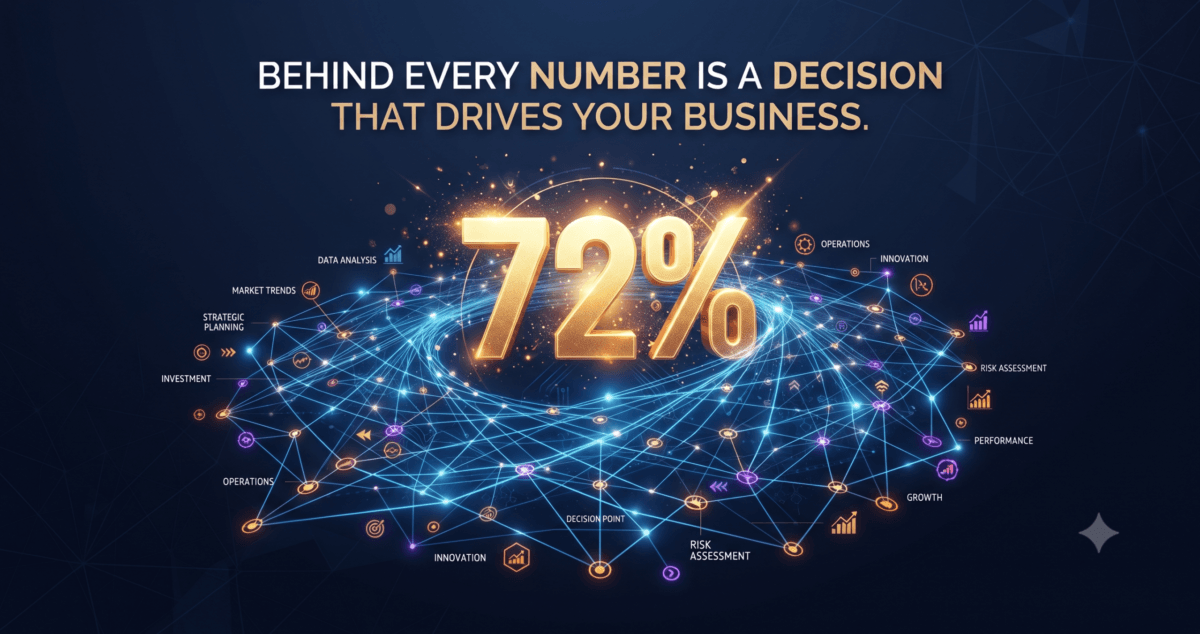
Behind every number is a decision that drives your business. That quarterly revenue figure, your customer acquisition cost, the employee turnover rate, your profit margin—each one represents choices made somewhere in your organization.
This truth separates thriving enterprises from struggling ones. Companies that understand that behind every number is a decision that drives your business actively manage their metrics through intentional strategy. Companies that don’t understand this treat numbers as unchangeable facts and miss opportunities for improvement.
For CFOs, business leaders, and decision-makers, this principle is foundational. Your financial statements tell stories of strategic decisions—whether to invest in innovation, how to price products, where to cut costs, and when to expand. Understanding this connection empowers you to take control of outcomes rather than merely reporting them.
In this comprehensive guide, we’ll explore:
- The philosophy behind numeric decision-making
- How business metrics reflect strategic choices
- Practical frameworks for improving your decision-to-number pipeline
- Common mistakes that distort business numbers
- Future trends in data-driven decision-making
Behind every number is a decision that drives your business—let’s learn how to make those decisions count.

Table of Contents
The Philosophy Behind Business Numbers
Every number on your dashboard has a story. Behind every number is a decision that drives your business, and understanding this philosophy transforms how you approach data. For a deeper perspective on how information structures modern corporate industries, explore insights from Harvard Business School on Data Analytics.
Numbers as Decision Artifacts
When you see a sales figure of $5.2 million for the quarter, you’re not just seeing revenue—you’re seeing the cumulative effect of decisions about:
- Which markets to enter or exit
- How to price products and services
- Where to allocate marketing budgets
- What sales compensation structures to implement
- Which customer segments to prioritize
Behind every number is a decision that drives your business, and each decision cascades through the organization to produce measurable outcomes.
The Decision-Number Feedback Loop
Understanding that behind every number is a decision that drives your business creates a powerful feedback loop:
- Decisions → 2. Actions → 3. Numbers → 4. Analysis → 5. Better Decisions
Organizations that master this loop continuously improve. They don’t just report numbers; they trace numbers back to decisions, learn from outcomes, and refine their approach.
Why Leaders Must Understand This Connection
For executives, recognizing that behind every number is a decision that drives your business is essential for:
- Strategic Planning: Numbers guide strategy, but strategy produces numbers
- Performance Management: Metrics reveal the effectiveness of decisions
- Resource Allocation: Numbers show where decisions produced results
- Accountability: Leaders own both decisions and their numeric outcomes
How Business Decisions Shape Financial Metrics
Revenue and Growth Numbers
When analyzing revenue metrics, remember that behind every number is a decision that drives your business. Revenue doesn’t appear magically—it results from deliberate choices.
Pricing Decisions
Your pricing strategy directly determines revenue. Behind every number is a decision that drives your business regarding whether to compete on price or value. Premium pricing decisions produce higher margins but potentially lower volume. Value pricing decisions generate volume but compress margins.
Market Entry Decisions
Expanding into new markets involves decisions about timing, investment, and approach. Behind every number is a decision that drives your business about which markets to prioritize. First-mover advantages, market saturation, and competitive responses all affect revenue outcomes.
Product Portfolio Decisions
Deciding which products to develop, maintain, or discontinue directly impacts revenue. Behind every number is a decision that drives your business about where to invest R&D resources. Innovation decisions shape future revenue streams.
Profitability and Margin Metrics
Profit margins reflect decisions about:
Cost Structure Decisions
Behind every number is a decision that drives your business about fixed versus variable costs. Decisions to outsource, automate, or insource affect cost structures. Operating leverage decisions determine how profitability scales with revenue.
Efficiency Decisions
Operational efficiency decisions affect margins. Behind every number is a decision that drives your business about process improvements, technology investments, and workforce optimization. Lean operations decisions compress costs.
Supplier and Partnership Decisions
Supply chain decisions impact cost of goods sold. Behind every number is a decision that drives your business about which suppliers to use, what terms to negotiate, and whether to vertically integrate.
Customer Acquisition and Retention Metrics
Marketing Channel Decisions
Customer acquisition costs reflect marketing decisions. Behind every number is a decision that drives your business about which channels to invest in, what messaging to use, and how to target audiences. Channel selection decisions determine acquisition efficiency.
Customer Experience Decisions
Retention metrics reflect customer experience choices. Behind every number is a decision that drives your business about service levels, product quality, and relationship management. Investment in customer success generates retention numbers.
Loyalty Program Decisions
Repeat purchase metrics reflect loyalty strategy decisions. Behind every number is a decision that drives your business about how to reward loyal customers and incentivize repeat business.

The Psychology of Business Decision-Making
Understanding that behind every number is a decision that drives your business requires understanding human psychology. Decisions are rarely purely rational—cognitive biases influence outcomes.
Cognitive Biases That Affect Business Numbers
Anchoring Bias
Initial reference points influence decisions. Behind every number is a decision that drives your business influenced by whatever anchor was present. Budget negotiations, salary decisions, and pricing strategies all suffer from anchoring effects.
Confirmation Bias
Leaders tend to favor information confirming existing beliefs. Behind every number is a decision that drives your business shaped by selective data interpretation. This can lead to ignoring warning signs in metrics.
Loss Aversion
Losses feel more painful than equivalent gains feel pleasurable. Behind every number is a decision that drives your business influenced by this asymmetry. Companies may avoid necessary changes because the potential loss feels worse than potential gain.
Overconfidence Bias
Leaders often overestimate their decision-making ability. Behind every number is a decision that drives your business affected by overconfidence in judgment. This can lead to excessive risk-taking or inadequate contingency planning.
Groupthink
Team decisions can suffer from conformity pressure. Behind every number is a decision that drives your business influenced by group dynamics. Diverse perspectives are essential for quality decision-making.
Overcoming Decision Biases
Implement Decision Frameworks
Structured decision processes reduce bias. Behind every number is a decision that drives your business should be evaluated through consistent frameworks that consider multiple perspectives.
Seek Diverse Input
Different viewpoints challenge assumptions. Behind every number is a decision that drives your business better when informed by varied expertise and experience.
Review Past Decisions
Learning from history improves future decisions. Behind every number is a decision that drives your business should be documented and reviewed to identify patterns and improvement opportunities.
Practical Decision Frameworks for Better Numbers
Framework 1: Decision Impact Analysis
Every significant business decision should include impact analysis. Behind every number is a decision that drives your business—make sure you understand what numbers will be affected.
Steps:
- Identify decision options
- Estimate numeric impact on key metrics
- Assess probability of outcomes
- Consider secondary and tertiary effects
- Document assumptions
Framework 2: Decision-Making Hierarchy
Not all decisions are equal. Behind every number is a decision that drives your business, but some decisions drive more numbers than others.
Strategic Decisions (Shape overall direction)
- Market entry/exit
- Major investments
- Core strategy changes
- These affect most business numbers
Tactical Decisions (Execute strategy)
- Marketing campaigns
- Hiring and training
- Process improvements
- These affect specific metric groups
Operational Decisions (Daily execution)
- Scheduling
- Resource allocation
- Supplier choices
- These affect efficiency metrics
Framework 3: Decision Quality Assessment
Behind every number is a decision that drives your business—assess whether your decision process was sound, regardless of outcome.
Assessment Criteria:
- Was the decision informed by quality data?
- Were alternatives properly considered?
- Were assumptions clearly stated?
- Was the decision documented?
- Are we prepared to learn from results?
Framework 4: Scenario Planning
Make decisions that perform well across multiple scenarios. Behind every number is a decision that drives your business across different economic conditions.
Scenario Types:
- Best case
- Worst case
- Most likely case
- Wild card scenarios
Common Mistakes in Business Decision-Making
Mistake 1: Treating Numbers as Destiny
Many leaders accept numbers as unchangeable facts. Behind every number is a decision that drives your business that can be changed. Recognizing this empowers improvement.
Solution: Ask “What decision led to this number?” and “What different decision would change it?”
Mistake 2: Making Decisions Without Data
Gut feelings aren’t enough. Behind every number is a decision that drives your business—use data to inform those decisions. Evidence-based decisions produce better outcomes.
Solution: Invest in data infrastructure and analytics capabilities. Train leaders to interpret and use data.
Mistake 3: Ignoring Second-Order Effects
Decisions affect multiple numbers simultaneously. Behind every number is a decision that drives your business—and one decision can affect many numbers.
Solution: Use systems thinking. Map how decisions cascade through the organization before making choices.
Mistake 4: Failing to Document Decisions
Memory fades. Behind every number is a decision that drives your business—document it to learn from outcomes.
Solution: Create decision logs. Record what was decided, why, and what outcomes were expected.
Mistake 5: Making Decisions in Silos
Interconnected decisions need coordination. Behind every number is a decision that drives your business across departments—ensure alignment.
Solution: Create cross-functional decision processes for significant choices.
Mistake 6: Prioritizing Short-Term Over Long-Term
Quick wins can create long-term problems. Behind every number is a decision that drives your business—consider all time horizons.
Solution: Evaluate decisions using multiple timeframes. Consider both immediate metrics and strategic positioning.
Data Analytics and Decision-Making
How Analytics Reveals Decision Impact
Modern analytics tools help leaders understand that behind every number is a decision that drives your business. Key analytical approaches include:
Attribution Modeling
Determines which decisions contributed most to outcomes. Behind every number is a decision that drives your business, and attribution modeling helps identify which decisions matter most.
Causal Inference
Distinguishes correlation from causation. Behind every number is a decision that drives your business, but correlation doesn’t prove causation. Causal analysis helps identify what actually works.
Predictive Analytics
Forecasts outcomes of decisions before implementation. Behind every number is a decision that drives your business—predictive models help choose better decisions.
Prescriptive Analytics
Recommends optimal decisions based on data. Behind every number is a decision that drives your business—prescriptive analytics helps identify the best choice.
Building a Data-Driven Decision Culture
Leadership Commitment
Leaders must model data-driven decision-making. Behind every number is a decision that drives your business—leaders should articulate the importance of evidence-based choices.
Investment in Tools and Training
Provide resources for analytics. Behind every number is a decision that drives your business—tools and skills matter.
Data Accessibility
Make data available to decision-makers. Behind every number is a decision that drives your business—access to information enables better choices.
Psychological Safety
Allow discussion of decision failures. Behind every number is a decision that drives your business—learning from mistakes requires psychological safety.
Case Studies: Decisions Driving Numbers
Case Study 1: Pricing Decision Impact
A software company faced declining margins. Analysis revealed that behind every number is a decision that drives your business—specifically, a pricing strategy that had remained unchanged for years.
The Decision: Implement tiered pricing with value-based features.
The Numeric Results:
- Revenue increased 24% in first year
- Customer acquisition cost decreased 18% due to better targeting
- Retention improved 12% because customers could choose appropriate tiers
- Profit margin expanded from 28% to 35%
Lesson: Behind every number is a decision that drives your business—pricing decisions affect multiple metrics simultaneously.
Case Study 2: Investment Decision
A manufacturing company was losing market share. Behind every number is a decision that drives your business—the decision was whether to invest in automation or maintain manual processes.
The Decision: Invest $15 million in automation technology.
The Numeric Results:
- Production costs decreased 32%
- Quality defects reduced 65%
- Lead times shortened 40%
- Market share increased from 18% to 27%
- ROI achieved in 22 months
Lesson: Behind every number is a decision that drives your business—capital investment decisions affect operational and market metrics.
Case Study 3: Talent Decision
A retail chain experienced high turnover. Behind every number is a decision that drives your business—the decision was about compensation and development programs.
The Decision: Increase wages 15% and implement career development programs.
The Numeric Results:
- Turnover decreased from 65% to 32% annually
- Recruitment costs reduced 45%
- Customer satisfaction improved 22%
- Sales per employee increased 18%
- Overall profitability improved 12%
Lesson: Behind every number is a decision that drives your business—talent decisions affect customer experience and financial outcomes.
Future Trends in Decision-Driven Business Metrics
Artificial Intelligence and Decision Support
AI is transforming how decisions are made. Behind every number is a decision that drives your business—AI helps identify patterns and recommend actions.
Current Applications:
- Predictive analytics for demand forecasting
- AI-assisted pricing optimization
- Automated risk assessment
- Intelligent resource allocation
Future Developments:
- Autonomous decision-making for routine choices
- Advanced scenario simulation
- Real-time decision support systems
- Explainable AI for decision transparency
Real-Time Decision Making
Speed is increasingly important. Behind every number is a decision that drives your business—real-time data enables faster, better decisions.
Implications:
- More rapid strategy adjustments
- Continuous performance monitoring
- Faster response to market changes
- Agile decision-making processes
Ethical Decision-Making and Transparency
Stakeholders demand ethical business practices. Behind every number is a decision that drives your business—ethical considerations must be part of decision frameworks.
Key Considerations:
- ESG metrics reflect ethical decisions
- Transparency builds trust
- Long-term sustainability requires ethical choices
- Regulation increasingly focuses on decision processes
Implementing Decision Excellence in Your Organization
Step 1: Audit Current Decision Processes
Understand how decisions are currently made. Behind every number is a decision that drives your business—assess the quality of those decisions.
Audit Questions:
- Who makes which decisions?
- What data informs decisions?
- Are decisions documented?
- How are outcomes tracked?
- Is there accountability for results?
Step 2: Create Decision Frameworks
Standardize the decision-making process. Behind every number is a decision that drives your business—use consistent frameworks.
Framework Elements:
- Problem definition
- Option generation
- Analysis and modeling
- Decision criteria
- Implementation plan
- Review process
Step 3: Invest in Decision Infrastructure
Provide the tools and data needed. Behind every number is a decision that drives your business—infrastructure enables better decisions.
Infrastructure Components:
- Business intelligence platforms
- Analytics tools and expertise
- Data governance
- Decision documentation systems
- Training and development
Step 4: Build Decision-Making Capability
Develop people to make better decisions. Behind every number is a decision that drives your business—capability matters.
Development Approaches:
- Decision-making training
- Mentoring and coaching
- Learning from experience
- Cross-functional exposure
- Feedback and reflection
Step 5: Establish Decision Review Processes
Continuously improve through review. Behind every number is a decision that drives your business—review reveals improvement opportunities.
Review Elements:
- Post-decision analysis
- Outcome evaluation
- Learning documentation
- Process improvement
- Best practice sharing
Conclusion
Behind every number is a decision that drives your business. This principle transforms how we view financial statements, operational metrics, and growth indicators. Numbers are not destiny—they are feedback.
For business leaders, this means taking ownership of your metrics by taking ownership of your decisions. The revenue you report next quarter will reflect decisions made today about talent, strategy, investment, and execution. The margins you achieve next year will trace back to decisions about efficiency, pricing, and market positioning.
By recognizing that behind every number is a decision that drives your business, you can systematically improve outcomes. Implement better decision-making frameworks, document your reasoning, learn from results, and continuously refine your approach.
The numbers on your dashboard today are the result of decisions made yesterday. The numbers you’ll see tomorrow depend on decisions you make today. Embrace this responsibility, make informed choices, and watch your business thrive.
Behind every number is a decision that drives your business—and great businesses make those decisions count.
Frequently Asked Questions (FAQs)
Q: What does “Behind every number is a decision that drives your business” mean?
A: It means every business metric—revenue, profit, customer acquisition cost, retention rate—is the direct result of strategic decisions made by leaders. Understanding this helps you improve outcomes through better decision-making.
Q: How can CFOs apply this principle?
A: CFOs can analyze which decisions led to current numbers, create systems to track decision outcomes, and develop frameworks that connect strategic choices to measurable results.
Q: What business numbers are most decision-sensitive?
A: Revenue, profit margins, customer acquisition costs, employee retention rates, operational efficiency metrics, and market share are all highly sensitive to strategic decisions.
Q: How do cognitive biases affect business decisions?
A: Biases like anchoring, confirmation bias, loss aversion, and overconfidence can distort decision-making, leading to suboptimal numeric outcomes. Recognizing these biases helps improve decision quality.
Q: What is the role of analytics in decision-making?
A: Analytics provides data and insights to inform decisions, enabling leaders to understand the connection between choices and outcomes, predict results, and optimize strategies.
Q: How can organizations improve decision-making?
A: Organizations can audit decision processes, create standardized frameworks, invest in data and analytics, build decision-making capability, and establish review processes for continuous improvement.
Q: What are common decision-making mistakes?
A: Common mistakes include treating numbers as destiny, making decisions without data, ignoring second-order effects, failing to document decisions, making siloed choices, and prioritizing short-term gains over long-term sustainability.
Q: Why is decision documentation important?
A: Documentation enables learning, accountability, and improvement. Behind every number is a decision that drives your business—documenting decisions helps leaders understand what worked and what didn’t.
Q: How does AI affect business decision-making?
A: AI provides predictive analytics, scenario simulation, and decision recommendations. It helps leaders identify patterns, assess options, and make more informed choices.
Q: What is the most important takeaway for business leaders?
A: Numbers are outcomes, not fate. Behind every number is a decision that drives your business, and improving decisions improves outcomes.
Disclaimer:
The content provided on cfostimes.com is for informational, educational, and analytical purposes only and should not be construed as professional financial, legal, or investment advice. While every effort is made to ensure that the data and macroeconomic insights presented are accurate and up-to-date, financial markets and corporate environments are inherently dynamic. Readers, C-suite executives, and business owners should conduct their own independent research and consult with qualified licensed professionals before making any strategic financial, operational, or capital allocation decisions. CFOs Times and its contributors assume no liability for any financial losses or business outcomes resulting from the use of information published on this platform.

Dr. Dinesh Kumar Sharma is a CMA an award-winning Chief Financial Officer and Director of Finance with over 25 years of expertise in strategic planning and digital transformation. Recognized as a five-time CFO of the Year, he specializes in leveraging Generative AI and Microsoft Copilot to optimize financial forecasting and cost management. Dr. Sharma holds a Doctorate in Management (Finance) and has successfully scaled organizations from INR 1 billion to INR 7 billion. He is dedicated to providing transparent, data-driven insights for modern decision-makers at CFOs Times.









2 thoughts on “Behind Every Number Is a Decision That Drives Your Business: 1 Proven Strategy”