
Introduction-AI Capex Crunch
AI capex crunch is the definitive phrase sweeping across global trading desks as the unstoppable multi-year surge in artificial intelligence investments officially hits a structural wall. For years, Wall Street rewarded mega-cap technology conglomerates for unlimited spending on graphics processing units (GPUs), massive data center footprints, and raw computational power. However, a profound shift is underway. Even as leading enterprises deliver robust top-line earnings, institutional investors are aggressively punishing corporations whose capital expenditures outpace near-term free cash flow.
Unpacking this pivotal moment requires examining the friction between soaring AI infrastructure costs, energy market volatility, and a broader rotation across global equity indexes—especially during volatile sessions when the bond market swings back to worries and knocks US stocks lower.
.
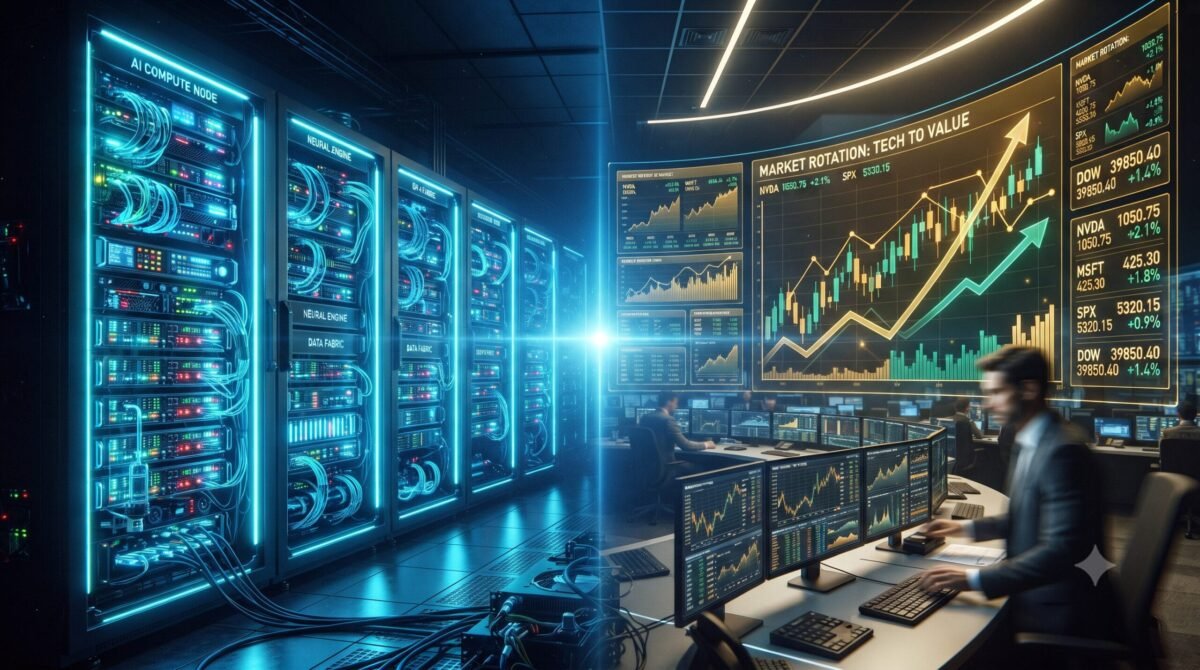
Table of Contents
1. The Capex Explosion: When Spending Outruns Free Cash Flow
The primary driver behind the recent technology pullback is the sheer velocity of capital deployment. Leading cloud and platform providers have dramatically escalated their infrastructure spending forecasts to secure dominance in generative intelligence.
- Negative Free Cash Flow Pressures: For major players like Alphabet and Meta, aggressive multi-billion-dollar buildouts have pushed free cash flow margins into unprecedented territory, triggering sharp single-session sell-offs despite headline-beating revenue figures. Argent Financial Group
- The ROI Timetable: Wall Street’s patience is wearing thin regarding the monetization timeline of enterprise AI applications. When capital spending climbs faster than immediate software revenue growth, investors demand clear visibility on return on investment (ROI).
- Narrowing Market Leadership: The days of broad, uncritical buying across the entire tech sector are over. Portfolio managers are separating infrastructure providers from application developers, creating distinct winners and losers within the AI ecosystem. AI Capex Crunch
2. Energy Shocks and the Power Constraints of Data Centers
Artificial intelligence is fundamentally an energy-intensive industry. The exponential expansion of hyperscale data centers requires a massive, uninterrupted supply of electricity—colliding directly with a fragile global energy landscape.
Renewed geopolitical friction in key energy corridors has driven Brent crude and global energy commodities sharply higher. As electricity grids face unprecedented strain from both industrial demand and continuous data center cooling requirements, utility costs are escalating. This energy bottleneck adds a hidden structural cost to AI operations, forcing technology firms to factor power scarcity into their long-term financial models.
3. Macroeconomic Cross-Currents: Sticky Inflation and Central Bank Friction
Equity markets do not operate in a vacuum. The technology sector’s valuation compression is amplified by shifting macroeconomic baselines across major economies.
With central banks navigating sticky inflation pulses driven by commodity fluctuations and massive sovereign debt issuance, long-term bond yields remain elevated. Higher risk-free yields increase the discount rate applied to future corporate earnings. For high-growth tech companies whose valuations rely heavily on cash flows projected far into the future, a higher discount rate mathematically reduces their present stock value. AI Capex Crunch

4. The Great Sector Rotation: Moving From Chips to Defensives
As volatility spikes in high-flying technology segments, institutional capital is executing a classic defensive rotation. Investors are shifting funds away from crowded chip and semiconductor trades toward sectors offering tangible cash flows and lower structural disruption risk:
- Financials & Industrials: Favored for robust balance sheets, strong dividend yields, and resilience against shifting interest rate cycles. Amundi Research Center
- Utilities & Infrastructure: Positioned directly to benefit from the surging power demands of the digital and energy transition. Amundi Research Center
- Healthcare & Consumer Staples: Act as traditional safe havens during periods of heightened macro uncertainty. Amundi Research Center
5. Global Divergence: Divergent Regional Market Performance
The turbulence in U.S. and mega-cap tech sectors is mirrored by a broader re-pricing across international markets. While domestic indexes grapple with tech concentration risk, international equities are displaying stark geographic divergences. Regions heavily weighted toward manufacturing, heavy industry, or commodities are reacting differently to shifting global trade flows and currency fluctuations, reminding portfolio managers of the critical necessity of global diversification.
Conclusion-AI Capex Crunch
The AI capex crunch marks the end of speculative exuberance and the beginning of a mature, highly selective phase for global technology markets. While artificial intelligence remains a transformative long-term secular trend, the market’s demand for fiscal discipline, operational efficiency, and clear cash generation has never been higher. For institutional treasuries and retail investors alike, navigating this environment requires looking beyond hype and focusing strictly on fundamental balance-sheet resilience.
Frequently Asked Questions (FAQs)
What is the “AI capex crunch” currently impacting markets?
The AI capex crunch refers to investor anxiety over the massive, escalating capital expenditures technology companies are pouring into AI infrastructure (like data centers and chips), which has begun outpacing near-term cash generation and depressing share prices.
Why do high capital expenditures cause tech stock prices to fall?
When companies spend heavily on long-term projects, their immediate free cash flow declines. If investors fear that the financial return on those investments will take too long to materialize, they sell off the stock to reallocate capital elsewhere.
How do energy prices affect artificial intelligence data centers?
Data centers consume vast amounts of electricity. Rising energy and oil prices increase operational and utility costs for tech infrastructure, squeezing profit margins and adding inflationary pressures.
What sectors are benefiting from the rotation away from tech stocks?
As capital rotates out of crowded technology and semiconductor trades, defensive sectors such as financials, healthcare, utilities, and industrial infrastructure are attracting renewed institutional interest. AI Capex Crunch
Disclaimer
The content, AI Capex Crunch published on cfostimes.com is strictly for informational, analytical, and educational purposes only and does not constitute formal professional financial, investment, legal, regulatory, or tax advice. Global market dynamics, artificial intelligence capital expenditures, and macroeconomic shifts involve substantial financial and operational risks. Readers must always conduct independent research, exercise individual due diligence, or consult a licensed fiduciary, certified financial advisor, or qualified legal and regulatory professional before executing any portfolio adjustments, corporate compliance decisions, or trading strategies.

Dr. Dinesh Kumar Sharma is a CMA an award-winning Chief Financial Officer and Director of Finance with over 25 years of expertise in strategic planning and digital transformation. Recognized as a five-time CFO of the Year, he specializes in leveraging Generative AI and Microsoft Copilot to optimize financial forecasting and cost management. Dr. Sharma holds a Doctorate in Management (Finance) and has successfully scaled organizations from INR 1 billion to INR 7 billion. He is dedicated to providing transparent, data-driven insights for modern decision-makers at CFOs Times.









1 thought on “5 Shocking Reasons the AI Capex Crunch is Reshaping Global Stock Markets”