
Higher-for-longer interest rates have fundamentally redefined the global macroeconomic landscape, replacing an era of ultra-cheap capital with a resilient environment of elevated borrowing costs. As central banks around the world navigate persistent core inflation, labor market adjustments, and geopolitical supply shocks, the financial paradigm has shifted decisively. For institutional investors, corporate treasurers, and everyday consumers, understanding the structural mechanics of a prolonged restrictive monetary stance is vital for navigating modern economic cycles.
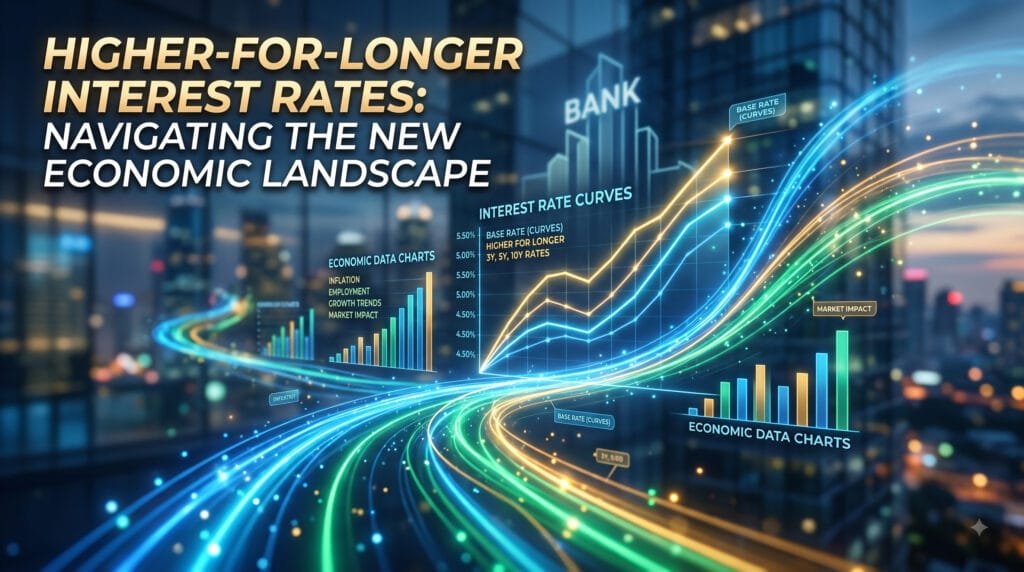
Table of Contents
The Macroeconomic Shift: Why Rates Are Staying Elevated
The prevailing monetary policy framework has transitioned from anticipating rapid policy easing to accepting a prolonged plateau of restrictive benchmark rates. Central banks, including the U.S. Federal Reserve, have maintained target interest rate ranges between 3.50% and 3.75% to combat lingering inflationary pressures.
Core Drivers of Sustained High Rates
- Resilient Economic Activity: Robust labor markets and consumer spending have prevented the sharp economic contractions typically required to force aggressive monetary easing.
- Persistent Core Inflation: Core consumer price indices and sticky service-sector inflation continue to hover above the idealized 2% target, keeping policymakers on high alert.
- Energy and Geopolitical Shocks: Ongoing supply chain frictions and recurring energy price volatility have re-ignited inflationary risks, prompting a more hawkish policy posture. Higher-for-longer interest rates
When evaluating how higher-for-longer interest rates influence global financial stability, economists examine the direct transmission channels into sovereign bond yields and commercial lending facilities. To explore comprehensive research on long-term monetary policy trends and macroeconomic forecasts, financial professionals regularly consult data published by the Federal Reserve Bank of San Francisco and the International Monetary Fund.
Reshaping Corporate Strategy and Capital Allocation
The permanence of elevated borrowing costs has forced a dramatic evolution in corporate finance, moving away from speculative expansion toward rigorous capital discipline.
Key Adjustments in Corporate Finance
- Elevated Hurdle Rates: As the cost of debt climbs, the minimum expected return required to justify new capital expenditures or long-term investments has risen sharply.
- Focus on Immediate Cash Flow: Businesses are prioritizing operational profitability and organic cash generation over long-term, unproven user-acquisition strategies.
- Deleveraging and Refinancing Pressures: Corporations holding maturing debt are forced to refinance at substantially higher coupon rates, separating financially resilient enterprises from over-leveraged entities.
When higher-for-longer interest rates dominate financial markets, organizations must optimize their working capital management and strengthen balance sheets. For authoritative analysis on corporate finance trends and global market developments, experts frequently reference reports provided by the Bank for International Settlements.
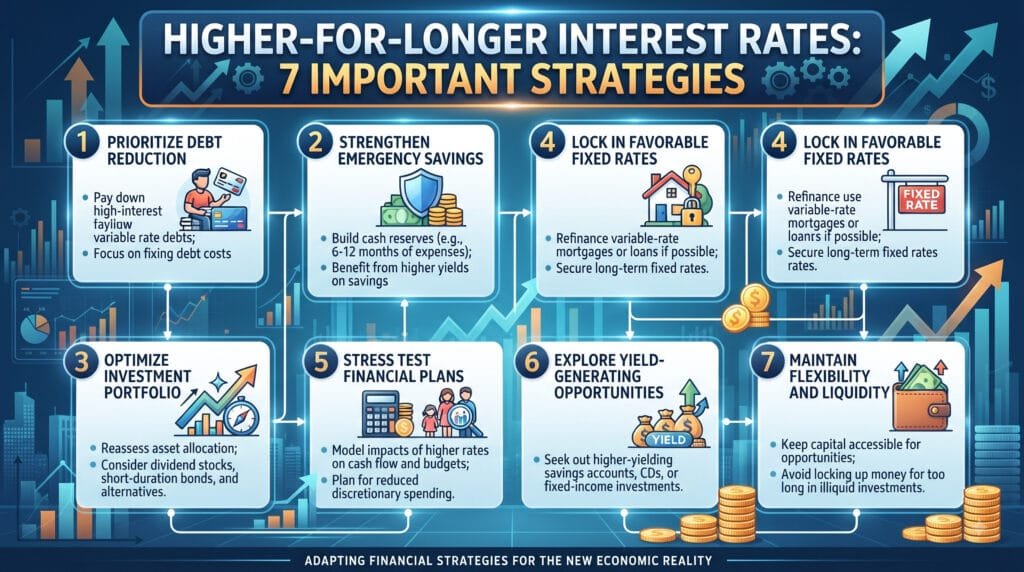
Comprehensive Pillar Analysis: 7 Strategic Pillars for Enterprise Resilience
To build a true pillar-grade resource, businesses and investors must implement comprehensive frameworks addressing structural monetary shifts. Higher-for-longer interest rates
1. Dynamic Liquidity Management and Cash Optimization
In a high-rate regime, holding idle cash in low-yielding accounts creates massive opportunity costs. Enterprises are shifting toward automated sweeps, money market funds, and short-term sovereign debt instruments to maximize yield on working capital.
2. Restructuring Corporate Debt Portfolios
With refinancing risks magnified, CFOs are proactively replacing floating-rate debt with fixed-rate instruments where feasible, or extending debt maturities to avoid near-term refinancing cliffs.
3. Rigorous Capital Expenditure Prioritization
Every capital project undergoes strict scrutiny. Projects must clear higher hurdle rates, ensuring that investments yield immediate operational efficiencies rather than speculative, long-term returns.
4. Supply Chain Resilience and Working Capital Efficiency
Tying up capital in excess inventory becomes increasingly expensive when borrowing costs are elevated. Companies are adopting Just-In-Time (JIT) optimization and tighter accounts receivable collection cycles.
5. Re-evaluating M&A and Valuation Multiples
Private equity and corporate acquirers are adjusting valuation models downward to account for higher cost of capital, focusing heavily on cash-generative targets rather than top-line growth alone.
6. Hedging Against Geopolitical and Currency Volatility
Prolonged high interest rates often strengthen domestic currencies against emerging market currencies, requiring sophisticated FX hedging strategies to protect international profit margins.
7. Strategic Pricing Power and Margin Protection
Passing rising input and financing costs onto consumers without destroying demand requires resilient product positioning, brand loyalty, and continuous operational cost rationalization.
Comparative Impact Across Economic Sectors
Different industries experience distinct structural reactions to a prolonged high-rate regime, altering risk-reward profiles across asset classes.
| Economic Sector | Short-Term Operational Effect | Long-Term Strategic Adaptation |
| Banking & Financial Services | Expanded net interest margins offset by rising loan default provisions | Stricter underwriting standards and enhanced liquidity risk management |
| Real Estate & Construction | Reduced transaction velocity and compressed commercial property valuations | Equity-heavy capital structures and conservative development financing |
| Technology & Venture Capital | Contraction in early-stage valuations and restricted access to cheap venture debt | Relentless focus on profitability, cost rationalization, and sustainable unit economics |
When analyzing higher-for-longer interest rates, market participants recognize that traditional asset allocation models must adapt to reward reliable income generation over speculative growth. Higher-for-longer interest rates
Frequently Asked Questions- Higher-for-longer interest rates
What does a higher-for-longer interest rate environment mean for borrowers?
It means that mortgages, commercial loans, and corporate debt will remain expensive for an extended period, requiring tighter budgeting and more rigorous debt service planning.
Why are central banks keeping interest rates elevated?
Central banks maintain restrictive policies to ensure core inflation sustainably returns to target levels while balancing resilient employment conditions and guarding against fresh supply-side shocks.
How do prolonged high rates affect fixed-income investors?
Investors benefit from attractive yields on short-term instruments, money market funds, and high-quality bonds, shifting capital away from speculative risk assets toward guaranteed income streams.
How can small and medium enterprises (SMEs) adapt to elevated borrowing costs?
SMEs can protect their bottom lines by renegotiating supplier terms, accelerating receivables, cutting non-essential overhead, and leaning into short-term cash flow financing rather than long-term debt commitments.
Conclusion-Higher-for-longer interest rates
The entrenchment of higher-for-longer interest rates marks the definitive end of the zero-interest-rate era, establishing a disciplined baseline for modern global economics. By embracing rigorous capital allocation, optimizing cash reserves, and executing the seven vital strategic pillars outlined above, businesses and investors can successfully thrive in a normalized yield environment.
Disclaimer:
The insights, analyses, and strategic frameworks presented on cfostimes.com about Higher-for-longer interest rates are for informational and educational purposes only and do not constitute professional financial, legal, or investment advice. Global macroeconomic conditions, central bank policies, and financial markets are subject to rapid and continuous change. Enterprise leaders, corporate treasurers, and financial professionals should conduct independent due diligence, evaluate their organization’s specific risk profile, and consult with qualified advisors before making capital allocation, debt restructuring, or strategic investment decisions. cfostimes.com assumes no responsibility or liability for any financial outcomes or operational consequences resulting from the application of information contained in this publication.

Dr. Dinesh Kumar Sharma is a CMA an award-winning Chief Financial Officer and Director of Finance with over 25 years of expertise in strategic planning and digital transformation. Recognized as a five-time CFO of the Year, he specializes in leveraging Generative AI and Microsoft Copilot to optimize financial forecasting and cost management. Dr. Sharma holds a Doctorate in Management (Finance) and has successfully scaled organizations from INR 1 billion to INR 7 billion. He is dedicated to providing transparent, data-driven insights for modern decision-makers at CFOs Times.









1 thought on “Higher-for-Longer Interest Rates: 7 Important Strategies”