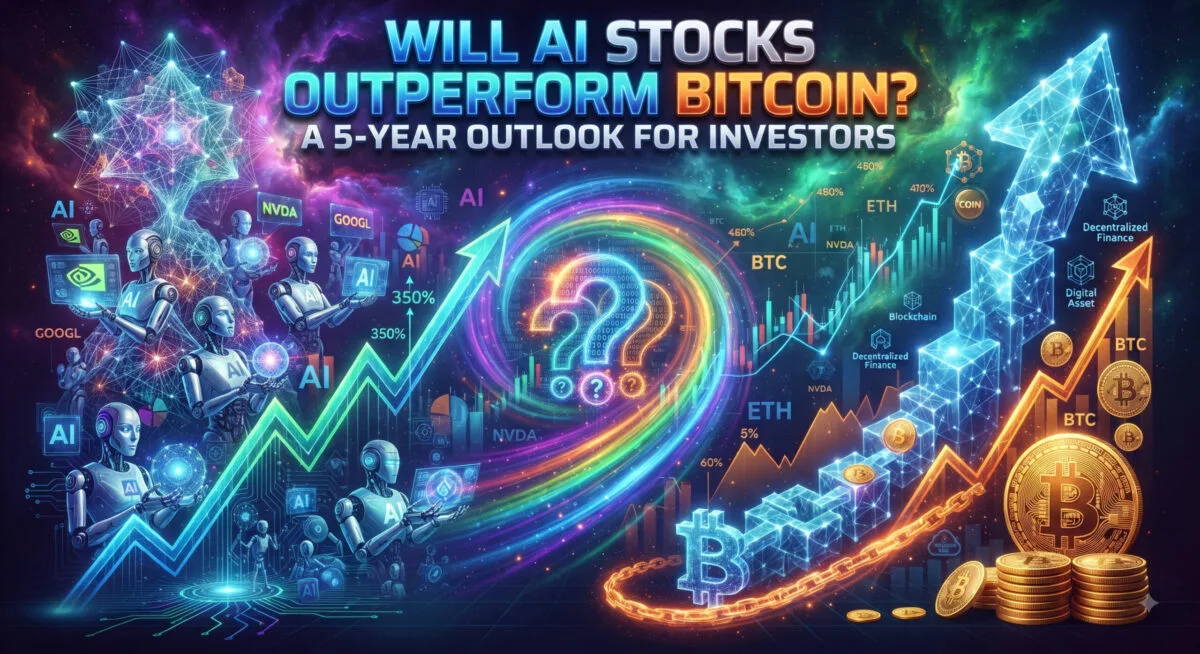
The landscape of modern investing is undergoing a profound structural evolution. For over a decade, digital assets stood unchallenged as the ultimate speculative frontier for retail participants and institutional allocators hunting extraordinary growth. However, the unprecedented emergence of the artificial intelligence (AI) infrastructure boom has introduced a formidable rival. As macroeconomic dynamics shift, portfolio managers, wealth advisors, and everyday investors are forced to re-evaluate asset allocation models and ask a critical question: will ai stocks outperform bitcoin over the next five-year cycle?
Answering this question requires looking far beyond surface-level market hype, examining fundamental valuation metrics, analysing cash-flow generation, understanding technological moats, and evaluating how capital rotation behaves in evolving monetary cycles. Detailed analytical breakdowns from institutional platforms like The Motley Fool
and market performance reviews by CoinDesk provide crucial data points for modern allocators navigating this transition.
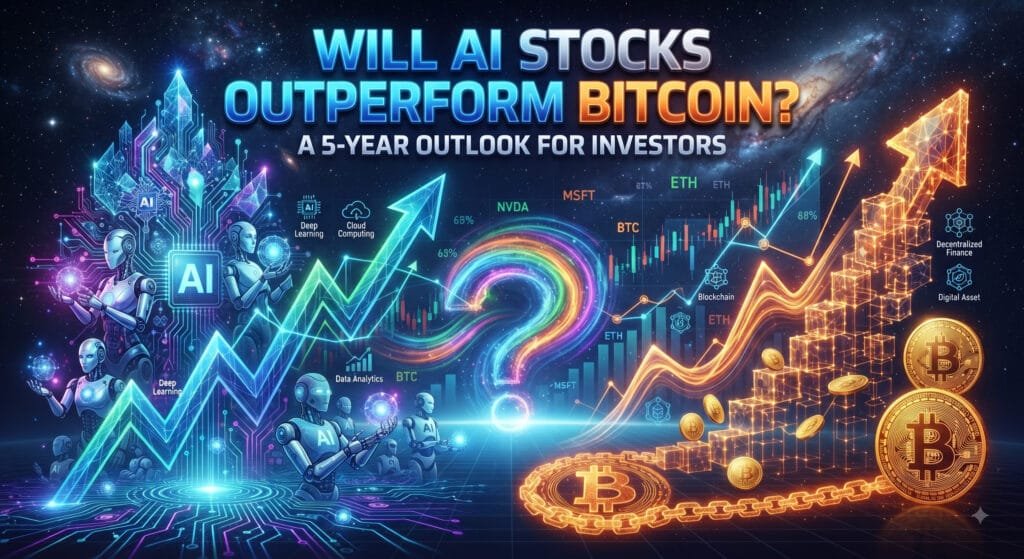
Table of Contents
1. Performance Reality Check: Bitcoin vs. The Broader Market and Tech Equities
When assessing a multi-year investment horizon, historical performance provides vital, sobering context for capital deployment. Over the past five years, Bitcoin has recorded gains of roughly 40%. While this reflects a positive long-term trajectory through severe macro cycles, regulatory headwinds, and mining reward halvings, it lags significantly behind traditional equity benchmarks.
By comparison, the S&P 500 delivered returns of approximately 74% over the exact same timeframe. Even more pronounced is the divergence when matching cryptocurrency progress against the hyper-growth of artificial intelligence equities. Major technology companies spearheading machine learning advancements, semiconductor manufacturing, cloud computing, and automated software solutions have consistently outperformed both digital tokens and traditional index averages, fundamentally altering how institutional capital is distributed globally.
2. Fundamental Differences: Real Revenue vs. Speculative Store of Value
The core divergence between digital tokens and artificial intelligence equities lies in operational mechanics and intrinsic value creation. Understanding these mechanics is essential for constructing a resilient multi-year portfolio.
The Cash Flow and Enterprise Advantage
Leading artificial intelligence corporations operate robust, highly profitable, revenue-generating enterprises. They sell scalable cloud infrastructure, enterprise-grade software, advanced semiconductors, and automated services to a global customer base. Their valuations are anchored by tangible earnings, expanding operating margins, and scalable business models that benefit directly from increasing enterprise spending. When an AI company increases its operational efficiency or secures multi-billion-dollar enterprise contracts, its underlying equity value rises in tandem with measurable financial output. Will AI stocks outperform Bitcoin?
The Digital Asset Model
Conversely, digital assets function under entirely different paradigms. They do not operate traditional corporate business models, nor do they distribute dividends, report quarterly earnings, or generate direct cash flow from commercial product sales. Instead, valuation depends primarily on market sentiment, global macro liquidity, algorithmic supply constraints, and what willing buyers are prepared to pay at any given moment. Because artificial intelligence corporations offer both organic business expansion and rising equity valuations, they increasingly pull capital away from purely speculative, non-yielding instruments. Will AI stocks outperform Bitcoin?
3. Bullish Catalysts for Digital Assets Over the Next Five Years
Despite facing stiff competition from high-growth technology equities, digital tokens retain unique structural characteristics that could support future price appreciation and attract defensive capital.
Scarcity and Capped Supply Mechanics
The total lifetime supply of Bitcoin is hard-capped at 21 million coins, with approximately 20 million already mined into circulation. This algorithmic scarcity mirrors precious metals like gold, establishing a decentralized store of value narrative that appeals strongly to investors seeking protection against fiat currency debasement and inflationary monetary policies.
Institutional Adoption and Regulated Financial Products
Institutional participation has expanded significantly over recent years. Figures like Morgan Stanley’s head of digital asset strategy, Amy Oldenburg, have noted that broader institutional integration could steadily expand network ownership. Furthermore, spot exchange-traded funds (ETFs)—such as those tracking spot market prices—have pulled in billions of dollars in institutional capital shortly after launch, signaling that traditional financial vehicles are successfully lowering barriers to entry for risk-averse allocators. Will AI stocks outperform Bitcoin?
Recession Hedge and Safe-Haven Potential
During periods of systemic economic stress, such as the regional banking instability observed during previous economic contractions, digital tokens occasionally exhibit safe-haven characteristics. Macroeconomic downturns, geopolitical tensions, or monetary policy shifts can trigger capital flight into alternative non-sovereign assets as a hedge against traditional financial system vulnerabilities. Will AI stocks outperform Bitcoin?
4. Why Artificial Intelligence Equities Pose a Formidable Threat
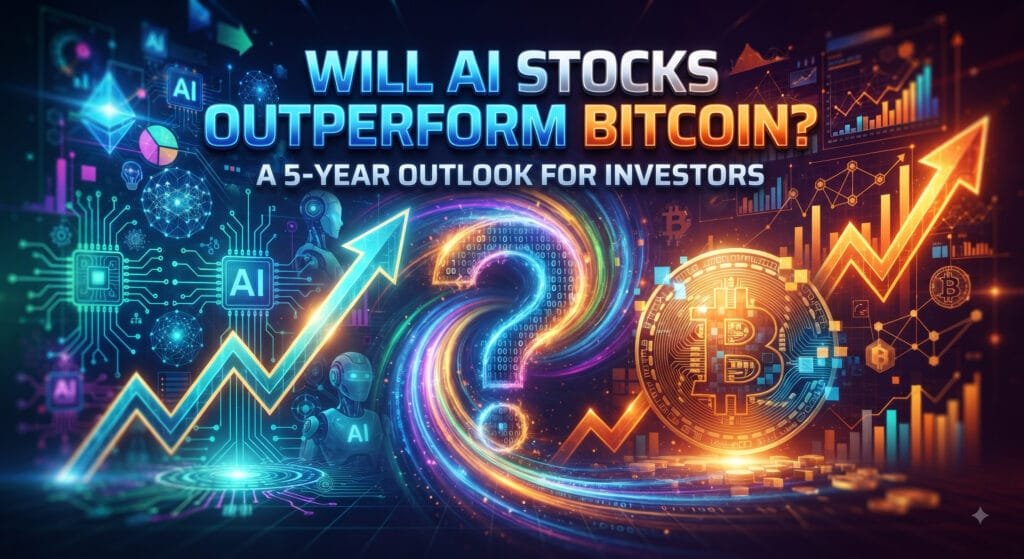
Before the machine learning revolution accelerated, investors seeking aggressive multi-year growth had limited choices outside of high-beta technology startups or emerging crypto assets. Today, artificial intelligence equities provide a compelling, fundamentally backed alternative. Will AI stocks outperform Bitcoin?
- Established Market Dominance and Network Effects: Mega-cap technology leaders integrating machine learning into cloud and mobile ecosystems offer safety combined with explosive upside. Their massive cash reserves allow them to acquire top-tier AI talent and research infrastructure that smaller competitors cannot match.
- Resilience Through Macro Volatility: Even during broader market corrections, the structural demand for enterprise automation, data processing, and advanced computing has preserved the underlying momentum of top-tier technology shares.
As long as the technology investment boom continues, digital currencies will find it increasingly difficult to replicate the explosive, short-term dominance they enjoyed in previous market cycles. Will AI stocks outperform Bitcoin?
5. Strategic Portfolio Allocation for the Next Decade
Navigating the next five years requires balancing growth with risk management. Institutional portfolios are increasingly adopting a barbell strategy, combining cash-generating technology equities with alternative stores of value. However, the shifting return profile suggests that capital may favor productive assets over non-yielding alternatives during periods of economic expansion. Will AI stocks outperform Bitcoin?
Frequently Asked Questions
Will ai stocks outperform bitcoin consistently over the next 5 years?
While past performance does not guarantee future results, technology equities benefit from underlying corporate cash flows and real-world revenue generation. This gives them a structural advantage over non-yielding speculative assets during stable economic expansions. Will AI stocks outperform Bitcoin?
Is digital currency still a viable long-term portfolio addition?
Yes. Many financial advisors suggest holding a modest, diversified allocation in digital assets or spot ETFs to hedge against macroeconomic uncertainty and capitalize on institutional maturation.
How does institutional adoption affect digital asset pricing?
Greater participation from major financial institutions, commercial banks, and asset managers increases market liquidity, legitimizes the asset class, and simplifies capital allocation for retail participants.
Conclusion
The market environment has shifted definitively. While digital tokens retain strong supply-side fundamentals, institutional catalysts, and potential safe-haven appeal during economic downturns, they no longer hold a monopoly on high-growth speculation. Artificial intelligence equities have emerged as dominant competitors, offering robust earnings, commercial utility, and impressive share-price appreciation. Investors navigating the next half-decade must weigh these contrasting risk-reward profiles carefully to construct balanced, resilient portfolios. Will AI stocks outperform Bitcoin?
Disclaimer
The information provided in this article—“Will AI stocks outperform bitcoin? A 5-Year Outlook for Investors”—is for general informational, educational, and analytical purposes only and does not constitute formal financial, investment, legal, or tax advice.
The author, editorial team, and cfostimes.com are not registered financial advisors, brokers, or investment dealers. Markets for digital assets, cryptocurrencies, and artificial intelligence equities carry substantial risks, including the potential for complete loss of capital. Past performance, historical data, or macroeconomic comparisons discussed herein are no guarantee of future returns or market trajectories.
Readers should conduct their own independent research, evaluate their personal risk tolerance, and consult with a qualified, licensed financial professional or wealth advisor before making any investment or asset allocation decisions. cfostimes.com assumes no responsibility or liability for any financial losses or damages arising directly or indirectly from the use of or reliance on any information presented in this publication. Will AI stocks outperform Bitcoin?

Dr. Dinesh Kumar Sharma is a CMA an award-winning Chief Financial Officer and Director of Finance with over 25 years of expertise in strategic planning and digital transformation. Recognized as a five-time CFO of the Year, he specializes in leveraging Generative AI and Microsoft Copilot to optimize financial forecasting and cost management. Dr. Sharma holds a Doctorate in Management (Finance) and has successfully scaled organizations from INR 1 billion to INR 7 billion. He is dedicated to providing transparent, data-driven insights for modern decision-makers at CFOs Times.