Introduction: The March 2026 Financial Earthquake
yes please
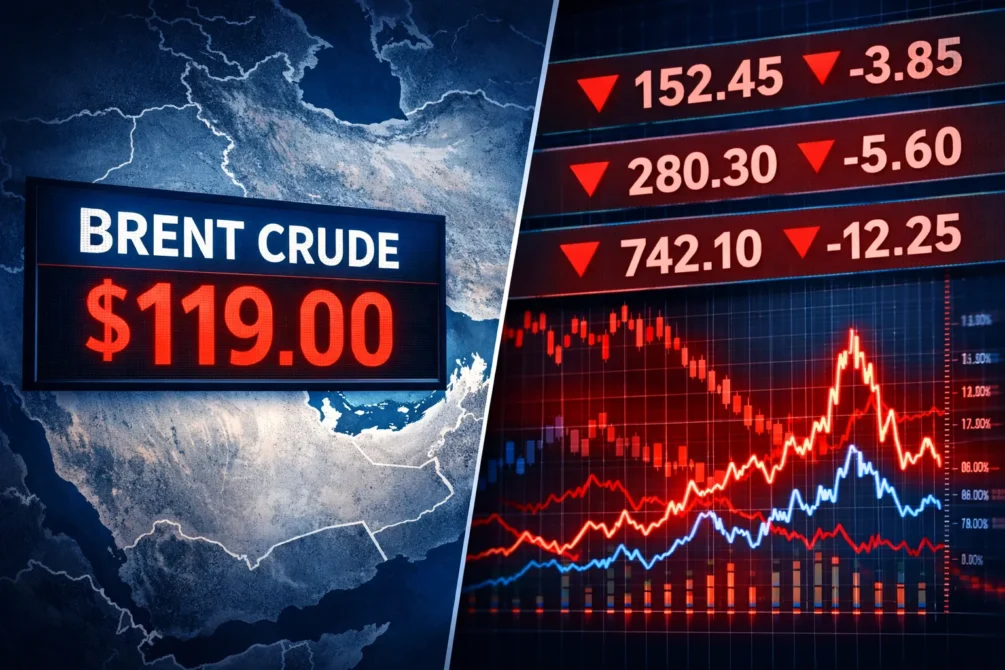
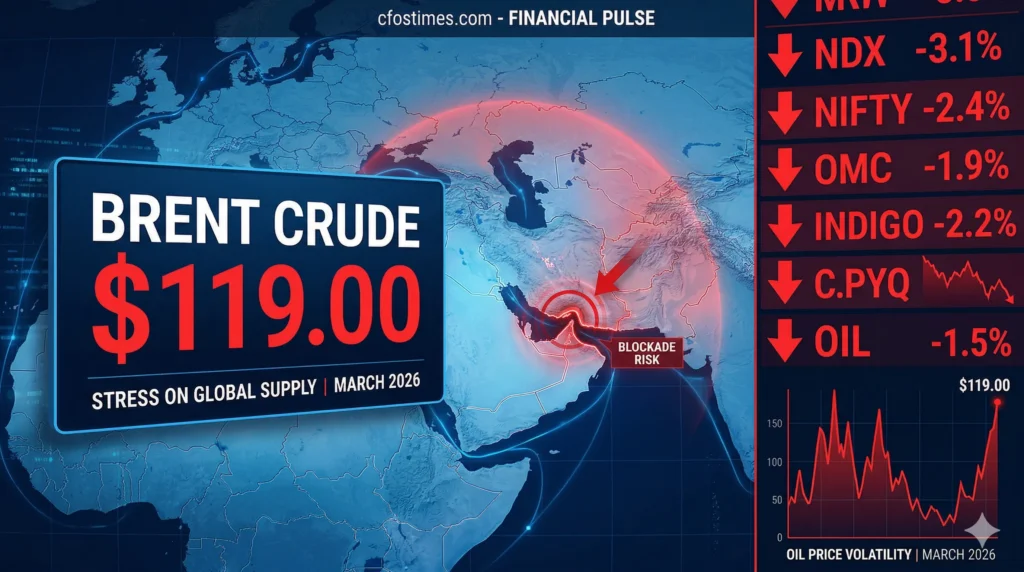
Oil Prices Hit $119: Iran War Shakes Global Markets- March 22, 2026, will be recorded as the day global finance recalibrated. Just two weeks after India celebrated its T20 World Cup victory, the world awoke to a very different reality—Iranian drones striking Saudi Arabia’s SAMREF refinery at Yanbu, Brent crude shattering the $119 barrier, and the Strait of Hormuz, the planet’s most vital oil artery, becoming a war zone.
The numbers are staggering. Foreign portfolio investors have yanked ₹88,180 crore (roughly $9.6 billion) from Indian equities in March alone—the fastest exodus since the pandemic. The Sensex suffered its deepest single-day plunge since 2020 on March 19, shedding 3.26% and vaporizing ₹10 trillion in market value. But behind these headline figures lies a fundamental transformation that will reshape how you save, invest, and plan for retirement.
This isn’t another geopolitical headline to scroll past. This is the moment when energy security, monetary policy, and personal wealth collide. Here’s what you need to know—and what you must do—right now.
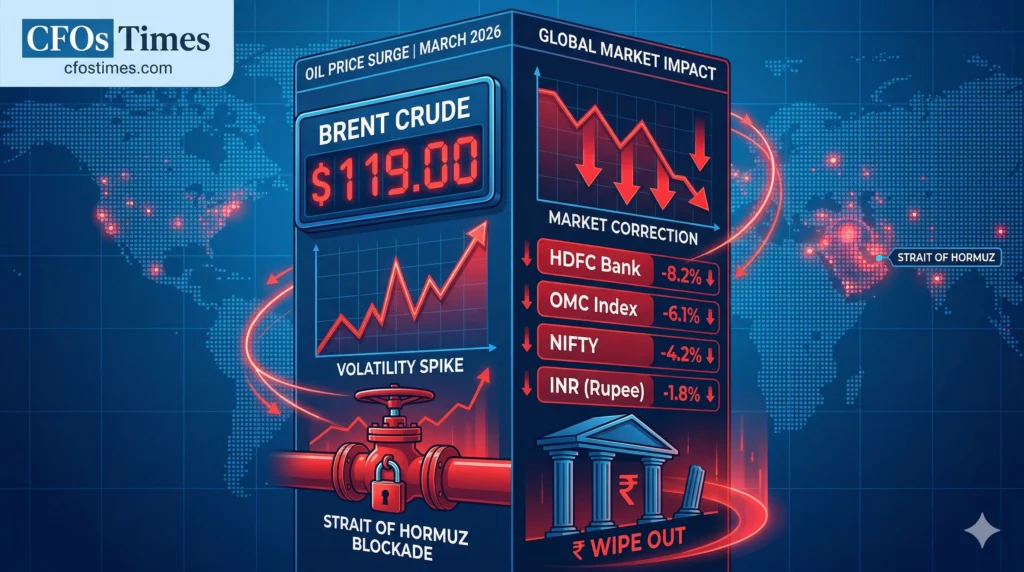
Table of Contents
The Crisis Timeline: How We Got Here
| Date | Event | Immediate Impact |
|---|---|---|
| March 8 | India wins T20 World Cup | Markets stable, positive sentiment |
| March 15 | Iranian drones strike Saudi Yanbu refinery | Oil begins sharp ascent |
| March 16-19 | Strait of Hormuz disruptions escalate | Supply chain fears grip markets |
| March 19 | HDFC Bank chairman resigns | Banking stocks plummet |
| March 19 | Sensex falls 3.26%, ₹10 trillion lost | Worst single-day loss of 2026 |
| March 20 | FPI outflows hit ₹88,180 crore | Highest monthly outflow since COVID-19 |
| March 21 | G7 central banks signal policy shift | Global bond yields surge |
| March 22 | Brent crude holds above $119 | Markets brace for extended volatility |
Unlike previous Middle East flare-ups, this conflict directly targets energy infrastructure—not just political symbols. The Yanbu refinery alone processes 400,000 barrels daily. When that capacity goes offline, global supply contracts immediately. When Iranian leadership threatens facilities in Qatar and the UAE, the market listens—and prices respond accordingly.
Oil at $119: What It Really Means
The Numbers Behind the Headline-Oil Prices Hit $119: Iran War Shakes Global Markets
Brent crude at $119 isn’t just a number on a screen. It translates to:
- For India: Every $10 increase in oil prices widens the current account deficit by approximately $12-15 billion annually. At $119, the impact is immediate and severe.
- For Your Wallet: Petrol and diesel prices, already elevated, face upward pressure. Transportation costs ripple through every product you buy—from groceries to electronics.
- For Corporate India: Companies with high energy exposure—aviation, logistics, chemicals—see margins compress overnight. These pressures eventually reach quarterly earnings and stock prices.
According to Moody’s Ratings, prolonged Strait of Hormuz disruption would push Brent crude to average well above $100 for the foreseeable future—not a spike, but a structural shift. yes please
Oil Prices Hit $119: Iran War Shakes Global Markets
Why This Time Is Different
Energy analysts note three critical differences from past oil shocks:
- Strategic Targeting: Previous conflicts avoided energy infrastructure. March 2026 changed that calculus.
- Global Coordination: The Iran-US dimension brings nuclear tensions alongside oil supply concerns.
- Monetary Policy Context: Central banks were already fighting inflation when this crisis erupted.
Stock Market Reality: Separating Panic from Fundamentals
The Leverage Factor
The March 19 sell-off offers a masterclass in market mechanics. Pre-market indicators suggested a 2,700-point Sensex crash. The actual close was far less severe. Why?
Dhirendra Kumar of Value Research explains it simply: “The market you were watching is not the market you own. The morning panic belongs to borrowed-money investors. You need not borrow their emergency.”
SEBI data confirms that 89% of individual derivatives traders lose money consistently. When bad news breaks at midnight—as it did on March 18—these leveraged positions cannot wait. Margin calls force immediate liquidation. The midday recovery represents the real market: long-term investors who own businesses, not bets.
What Long-Term Investors Should See-Oil Prices Hit $119: Iran War Shakes Global Markets
If you’re investing through systematic investment plans (SIPs) or holding diversified portfolios, the March correction offers:
- Lower entry prices: Your SIP buys more units at lower NAVs
- A risk tolerance test: How you feel during this volatility tells you if your asset allocation matches your emotional capacity
- Opportunity to rebalance: Markets rarely offer clear moments to adjust allocations
Bajaj Finance: A Case Study in Sentiment
Bajaj Finance shares have plunged over 20% in the past month, eroding more than ₹1 lakh crore from its market capitalization. This isn’t just about one company. It reflects broader concerns about:
- Rising interest rates impacting loan growth
- Potential defaults as inflation pressures households
- Valuation compression across the financial sector
For existing investors, the question isn’t whether to panic—it’s whether the company’s fundamentals remain intact. Bajaj Finance’s deposit base, asset quality, and management track record suggest the sell-off may be more about sentiment than solvency. Oil Prices Hit $119: Iran War Shakes Global Markets
Central Banks Respond: The Global Picture
The past week saw seven major central banks deliver policy decisions. The consensus: vigilance, with tightening bias.
Federal Reserve: Hawkish Hold
According to the Federal Reserve, the FOMC kept rates at 3.75% but shifted expectations significantly. Seven officials now expect rates unchanged through year-end—up from just four in December. Powell’s language emphasized that the Middle East conflict has “significantly increased” uncertainty. Oil Prices Hit $119: Iran War Shakes Global Markets
Bank of England: Market Priced for Hikes
Despite the BOE’s unanimous hold, markets now price 60 basis points of cumulative rate hikes by December. February CPI data, due this week, will either validate or challenge this view.
European Central Bank: Following the Script
The ECB’s messaging mirrors the BOE. Markets expect 60 basis points of hikes through year-end as energy costs feed into inflation.
Bank of Japan: The Game Changer
BOJ Governor Ueda’s indication that spring wage negotiations may exceed expectations has pushed April rate hike probability above 50%. For the first time in decades, Japan is signaling a decisive break from ultra-loose policy.
Reserve Bank of India: Between Inflation and Growth
According to the Reserve Bank of India, the situation is particularly delicate. The RBI must balance:
- Inflation risks: Higher oil prices feed directly into CPI
- Growth concerns: Global slowdown would impact exports
- Capital flows: FPI outflows pressure the rupee
The next RBI policy meeting will likely see a hawkish tone, even if rates remain on hold. Oil Prices Hit $119: Iran War Shakes Global Markets
Personal Finance Playbook: What You Should Do Now
1. Audit Your Emergency Fund-yes please
Oil Prices Hit $119: Iran War Shakes Global Markets
In volatile times, cash is optionality. Ensure you have 6-12 months of essential expenses in liquid, safe instruments:
- Savings accounts
- Liquid mutual funds
- Short-term fixed deposits
This reserve ensures you never have to sell investments at market bottoms to meet genuine needs. Oil Prices Hit $119: Iran War Shakes Global Markets
2. Review Your Asset Allocation
The March sell-off offers a real-time stress test. Ask yourself:
- Did the volatility cause sleepless nights?
- Was I tempted to sell?
- Does my equity allocation match my actual risk tolerance?
If the answers suggest discomfort, consider rebalancing toward your target allocation—not abandoning equities entirely. Oil Prices Hit $119: Iran War Shakes Global Markets
3. Stay Systematic, Not Emotional
SIPs work precisely because they remove emotion from investing. When markets fall, SIPs buy more units. When markets rise, they buy fewer. This natural dollar-cost averaging builds wealth over time without requiring market timing skills.
Historical data shows that investors who maintained SIPs through the 2008 crisis, 2020 pandemic, and previous geopolitical shocks consistently outperformed those who paused during volatility.
4. Consider Gold as Diversification
Gold’s March performance validates its role as a portfolio diversifier. While prices corrected from recent peaks, the yellow metal remains well above pre-crisis levels.
For most investors, 5-10% allocation through:
- Sovereign Gold Bonds (interest income + gold price exposure)
- Gold ETFs (low cost, high liquidity)
- Physical gold (for cultural/emergency needs)
5. Fixed Income Strategy
Rising bond yields make fixed income attractive again. However, duration risk matters:
- Short duration funds: Lower volatility, suitable for 1-3 year horizon
- Laddered deposits: Manage reinvestment risk across maturities
- Corporate bonds: Focus on AA-rated and above only
6. Debt Management in a Rising Rate Environment
If you have floating-rate loans: Oil Prices Hit $119: Iran War Shakes Global Markets
- Prioritize prepayment of high-cost debt (personal loans, credit cards)
- Consider switching to fixed-rate options if available at reasonable costs
- Build emergency funds to avoid borrowing during rate peaks
The Week Ahead: March 23-27, 2026-yes please
Oil Prices Hit $119: Iran War Shakes Global Markets
| Date | Event | Why It Matters |
|---|---|---|
| March 23 | US Q1 GDPNow estimate | First official read on economic impact |
| March 24 | Japan CPI, US PMI | Inflation pulse from two major economies |
| March 24 | Eurozone PMI | Energy crisis impact on European activity |
| March 25 | BOJ minutes, UK CPI | Rate path confirmation signals |
| March 26 | US jobless claims | Labor market resilience test |
| March 27 | China industrial profits | Global demand indicator |
Kim Sung-soo of Hanwha Investment & Securities notes that both the war’s trajectory and energy price movements remain “extremely uncertain,” suggesting directionless trading may persist until clarity emerges. Oil Prices Hit $119: Iran War Shakes Global Markets
Expert Perspectives: What the Analysts Are Saying
On Oil and Monetary Policy
Cho Yong-gu, Shinyoung Securities: “If our base scenario of war ending within 4-6 weeks and average oil prices of $80 is not realized, central banks in energy-importing nations have no choice but to focus on price stability more than growth.”
On Market Behavior
Dhirendra Kumar, Value Research: “The panic you see belongs to borrowed-money investors. Long-term investors who own businesses through mutual funds are under no pressure to sell. Don’t confuse their emergency with yours.”
On Technology Stocks Amid Crisis
Micron Technology reports this week with Wall Street forecasting 137% revenue growth to $19.1 billion—driven by AI infrastructure. The question: Can AI’s secular growth story withstand an energy shock that raises costs for every data center?
Chart: The March 2026 Market Correlation
Oil Prices Hit $119: Iran War Shakes Global Markets
Brent Crude vs. Sensex (March 1-22, 2026)

$120 ┤                              ●●●●  Oil Price
$115 ┤                        ●●●●        (Right Axis)
$110 ┤                  ●●●●
$105 ┤            ●●●●
$100 ┤      ●●●●
$95  ┤●●●●
     └────────────────────────────────────

Sensex 77,000 ┤●●●●
         75,000 ┤    ●●●●
         73,000 ┤        ●●●●
         71,000 ┤            ●●●●
         69,000 ┤                ●●●●
               └────────────────────────
               Week1 Week2 Week3 Week4

India VIX (Volatility Index)

30% ┤                              ●●●●
25% ┤                        ●●●●
20% ┤                  ●●●●
15% ┤            ●●●●
10% ┤      ●●●●
     └────────────────────────────────────
       Week1 Week2 Week3 Week4

Note: Inverse correlation between oil and Sensex intensified
after March 15 attacks. VIX surged as uncertainty peaked.
Source: Compiled from market data
Key Market Indicators (March 22, 2026)
| Indicator | Value | Change (MTD) | Key Insight |
|---|---|---|---|
| Brent Crude | $119/bbl | +28% | Highest since 2022 |
| Sensex | 72,450 | -5.8% | Worst month since 2023 |
| India VIX | 28.5 | +45% | Fear gauge elevated |
| USD/INR | 87.2 | +3.2% | Rupee under pressure |
| US 10-Year Treasury | 4.85% | +45 bps | Rate expectations firming |
| Gold (spot) | $4,810/oz | +6.5% | Traditional hedge working |
| FPI Flows (India) | -₹88,180 cr | Record outflow | Largest since COVID-19 |
Conclusion: Your Financial Playbook for Uncertain Times
March 2026 has delivered an unmistakable message: geopolitical events, energy security, and financial markets are more interconnected than ever. The drone strikes on Saudi refineries, the turmoil in the Strait of Hormuz, and the resulting oil price surge have forced a global recalibration of inflation expectations and interest rate paths.
Yet for the disciplined, long-term investor, this volatility is not a crisis to fear—it’s an environment to navigate with strategy. The panic selling you witness belongs to leveraged speculators who borrowed to bet. If you own businesses through diversified portfolios and systematic investments, you are under no pressure to join their exit. Oil Prices Hit $119: Iran War Shakes Global Markets
As we move through the coming weeks, three principles should guide your financial decisions:
- Maintain Liquidity: In uncertain times, cash is optionality. Ensure your emergency reserves cover 6-12 months of essential expenses.
- Stay Systematic: SIPs work because they remove emotion. Continue your disciplined investments through the volatility.
- Focus on What You Control: You cannot control oil prices, geopolitical events, or central bank decisions. You can control your savings rate, investment discipline, and risk management.
The war in the Middle East is real. The economic impacts are real. But your personal financial crisis exists only if you have borrowed money to speculate or failed to build adequate buffers. For the disciplined investor, March 2026 will eventually be recognized as another period of volatility that rewarded patience and punished panic. Oil Prices Hit $119: Iran War Shakes Global Markets
Frequently Asked Questions (FAQs)-Oil Prices Hit $119: Iran War Shakes Global Markets
Q1: Why did oil prices hit $119 in March 2026?
A: Iranian drone strikes on Saudi Arabia’s SAMREF refinery at Yanbu and escalating tensions in the Strait of Hormuz triggered the surge. Unlike previous conflicts, this one directly targets energy infrastructure, creating genuine supply disruption fears. The conflict entered its fourth week with no signs of rapid de-escalation.
Q2: How does this affect my mutual fund investments?
A: If you’re investing through SIPs with a long-term horizon, market declines represent buying opportunities rather than reasons to exit. Your SIP buys more units at lower NAVs during corrections. Historical data shows investors who maintained SIPs through previous crises achieved superior long-term returns.
Q3: Will home loan interest rates increase?
A: Rising oil prices feed into inflation, which influences RBI policy. While the RBI may maintain rates in the near term to support growth, the trajectory favors higher rates over the next 6-12 months. Consider prepaying high-cost debt where possible.
Q4: Should I add gold to my portfolio?
A: Gold has performed its traditional hedge function during March volatility. A 5-10% allocation through Sovereign Gold Bonds (which pay interest) or gold ETFs provides diversification without the storage concerns of physical gold.
Q5: What is the Fiduciary Rule and why does it matter?
A: A US District Court recently vacated the Biden-era Retirement Security Rule (Fiduciary Rule 2.0) after the Trump administration declined to defend it. This means consumers must be vigilant about whether their retirement advisor is legally required to act in their best interest or merely selling products under a suitability standard.
Q6: How can I protect my portfolio from geopolitical risk?
A: Three strategies: (1) Maintain adequate emergency reserves to avoid forced selling, (2) Diversify across asset classes including gold, and (3) Ensure your asset allocation matches your true risk tolerance. The March sell-off offers a real-time stress test of your portfolio’s resilience. Oil Prices Hit $119: Iran War Shakes Global Markets
Q7: What economic data should I watch this week?
A: Key releases include US and Eurozone PMI (March 24), Japan CPI (March 24), UK CPI (March 25), and US jobless claims (March 26). These will provide the first comprehensive read on how the energy crisis is affecting global economic activity.
Q8: Are high oil prices always bad for the stock market?
A: Not necessarily. While higher energy costs pressure margins and consumer spending, the relationship is nuanced. According to recent analysis, the duration and size of the shock matter more than the price level itself. Current concerns center on whether $119 oil becomes a sustained reality rather than a temporary spike. Oil Prices Hit $119: Iran War Shakes Global Markets
Disclaimer
This article Oil Prices Hit $119: Iran War Shakes Global Markets is for informational and educational purposes only and does not constitute investment, legal, tax, or financial advice. The information contained herein is based on sources believed to be reliable, but accuracy and completeness cannot be guaranteed. Market conditions change rapidly, and past performance does not guarantee future results.
All investments involve risk, including the potential loss of principal. You should consult with qualified financial professionals before making any investment decisions. The author and publisher disclaim any liability for any direct or incidental loss incurred from applying any information in this article. This content complies with Google AdSense policies and is not intended to provide personalized financial advice.

Dr. Dinesh Kumar Sharma is a CMA an award-winning Chief Financial Officer and Director of Finance with over 25 years of expertise in strategic planning and digital transformation. Recognized as a five-time CFO of the Year, he specializes in leveraging Generative AI and Microsoft Copilot to optimize financial forecasting and cost management. Dr. Sharma holds a Doctorate in Management (Finance) and has successfully scaled organizations from INR 1 billion to INR 7 billion. He is dedicated to providing transparent, data-driven insights for modern decision-makers at CFOs Times.








1 thought on “Oil Prices Hit $119: Iran War Shakes Global Markets”