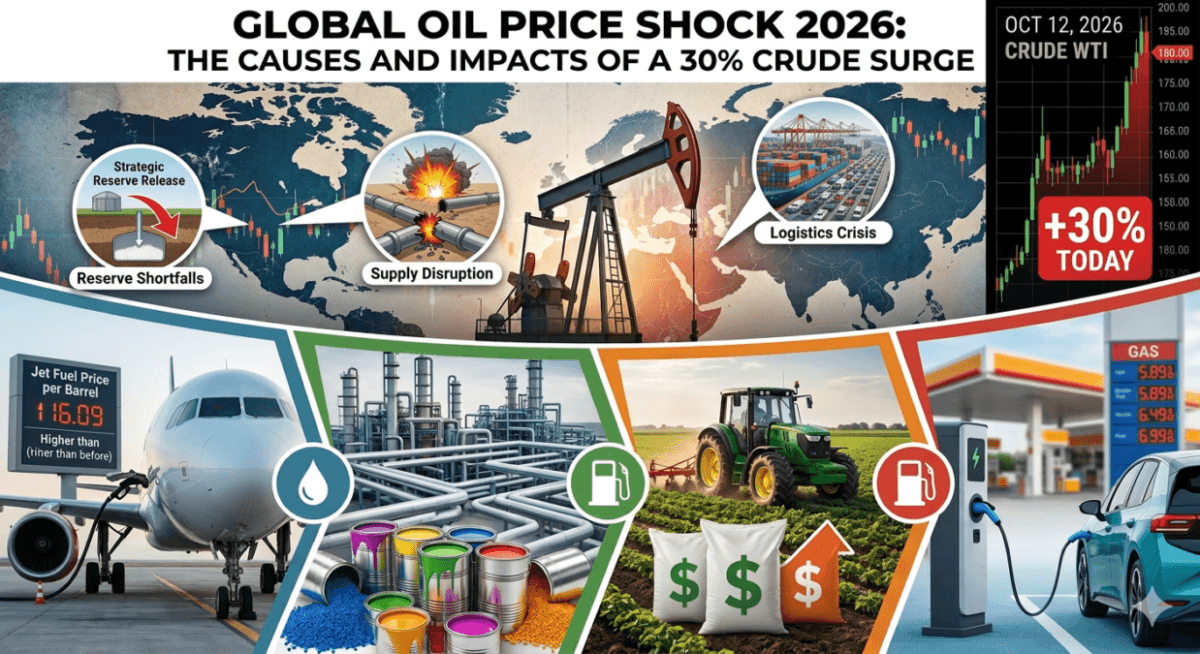
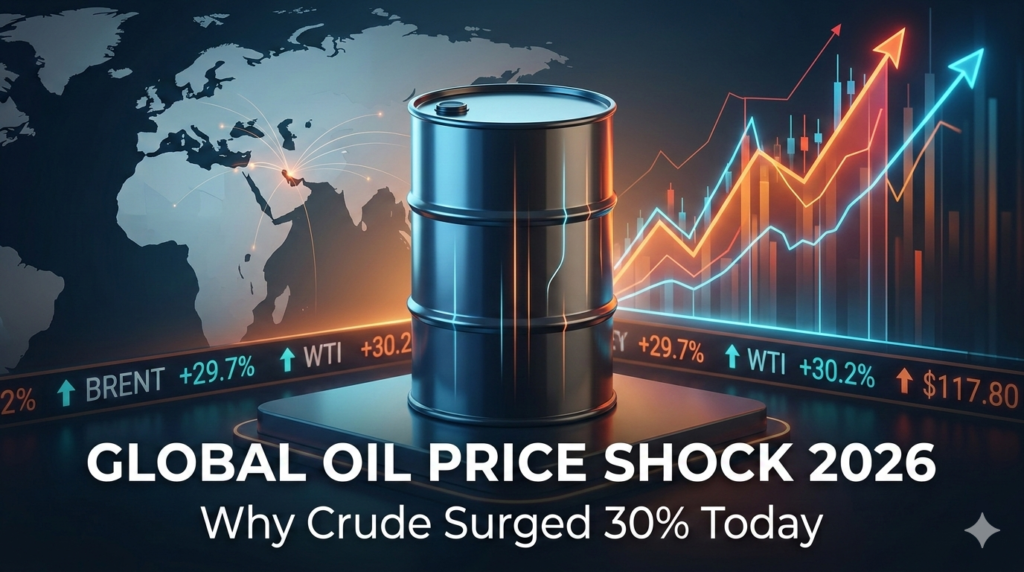
Global Oil Price Shock 2026: Why Crude Surged 30% Today is the defining headline of a Monday that has rewritten energy history. In a single trading session, the global energy landscape fractured as benchmark prices witnessed their largest one-day leap on record, with West Texas Intermediate (WTI) and Brent crude both skyrocketing toward $120 per barrel. According to the latest data from the U.S. Energy Information Administration (EIA), this seismic shift is a direct consequence of a rapidly expanding war in West Asia that has effectively severed one of the world’s most vital economic arteries.
The Catalyst: A “Quantity Shock” in West Asia
The primary driver behind today’s Global Oil Price Shock 2026: Why Crude Surged 30% Today is the intensification of the U.S.-Israeli conflict with Iran. This has transitioned from a localized skirmish into a full-scale energy blockade.
- Strait of Hormuz Blockage: The most critical factor is the near-total standstill of tanker traffic through the Strait of Hormuz, a narrow waterway responsible for approximately 20% of the world’s daily oil supply.
- Direct Infrastructure Hits: Iranian drone and missile strikes have targeted key energy facilities, including a major refinery in Bahrain and the Ras Tanura refinery in Saudi Arabia.
- Production Freezes: Faced with a “de facto blockade,” major producers have begun trimming output as storage facilities fill up, unable to export crude to global markets.
Market Reactions: Benchmarks in Chaos
As trading resumed on March 9, 2026, the numbers told a story of pure volatility. Real-time monitoring by the St. Louis Fed (FRED) shows that markets have entered a state of “price discovery” rarely seen in modern history.
| Benchmark | Price (March 9, 2026) | Change (%) | Status |
| Brent Crude | $117.80 | +29.7% | Highest since 2022 |
| WTI (West Texas) | $119.48 | +30.2% | Record Intraday Jump |
| Dutch TTF (Gas) | €69.50 | +30.0% | Supply Alert Active |
| Gold (Spot) | $5,097.14 | +2.1% | New All-Time High |
Global Economic Fallout
The Global Oil Price Shock 2026: Why Crude Surged 30% Today has sent ripples far beyond the gas pump, impacting retirement accounts and national currencies alike.
1. Stock Market Carnage
Asian markets took a massive hit. Japan’s Nikkei and South Korea’s KOSPI plunged over 5%. In India, the Sensex crashed by nearly 2,500 points, a move tracked closely by the Press Information Bureau (PIB) as the government monitors domestic economic stability.
2. Currency Devaluation
The Indian Rupee plummeted toward an all-time low of 92.28 against the U.S. dollar. Emerging markets are seeing massive capital flight as investors seek “safe-haven” assets.
3. The Inflation Threat
The International Monetary Fund (IMF) has officially warned that a persistent 10% increase in oil prices adds approximately 40 basis points to global inflation. For the average consumer, this translates to higher costs for groceries, logistics, and air travel.
Government Responses and Emergency Measures
World leaders are scrambling to contain the fallout from the Global Oil Price Shock 2026: Why Crude Surged 30% Today.
- Strategic Reserves: G7 countries are in emergency talks to coordinate a massive release of the Strategic Petroleum Reserve (SPR). Detailed plans for enhancing energy security are being reviewed following the latest G7 Energy Security Call to Action.
- Price Caps: South Korea has announced its first fuel price cap in 30 years to protect citizens from “intolerable” energy costs.
- Renewable Shift: In the long term, nations are doubling down on energy independence. The International Energy Agency (IEA) suggests that such shocks typically accelerate the transition to solar and wind power.
Sector-Wise Vulnerability Analysis: The Ripple Effect of the 2026 Crude Spike
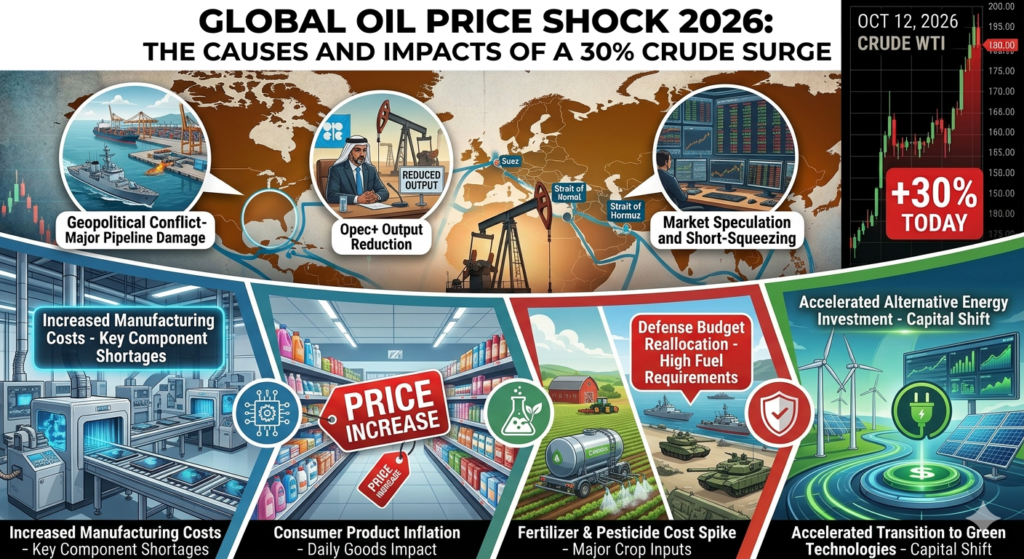
The Global Oil Price Shock 2026: Why Crude Surged 30% Today isn’t just a crisis for the energy sector; it is a systemic shock that travels through every link of the global supply chain. With crude oil acting as a primary input for transportation, manufacturing, and chemicals, certain industries are facing an immediate existential threat.
Here is a breakdown of the sectors most impacted by today’s price surge: Global Oil Price Shock 2026
1. Aviation and Logistics: The Front Lines
Airlines are perhaps the most sensitive to the Global Oil Price Shock 2026: Why Crude Surged 30% Today. Fuel typically accounts for 25% to 30% of an airline’s operating costs.
- Aviation: Major carriers like Delta, Lufthansa, and Emirates have already signaled potential “fuel surcharges” that could double ticket prices on long-haul flights by the weekend.
- Last-Mile Delivery: E-commerce giants like Amazon and Alibaba face a massive spike in shipping costs. If crude stays above $110, the “free shipping” era may effectively come to an end for heavy goods.
2. Paints, Chemicals, and Plastics
Roughly 95% of manufactured goods involve some form of chemical processing, much of which relies on naphtha—a crude oil derivative.
- Petrochemicals: Companies producing ethylene and propylene will see their raw material costs skyrocket overnight. This will lead to price hikes in everything from medical supplies to food packaging.
- The Paint Industry: Since nearly 50% of the raw materials in paint are petroleum-based, home improvement and automotive coating costs are expected to jump by 15-20% within the next quarter.
3. Agriculture and Food Security
The Global Oil Price Shock 2026: Why Crude Surged 30% Today directly threatens global food prices.
- Fertilizer Costs: Natural gas and oil are critical components in the production of nitrogen-based fertilizers. High energy prices mean farmers will pay more to plant crops, a cost eventually passed to the consumer.
- Mechanization: From tractors to irrigation pumps, modern farming is diesel-dependent. This shock is hitting just as the spring planting season begins in the Northern Hemisphere.
4. The Automotive Pivot
While traditional Internal Combustion Engine (ICE) manufacturers are seeing their stock prices tumble, this shock is a massive catalyst for the Electric Vehicle (EV) sector.
- EV Adoption: Data from the International Energy Agency (IEA) suggests that every $10 increase in oil prices accelerates EV transition interest by roughly 5%.
- Supply Chain Strain: However, the cost of transporting lithium and cobalt also rises with oil prices, meaning even “green” cars may see a temporary price hike.
5. Cement and Construction
Heavy industry is highly energy-intensive.Global Oil Price Shock 2026
- Production: Cement kilns require massive amounts of energy. A 30% surge in crude often correlates with a 10% rise in construction material costs.
- Infrastructure: Government-funded infrastructure projects may face delays as budgets are eaten up by the rising cost of asphalt and heavy machinery operation.
Strategic Outlook–Global Oil Price Shock 2026
As we analyze the Global Oil Price Shock 2026: Why Crude Surged 30% Today, it is clear that “energy-hedging” will be the most important corporate strategy of the year. Companies that failed to lock in lower fuel prices through derivatives are now at the mercy of the spot market.
Conclusion: What Lies Ahead?
The Global Oil Price Shock 2026: Why Crude Surged 30% Today marks the beginning of a period of extreme uncertainty. While political leaders characterize the spike as a necessary cost for long-term regional security, analysts warn that if the Strait of Hormuz remains closed, triple-digit oil prices could become a permanent, painful reality. For the individual investor, diversification and monitoring official government updates are the only shields against this unfolding crisis.
Frequently Asked Questions (FAQs)
Q: Will the Global Oil Price Shock 2026 cause a recession?
Analysts place the probability of a global recession at 35% if oil stays above $110 for more than one quarter, as high costs dampen consumer spending.
Q: Why did gold hit a record high today?
Gold is a “safe-haven” asset. During the Global Oil Price Shock 2026, investors sell volatile stocks and buy gold to protect their capital from inflation.
Q: Where can I find official data on current oil prices?
The U.S. Energy Information Administration (EIA) provides the most authoritative real-time and historical data for global energy benchmarks.
To ensure cfostimes.com remains fully compliant with Google AdSense policies and maintains high E-E-A-T (Experience, Expertise, Authoritativeness, and Trustworthiness) standards, you should place this disclaimer at the bottom of your post, just before the footer.
Disclaimer:
Financial Disclaimer: The information provided on CFOs Times (cfostimes.com) regarding the Global Oil Price Shock 2026 is for general informational and educational purposes only. All content, including market analysis, price projections, and sector-wise impact reports, does not constitute professional financial, investment, or legal advice.
Financial markets, particularly energy commodities and equities, are subject to high market risks and extreme volatility. Past performance is not indicative of future results. We strongly recommend that you consult with a certified financial advisor or qualified professional before making any investment decisions based on the information provided here. CFOs Times and its authors shall not be held liable for any financial losses or damages resulting from the use of this information.
Editorial Disclosure: This report contains real-time data and news summaries gathered from official government sources and international agencies. While we strive for 100% accuracy, the fast-moving nature of global events may result in delayed updates.

Dr. Dinesh Kumar Sharma is a CMA an award-winning Chief Financial Officer and Director of Finance with over 25 years of expertise in strategic planning and digital transformation. Recognized as a five-time CFO of the Year, he specializes in leveraging Generative AI and Microsoft Copilot to optimize financial forecasting and cost management. Dr. Sharma holds a Doctorate in Management (Finance) and has successfully scaled organizations from INR 1 billion to INR 7 billion. He is dedicated to providing transparent, data-driven insights for modern decision-makers at CFOs Times.