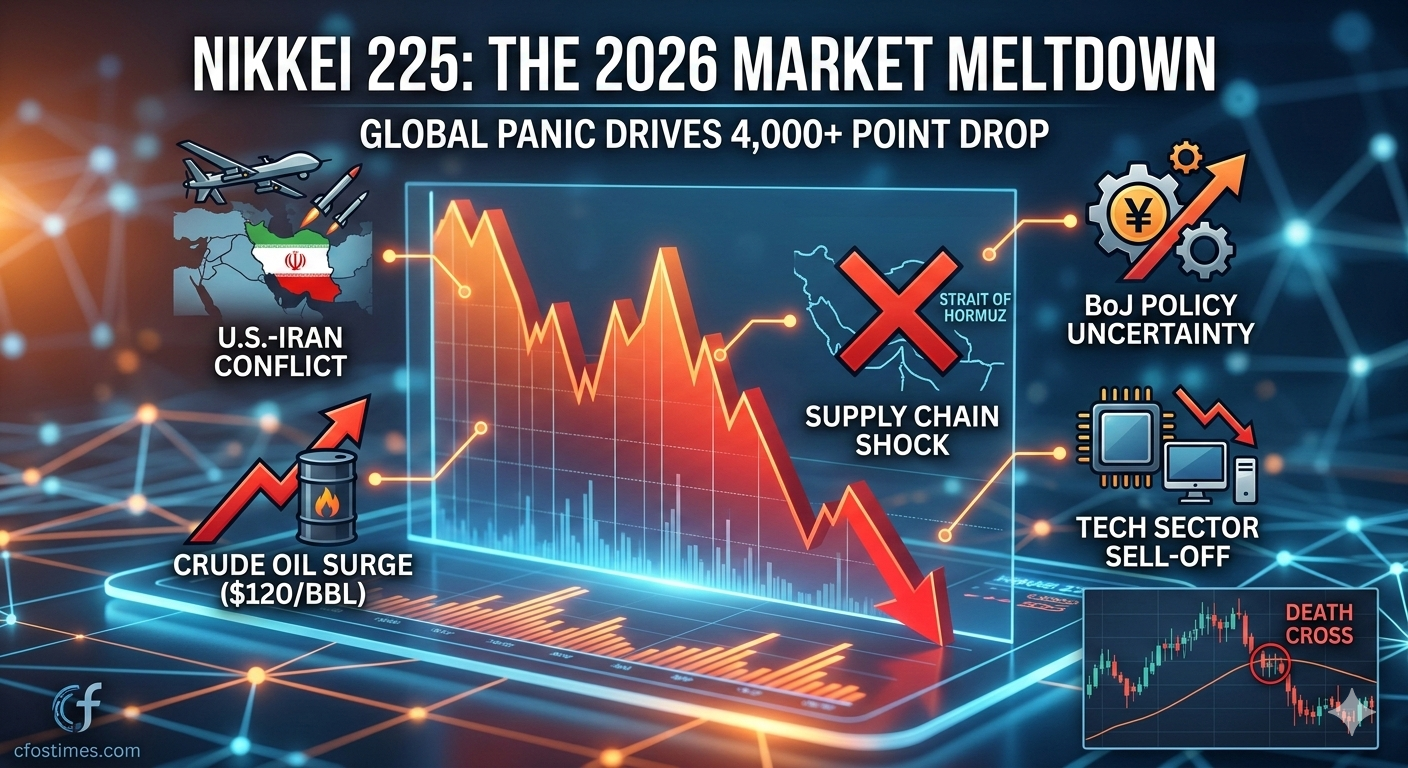
Why Nikkei 225 stock index is crashing today, March 9, 2026, is a question dominating the global financial landscape as Japan’s benchmark index plummeted over 4,000 points—a staggering drop that has sent the index toward the 51,000 level. This massive sell-off, which follows the index hitting a record high of 59,332 in February 2026, marks the most volatile period for the Tokyo Stock Exchange (JPX) in recent years
The Japanese government has signaled “extreme vigilance” as the index breaches critical technical supports. Below are the 10 reasons explaining why the Nikkei 225 is crashing today.
1. Escalating U.S.-Iran Conflict
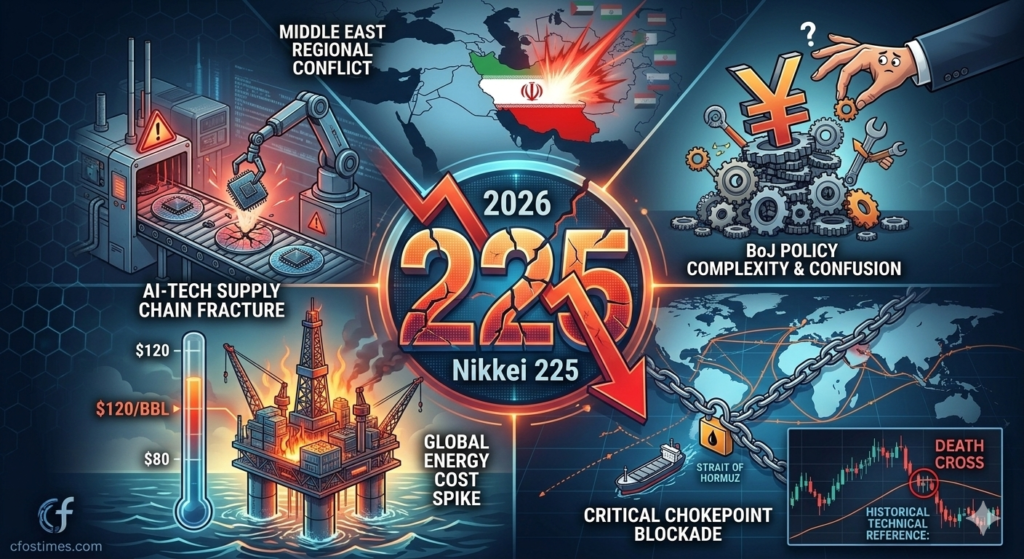
The primary catalyst for the crash is the expansion of hostilities in the Middle East. Following high-intensity strikes, the Ministry of Foreign Affairs (MOFA) has issued statements condemning the disruption of international stability. This has triggered a global “risk-off” environment, hitting Japan’s export-heavy index hardest.
2. Parabolic Surge in Oil Prices
As of March 9, Brent Crude has spiked to $114–$120 per barrel. For a nation that relies on the Middle East for 95% of its crude, this is a systemic shock. The Ministry of Finance (MOF) is reportedly monitoring the impact on Japan’s trade balance.
3. Closure of the Strait of Hormuz
Panic selling accelerated following reports that the Strait of Hormuz is effectively closed to Western-aligned shipping. With nearly 70% of Japan’s oil arriving via this route, the energy sector has seen a “Waterfall Sell-off” due to supply-chain existential risk.
4. Bank of Japan (BoJ) Policy Uncertainty
Governor Ueda’s upcoming March 18-19 meeting is now the market’s focal point. While the Bank of Japan (BoJ) previously hinted at a rate hike pause, surging import costs may force a defensive hike to protect the Yen, creating a “double-bind” for equity valuations.
5. Reversal of the “Takaichi Trade”
The “Sanaenomics 2.0” momentum that fueled the 2025 rally has stalled. Fears that Prime Minister Sanae Takaichi’s fiscal expansion will lead to debt overheating amid rising rates have caused a massive rotation out of Japanese domestic stocks.
6. Tech & AI Sector Capitulation
The semiconductor-heavy Nikkei is bearing the brunt of a global growth-stock liquidation. Weights like Tokyo Electron and SoftBank Group have entered “bear market territory” (down 20% from peaks) as investors flee high-multiple AI plays.
7. Regional Market Contagion (The Kospi Collapse)
The crash is synchronized across Asia. South Korea’s Kospi recently recorded its worst day since 2008, dropping 7.4%. This regional flight of capital has led to “contagion selling” in Tokyo, as international funds liquidate Asian positions to cover margins elsewhere.
8. Destabilizing Yen Volatility
While a weak JPY historically helps exporters, the current volatility is viewed as a systemic risk. Rapid swings in the Yen make corporate earnings projections impossible to anchor, leading to “valuation paralysis” among institutional buyers.
9. Fibonacci Support Breach
From a technical standpoint, the Nikkei sliced through its 50-day and 100-day moving averages. It is now testing the 61.8% Fibonacci retracement from the 2025 lows. A failure to hold the 50,000 level by Friday’s close could signal a drop toward 47,200.
10. Mean Reversion from Overbought Peaks
In late February, the Nikkei’s Relative Strength Index (RSI) hit a staggering 82. Historically, any reading above 70 indicates a market “primed for a correction.” The current crash is a violent mean-reversion as the market “pops” its own valuation bubble.
Market Indicator Dashboard (March 9, 2026)
| Indicator | Current Status | Impact on Nikkei |
| USD/JPY | 158.60 (High Volatility) | Negative |
| Brent Crude | $114.11/barrel | Critical/Negative |
| Nikkei VI (Fear Index) | 61.5 (Extreme Fear) | Negative |
| VIX (Global Fear) | 32.4 | High Risk |
Technical Support Levels: Finding the Bottom
When analyzing why Nikkei 225 stock index is crashing, technical traders look at “support zones”—price levels where buying interest historically outweighs selling pressure. On March 9, 2026, the Nikkei plummeted through its 50-day and 100-day moving averages with such force that it triggered a “Waterfall Sell-off.”
The psychological floor of 50,000 has been breached. If the index cannot reclaim this level by the end of the week, the technical reason why Nikkei 225 stock index is crashing will shift toward a target of 47,200. This level represents the 61.8% Fibonacci retracement from the 2025 lows, making it a critical “line in the sand” for those wondering why Nikkei 225 stock index is crashing.
RSI and Overbought Conditions
Before this meltdown, the Relative Strength Index (RSI) for the Nikkei 225 was screaming “overbought” at a reading of 82. One fundamental reason why Nikkei 225 stock index is crashing is simply market gravity; the index had climbed too far, too fast in early 2026. This mean-reversion is a mathematical explanation for why Nikkei 225 stock index is crashing today.
The “Death Cross” Formation
Market analysts are bracing for a “Death Cross”—where the short-term moving average crosses below the long-term average. This bearish signal is a primary technical driver for why Nikkei 225 stock index is crashing. For institutional algorithms, this signal acts as a “sell everything” trigger, further accelerating the question of why Nikkei 225 stock index is crashing.
For the latest official data, investors should monitor the Japan Exchange Group (JPX) real-time alerts.
Investor Checklist: Navigating the 2026 Meltdown
To help cfostimes.com readers manage the stress of why Nikkei 225 stock index is crashing, consider this survival guide:
- Watch the Bank of Japan Announcements: Any hint of yield curve control will change the narrative of why Nikkei 225 stock index is crashing.
- Monitor Oil Futures: If Brent Crude stays above $115, the reason why Nikkei 225 stock index is crashing will remain energy-dependent.
- Check the VIX (Volatility Index): A spike in the “Fear Gauge” confirms why Nikkei 225 stock index is crashing is driven by sentiment, not just math.
- Evaluate Blue-Chip Fundamentals: Despite why Nikkei 225 stock index is crashing, companies like Toyota still have strong balance sheets.
Frequently Asked Questions (FAQ)
Q: Why is the Nikkei 225 crashing more than the S&P 500?
A: Japan is far more sensitive to Middle Eastern energy disruptions than the energy-independent U.S. The closure of the Strait of Hormuz is a direct threat to 70% of Japan’s fuel, whereas the U.S. has domestic reserves.
Q: Is this a “Buying Opportunity”?
A: Historically, “event-driven” crashes (like war) offer long-term value once a ceasefire or supply resolution is reached. However, analysts suggest waiting for the RSI to dip below 30 (Oversold) before entering.
Q: What is the Bank of Japan’s role in this crash?
A: The BoJ is caught between fighting inflation (caused by oil) and supporting growth. Any emergency statement before the March 18 meeting will be a major market-moving event.
Disclaimer:
The information provided on cfostimes.com is for educational and informational purposes only and does not constitute professional financial, investment, or legal advice.
Trading in the Nikkei 225 and other global markets involves significant risk of loss. While we strive for accuracy, market conditions are subject to rapid change.
We recommend consulting with a certified financial advisor before making any investment decisions. cfostimes.com and its authors are not responsible for any financial losses resulting from the use of this content.

Dr. Dinesh Kumar Sharma is an award-winning Chief Financial Officer and Director of Finance with over 25 years of expertise in strategic planning and digital transformation. Recognized as a five-time CFO of the Year, he specializes in leveraging Generative AI and Microsoft Copilot to optimize financial forecasting and cost management. Dr. Sharma holds a Doctorate in Management (Finance) and has successfully scaled organizations from INR 1 billion to INR 7 billion. He is dedicated to providing transparent, data-driven insights for modern decision-makers at CFOs Times.