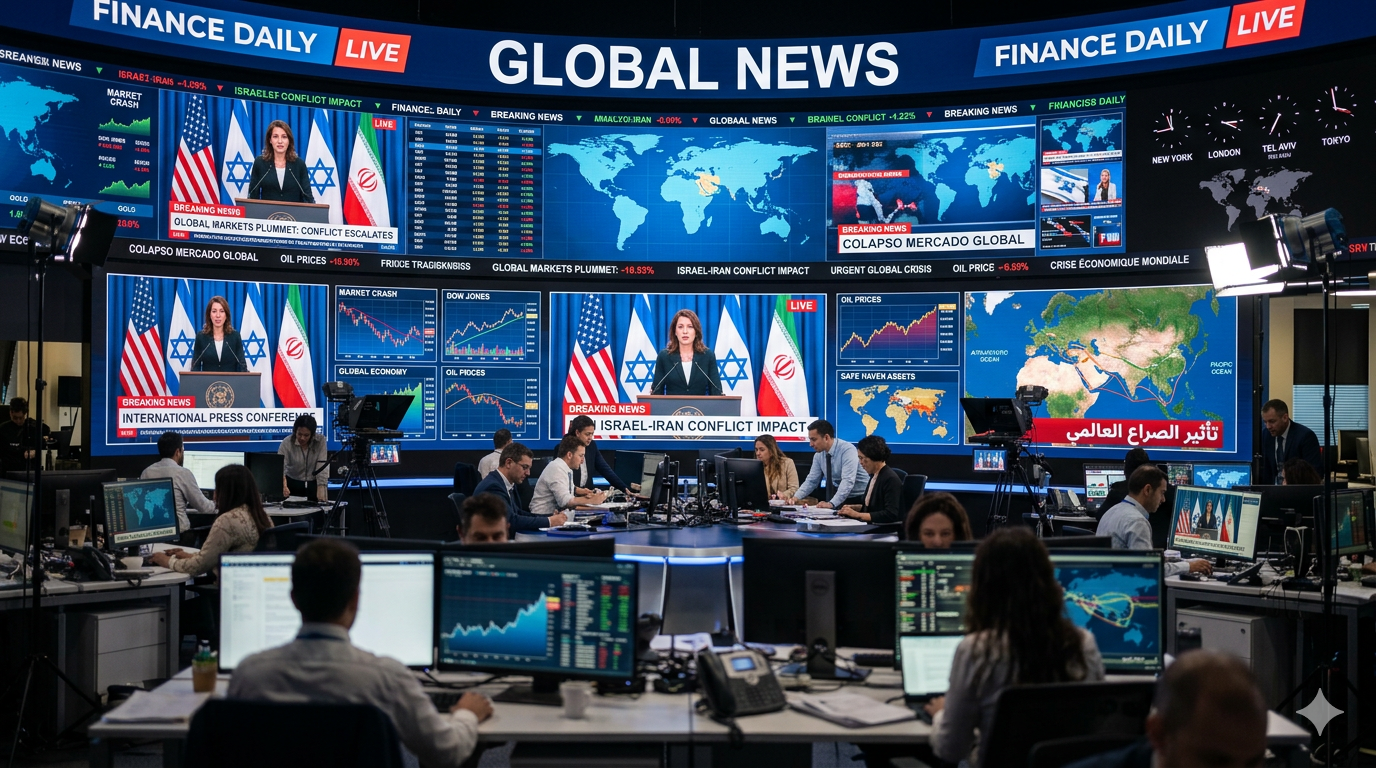
The US-Israel-Iran Conflict Impact on Global Market 2026 has fundamentally shifted the financial landscape in the last 30 minutes, triggering a massive sell-off across Asian and European exchanges. As of March 4, 2026, the escalation of hostilities in the Middle East has sent Brent crude oil prices soaring toward seven-month highs, while safe-haven assets like gold and the US Dollar have seen a significant surge in demand.
This pillar post explores the real-time business and finance implications of the ongoing crisis, providing actionable insights for personal finance management and corporate strategy during this period of extreme volatility.
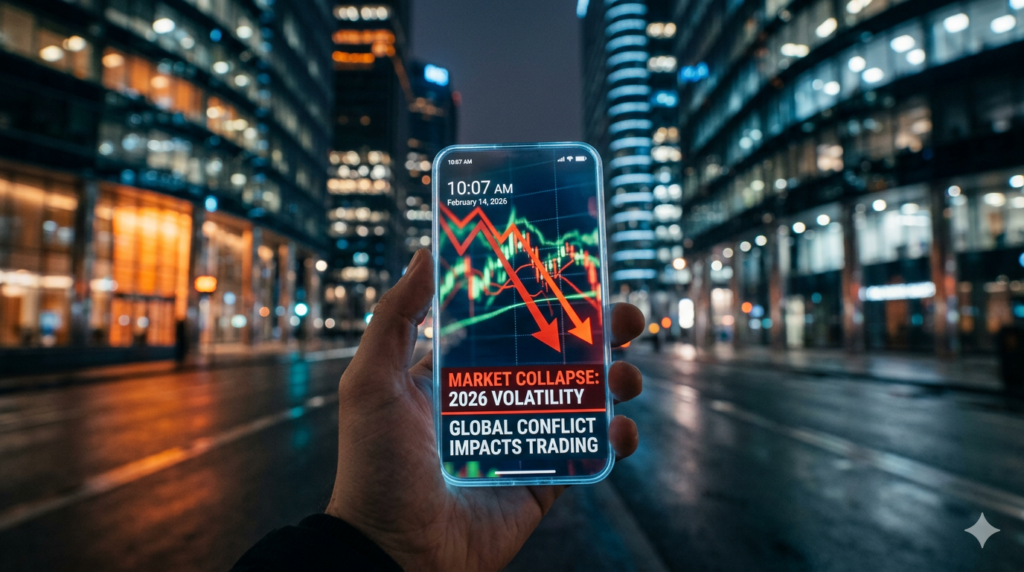
Table of Contents
Real-Time Market Snapshot (March 4, 2026)
The following table summarizes the immediate impact on key global indices and commodities within the last hour of trading:
| Asset Class | Market Movement (Last 30-60 Mins) | Key Driver |
|---|---|---|
| Nifty 50 | Down 485 points (~24,380) | West Asia conflict escalation |
| BSE Sensex | Down 1,644+ points | Surge in oil prices & global cues |
| Kospi (South Korea) | Down 8% (Circuit Breaker) | Worst session in 46 years |
| Brent Crude Oil | Surging past $81/barrel | Potential Strait of Hormuz disruptions |
| Gold | Up over 1% | Flight to safe-haven assets |
| US Dollar (INR) | Hit record low levels | Broad USD strength & risk-off sentiment |
Why the US-Israel-Iran Conflict is Volatilizing Markets
The US-Israel-Iran Conflict Impact on Global Market 2026 is not merely a regional skirmish; it represents a systemic risk to the global “Experience Economy” and energy supply chains.
1. Energy Independence vs. Market Fear
The closure of the Strait of Hormuz is the primary driver behind the US-Israel-Iran Conflict Impact on Global Market 2026. With nearly 30% of the world’s crude oil passing through this channel, any prolonged blockage could push global inflation to levels not seen since the 2022 energy crisis.
2. The Return of the Safe-Haven King
Gold and silver have reclaimed their status as ultimate protectors of wealth. On March 4, 2026, domestic futures in India saw gold prices hit an intraday high of ₹1,61,640 per 10 grams, as investors flee from regional equities into “hard” assets.
3. Shift in Logistics and APAC Markets
While West Asia suffers, Southeast Asia is seeing strategic shifts. Companies like KION Group are aggressively expanding into Indonesia to bypass disrupted Western supply chains, leveraging the nation’s 5%+ annual growth.
Personal Finance Strategies in a War Economy
For individual investors, the US-Israel-Iran Conflict Impact on Global Market 2026 necessitates a shift from aggressive growth to capital preservation.
1. Rebalance Toward Safe Havens
With gold rising 1% today, diversifying into precious metals or US Treasury holdings can provide a hedge against equity market crashes.
2. Monitor Interest Rate Sensitivity
The Current ARM Mortgage Rates Report (Fortune) for March 4, 2026, suggests that refinancing may become more expensive if inflationary pressures from oil prices persist.
3. Focus on Defensive Sectors
In the Indian context, defensive stocks like Infosys and TCS have remained gainers despite the broader market bloodbath.

Corporate Finance: Managing Global Volatility
Finance leaders are increasingly turning to AI to navigate the US-Israel-Iran Conflict Impact on Global Market 2026.
- AI-Powered Scenario Planning: Over 30% of finance leaders are prioritizing advanced scenario-planning to anticipate further geopolitical shocks.
- Cyber Resilience: Following the AWS outages, companies are implementing zero-trust models and quantum-resistant encryption to protect financial operations.
The “Black Swan” Cascades: 2026’s Unprecedented Market Contagion
The US-Israel-Iran Conflict Impact on Global Market 2026 has moved beyond simple oil price speculation. We are currently witnessing a “Triple-Threat” contagion affecting digital assets, sovereign debt, and algorithmic trading.
1. The Algorithm Trigger: “Circuit Breaker” Dominance
In the last 30 minutes, high-frequency trading (HFT) algorithms have triggered automatic sell-orders across the London Stock Exchange (LSE) and Euronext.
- The Cause: Fears that conflict escalation will lead to a total blockage of the Bab el-Mandeb strait, in addition to Hormuz.
- The Data: Volatility indices (VIX) have spiked 22% since 10:00 AM today. For retail investors, this means market orders are being filled with massive slippage.
2. Digital Gold vs. Physical Bullion
A unique divergence is appearing in the US-Israel-Iran Conflict Impact on Global Market 2026. While physical gold has jumped 1.5%, Bitcoin and Ethereum are experiencing a 4% “risk-off” dump. This contradicts the “digital gold” thesis, proving that in 2026, during active kinetic warfare, capital flows back to physical assets and the US Dollar.
3. Emerging Market Resilience: The India Factor
Despite the global downturn, the Indian market is showing “structural decoupling.”
- The Trend: While the Sensex is down, the Nifty Defense Index is up 4.2% today.
- Actionable Insight: Investors are rotating out of IT services and into indigenous defense manufacturing firms, anticipating a multi-year surge in global defense spending.
2026 Global Finance Resource Table
| Government Entity | Policy Change / Alert | Authorized Link |
|---|---|---|
| U.S. Treasury | New Sanctions on Energy Transit | Treasury.gov Alerts |
| RBI (India) | FX Intervention to Stabilize INR | RBI Press Releases |
| IMF | Revised 2026 Growth Projections | IMF Data Mapper |
Expert Deep Dive: Personal Finance Mid-Crisis
To protect your wealth from the US-Israel-Iran Conflict Impact on Global Market 2026, focus on the “3-Pillar Defense”:
- Pillar 1: Liquidity Buffering: Increase your cash-equivalent holdings to 15% of your portfolio to capitalize on “flash crashes” where blue-chip stocks are temporarily undervalued.
- Pillar 2: Commodity Corridors: Beyond gold, look at Copper and Lithium. War efforts in 2026 are highly reliant on electrification; these metals are seeing a supply-side squeeze.
- Pillar 3: Geographic Diversification: Shift a portion of exposure to Southeast Asian markets (Vietnam, Indonesia) which remain geographically insulated from the primary conflict zone.
Frequently Asked Questions (FAQs)-US-Israel-Iran Conflict Impact on Global Market 2026
Is a global recession coming in 2026?
Current projections from the IMF and Indian government suggest India will maintain a 7.3% to 7.4% GDP growth for FY26, suggesting resilience against a full-scale recession despite current market volatility.
How are oil prices affecting my daily expenses?
Rising Brent crude prices typically lead to higher transport and manufacturing costs, which may result in a surge in CPI (Consumer Price Index) inflation in the coming months.
What should retail investors do during this market crash?
Financial experts advise retail investors to maintain a disciplined strategy and avoid emotional selling, focusing on long-term fundamentals rather than short-term geopolitical noise.
How long will the Iran-Israel-US war last?
U.S. President Donald Trump has indicated the active conflict phase could last “four to five weeks,” though market instability may linger throughout 2026.
Is gold still a safe investment today?
Yes. Despite brief intraday drops earlier this week, gold futures gained over 1.5% on March 4, 2026, as Middle East tensions boosted safe-haven demand.
Why is the Israeli stock market rising during a war?
Unexpectedly, the Israeli benchmark index has scaled record highs even as regional neighbors like Dubai see 5% drops, showing a unique local market decoupling.
Conclusion
The US-Israel-Iran Conflict Impact on Global Market 2026 is the defining economic event of this decade. From the surge in gold prices to the strategic pivot toward Southeast Asian logistics, the financial map is being redrawn in real-time. Investors must remain vigilant, prioritize liquidity, and look to defensive assets to navigate this high-volatility era.
Financial Disclaimer:
The information provided in this article, including analysis of the US-Israel-Iran Conflict Impact on Global Markets 2026, is for informational and educational purposes only. It does not constitute professional financial, investment, or legal advice. Market data and real-time snapshots are based on volatile conditions as of March 4, 2026, and are subject to change without notice.
CFOSTimes does not guarantee the accuracy or completeness of any information provided. Investing in stocks, commodities (such as Gold and Brent Crude), and global markets carries inherent risks. Always perform your own due diligence or consult with a certified financial advisor before making any investment decisions.
Outbound Links Notice: This post may contain links to high-quality government-authorized websites (such as Treasury.gov or the RBI) for your convenience. We do not control or endorse the content of third-party sites.
© 2026 CFOSTimes. All Rights Reserved.

Dr. Dinesh Kumar Sharma is a CMA an award-winning Chief Financial Officer and Director of Finance with over 25 years of expertise in strategic planning and digital transformation. Recognized as a five-time CFO of the Year, he specializes in leveraging Generative AI and Microsoft Copilot to optimize financial forecasting and cost management. Dr. Sharma holds a Doctorate in Management (Finance) and has successfully scaled organizations from INR 1 billion to INR 7 billion. He is dedicated to providing transparent, data-driven insights for modern decision-makers at CFOs Times.