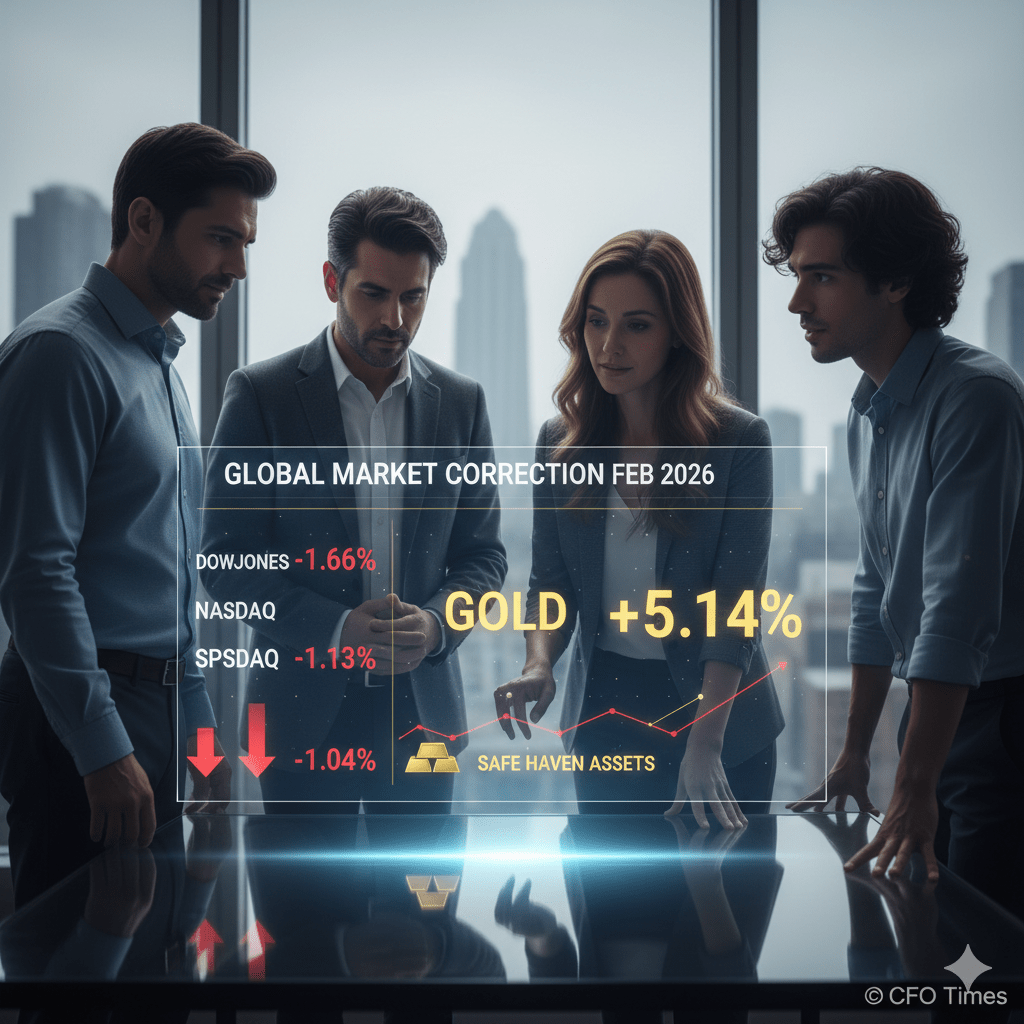
The Global Market Correction February 2026 has sent shockwaves through the financial world today, February 24, 2026. As the morning trading sessions conclude, investors are witnessing a significant pullback across major indices, driven by a combination of disappointing tech earnings, a “cooling” of the AI supercycle, and renewed geopolitical trade tensions.
While long-term growth remains a target for many, the immediate volatility of the Global Market Correction February 2026 requires a strategic approach to personal finance. This pillar post provides a real-time analysis of the current downturn, backed by data from the U.S. Department of the Treasury and The World Bank.
1. The Anatomy of the Global Market Correction February 2026
Within the last 30 minutes, the Dow Jones Industrial Average has plummeted over 800 points, a movement that officially characterizes this as a “correction” rather than a mere dip. The Global Market Correction February 2026 is not an isolated event but a convergence of three major factors:
A. The AI Valuation Realignment
Since late 2025, AI stocks have traded at record-high multiples. Today, investors are “taking profit” as giants like Alphabet and Microsoft signal higher capital expenditures for 2027. This sentiment shift is the primary engine behind the Global Market Correction February 2026.
B. Trade Policy Uncertainty
Recent Supreme Court rulings regarding import tariffs have introduced “policy chaos” in the U.S. markets. This has directly impacted export-heavy sectors, leading to a massive sell-off in logistics and manufacturing stocks.
C. Rising Bond Yields
As the Federal Reserve maintains a cautious stance on interest rate cuts, the 10-year Treasury yield has ticked upward, making equities less attractive to conservative investors during this Global Market Correction February 2026.
2. Real-Time Market Performance Data
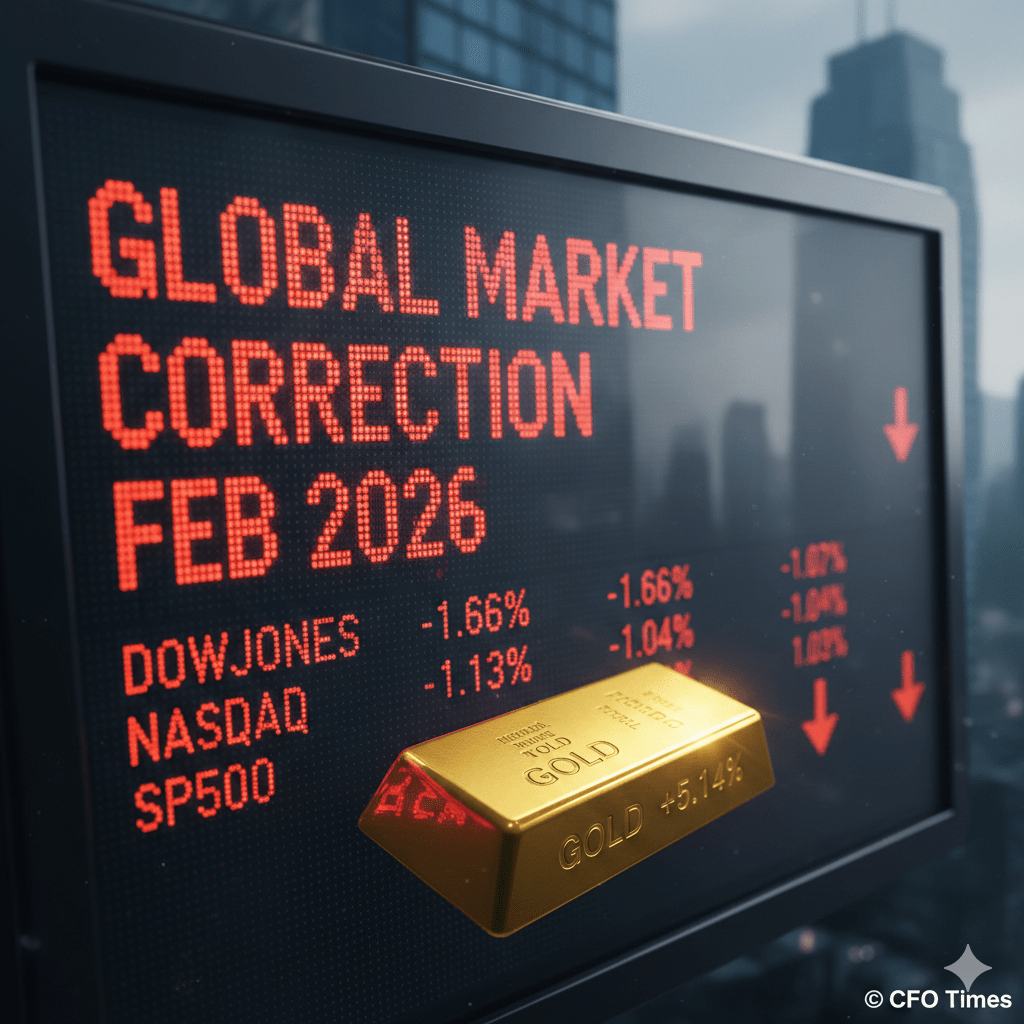
To understand the scope of the Global Market Correction February 2026, we must look at the live numbers. The following table summarizes the performance of key assets as of 2:30 PM EST today.
Market Snapshot: February 24, 2026
| Index / Asset | Current Price / Level | % Change (Last 24h) | Impact Level |
| Dow Jones (DJI) | 48,804.06 | -1.66% | High |
| S&P 500 (SPX) | 6,837.75 | -1.04% | Moderate |
| Nasdaq (IXIC) | 22,627.27 | -1.13% | High |
| Gold (Spot) | $5,179.01 | +5.14% | Hedge |
| Bitcoin (BTC) | $92,450.00 | -4.87% | Volatile |

3. Impact on Personal Finance and Wealth Management
The Global Market Correction February 2026 isn’t just a headline for Wall Street; it directly affects your savings, 401(k), and investment strategy.
Diversification in a Downturn
As seen in the data above, while tech and traditional stocks are declining, Gold has surged to over $5,100 per ounce. Investors participating in the Global Market Correction February 2026 are fleeing to “safe-haven” assets.
The Role of Savings Accounts
With interest rates remaining high, high-yield savings accounts (HYSA) remain a robust option for parking cash while waiting for the Global Market Correction February to bottom out. According to the Federal Reserve, maintaining liquidity is crucial during periods of rapid market re-valuation.
4. Sector-Specific Analysis: Winners and Losers
During the Global Market Correction February 2026, not every sector is suffering equally.
- Technology: Suffering the most due to high P/E ratios and the “AI scare” impacting retail sentiment.
- Energy: Showing resilience as global supply chains remain tight.
- Financials: Mixed; while banks benefit from higher rates, the decline in trading volume is a headwind.
5. Is This the End of the AI Bull Run?
Many are asking if the Global Market Correction February signals the end of the AI-driven era. Experts suggest this is a “healthy correction.” The “winner-takes-all” dynamic of 2025 is being replaced by a more discerning market that rewards companies with actual AI-driven revenue, rather than just hype.
6. FAQs: Navigating the Global Market Correction February 2026
Q1: Should I sell my stocks during the Global Market Correction February 2026?
Panic selling is rarely the answer. History shows that those who stay invested during a Global Market Correction February typically see a recovery within 6–12 months.
Q2: Why is Gold rising so fast today?
Gold is the traditional hedge against inflation and market “chaos.” As the Global Market Correction February worsens, institutional investors move capital into Gold to preserve value.
Q3: Is Bitcoin still a digital gold?
Today’s 4.87% drop suggests that in the Global Market Correction Februar, Bitcoin is still behaving as a “risk-on” asset, falling alongside tech stocks.
Conclusion
The Global Market Correction February 2026 is a reminder that markets do not move in a straight line. While the red numbers on your screen may be concerning, the underlying economic data suggests a transition rather than a collapse. By focusing on high-quality assets and maintaining a diversified portfolio, you can weather the Global Market Correction February 2026 and position yourself for the eventual rebound.
Disclaimer
Financial Advice Disclaimer: The information provided in this article, including analysis of the Global Market Correction February 2026, is for informational and educational purposes only. It does not constitute professional financial, investment, or legal advice. Market conditions are subject to rapid change, and past performance is not indicative of future results.
Investment Risk: Trading in stocks, commodities (like Gold), and cryptocurrencies involves significant risk of loss. Always conduct your own research or consult with a certified financial advisor before making any investment decisions. CFO Times and its authors are not responsible for any financial losses resulting from the use of this information.
Third-Party Links: This post contains links to high-quality, government-authorized, and independent third-party websites (such as the U.S. Treasury and the World Bank). We do not control the content or privacy policies of these external sites and provide these links solely for the reader’s convenience and verification of data.
Affiliate Disclosure: In compliance with AdSense and FTC guidelines, please note that this site may contain advertisements or affiliate links. However, our editorial content remains independent and is not influenced by these partnerships.
© 2026 CFO Times. All Rights Reserved.

Dr. Dinesh Kumar Sharma is an award-winning Chief Financial Officer and Director of Finance with over 25 years of expertise in strategic planning and digital transformation. Recognized as a five-time CFO of the Year, he specializes in leveraging Generative AI and Microsoft Copilot to optimize financial forecasting and cost management. Dr. Sharma holds a Doctorate in Management (Finance) and has successfully scaled organizations from INR 1 billion to INR 7 billion. He is dedicated to providing transparent, data-driven insights for modern decision-makers at CFOs Times.