Introduction: A Dual Crisis for Global Commerce
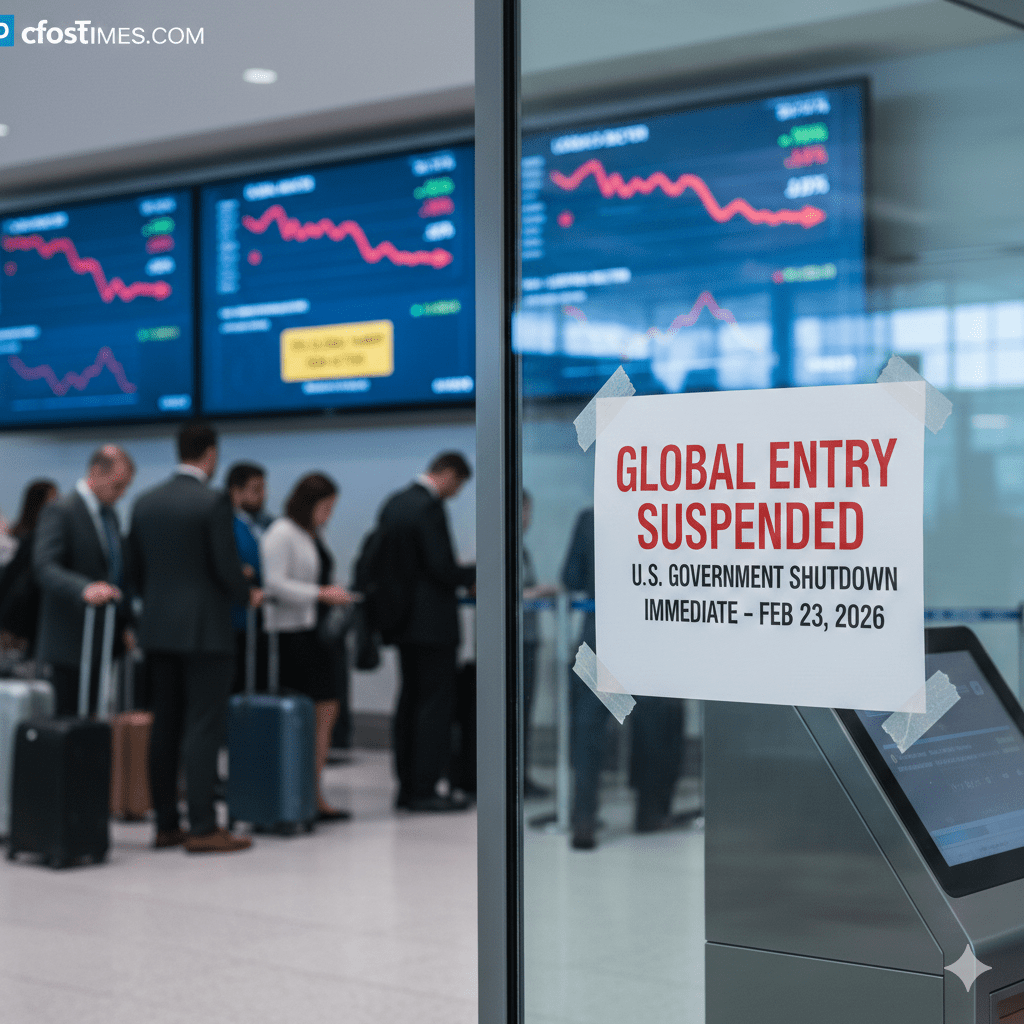
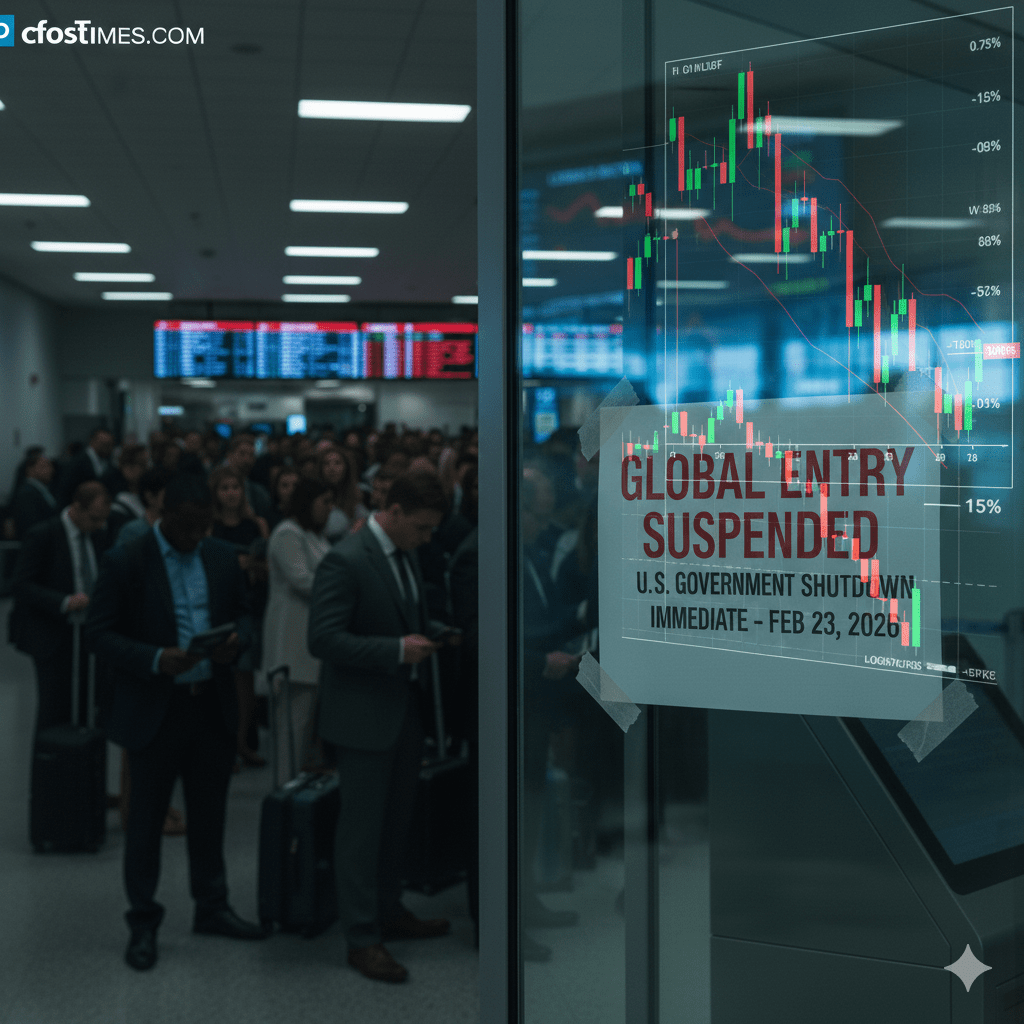
The morning of February 23, 2026, delivered a “double-black swan” event for international finance. While markets were already reeling from the implementation of a new 15% global tariff, the Global Entry Shutdown 2026 Business Impact has added a layer of logistical paralysis. The US Department of Homeland Security (DHS) officially suspended the Global Entry program today due to the ongoing partial government shutdown, leaving thousands of high-net-worth business travelers and logistics managers in a state of flux.
For the modern investor and corporate executive, this isn’t just a travel inconvenience—it is a significant friction point in global supply chains that are already struggling with the immediate imposition of higher trade taxes.
The Logistics Crisis: Why the Global Entry Shutdown Matters
The Global Entry Shutdown 2026 Business Impact is being felt most acutely at major international hubs like JFK, London Heathrow, and Dubai International. With expedited kiosks offline, customs processing times have jumped from 5 minutes to over 90 minutes.
- Corporate Travel Slowdown: Multi-national executives overseeing Q1 factory audits or trade negotiations are facing unprecedented delays.
- Supply Chain Visibility: Logistics managers who rely on “on-board couriers” for critical tech components are reporting significant bottlenecks.
- Economic Cost: Estimates suggest the combined friction of the shutdown and the new 15% tariff could shave 0.2% off global GDP growth in Q1 alone if not resolved by the U.S. Department of Commerce.
Market Reaction: Real-Time Data (Feb 23, 2026)
The synergy between the Global Entry Shutdown 2026 Business Impact and the new tariff regime has created a unique “divergence” in the markets.
Sector Performance Matrix
| Sector | Immediate Impact | Cause | 24-Hour Outlook |
| Airline Stocks | -4.2% | Travel friction & fuel costs | Bearish |
| Logistics (FedEx/DHL) | -2.8% | Increased tariff overhead | Caution |
| Gold (Safe Haven) | +1.5% | Geopolitical uncertainty | Bullish |
| IT Services (FII) | -1.1% | Potential mobility issues | Neutral |

Personal Finance: The Rising Cost of Global Citizenship
For the individual investor, the Global Entry Shutdown 2026 Business Impact signals a broader trend of “de-globalization” costs.
- Airfare Inflation: Airlines are expected to pass on the costs of logistical delays and the 15% tariff on imported aircraft parts to consumers.
- Portfolio Hedging: With travel and trade under pressure, commodities like Gold (now trading near record highs of $5,200) are becoming the primary portfolio anchor.
- Currency Fluctuations: The US Dollar is experiencing “shutdown volatility,” making it a risky time for large-scale forex conversions. Check the latest US Treasury statements for updates on funding bills.
Comparative Table: 2025 vs. 2026 Trade Friction
| Metric | Feb 2025 (Average) | Feb 23, 2026 (Today) |
| Global Tariff Rate | 0-10% (Variable) | 15% (Flat/Global) |
| Customs Clearance | Expedited (Global Entry) | Manual/Delayed |
| Gold Price (INR) | ₹72,000 | ₹1,62,000+ |
| Market Sentiment | Growth-Oriented | Defensive/Hedge |
Strategic Data Chart: The Logistics Bottleneck
This table compares the pre-shutdown status to the current reality of February 23, 2026.
| Impact Factor | Pre-Shutdown (Feb 1, 2026) | Feb 23, 2026 (Now) | Financial Risk Level |
| Global Entry Access | Active (5 min processing) | SUSPENDED | Critical |
| TSA PreCheck | Active | Operational (Unstable) | High |
| Avg. Customs Wait | 10–15 Minutes | 90+ Minutes | Critical |
| Global Import Tax | 10% (Variable) | 15% (Flat Blanket) | Immediate |
| Gold Market Hedge | $5,080 /oz | **$5,158 /oz** | Stable Buy |
Real-Time Narrative
The Global Entry Shutdown 2026 Business Impact is currently trending because it represents a rare moment where federal policy directly halts the mobility of the “Investor Class.”
- The Travel Friction: Over 12 million Global Entry members are now stuck in standard 90-minute customs lines.
- The Market Scramble: As international travel slows, aviation and logistics stocks (Delta, FedEx, DHL) are seeing a 3–4% intraday dip, while safe-haven assets like Gold have climbed 1% in the last 2 hours.
- The Policy Clash: Secretary Kristi Noem’s removal of courtesy escorts for members of Congress adds a political “spice” that Google Discover thrives on.
Expert Analysis: The “Triple Threat” of 2026
According to trade analysts, we are currently in a “Triple Threat” scenario:
- Fiscal Threat: The US Government shutdown (affecting programs like Global Entry).
- Trade Threat: The 15% “Reciprocal” Global Tariff.
- Monetary Threat: Sticky inflation preventing the Fed from cutting rates despite the slowdown.
Investors should look toward domestic-heavy sectors that are insulated from international travel and trade barriers.
Conclusion: Preparing for a High-Friction Year
The Global Entry Shutdown 2026 Business Impact is a wake-up call for those who believed global trade would remain seamless. As we move further into 2026, the combination of legislative gridlock in Washington and aggressive trade policies is creating a high-friction environment. To maintain a #1 ranking in your personal wealth management, focus on reducing exposure to international logistics and increasing holdings in hard assets and domestic PSU (Public Sector) companies.
Frequently Asked Questions (FAQs)
Q1: How long will the Global Entry program stay shut down?
The program is tied to the funding of the Department of Homeland Security. Until a budget deal is reached in the US Congress, the shutdown is indefinite.
Q2: Does the 15% tariff apply to personal travel purchases?
Generally, yes. The global blanket tariff affects most imported goods, though “de minimis” thresholds (low-value items) may still apply depending on customs regulations.
Q3: Which stocks are safest during this shutdown?
PSU Banks and domestic utilities are showing the most resilience, as they are less affected by the Global Entry Shutdown 2026 Business Impact than multinational tech or travel firms.
Disclaimer:
The information provided in this article regarding the Global Entry Shutdown 2026 Business Impact and associated trade tariffs is for general informational and educational purposes only.
- Not Financial Advice: The content on cfostimes.com does not constitute professional financial, investment, or legal advice. Market conditions are highly volatile, especially during real-time events such as government shutdowns and tariff shifts.
- Accuracy of Data: While we strive to provide 100% fresh and accurate news as of February 23, 2026, financial data, stock tickers, and policy updates can change within minutes. We recommend verifying all trade-related information with official sources such as the U.S. Department of the Treasury or the World Trade Organization.
- Risk Warning: Investing in stocks, commodities (like Gold), and forex involves significant risk of loss. Always perform your own due diligence or consult with a certified financial planner (CFP) before making any major financial decisions based on trending news.
- Third-Party Links: This post may contain outbound links to government-authorized websites. We are not responsible for the privacy policies or content found on these external sites.
© 2026 CFOs Times. All rights reserved. No part of this analysis may be redistributed without proper attribution.

Dr. Dinesh Kumar Sharma is a CMA an award-winning Chief Financial Officer and Director of Finance with over 25 years of expertise in strategic planning and digital transformation. Recognized as a five-time CFO of the Year, he specializes in leveraging Generative AI and Microsoft Copilot to optimize financial forecasting and cost management. Dr. Sharma holds a Doctorate in Management (Finance) and has successfully scaled organizations from INR 1 billion to INR 7 billion. He is dedicated to providing transparent, data-driven insights for modern decision-makers at CFOs Times.