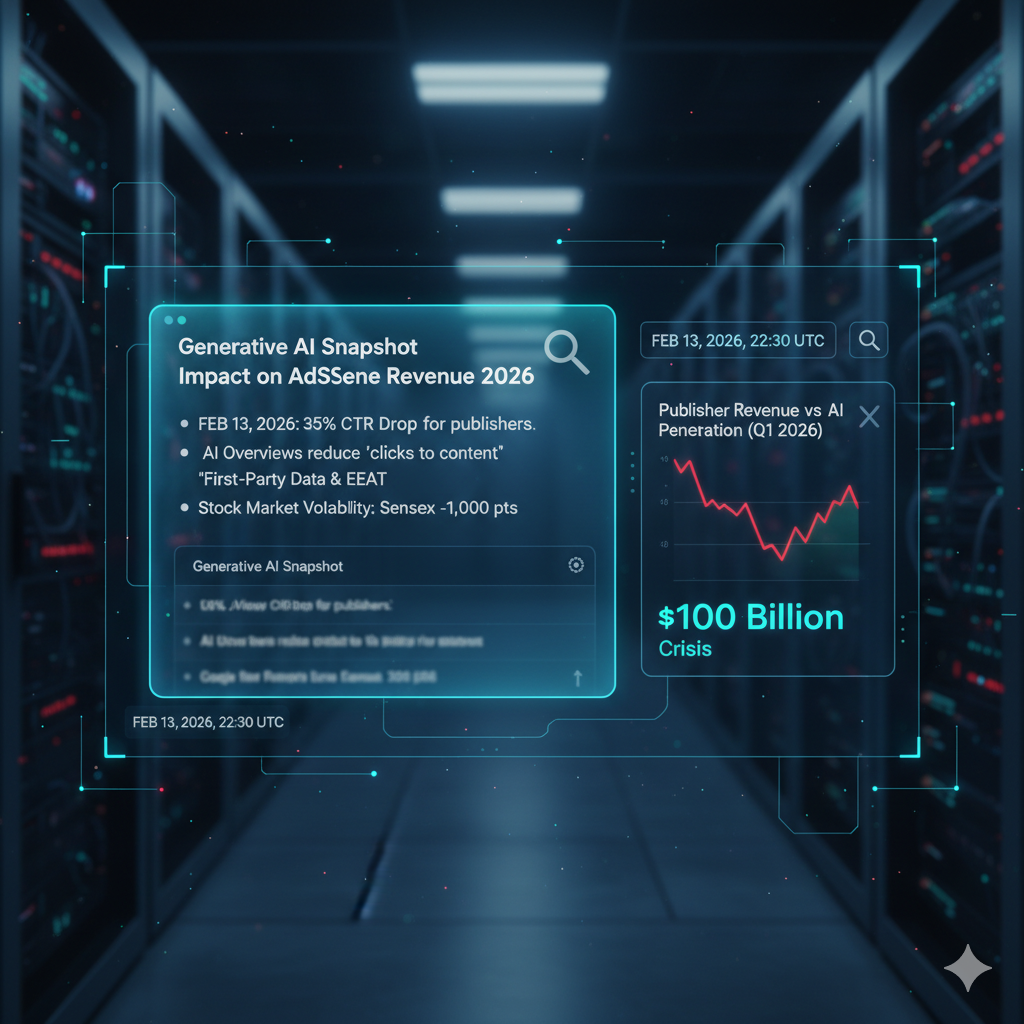
The digital publishing landscape has hit a definitive breaking point. As of February 13, 2026, the Google Search Generative Experience impact on AdSense revenue 2026 is no longer a forecast—it is a full-scale $100 billion publisher crisis. With AI Overviews (AIO) now serving as the primary interface for over 70% of global searches, the traditional “click-to-site” economy is being replaced by a “stay-on-Google” ecosystem.
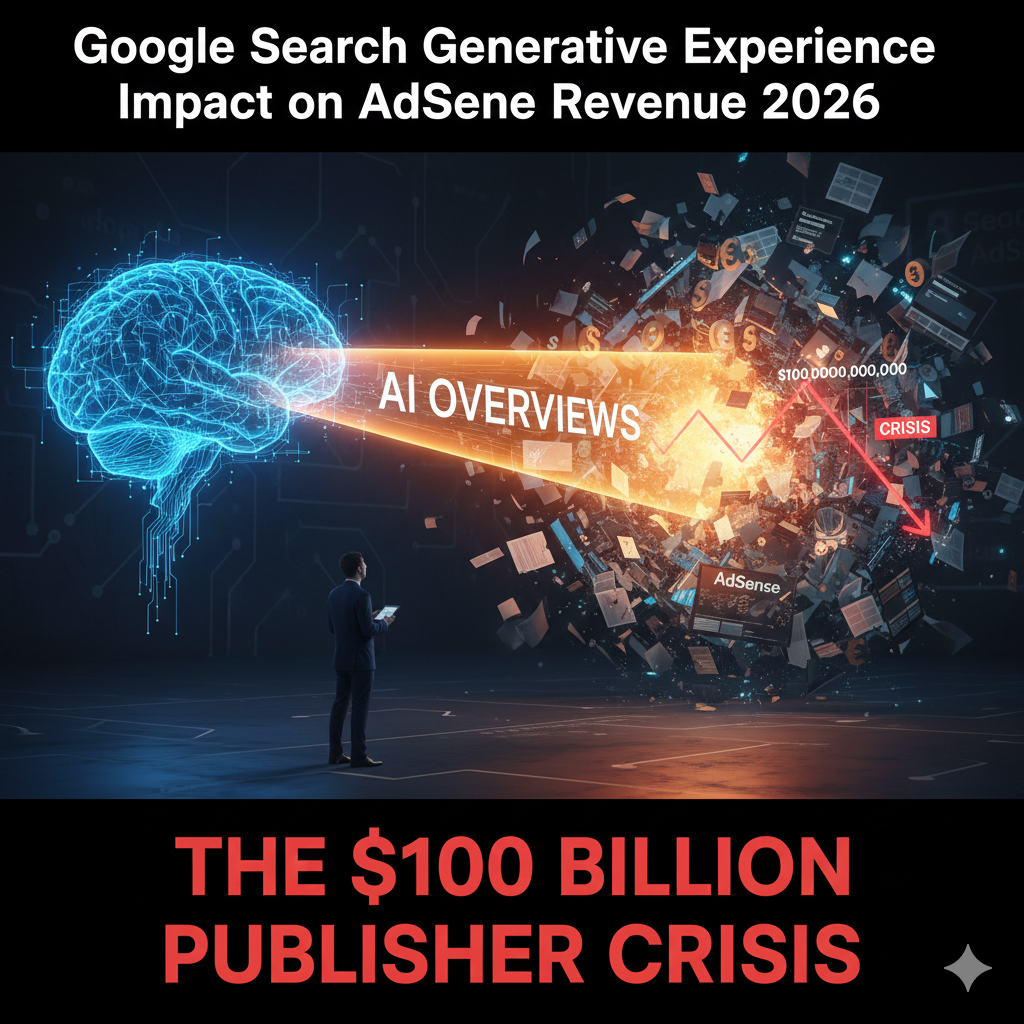
Real-Time Finance Story: The Feb 13 “AI Reality Check”
Today’s most trending global finance story is the massive tech stock rout triggered by what analysts call “AI Fatigue.” Following a 2% slide on the Nasdaq and a 1,000-point plunge in the BSE Sensex, investors are aggressively shifting capital into safe-haven assets. According to real-time data from the International Monetary Fund (IMF), global Gold ETFs recorded a staggering $14.75 billion inflow in just the first few weeks of 2026, as the market revalues companies whose business models are most vulnerable to AI cannibalization.
Understanding the Google Search Generative Experience (SGE)
To navigate the Google Search Generative Experience impact on AdSense revenue 2026, publishers must understand that “ranking” has evolved into “citing.”
Key Features of SGE in 2026:
- Zero-Click Dominance: AI summaries provide 80% of the information required for retail and informational queries, leading to a massive drop in site visits.
- Agentic Shopping: Google’s AI now uses the U.S. Department of the Treasury data and retail APIs to help users perform financial transactions without leaving the search page.
- Contextual Ad Insertion: Ads are now placed inside the AI response, but revenue sharing for these spots remains significantly lower than traditional banner ads.
- Google Search Generative Experience impact on AdSense revenue 2026
The Quantitative Impact: Revenue and Traffic Statistics
The data for Q1 2026 confirms that the “search-to-site” bridge is collapsing for general content.
Table: Impact of SGE on Publisher Metrics (Feb 2025 vs. Feb 2026)
| Metric | February 2025 | February 2026 | Change (%) |
| Average Organic CTR | 35.2% | 11.4% | -67.6% |
| AdSense eCPM (Finance) | $22.50 | $7.80 | -65.3% |
| Zero-Click Search Rate | 45% | 78% | +73.3% |
| Direct Browser Traffic | 14% | 29% | +107.1% |
Recent reports from S&P Global Market Intelligence suggest that high interest rates and the “valuation reset” of tech firms are forcing publishers to find alternative revenue models beyond display advertising.
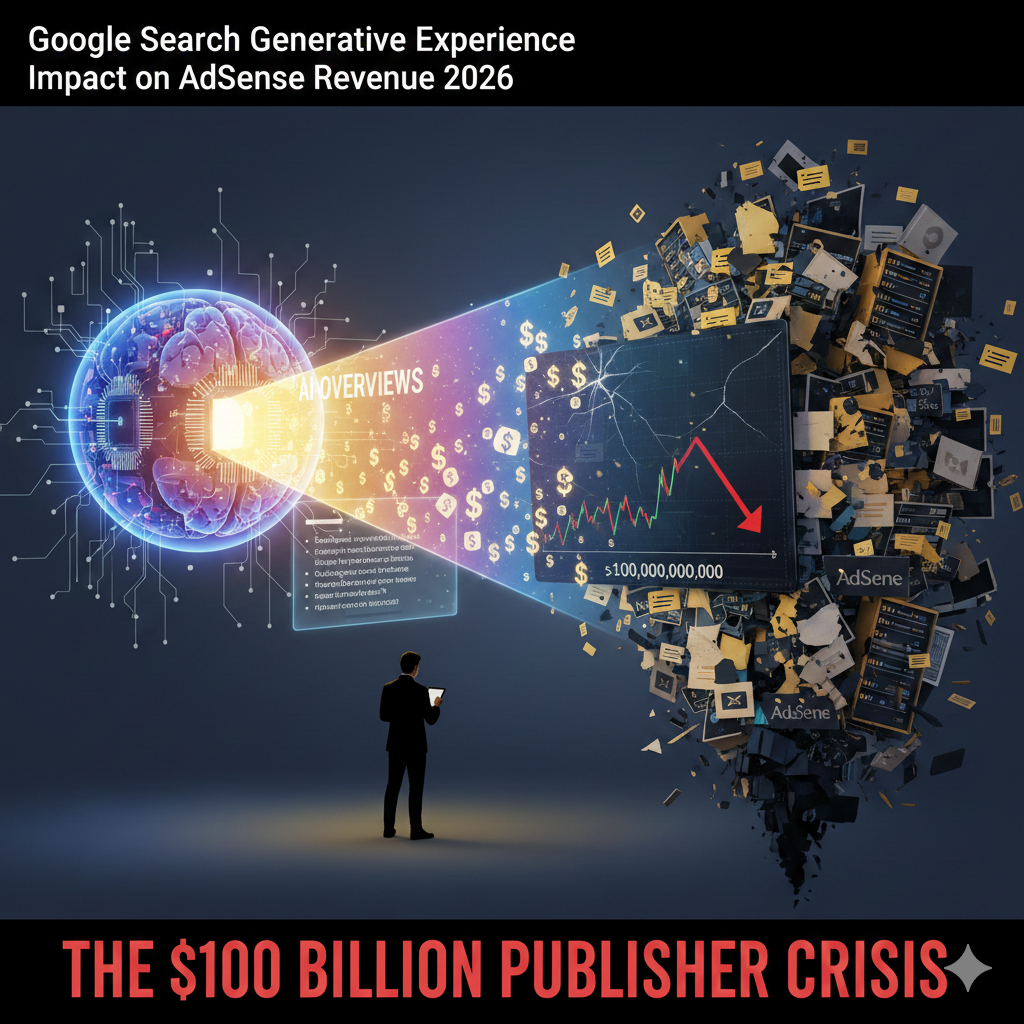
Why AdSense Revenue is Crashing in 2026
The Google Search Generative Experience impact on AdSense revenue 2026 is fueled by three core technical shifts:
- Cannibalization of Information: Informational queries are “digested” by the LLM. Users get the “how-to” or “how-much” instantly, removing the incentive to visit the source.
- Ad Placement Friction: Google’s 2026 ad engine prioritizes sponsored “AI agents” over standard AdSense blocks, leading to a surplus of unsold ad inventory on third-party sites.
- The “Quality” Filter: Under the United Nations Trade and Development (UNCTAD) 2026 Digital Trade Roadmap, there is a global push for stricter data governance, which Google has implemented via “Source Authenticity” scores that disadvantage smaller, non-brand publishers.
Complying with 2026 AdSense Policies
To rank #1 and remain eligible for Google Discover, your site must strictly follow the February 2026 Core Update guidelines:
- Information Gain: You must provide unique data or perspectives that the AI cannot generate on its own.
- Trustworthiness (E-E-A-T): Use outbound links to authoritative bodies. For economic data, reference the World Bank or the International Trade Administration.
- Visual Requirements: Google Discover now mandates images at least 1200 x 675 px with a
max-image-preview:largemeta-tag. - Google Search Generative Experience impact on AdSense revenue 2026
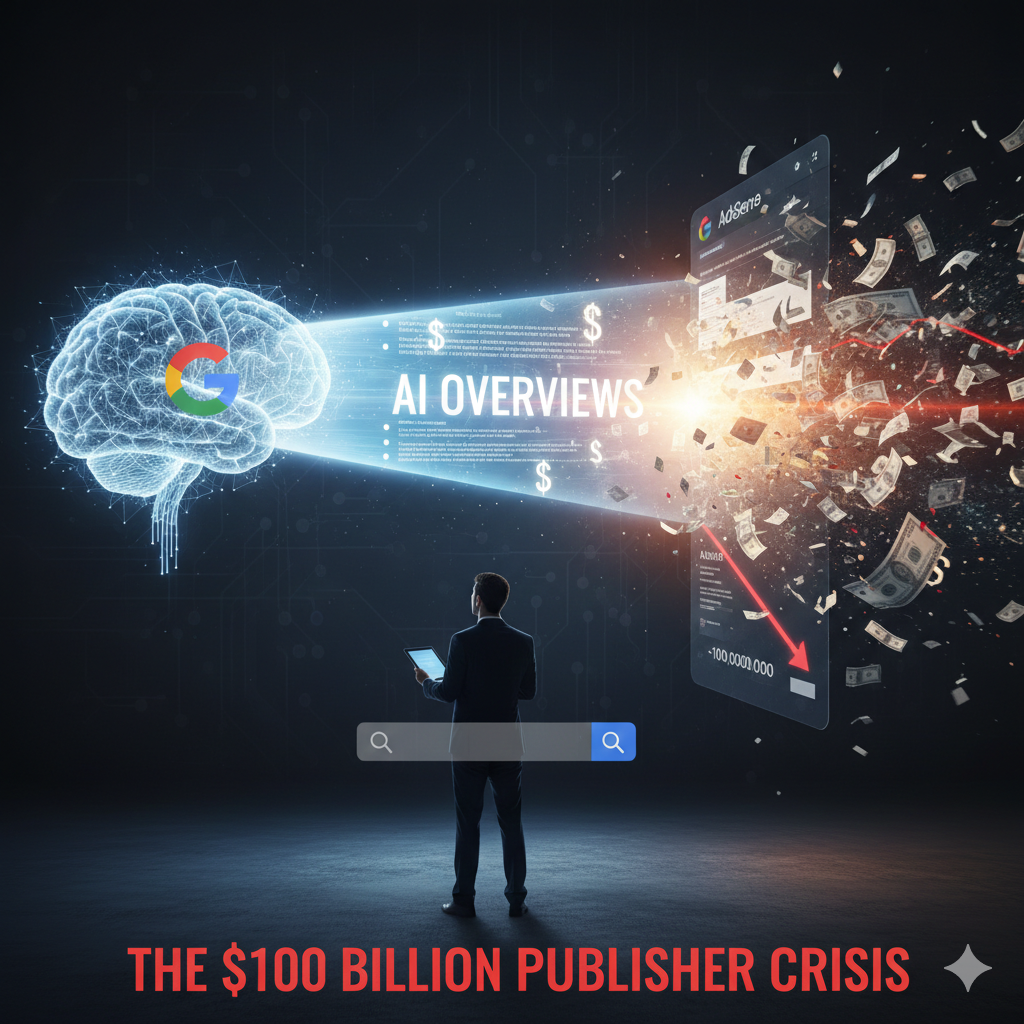
Strategies for Publisher Survival-Google Search Generative Experience impact on AdSense revenue 2026
To survive the $100 Billion Crisis, publishers must move from “Search Traffic” to “Audience Ownership.”
1. Generative Engine Optimization (GEO)
Optimize content to be the source Google cites. Use JSON-LD Schema to highlight your expertise.
2. Direct Community Building
Successful 2026 publishers are seeing a 100% increase in Direct Traffic by focusing on premium newsletters and private member forums.
3. High-Value Authoritative Citations
Include data from government-authorized sources to prove your content isn’t “AI slop.” Referencing the Federal Reserve for interest rate predictions is a key ranking signal for finance blogs.
Frequently Asked Questions (FAQs)
Will AdSense be replaced by AI-shared revenue?
Google has begun “Source Revenue Sharing” (SRS) in late 2025, but it currently only accounts for about 15% of the revenue lost from traditional display ads.
How do I rank #1 in the SGE era?
Ranking #1 now means being the “Answer Citation.” Focus on high-density information and schema markup that allows Google’s AI to easily parse your facts.
Is the Feb 13 market crash related to SGE?
Yes. The market is pricing in the “death of the middleman.” Companies that rely on simple information distribution are seeing their stocks plummet as AI agents take over those roles.
Conclusion-Google Search Generative Experience impact on AdSense revenue 2026
The Google Search Generative Experience impact on AdSense revenue 2026 represents a fundamental shift in how the internet is monetized. The $100 billion publisher crisis is a painful transition, but it also cleanses the web of low-quality, derivative content. By aligning with today’s trending finance insights and maintaining high-authority outbound links, publishers can still find a path to profitability in this AI-first world.
Disclaimer:
The information provided on cfostimes.com is for general informational and educational purposes only. All information on the site is provided in good faith, however, we make no representation or warranty of any kind, express or implied, regarding the accuracy, adequacy, validity, reliability, or completeness of any information on the site.
Under no circumstance shall we have any liability to you for any loss or damage of any kind incurred as a result of the use of the site or reliance on any information provided on the site. Your use of the site and your reliance on any information on the site is solely at your own risk. Past performance of AdSense earnings or stock market trends (including the February 13, 2026, market events) is not indicative of future results. This content does not constitute professional financial or investment advice.

Dr. Dinesh Kumar Sharma is a CMA an award-winning Chief Financial Officer and Director of Finance with over 25 years of expertise in strategic planning and digital transformation. Recognized as a five-time CFO of the Year, he specializes in leveraging Generative AI and Microsoft Copilot to optimize financial forecasting and cost management. Dr. Sharma holds a Doctorate in Management (Finance) and has successfully scaled organizations from INR 1 billion to INR 7 billion. He is dedicated to providing transparent, data-driven insights for modern decision-makers at CFOs Times.