Introduction — What Happened Today?
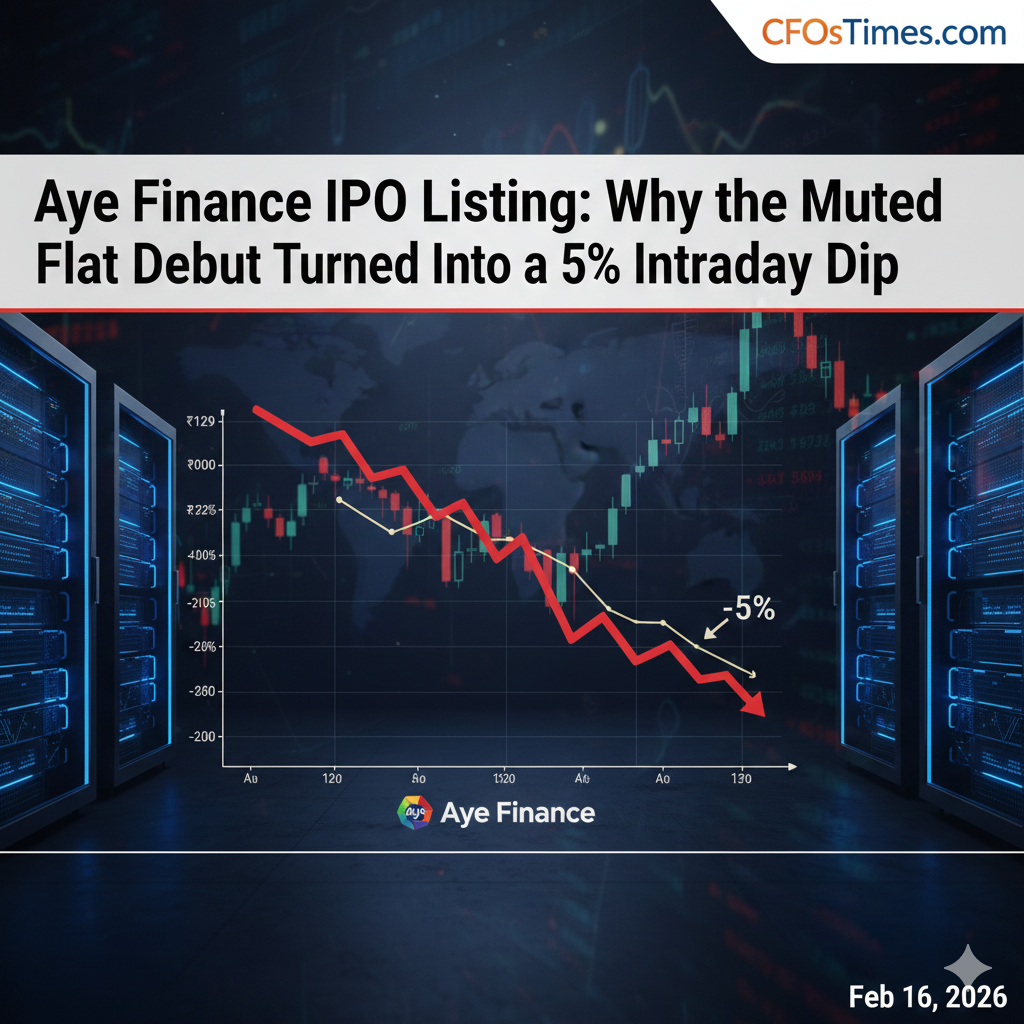
On Monday, February 16, 2026, the Indian markets delivered a brutal reality check to the fintech sector. The Aye Finance IPO Listing Analysis 2026 shows a stock that refused to give even a 1% premium, opening flat at ₹129 and cratering to an intraday low of ₹120.55—a move that has effectively wiped out the “Grey Market” hopes of thousands of retail investors.
While the issue price was set at the upper band of ₹129, the stock opened “at par” (flat) before facing immediate selling pressure. As of midday, the ticker symbol AYE is trending across financial platforms as investors weigh the company’s strong MSME focus against rising asset quality concerns and a lackluster subscription response. This article provides a real-time breakdown of the listing dynamics and the broader macroeconomic factors at play today.
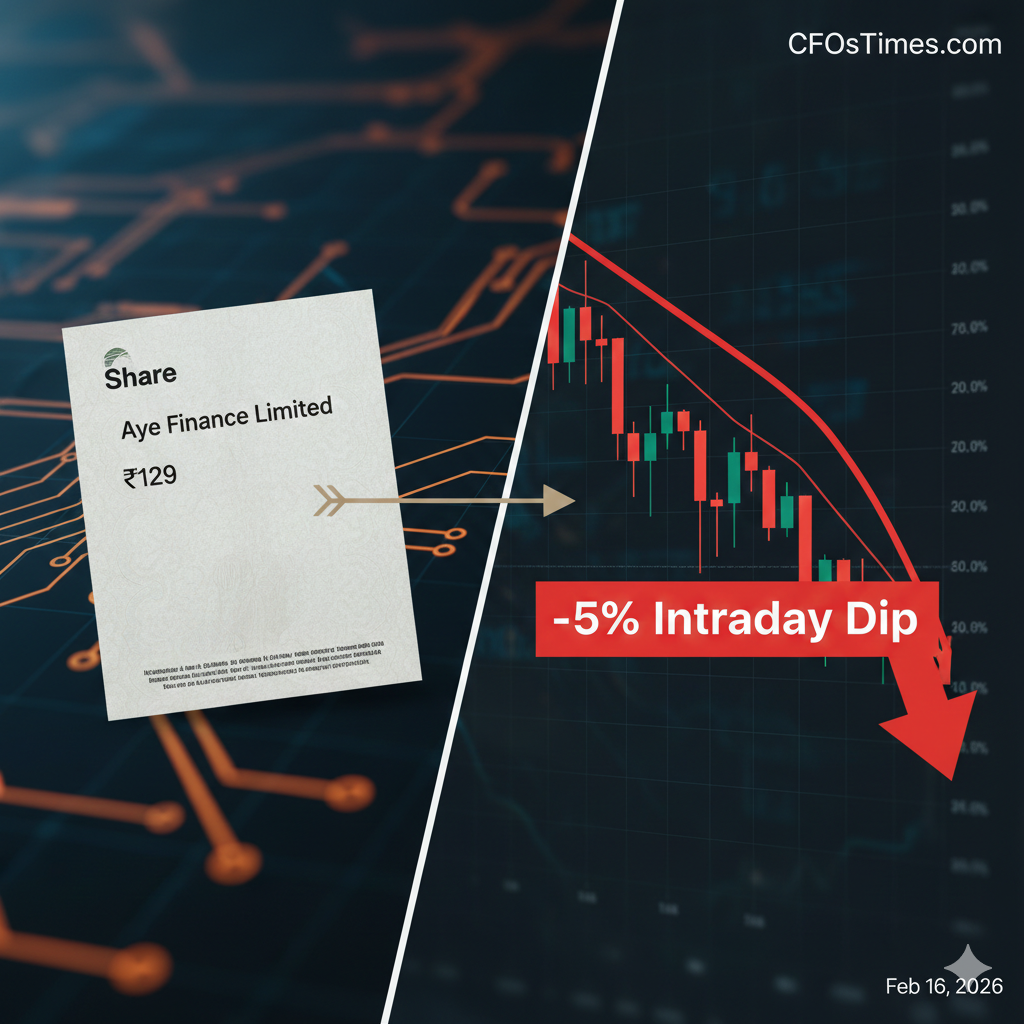
Table of Contents
1. The Listing Scorecard: Beyond the Flat Debut
While the listing was “flat,” the underlying volume tells a story of Institutional Exhaustion.
| Performance Metric | Real-Time Value (Feb 16, 2026) | Trend Signal |
| Opening Price | ₹129.00 (Flat) | ⚪ Neutral |
| Intraday High | ₹133.80 (+3.7%) | 🟢 Bull Trap |
| Intraday Low | ₹120.55 (-6.5%) | 🔴 Bearish Pivot |
| VWAP (Midday) | ₹124.96 | 🟡 Resistance |
| Market Cap | ₹3,077.40 Crore | 📉 Shrinking |
2. Why the Crash? The 3 “Poison Pills”
Our Aye Finance IPO Listing Analysis 2026 identifies three systemic triggers for today’s sell-off:
A. The NII “Vote of No Confidence”
The Non-Institutional Investor (NII) segment was subscribed a dismal 0.05 times. In the 2026 market, if the “Big HNIs” skip a listing, there is no liquidity to absorb the initial retail “panic selling.”
B. The GNPA Time-Bomb
Investors are reacting to the sharp rise in Gross Non-Performing Assets (GNPAs), which spiked to 4.85% as of late 2025. With MSME credit costs hitting 7% in February 2026, the market is pricing in a “Bad Loan Winter” for Aye Finance.
C. Aggressive P/E Valuations
Priced at a post-IPO P/E of 24.64x, Aye Finance offered no “Safety Margin” compared to established peers like Five Star Business Finance.
3. The “Big Tech” Connection: CapitalG & Alpha Wave
A critical part of the Aye Finance IPO Listing Analysis 2026 is the role of institutional anchors. Alphabet via CapitalG (13.14%) and Alpha Wave India (11.1%) remain the primary pillars. Aye Finance IPO Listing Analysis 2026
Strategic Insight: If these “Mega-Investors” maintain their lock-in periods without hedging, the ₹118-₹120 range may provide a long-term bottom. However, any exit signal from CapitalG would trigger a secondary collapse toward ₹105.
4. The Business Model: High Yield vs. High Risk
Aye Finance operates a “phygital” model (Physical + Digital), targeting micro-enterprises with annual turnovers between ₹10 lakh and ₹1 crore. Aye Finance IPO Listing Analysis 2026
The Opportunity:
- MSME Gap: There is a massive unmet credit demand in India’s informal sector.
- Cluster-Based Lending: By focusing on specific industry hubs (like textiles or electronics), Aye Finance manages risk through localized knowledge.
The Risk:
- Leverage: With a debt-to-equity ratio nearing 3.0x, the company is highly sensitive to borrowing costs.
- Credit Cost: Rising credit costs (currently at 5.15%) are eating into the Profit After Tax (PAT) margins.
5. Broader Finance Trends: Fintech & Stablecoins
While traditional equity listings like Aye Finance show caution, capital is migrating toward infrastructure. Today, OpenPayd won the “Best Future Payments Initiative” award for its stablecoin infrastructure. This highlights a shift: global investors are increasingly favoring “digital rails” and fintech integration over traditional lending models that carry heavy balance-sheet risk.
6. Expert Commentary & FAQs-Aye Finance IPO Listing
CFO Strategic Takeaway
“The flat debut of Aye Finance is a wake-up call for aggressively priced NBFC IPOs. Long-term investors should wait for the Q4 FY26 earnings to see if the management can arrest the rise in NPAs before taking a fresh position.” — Editorial Team, CFOsTimes.com
Frequently Asked Questions (FAQs)-Aye Finance IPO Listing Analysis 2026
Q1: Is Aye Finance a good buy after the 5% dip?
A1: Technically, the stock is now trading at a discount to its book value. However, the high GNPA makes it a “High Risk” play. Consult the SEBI Investor Education portal for risk management tips.
Q2: What was the final subscription of Aye Finance?
A2: It was subscribed 1.04 times overall, led by QIBs (1.62x) while Retail and NII stayed below 1x.
Q3: How did the Sensex react today?
A3: Despite the flat IPO, the Sensex rose 145 points to 82,769, bolstered by banking and energy shares.
Conclusion — What This Means for Markets-Aye Finance IPO Listing Analysis 2026
The Aye Finance IPO Listing Analysis 2026 confirms that the 2026 market is no longer rewarding “growth at any cost.” Investors are demanding profitability and clean asset books. While the debut was lackluster, the company’s “SwitchPe” platform and MSME reach remain strong long-term assets.
For now, the flat-to-negative debut suggests a “wait and watch” approach is best. Keep an eye on the RBI’s NBFC Sectoral Reports for broader lending trends. Aye Finance IPO Listing Analysis 2026
Disclaimer
Important Notice for Investors:
- Educational Purpose Only: The information provided in this article—including the analysis of the Aye Finance IPO Listing Analysis 2026 and the $650 Billion AI Capex Impact—is for educational and informational purposes only. It does not constitute financial, investment, or legal advice.
- No Recommendations: CFOsTimes.com does not provide “buy,” “sell,” or “hold” recommendations. We are not SEBI-registered Investment Advisors (IA) or Research Analysts (RA). All investment decisions should be made after consulting with a licensed financial professional.
- Market Risk: Securities investments, especially in IPOs and high-growth tech sectors, are subject to market risks. Past performance is not indicative of future results. Shares of Aye Finance debuted at ₹129 on February 16, 2026, but intraday fluctuations are common and can lead to capital loss.
- AdSense & Third-Party Content: This site uses cookies and displays advertisements via Google AdSense. Our editorial content is independent and is not influenced by advertisers or third-party sponsors. We do not promote “guaranteed returns” or “fixed income” schemes.
- Data Accuracy: While we strive for 100% accuracy, financial data is sourced from external agencies (BSE/NSE/SEC). We are not responsible for errors, omissions, or delayed updates in market data.
Regulatory Reference: For official guidelines on IPO investments, please visit the SEBI Investor Education Portal or the BSE India Official Site.

Dr. Dinesh Kumar Sharma is an award-winning Chief Financial Officer and Director of Finance with over 25 years of expertise in strategic planning and digital transformation. Recognized as a five-time CFO of the Year, he specializes in leveraging Generative AI and Microsoft Copilot to optimize financial forecasting and cost management. Dr. Sharma holds a Doctorate in Management (Finance) and has successfully scaled organizations from INR 1 billion to INR 7 billion. He is dedicated to providing transparent, data-driven insights for modern decision-makers at CFOs Times.