Bitcoin Gold Correlation 2026 Is Sending a New Market Signal
The financial market is beginning to treat Bitcoin differently.
For years, Bitcoin frequently behaved like a high-risk technology asset. When investors became more optimistic about growth and liquidity, Bitcoin often benefited. When technology stocks sold off and financial conditions tightened, Bitcoin could fall sharply alongside equities.
That relationship is changing.
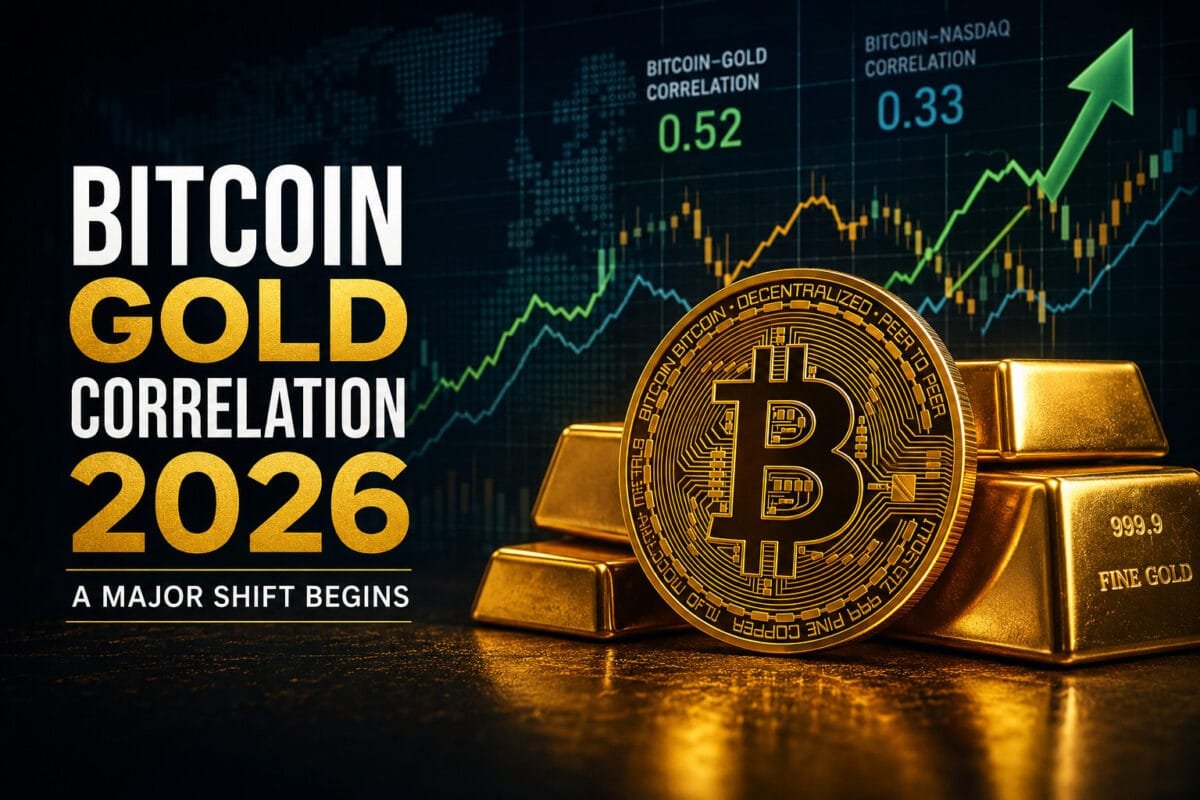
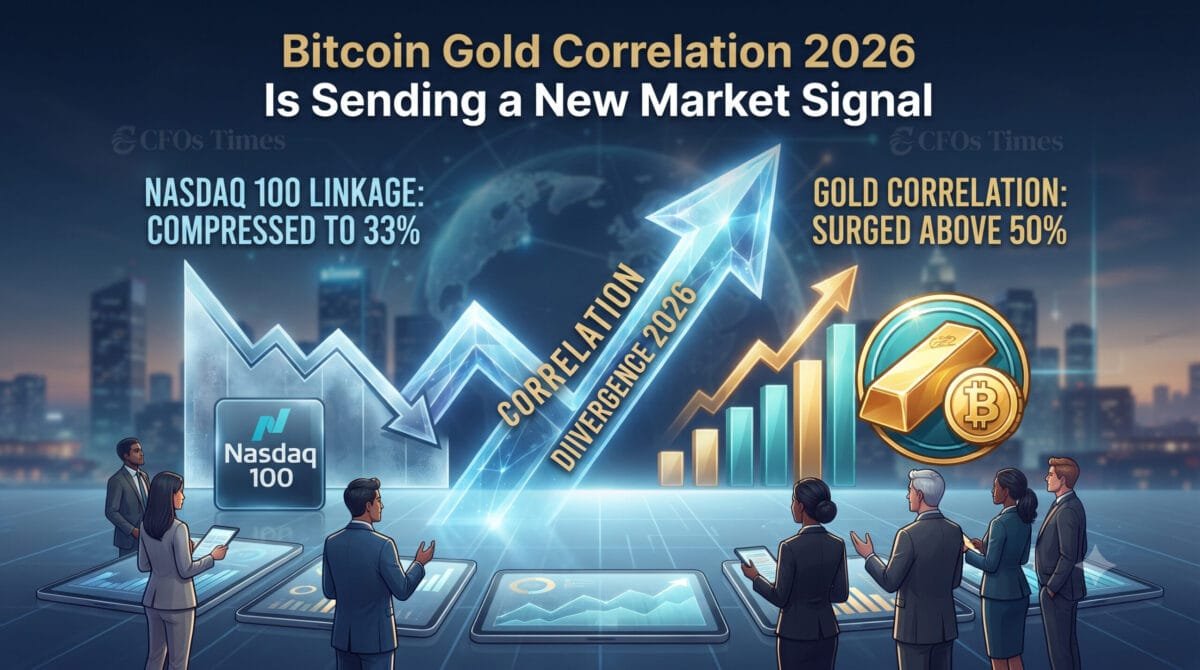
Recent market data show Bitcoin’s rolling 90-day correlation with gold has climbed above 50%, while its correlation with the Nasdaq 100 has fallen from above 60% to around 33%.
That is a notable shift in Bitcoin’s market identity.
The move does not prove that Bitcoin has become a digital version of gold. Gold and Bitcoin have very different histories, volatility characteristics, investor bases and market structures. The World Gold Council has repeatedly emphasized those differences.
But the changing correlation is worth watching because it is occurring alongside a broader reassessment of U.S. debt, Treasury markets, the dollar, inflation and the role of scarce assets.
For investors and financial professionals, the more important question is therefore not whether Bitcoin is “the new gold.”
It is whether Bitcoin is beginning to respond to macroeconomic forces in a way that increasingly resembles gold rather than technology stocks.
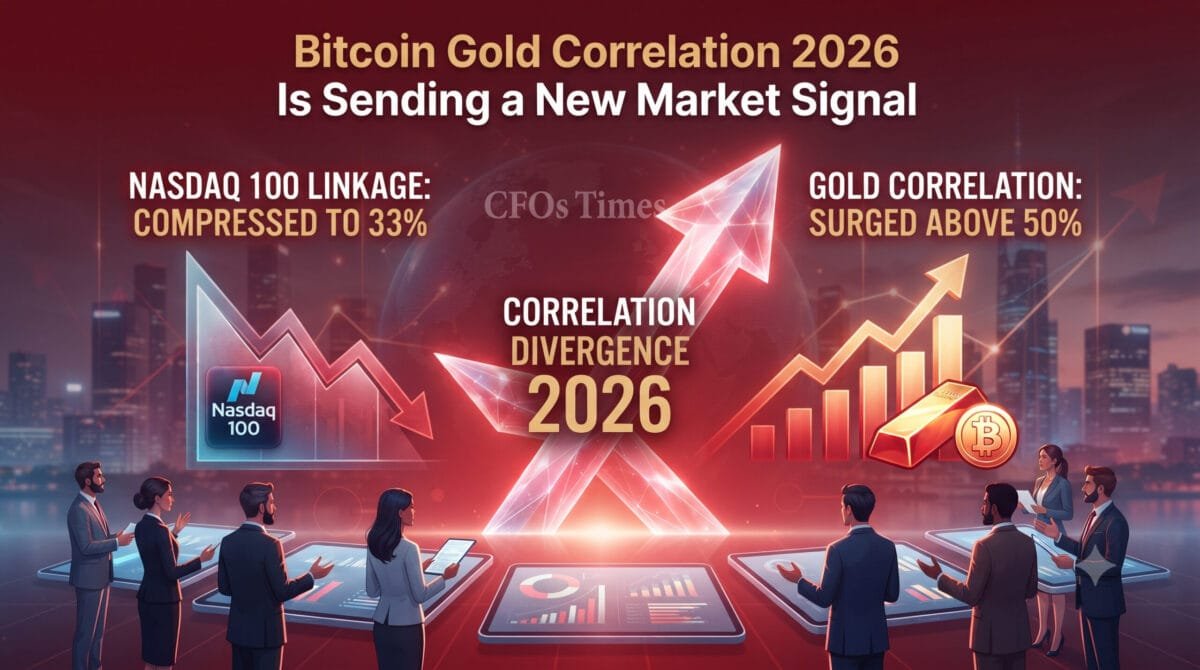
Table of Contents
What the Bitcoin Gold Correlation 2026 Data Actually Means
Correlation is a statistical measure showing how two assets have moved relative to one another over a particular period.
A positive correlation means the assets have tended to move in the same direction. A negative correlation means they have tended to move in opposite directions. A correlation near zero indicates that there has been little consistent linear relationship.
The latest Bitcoin Gold Correlation 2026 reading above 50% therefore means that Bitcoin and gold have recently displayed a moderately positive relationship.
It does not mean:
- Bitcoin and gold have the same risk profile.
- Bitcoin will continue rising whenever gold rises.
- Bitcoin has become a safe-haven asset.
- Gold investors are automatically becoming Bitcoin investors.
- Correlation establishes a causal relationship.
This distinction matters.
Rolling correlations are backward-looking. As new price observations enter the calculation, the measurement can change quickly.
The World Gold Council maintains regularly updated gold correlation and performance data precisely because relationships between asset classes are dynamic rather than permanent.
That makes the current Bitcoin-gold relationship important—but not conclusive. Bitcoin Gold Correlation 2026
Why Bitcoin Is Moving Away From Technology Stocks
The second part of the story may be even more significant.
Bitcoin’s relationship with the Nasdaq 100 has weakened materially. Recent reporting based on Grayscale’s analysis puts the 90-day Nasdaq correlation at roughly 33%, compared with more than 60% earlier in 2026.
That suggests Bitcoin is becoming less synchronized with the technology-heavy equity market.
This matters because Bitcoin has often been treated as a liquidity-sensitive risk asset.
When investors expect easier monetary conditions, falling yields or strong economic growth, high-beta assets can attract capital. When yields rise and liquidity tightens, those same assets can face selling pressure.
Bitcoin still responds to those forces.
But the latest market behavior suggests another variable is becoming increasingly important: monetary and fiscal credibility.
The distinction is subtle.
Technology stocks are primarily valued according to expectations surrounding corporate earnings, economic growth, interest rates and future cash flows.
Bitcoin has no corporate earnings.
Gold has no corporate earnings either.
Both are instead influenced by scarcity, liquidity, monetary conditions, investor positioning and perceptions of the value of traditional currencies.
That does not make them equivalent.
It does help explain why Bitcoin can sometimes trade more like gold than the Nasdaq. Bitcoin Gold Correlation 2026
The $40 Trillion Debt Question
One of the strongest macroeconomic themes behind the current Bitcoin Gold Correlation 2026 discussion is the U.S. fiscal position.
U.S. federal debt crossed the $40 trillion threshold in August, intensifying investor attention toward government borrowing and debt sustainability.
A large debt burden does not automatically make Bitcoin or gold attractive.
The important issue is what happens to the cost of servicing that debt and how investors perceive the long-term purchasing power of the currency in which the debt is denominated.
If markets become increasingly concerned about persistent fiscal deficits, investors may seek assets that are not directly dependent on government repayment.
Gold has occupied that role for centuries.
Bitcoin offers a modern alternative based on digital scarcity.
That is the foundation of what analysts often call the debasement trade.
The thesis is straightforward: if investors believe the supply of fiat currency and government liabilities will grow faster than the supply of scarce assets, demand for assets perceived as stores of value can increase.
The thesis is not guaranteed.
It also does not mean that every rise in government debt automatically produces a Bitcoin rally.
The market still has to price interest rates, liquidity, economic growth and risk appetite. Bitcoin Gold Correlation 2026
Treasury Markets Are Becoming More Important
The U.S. Treasury’s recent actions have added another layer to the story.
The Treasury announced that it would increase the maximum size of certain long-end buyback operations from $2 billion to at least $4 billion per operation beginning September 9 and continuing through the refunding quarter.
The move is designed to support liquidity in longer-dated Treasury securities.
For Bitcoin investors, the significance is indirect.
Treasury-market conditions influence yields, liquidity and broader financial conditions. Changes in long-term government bond markets can therefore affect everything from equity valuations to currency expectations and alternative assets.
Recent market coverage linked the Treasury buyback developments with a rally in Bitcoin and gold, alongside a weaker dollar.
That does not mean Treasury buybacks mechanically cause Bitcoin to rise.
Markets are considerably more complicated.
The more useful interpretation is that Treasury operations have become part of a broader conversation about U.S. debt, bond-market liquidity and the attractiveness of holding long-duration government securities.
That conversation can influence the relative appeal of scarce assets.
The Federal Reserve Is the Major Counterweight
There is, however, a significant challenge to the bullish macro narrative.
The Federal Reserve remains focused on inflation.
In his August 28 Jackson Hole speech, Federal Reserve Chair Kevin Warsh emphasized the importance of maintaining the 2% inflation objective. Market participants subsequently increased expectations for a possible rate hike, with the probability of a September increase reportedly rising from approximately 35% to 60%. Short-term Treasury yields also moved higher and the dollar strengthened.
This is crucial.
Bitcoin and gold may benefit from concerns about fiscal sustainability and currency purchasing power, but higher real yields can work in the opposite direction.
Neither Bitcoin nor physical gold generates a conventional interest payment.
If safe government securities offer increasingly attractive yields, investors may demand a greater expected return before allocating capital to non-yielding assets.
The latest gold market reaction illustrates this tension. Gold futures fell sharply during the week following the Jackson Hole remarks as concerns about persistent inflation and potentially tighter monetary policy increased.
Bitcoin has faced similar pressure.
On August 29, Bitcoin traded below $78,000 after its recent move above $80,000, showing how quickly the market can challenge the “digital gold” narrative when monetary-policy expectations change.
This is one reason investors should avoid interpreting the current correlation as a one-way bullish signal. Bitcoin Gold Correlation 2026
Bitcoin ETFs Are Changing the Demand Structure
Institutional access is another major difference between the current market and earlier Bitcoin cycles.
Spot Bitcoin ETFs have created a simpler mechanism for traditional investors to obtain Bitcoin exposure without directly managing private keys or cryptocurrency wallets.
Recent reporting indicates that Bitcoin ETF flows have strengthened during the August rebound. One market report put weekly spot Bitcoin ETF inflows at approximately $1.92 billion, describing it as a record weekly inflow for 2026.
Other market analysis has similarly identified renewed ETF demand as an important factor behind Bitcoin’s rebound.
This matters because the investor base is changing.
A retail trader may view Bitcoin primarily as a speculative asset.
A portfolio manager can view it differently.
The question becomes whether Bitcoin can provide:
- Portfolio diversification
- Exposure to digital scarcity
- An alternative monetary asset
- A potential hedge against currency concerns
- A different return stream from traditional equities and bonds
None of these characteristics eliminates Bitcoin’s volatility.
But they help explain why the asset is increasingly being discussed in institutional portfolio construction.
Bitcoin Is Still Not Gold
The phrase “digital gold” is useful as shorthand, but it can also be misleading.
Gold has thousands of years of monetary history.
Central banks hold it as a reserve asset. Institutional investors use it for diversification. Physical gold has no dependence on electricity, internet connectivity or a blockchain network.
Bitcoin is fundamentally different.
Its advantages include:
- A predetermined maximum supply of 21 million coins
- Digital portability
- Global transferability
- Continuous trading
- Transparent monetary issuance
- Growing institutional infrastructure
But Bitcoin also carries risks that gold does not.
Its price volatility is substantially higher, and its history as a financial asset is comparatively short.
The World Gold Council’s research has explicitly argued that Bitcoin should not be treated as an equivalent replacement for gold, citing differences in volatility, risk and behavior.
Therefore, the stronger argument is not that Bitcoin has replaced gold. Bitcoin Gold Correlation 2026
It is that Bitcoin has developed into a distinct scarce asset that can sometimes respond to the same macroeconomic forces as gold.
What Could Make the Correlation Continue?
Several developments could reinforce the Bitcoin Gold Correlation 2026 trend.
Persistent fiscal concerns
If concerns about U.S. debt sustainability remain elevated, demand for assets outside traditional government liabilities could continue.
A weaker dollar
A sustained decline in the dollar could support both gold and Bitcoin, although their reactions will not necessarily be identical.
Institutional Bitcoin allocation
Continued ETF inflows could create a more stable institutional demand base.
Lower real yields
If inflation remains elevated while nominal yields decline, the relative appeal of non-yielding scarce assets could increase.
Continued decoupling from equities
If Bitcoin continues to diverge from the Nasdaq during equity-market weakness, the argument for Bitcoin as a distinct macro asset becomes stronger.
What Could Break the Bitcoin-Gold Relationship?
The opposite scenario is equally important.
A stronger dollar could pressure both assets.
Higher real yields could reduce demand for non-yielding assets.
A severe liquidity shock could cause investors to sell Bitcoin because of its high volatility even if gold remains resilient.
Crypto-specific risks could also overwhelm macroeconomic factors.
These include:
- Excessive leverage
- Regulatory changes
- Exchange or custody problems
- Large-scale investor liquidations
- Changes in ETF flows
- Sharp shifts in speculative positioning
This is why correlation should be treated as an observation, not a portfolio guarantee. Bitcoin Gold Correlation 2026
Three Scenarios for the Rest of 2026
Bull case: Bitcoin becomes a stronger macro asset
In the bullish scenario, Bitcoin continues to separate from technology stocks while maintaining a positive relationship with gold.
ETF demand remains strong, the dollar weakens, fiscal concerns increase and real yields decline.
Under those conditions, Bitcoin could increasingly attract capital from investors looking for exposure to digital scarcity.
Base case: Correlation remains unstable
The most realistic scenario may be continued fluctuation.
Bitcoin could trade like gold during periods dominated by fiscal and monetary concerns, then revert toward technology stocks when liquidity and risk appetite become the dominant drivers.
This would mean the current correlation is meaningful but not permanent.
Bear case: Monetary tightening dominates
If inflation remains stubborn and the Federal Reserve becomes more restrictive, Treasury yields and the dollar could rise.
That environment could pressure both Bitcoin and gold, while Bitcoin’s higher volatility could amplify downside moves.
The recent market reaction to Warsh’s Jackson Hole remarks demonstrates that this risk is already visible. Bitcoin Gold Correlation 2026
What Investors Should Monitor
The Bitcoin Gold Correlation 2026 thesis should be evaluated using several indicators rather than one statistic.
1. Rolling Bitcoin-gold correlation:
Does the relationship remain elevated over several months?
2. Bitcoin-Nasdaq correlation:
Does Bitcoin continue separating from technology stocks?
3. U.S. Treasury yields:
Are long-term yields rising or falling?
4. Real interest rates:
Are inflation-adjusted yields becoming more attractive?
5. Dollar index:
Is the dollar strengthening or weakening?
6. Bitcoin ETF flows:
Is institutional demand persistent or temporary?
7. Gold demand:
Are investors and central banks continuing to increase gold exposure?
The World Gold Council’s data platform provides updated information on gold returns, volatility and correlations across major asset classes. Bitcoin Gold Correlation 2026
Why This Matters for CFOs and Institutional Investors
For a publication such as CFOSTimes, the most important issue is not whether Bitcoin will reach a particular price target.
It is whether Bitcoin’s portfolio role is changing.
CFOs, treasury professionals and institutional investors increasingly need to understand how digital assets interact with traditional macroeconomic variables.
The current correlation shift raises several practical questions.
Could Bitcoin become a more meaningful diversification asset?
Could institutional investors eventually evaluate Bitcoin alongside gold rather than alongside technology stocks?
Could fiscal concerns increase demand for both assets? Bitcoin Gold Correlation 2026
And, perhaps most importantly, will Bitcoin maintain this behavior when monetary conditions become less favorable?
Those questions are more valuable than short-term price predictions.
A mature institutional analysis should examine Bitcoin through the same framework used for other asset classes: liquidity, volatility, correlation, drawdown risk, regulatory exposure and portfolio contribution.

The Bigger Picture- Bitcoin Gold Correlation 2026
The most interesting aspect of Bitcoin Gold Correlation 2026 is not the 50% figure itself.
It is the possibility that Bitcoin’s market identity is becoming more flexible.
Bitcoin can still behave like a risk asset.
It can still respond strongly to liquidity.
It can still fall sharply when interest rates rise.
But the market is increasingly capable of treating it as something else as well.
That “something else” is a scarce monetary asset.
Gold has occupied that category for generations.
Bitcoin is attempting to establish itself within it.
Whether it succeeds remains an open question. Bitcoin Gold Correlation 2026
Conclusion- Bitcoin Gold Correlation 2026
The latest Bitcoin Gold Correlation 2026 data point to a meaningful change in market behavior.
Bitcoin’s 90-day correlation with gold has risen above 50%, while its relationship with the Nasdaq 100 has fallen to roughly 33%.
The shift comes as investors confront a complicated macroeconomic environment involving U.S. debt, Treasury-market liquidity, dollar movements, inflation and Federal Reserve policy.
At the same time, Bitcoin ETF flows have returned strongly, creating a potentially more institutional demand base.
Yet the latest pullback in Bitcoin following the Federal Reserve‘s Jackson Hole messaging provides an important warning: Bitcoin remains highly sensitive to monetary conditions.
The correct conclusion is therefore not that Bitcoin has permanently become gold.
The stronger conclusion is that Bitcoin may be developing a more complex macroeconomic identity.
If the correlation with gold remains elevated while Bitcoin continues to decouple from technology stocks, the development could mark a significant evolution in how institutional investors classify the asset.
If the relationship quickly reverses, it will demonstrate that Bitcoin remains a highly dynamic asset whose correlations can change with the economic cycle.
For now, the signal is powerful—but the market still needs time to determine whether it represents a temporary correlation or the beginning of a genuine structural shift.
Frequently Asked Questions- Bitcoin Gold Correlation 2026
What is Bitcoin Gold Correlation 2026?
Bitcoin Gold Correlation 2026 describes the statistical relationship between Bitcoin and gold prices during 2026. Recent market analysis indicates that Bitcoin’s rolling 90-day correlation with gold has risen above 50%.
Why is Bitcoin becoming more correlated with gold?
The recent shift coincides with increased attention toward U.S. debt, fiscal sustainability, currency purchasing power, Treasury-market conditions and scarce assets. These factors can influence both Bitcoin and gold.
Does a 50% correlation mean Bitcoin is a safe haven?
No. Correlation measures price movement, not safety. Bitcoin remains considerably more volatile than gold and has unique technological, regulatory and market-structure risks.
Is Bitcoin replacing gold?
There is currently no evidence that Bitcoin is replacing gold as a global reserve asset. Gold has a much longer monetary history and remains important to central banks and institutional portfolios.
Why does Bitcoin’s Nasdaq correlation matter?
Bitcoin has historically behaved partly like a high-risk technology asset. A declining Nasdaq correlation could indicate that monetary, fiscal and scarcity-related factors are becoming more influential in Bitcoin pricing.
Could the Bitcoin-gold correlation fall again?
Yes. Correlations are dynamic. Changes in interest rates, liquidity, the dollar, investor positioning or crypto-specific conditions can quickly alter the relationship.
What should investors watch next?
Investors should monitor Bitcoin-gold correlation, Bitcoin-Nasdaq correlation, Treasury yields, real interest rates, the U.S. dollar, ETF flows and gold demand rather than relying on a single market statistic.
Is Bitcoin a substitute for gold?
Not necessarily. Bitcoin and gold share certain scarcity characteristics but have very different histories, volatility profiles and market structures. The World Gold Council specifically cautions against treating Bitcoin as an equivalent substitute for gold. Bitcoin Gold Correlation 2026
Is this article financial advice?
No. This article is intended for educational and informational purposes. It does not constitute investment, financial, tax or legal advice. Cryptocurrency and precious-metal investments involve risks, including substantial price volatility and potential loss of capital. Bitcoin Gold Correlation 2026
Disclaimer:
The information provided on CFOs Times (cfostimes.com) regarding macroeconomic trends, digital asset correlations, precious metals, Bitcoin Gold Correlation 2026 and market analysis is for general informational and educational purposes only. It does not constitute formal professional financial, investment, legal, or tax advice.
Cryptocurrency markets, precious metals, and global equities involve substantial risk of loss and are subject to extreme price volatility and regulatory shifts. Readers and institutional market participants should conduct their own independent due diligence, verify official data sources (such as SEC filings or the World Gold Council), and consult a licensed financial advisor or certified professional before executing any investment or corporate treasury strategy.

Dr. Dinesh Kumar Sharma is a CMA an award-winning Chief Financial Officer and Director of Finance with over 25 years of expertise in strategic planning and digital transformation. Recognized as a five-time CFO of the Year, he specializes in leveraging Generative AI and Microsoft Copilot to optimize financial forecasting and cost management. Dr. Sharma holds a Doctorate in Management (Finance) and has successfully scaled organizations from INR 1 billion to INR 7 billion. He is dedicated to providing transparent, data-driven insights for modern decision-makers at CFOs Times.










2 thoughts on “Bitcoin Gold Correlation 2026: A Powerful Market Shift”