CRM Stock Surges as Salesforce Delivers a Major AI Test
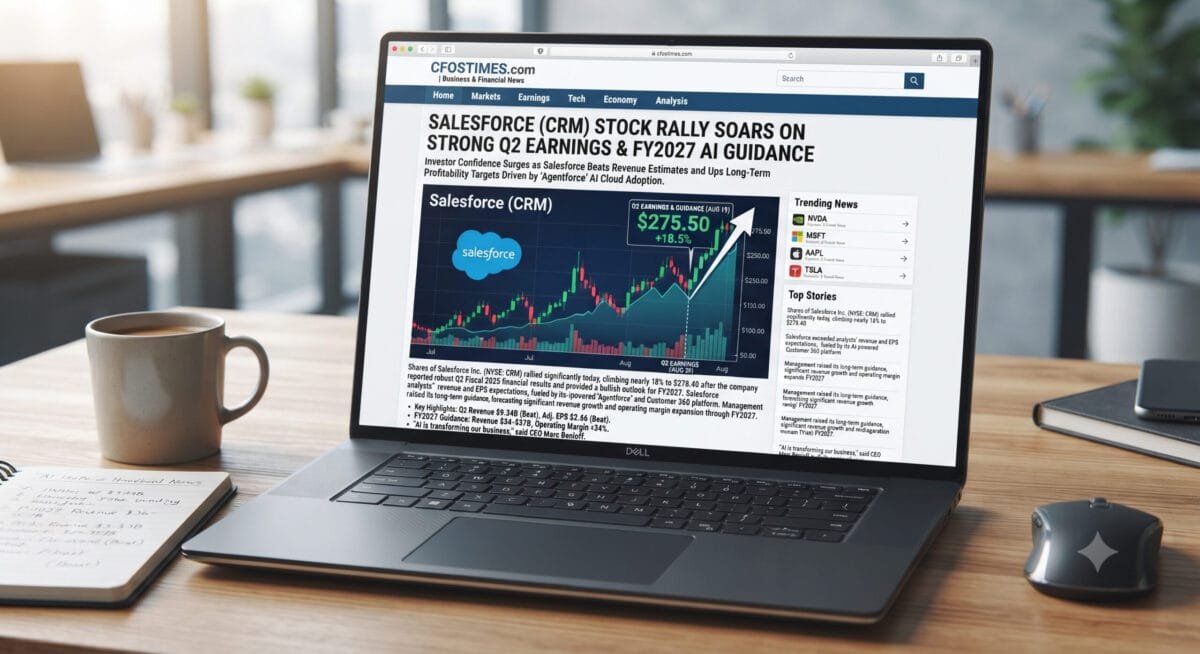
CRM Stock is back in the spotlight after Salesforce delivered a stronger-than-expected second quarter and raised its fiscal 2027 revenue outlook, giving investors fresh evidence that artificial intelligence may be becoming a meaningful growth engine for the enterprise-software giant.
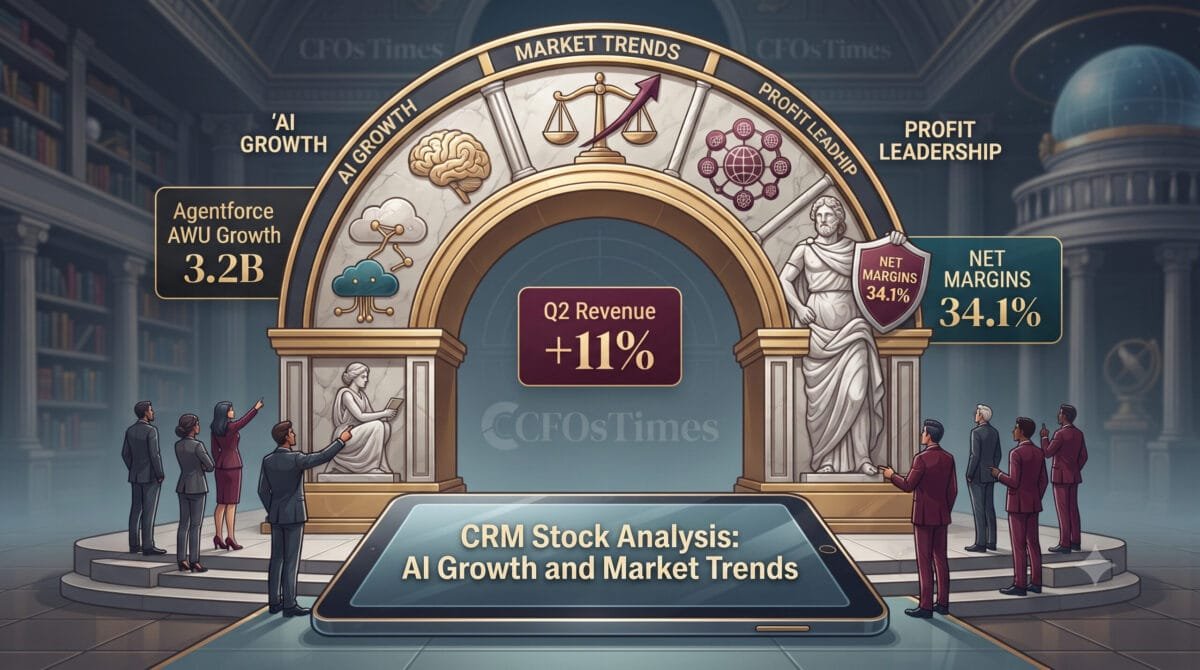
Salesforce reported fiscal Q2 2027 revenue of approximately $11.3 billion, up 11% year over year. Current remaining performance obligations, or cRPO, increased 14% to $33.5 billion. Subscription and support revenue reached $10.8 billion, while operating cash flow climbed 71% to $1.3 billion and free cash flow jumped 81% to $1.1 billion.
The bigger story, however, is artificial intelligence.
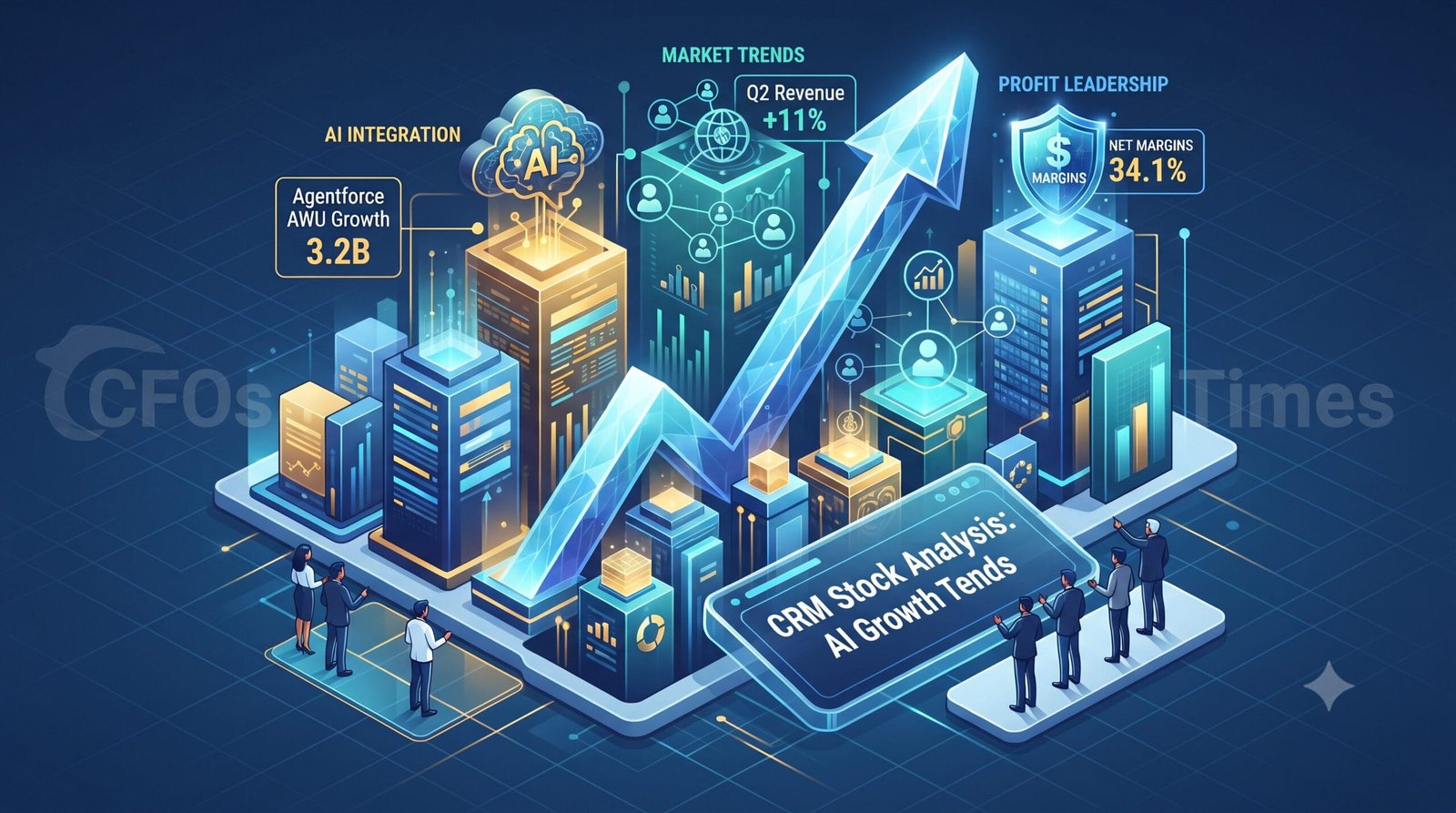
Salesforce said combined Agentforce and Data 360 annual recurring revenue reached nearly $3.9 billion, up more than 210% year over year. Agentforce ARR exceeded $1.5 billion, growing more than 240%.
The company also expanded its relationship with Anthropic through a new initiative called Claudeforce, combining Claude’s AI capabilities with Salesforce’s enterprise data, workflows and governance.
Investors reacted aggressively. Salesforce shares jumped sharply in extended trading after the results, with Reuters reporting an increase of about 14% initially.
But a large post-earnings rally does not automatically make a stock a buy.
The more important question is whether Salesforce can turn extraordinary AI adoption into sustainable organic growth, higher cash generation and durable shareholder returns.
Here are seven factors that explain the latest CRM Stock surge—and the risks investors should not overlook.
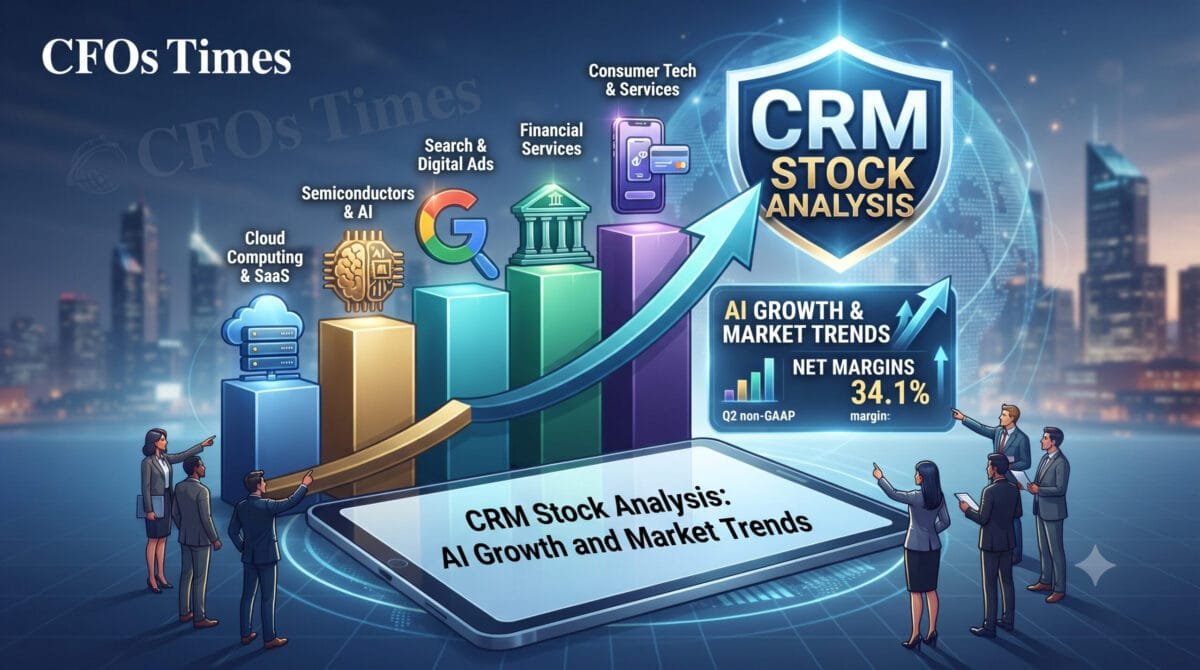
Table of Contents
1. CRM Stock Is Getting a Powerful AI Growth Catalyst
The most important change in the Salesforce investment story is the company’s progress in monetizing AI.
For years, investors debated whether artificial intelligence would strengthen established software companies or eventually make some of their products less valuable.
Salesforce is attempting to prove the first scenario.
Agentforce is designed to allow companies to deploy AI agents that can interact with enterprise data, perform tasks and participate in business workflows. Instead of simply giving employees another software interface, Salesforce wants AI agents to become active participants in sales, service, marketing and other operations.
The latest numbers are significant.
Salesforce reported that Agentforce and Data 360 together generated nearly $3.9 billion in ARR. Agentforce ARR exceeded $1.5 billion, increasing more than 240% year over year.
Salesforce also reported 7 billion cumulative Agentic Work Units delivered across Agentforce and Slack, including 3.2 billion during the latest quarter.
That suggests customer experimentation with AI is becoming actual product usage.
For CRM Stock, this is crucial.
If AI merely increases research and development expenses, investors may eventually become disappointed. But if AI products produce recurring subscription revenue, increase customer spending and improve retention, Salesforce could potentially create a much larger revenue opportunity from its existing customer base.
That is the central bullish argument.
2. Salesforce Raised Its FY2027 Revenue Guidance
Another major reason CRM Stock is attracting investors is Salesforce’s upgraded fiscal-year outlook.
The company now expects fiscal 2027 revenue of $46.1 billion to $46.4 billion, representing approximately 11%-12% year-over-year growth.
The increase deserves closer examination.
Salesforce said the $200 million increase in its revenue forecast reflects:
- $100 million of additional organic growth
- $200 million from pending Contentful and Fin acquisitions
- $100 million of foreign-exchange headwinds
That breakdown is particularly important.
The headline guidance increase is positive, but investors should not assume the entire improvement represents accelerating organic demand.
Only part of the increase comes from organic growth.
The pending acquisitions are also incorporated into the updated guidance, subject to their closing.
That makes the quality of the forecast more nuanced than a simple “Salesforce raised guidance” headline suggests.
Still, the underlying direction is encouraging.
Salesforce expects subscription and support revenue growth to be slightly above 12% for FY2027, while maintaining a 34.3% non-GAAP operating-margin target.
For investors studying CRM Stock, recurring revenue growth and cRPO are arguably more important than one-quarter EPS growth because they provide insight into future contracted business.
3. Agentforce Could Transform Salesforce’s Economics
The third major catalyst behind CRM Stock is the possibility that Agentforce changes how Salesforce monetizes its installed customer base.
Traditional enterprise software largely charges customers for seats, applications or usage.
AI agents introduce another potential pricing model.
Companies could pay for AI-powered capabilities that perform tasks, process data and automate workflows.
That could allow Salesforce to increase revenue per customer without necessarily acquiring an entirely new customer.
The latest quarter provides early evidence of that opportunity.
Salesforce said bookings from Agentforce One Edition and Agentforce for Apps, premium offerings anchored in sales and service applications, more than doubled quarter over quarter.
Data 360 is also becoming strategically important.
Salesforce said Data 360 ingested 104 trillion records during the quarter, up 355% year over year, including 82 trillion records through Zero Copy, which increased 731%.
Why does this matter?
AI models need useful data.
If Salesforce can become the trusted layer connecting business data, applications, workflows and AI agents, its competitive position could become significantly stronger.
That is why the long-term CRM Stock story is increasingly about much more than customer relationship management.
It is about whether Salesforce can become an enterprise operating layer for the AI era.
4. The Anthropic Partnership Raises the Stakes
The fourth major catalyst is Salesforce’s expanded partnership with Anthropic.
The two companies announced Claudeforce, an initiative designed to bring Anthropic’s Claude models together with Salesforce’s enterprise platform.
Salesforce says the collaboration combines AI reasoning with business data, workflows, logic, actions and governance.
That strategy addresses one of the biggest challenges facing enterprise AI.
Businesses do not simply need powerful AI models.
They need AI that understands their customers, internal processes, permissions, data structures and business rules.
That is where Salesforce has a potentially valuable advantage.
Reuters reported that the expanded Anthropic relationship was announced alongside Salesforce’s earnings and contributed to the strong market reaction.
Salesforce says its Salesforce-in-Claude product is expected to enter open beta in September 2026.
The development could become an important catalyst for CRM Stock if customers adopt the combined offering at scale.
However, investors should remember that partnerships do not automatically produce material revenue.
The important evidence will come from customer adoption, contract values, retention and recurring revenue.
5. The Earnings Beat Looks Strong—but EPS Needs Careful Analysis
This is where investors need to look beyond the headline. CRM Stock Surges
Salesforce reported GAAP diluted EPS of $4.29, up 119% year over year, while non-GAAP diluted EPS reached $5.90, up 103%.
At first glance, those numbers look extraordinary.
But reported earnings were also influenced by gains on Salesforce’s strategic investment portfolio.
Reuters reported that strategic investment gains contributed materially to the quarter’s adjusted earnings, including an approximately $2.53-per-share impact.
That distinction matters.
An investment gain is not equivalent to recurring operating income generated from selling software.
A professional investor evaluating CRM Stock should therefore examine:
- Revenue growth
- Subscription revenue
- cRPO
- Operating margin
- Operating cash flow
- Free cash flow
- Share count
- Investment gains and losses
Salesforce’s operational figures were still encouraging.
GAAP operating margin was 20.5%, while non-GAAP operating margin was 34.1%. Operating cash flow increased 71% and free cash flow rose 81%.
So the correct interpretation is not that the earnings were weak.
Rather, the quality and composition of EPS growth deserve careful analysis.
That nuance makes the investment case more credible—not less. CRM Stock Surges
Investors can review Salesforce’s official financial statements and regulatory disclosures through its SEC filings.
6. Salesforce’s $25 Billion Buyback Adds Another Tailwind
Capital allocation is another reason CRM Stock has attracted attention.
Salesforce continues to execute a massive $25 billion accelerated share repurchase program.
The company expects the final settlement of that ASR in October 2026.
Buybacks can increase earnings per share by reducing the number of shares over which earnings are distributed.
Salesforce said its Q2 results included continued execution against the $25 billion ASR and that shareholders also received $364 million in dividends during the quarter.
The company also said its guidance reflects the reduction in share count resulting from the initial 103 million shares delivered under the ASR.
For CRM Stock, this creates another potential EPS tailwind.
But investors should not automatically treat buybacks as value creation.
The key question is the price Salesforce pays for its own shares.
Repurchasing stock below intrinsic value can create substantial long-term value.
Buying aggressively when valuation is stretched can produce a much smaller benefit.
Therefore, the buyback should be viewed alongside free cash flow and valuation—not in isolation.
7. The Biggest Risk to CRM Stock Is Now Investor Expectations
Ironically, Salesforce’s strongest quarter may have created its biggest short-term risk.
Expectations are rising.
When a stock jumps sharply following earnings, investors begin pricing in stronger future performance.
That means the company may need to deliver several consecutive quarters of strong results to maintain the new narrative.
There are at least five major risks. CRM Stock Surges
AI Competition
Salesforce competes with Microsoft, Oracle, ServiceNow, Adobe and other enterprise technology companies.
The competitive environment could become even more intense as AI-native companies expand into enterprise applications.
AI Disruption
AI could ultimately help Salesforce—or reduce the value of traditional software applications.
That remains one of the industry’s central strategic questions.
The global software sector has already experienced periods of intense concern about AI disruption, showing how quickly investor sentiment can change.
Acquisition Risk
Salesforce’s revised FY2027 guidance includes expected contributions from Contentful and Fin.
The company expects both transactions to close during Q3 FY2027, subject to closing conditions.
Acquisitions can accelerate growth, but integration costs and execution risks must be considered.
Slowing Core Growth
Investors should distinguish between rapid growth in AI-related products and the growth rate of Salesforce’s broader business.
If AI revenue grows extremely quickly while traditional CRM demand remains relatively slow, the overall business may still struggle to reach the growth rates implied by a more aggressive valuation.
Valuation
Even a high-quality company can become an unattractive investment if investors pay too much for future growth.
That is particularly important following a sharp earnings-driven rally. CRM Stock Surges
What Should Investors Watch Next?
The next phase of the CRM Stock story will depend on whether Salesforce can sustain its momentum.
Investors should focus on five indicators.
Agentforce ARR
Continued triple-digit growth would strengthen the argument that AI is becoming a major Salesforce revenue stream.
cRPO Growth
Salesforce reported 14% cRPO growth in Q2 and expects approximately 14% growth in Q3.
This is one of the most useful indicators of contracted future business.
Organic Revenue Growth
This deserves special attention because the revised FY2027 guidance includes acquisition contributions.
The company itself identified $100 million of the guidance increase as organic growth, compared with $200 million from pending Contentful and Fin acquisitions.
Free Cash Flow
Salesforce currently expects FY2027 operating cash flow and free cash flow growth of approximately 4%-5%.
That is much slower than the latest quarterly free-cash-flow growth rate.
The difference deserves monitoring.
Margins
Salesforce is targeting a 34.3% FY2027 non-GAAP operating margin while continuing to invest heavily in AI.
Maintaining that margin while scaling AI could be a significant proof point.
Salesforce’s official investor-relations page provides quarterly results, presentations, events and financial information.
CRM Stock Outlook: Bull Case vs. Bear Case
| Factor | Bull Case | Bear Case |
|---|---|---|
| Agentforce | AI becomes a major recurring revenue engine | AI competition limits monetization |
| Revenue | Organic growth reaccelerates | Growth remains dependent on acquisitions |
| Data 360 | Becomes critical AI infrastructure | Customers choose alternative data platforms |
| Anthropic | Claudeforce accelerates enterprise adoption | Partnership produces limited incremental revenue |
| Margins | AI improves customer economics | AI infrastructure raises costs |
| Buybacks | Lower share count boosts EPS | Repurchases occur at elevated valuations |
| Valuation | Earnings catch up with expectations | Multiple contracts if growth disappoints |
The bull case is compelling.
Salesforce has a massive installed customer base, strong recurring revenue, growing AI products, substantial cash generation and an expanding ecosystem.
The bear case is equally worth considering.
AI could disrupt traditional software economics, competition could intensify, acquisitions may not deliver expected synergies, and investors may already be pricing in considerable future success.
Is CRM Stock a Buy After the Rally?
Whether CRM Stock is attractive today depends on the price investors are paying relative to the company’s future earnings and cash flows.
The operational evidence is encouraging.
Salesforce delivered 11% quarterly revenue growth, 14% cRPO growth, rapidly expanding Agentforce and Data 360 ARR, strong cash generation and higher FY2027 revenue guidance.
But investors should not confuse a strong company with a guaranteed strong investment.
The most important question is whether Salesforce can convert its AI momentum into sustainable organic growth.
If Agentforce and Data 360 continue scaling rapidly, AI could become a meaningful contributor to Salesforce’s overall growth.
If organic growth accelerates while margins remain strong, the bullish case becomes considerably stronger.
But if AI revenue grows rapidly without materially changing total company growth, investors may eventually question whether the market has become too optimistic.
That is why valuation matters.
Investors considering CRM Stock should review Salesforce’s official filings, understand the distinction between GAAP and non-GAAP earnings and pay particular attention to investment gains that can make quarterly EPS look stronger than underlying operating performance.
For general investor education, Investor.gov explains the risks associated with investing in individual stocks.
Why CRM Stock Could Remain a Major AI Trade
There is a broader reason this story matters.
The debate around AI investing has increasingly shifted from “Who is building the biggest AI model?” to “Who will make money from deploying AI across businesses?”
That distinction could be important for Salesforce.
Nvidia benefits from AI infrastructure spending.
AI-model companies benefit from model demand.
Salesforce is positioning itself further down the value chain, where AI interacts with enterprise customers, data and business processes.
If that strategy succeeds, Salesforce could monetize AI without needing to build the dominant foundational model itself.
The Anthropic relationship reinforces that strategy.
Salesforce can potentially provide the enterprise context, customer data, workflows and governance while Anthropic provides advanced model capabilities.
That division of roles could prove powerful.
But it also means Salesforce must demonstrate that customers are willing to pay enough for the combined value.
The next several quarters will provide the answer.
Frequently Asked Questions About CRM Stock
1. Why is CRM Stock surging?
CRM Stock is surging after Salesforce reported strong Q2 FY2027 results, raised its FY2027 revenue outlook and announced the expanded Anthropic partnership and Claudeforce initiative. Salesforce also reported rapid growth in Agentforce and Data 360 ARR.
2. What was Salesforce’s Q2 FY2027 revenue?
Salesforce reported approximately $11.3 billion of revenue for Q2 FY2027, representing 11% year-over-year growth. Subscription and support revenue reached $10.8 billion.
3. What is Salesforce’s FY2027 revenue forecast?
Salesforce now expects FY2027 revenue of $46.1 billion to $46.4 billion, representing approximately 11%-12% annual growth.
4. How fast is Agentforce growing?
Agentforce ARR exceeded $1.5 billion, up more than 240% year over year. Salesforce’s combined Agentforce and Data 360 ARR reached nearly $3.9 billion, up more than 210%.
5. What is Claudeforce?
Claudeforce is Salesforce’s expanded collaboration with Anthropic, designed to combine Claude’s AI capabilities with Salesforce’s enterprise data, workflows, business logic, actions and governance.
6. Did Salesforce’s EPS growth come entirely from operations?
No. Although operating performance improved substantially, strategic investment gains also materially affected reported EPS. Investors should therefore distinguish recurring operating earnings from investment gains.
7. Is CRM Stock guaranteed to rise further?
No. A strong earnings report does not guarantee future share-price gains. Valuation, competition, AI adoption, economic conditions, enterprise technology spending and execution can all affect future performance.
8. What is the biggest long-term catalyst for CRM Stock?
The biggest potential catalyst is successful monetization of AI through Agentforce, Data 360 and related products. If AI significantly increases recurring revenue per customer while Salesforce maintains strong margins, the long-term opportunity could expand substantially.
9. What is the biggest risk?
The biggest risk may be the gap between expectations and actual future growth. If AI adoption fails to accelerate Salesforce’s overall organic growth, investors could reassess the premium placed on the stock.
10. Where should investors get Salesforce’s financial information?
Investors should prioritize Salesforce’s own financial releases, SEC filings and investor presentations rather than relying solely on social-media commentary or stock-prediction websites. Salesforce publishes those materials through its Investor Relations website.
Conclusion: CRM Stock Has Entered a New AI Phase
CRM Stock is no longer simply a story about whether Salesforce can defend its traditional CRM franchise.
The investment debate has changed.
Salesforce is now attempting to become a major enterprise platform for the AI economy, combining applications, customer data, workflows, AI agents and governance.
The latest quarter provides meaningful evidence that the strategy is gaining traction.
Revenue increased 11%, cRPO accelerated 14%, Agentforce and Data 360 ARR approached $3.9 billion, Agentforce ARR exceeded $1.5 billion, free cash flow jumped 81% and Salesforce raised its FY2027 revenue forecast.
The expanded Anthropic partnership adds another potentially important catalyst.
At the same time, investors should remain analytical.
The revised revenue outlook includes acquisition contributions. Reported EPS benefited from strategic investment gains. AI competition is intense. And a sharp share-price rally can raise expectations faster than fundamentals improve.
Therefore, the most useful way to view CRM Stock today is neither as an obvious buy nor an obvious sell.
It is a high-profile test of whether an established enterprise software company can successfully monetize the AI revolution.
If Salesforce continues converting Agentforce adoption into recurring revenue, accelerates organic growth and protects its margins, the bullish case could strengthen considerably.
If those expectations fail to materialize, today’s enthusiasm could prove difficult to sustain.
For investors, the next earnings reports—not today’s headline rally—will ultimately determine whether Salesforce’s AI transformation is producing a durable change in the company’s economics.
Disclaimer
This article is intended solely for informational and educational purposes and does not constitute investment, financial, tax, accounting or legal advice.
The information has been researched and updated using publicly available information available through August 27, 2026. Financial markets can change rapidly, and information may become outdated after publication.
Nothing in this article should be interpreted as a recommendation to buy, sell or hold Salesforce shares. Individual stocks involve substantial risk, including the possibility of losing part or all of invested capital.
Readers should conduct their own research, review official company filings and consider consulting a qualified financial adviser before making investment decisions.
CFOsTimes does not guarantee any particular investment outcome, stock-price target, return or future performance.

Dr. Dinesh Kumar Sharma is a CMA an award-winning Chief Financial Officer and Director of Finance with over 25 years of expertise in strategic planning and digital transformation. Recognized as a five-time CFO of the Year, he specializes in leveraging Generative AI and Microsoft Copilot to optimize financial forecasting and cost management. Dr. Sharma holds a Doctorate in Management (Finance) and has successfully scaled organizations from INR 1 billion to INR 7 billion. He is dedicated to providing transparent, data-driven insights for modern decision-makers at CFOs Times.