Apple AI strategy implementations have taken center stage on Wall Street as the technology giant’s cautious stance transforms into a complex market challenge. While Apple has traditionally prioritized privacy, hardware integration, and disciplined capital allocation, the hyper-accelerated artificial intelligence boom has forced investors to re-evaluate the stock’s growth trajectory. For institutional investors, retail shareholders, and tech market analysts, understanding the friction between Apple’s deliberate approach and market-driven AI expectations is essential for evaluating long-term portfolio positioning.

Table of Contents
The Evolution of Big Tech AI Spending and Apple’s Divergence
Over the past several years, the global technology sector has witnessed an unprecedented capital expenditure (CapEx) super-cycle. Hyperscalers and semiconductor giants have poured hundreds of billions of dollars into proprietary data centers, specialized neural processing units, and massive large language model (LLM) training clusters. Apple AI strategy
Key Divergences in Tech Strategies
- Aggressive Infrastructure Accumulation: Competitors have aggressively scaled physical compute capacity, accepting massive near-term capital outlays to secure dominant positions in enterprise and consumer AI applications.
- Capital Discipline and Margin Protection: Apple deliberately chose a more measured capital allocation model, leveraging on-device processing and strategic third-party partnerships rather than building out massive, high-overhead data center footprints.
- The Investor Sentiment Flip: Initially, this conservative restraint was celebrated as a prudent defensive moat against uncertain return-on-investment (ROI) cycles. However, as macroeconomic sentiment shifted to heavily reward direct infrastructure beneficiaries, Apple’s cautious posture began to face headwinds.
When evaluating how the Apple AI strategy influences market valuations, financial analysts frequently examine comparative metrics published by institutional research groups. To review broader macroeconomic tech sector analyses and capital expenditure trends, financial professionals consult resources provided by the U.S. Securities and Exchange Commission and technology sector reports from Bloomberg Technology. Apple AI strategy
Evaluating the Partnership Model vs. Proprietary Development
At the heart of the debate surrounding the Apple AI strategy is its reliance on collaborative external ecosystems rather than exclusively in-house foundational model development.
Mechanics of Apple’s Approach
- Hybrid Integration: By integrating external generative AI models directly into iOS and macOS frameworks, Apple preserves its core brand pillars of user privacy and hardware-level optimization.
- Risk Mitigation: Avoiding multi-billion-dollar data center investments shields operating margins and protects free cash flow generation, ensuring robust capital returns via dividends and share buybacks.
- Monetization Questions: Wall Street remains deeply divided on whether this distribution-first model allows Apple to capture premier revenue shares or reduces it to a high-end conduit for rival technologies. Apple AI strategy
When corporate treasurers and institutional investors model tech stock valuations, understanding the nuances of partnership-driven ecosystems is paramount. To explore comprehensive studies on technology sector competitive dynamics, analysts frequently reference white papers from the Massachusetts Institute of Technology (MIT) Initiative on the Digital Economy.
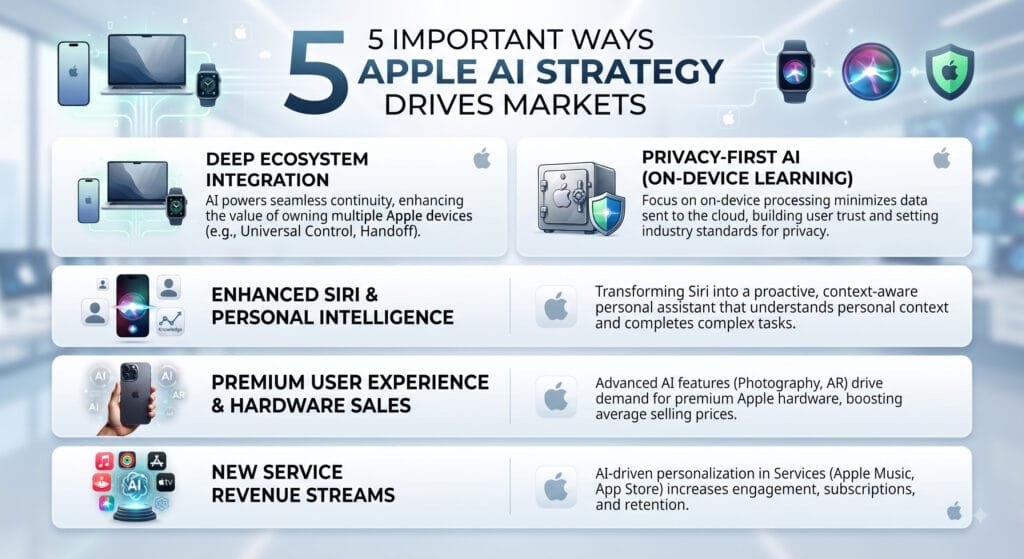
Comprehensive Pillar Analysis: 5 Critical Dimensions of Apple’s AI Shift
To evaluate whether Apple can overcome current market pressures, market participants must examine five distinct operational and strategic dimensions.
1. On-Device Processing and Privacy Architecture
Apple’s core competitive advantage lies in its custom silicon (M-series and A-series chips) optimized for private cloud compute and localized inference. This protects user data integrity but restricts massive cloud-scale training capabilities.
2. Monetizing the Installed Active Device Base
With over two billion active devices globally, Apple commands an unrivaled consumer ecosystem. Translating this hardware footprint into recurring high-margin AI service revenue remains the ultimate test for executive leadership.
3. Developer Ecosystem and App Store Integration
Empowering third-party developers to harness on-device machine learning APIs creates a sticky software network effect, encouraging long-term user retention across mobile and desktop platforms.
4. Navigating Regulatory and Antitrust Scrutiny
As global regulators scrutinize Big Tech partnerships and default search or AI agreements, Apple must navigate complex compliance frameworks across the European Union, United States, and Asia.
5. Managing Investor Expectations on Multi-Year Horizons
Wall Street’s quarterly earnings cycle often clashes with Apple’s multi-year hardware development roadmap, creating temporary stock volatility as investors weigh near-term AI momentum against long-term execution.
Comparative Analysis of Big Tech AI Approaches
Different technology giants employ contrasting models to capture value from the artificial intelligence revolution, altering risk-reward profiles across asset classes.
| Tech Giant | Primary AI Strategy | Infrastructure Capital Intensity | Monetization Focus |
| Apple | On-device processing & external partnerships | Low to Moderate | Premium hardware ecosystem & services integration |
| Microsoft / Google | Proprietary cloud infrastructure & foundational models | Extremely High | Enterprise cloud services, ads, and SaaS subscriptions |
| Meta Platforms | Open-source ecosystem & localized recommendation AI | High | Advertising efficiency and engagement optimization |
When analyzing the Apple AI strategy, market participants recognize that traditional valuation multiples must adapt to account for differing capital expenditure profiles and cash flow durability.
Frequently Asked Questions-Apple AI strategy
What is the core focus of the Apple AI strategy?
Apple’s approach centers on deep on-device hardware integration, strict data privacy guarantees, and strategic external partnerships rather than massive proprietary data center construction.
Why has Apple’s cautious AI stance created stock market friction?
While conservative capital spending initially insulated the company, market sentiment shifted toward aggressively rewarding direct infrastructure leaders, causing Apple’s pace to be viewed as a growth lag.
How does on-device processing differentiate Apple from competitors?
By executing machine learning tasks locally on custom silicon, Apple minimizes cloud dependency and data privacy risks, though it requires sophisticated hardware engineering.
Will Apple’s partnership model impact its long-term profit margins?
By outsourcing heavy cloud training workloads while retaining control over user experience and monetization channels, Apple aims to protect high service margins without heavy infrastructure liabilities.
Conclusion-Apple AI strategy
The evolution of the Apple AI strategy represents a fascinating turning point in modern corporate finance and technology leadership. By balancing strict capital discipline, cutting-edge on-device silicon engineering, and collaborative ecosystem partnerships, Apple navigates a delicate line between shareholder protection and aggressive technological expansion. As hardware-replacement cycles evolve and generative AI matures, execution across these strategic pillars will define the stock’s trajectory in the years ahead.
Disclaimer:
The insights, analyses, and strategic frameworks presented on cfostimes.com are for informational and educational purposes only and do not constitute professional financial, legal, or investment advice. Global macroeconomic conditions, technology sector valuations, and corporate strategies are subject to rapid and continuous change. Enterprise leaders, institutional investors, and financial professionals should conduct independent due diligence, evaluate their organization’s specific risk profile, and consult with qualified advisors before making capital allocation, portfolio restructuring, or strategic investment decisions. cfostimes.com assumes no responsibility or liability for any financial outcomes or operational consequences resulting from the application of information contained in this publication

Dr. Dinesh Kumar Sharma is a CMA an award-winning Chief Financial Officer and Director of Finance with over 25 years of expertise in strategic planning and digital transformation. Recognized as a five-time CFO of the Year, he specializes in leveraging Generative AI and Microsoft Copilot to optimize financial forecasting and cost management. Dr. Sharma holds a Doctorate in Management (Finance) and has successfully scaled organizations from INR 1 billion to INR 7 billion. He is dedicated to providing transparent, data-driven insights for modern decision-makers at CFOs Times.