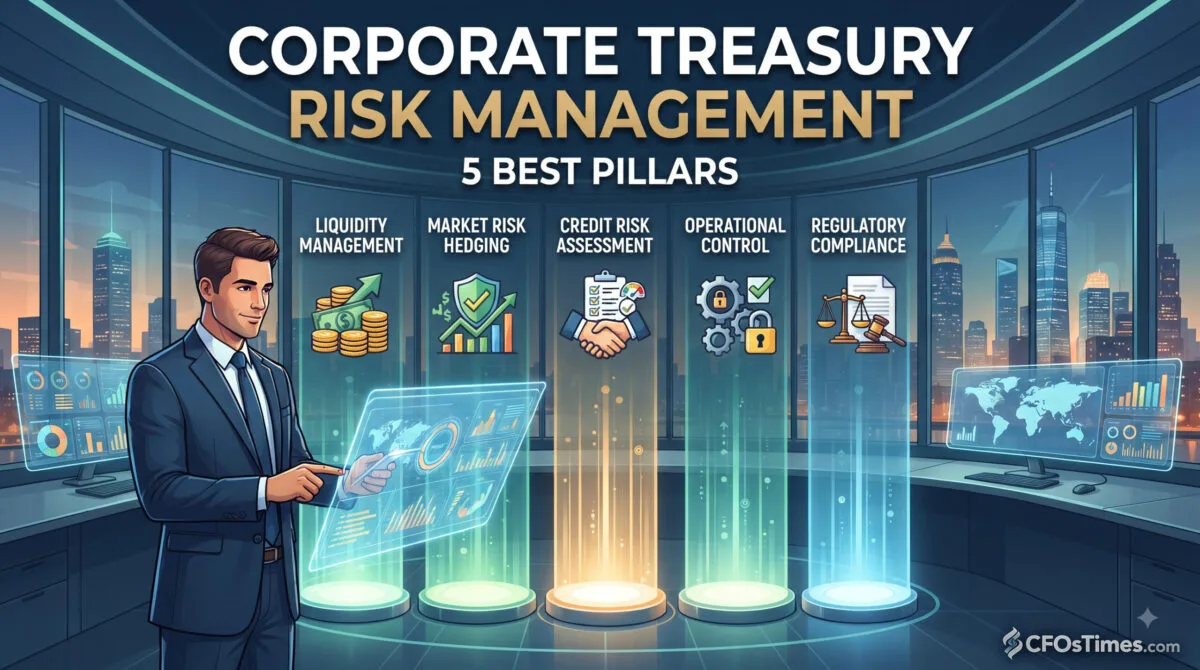
Corporate treasury risk management has evolved into a vital discipline for safeguarding enterprise solvency amidst ongoing macroeconomic volatility. As corporate leaders navigate fluctuating exchange rates, volatile commodity pricing, and restrictive borrowing costs, treasury departments must modernize their defensive frameworks. For chief financial officers and financial controllers, implementing rigorous liquidity controls, automated cash visibility, and advanced hedging strategies is essential for maintaining financial resilience.

Table of Contents
The Macroeconomic Imperative for Modern Treasury
The traditional role of a corporate treasurer—historically focused on basic cash management and bank reconciliation—has transformed into a strategic command center. With central banks maintaining restrictive monetary stances, the cost of holding inefficient capital or mismanaging liquidity has escalated dramatically.
Core Vulnerabilities Facing Modern Treasurers
- Interest Rate Volatility: Unpredictable debt servicing costs make floating-rate liabilities a severe hazard for corporate cash flows.
- Foreign Exchange (FX) Exposure: Globalized supply chains expose cross-border enterprises to sudden currency fluctuations that can erode operating margins overnight.
- Counterparty Risk: Economic strains increase the likelihood of banking partner defaults or delayed settlements across commercial networks.
When assessing enterprise exposure, financial leaders recognize that proactive corporate treasury risk management prevents unexpected liquidity crunches. To review global banking stability guidelines and international treasury standards, professionals frequently consult frameworks published by the Bank for International Settlements and the International Monetary Fund.

The 5 Strategic Pillars of Treasury Risk Mitigation
To establish institutional-grade protection, organizations must deploy five foundational pillars designed to neutralize financial exposure and optimize capital efficiency.
1. Centralized Cash Visibility and Real-Time Forecasting
Fragmented bank accounts across multiple geographies obscure true liquidity positions. Implementing advanced Treasury Management Systems (TMS) enables automated, real-time cash pooling and accurate short-term cash flow forecasting. Corporate treasury risk management
2. Proactive Interest Rate Hedging
To insulate balance sheets from elevated borrowing costs, treasurers are locking in fixed rates through interest rate swaps, caps, or collars, ensuring predictable debt service obligations over multi-year horizons.
3. Dynamic Foreign Exchange (FX) Risk Management
Cross-border cash flows require disciplined hedging programs utilizing forward contracts and options. By establishing clear risk tolerance thresholds, treasurers protect international earnings from adverse currency swings.
4. Comprehensive Counterparty and Liquidity Risk Assessment
Diversifying cash holdings across multiple high-credit-rating financial institutions minimizes systemic exposure. Treasurers regularly stress-test credit portfolios against severe liquidity shocks.
5. Working Capital Optimization and Supply Chain Finance
Optimizing accounts payable and receivable cycles reduces reliance on expensive external short-term debt. Utilizing dynamic discounting and supply chain finance programs strengthens supplier ecosystems while preserving internal cash reserves. Corporate Treasury Risk Management
Deep-Dive Analysis: Advanced Technologies and Emerging Risk Vectors
To maintain a true pillar-grade posture, modern treasury departments must integrate cutting-edge operational controls, artificial intelligence, and rigorous fraud mitigation defenses.
The Shift to Predictive and Agentic AI Operations
Advanced treasuries are moving past basic dashboard automation and static spreadsheet modeling, adopting agentic and AI-driven systems that actively classify cash flows, predict daily liquidity positions, and flag operational anomalies before they impact the ledger.
Mitigating High-Velocity Fraud and Cyber Threats
As digital payment rails and real-time settlement systems accelerate transaction velocities, organizations face heightened exposure to business email compromise, payment diversion, and spoofing. Effective treasury risk management requires a blend of behavioral controls, dual-authorization protocols, and intelligent monitoring.
Navigating Economic Fragmentation and Regional Divergence
Global supply chains and monetary policies no longer move in synchronized cycles. Regional interest rate disparities and shifting geopolitical trade regulations demand localized cash buffers, decentralized liquidity calibration, and agile scenario modeling. Corporate treasury risk management
Comparative Risk Management Frameworks
Different organizational structures require tailored approaches to managing financial exposures across varying market cycles.
| Risk Category | Traditional Approach | Modern Treasury Approach |
| Cash Forecasting | Periodic spreadsheets and historical estimates | Automated, AI-driven real-time multi-currency cash positioning |
| Debt Management | Reactive refinancing upon maturity | Proactive capital structure alignment and fixed-floating rebalancing |
| FX Protection | Unhedged open positions or manual spot conversions | Systematic programmatic hedging via structured financial derivatives |
When executing corporate treasury risk management, organizations that transition from reactive firefighting to predictive analytics consistently outperform their peers in capital efficiency. For deep dives into corporate finance best practices, treasury leaders reference insights from the Association for Financial Professionals.
Frequently Asked Questions
What is the primary goal of corporate treasury risk management?
The primary goal is to safeguard the enterprise against financial losses resulting from interest rate fluctuations, currency volatility, liquidity shortages, and counterparty defaults.
How do Treasury Management Systems (TMS) improve risk control?
A TMS automates cash visibility, centralizes global bank accounts, streamlines transaction processing, and provides real-time analytics required for accurate liquidity forecasting.
Why is interest rate hedging critical in the current economic environment?
Hedging protects corporate borrowers from unexpected spikes in debt servicing costs, stabilizing cash flows and ensuring predictable capital allocation budgets.
How can treasurers mitigate rising supplier and counterparty risks?
By monitoring working capital metrics closely, utilizing supply chain finance solutions, diversifying banking partners, and adjusting liquidity strategies in near real time. Corporate Treasury Risk Management
Conclusion
The discipline of corporate treasury risk management serves as the ultimate line of defense for modern enterprises navigating complex financial markets. By embracing real-time cash visibility, proactive hedging structures, advanced AI analytics, and rigorous working capital discipline, corporate treasurers can transform financial uncertainty into a distinct competitive advantage.
Disclaimer:
The insights, analyses, and strategic frameworks presented on cfostimes.com about Corporate Treasury Risk Management are for informational and educational purposes only and do not constitute professional financial, legal, or investment advice. Global macroeconomic conditions, financial markets, and regulatory standards are subject to rapid and continuous change. Enterprise leaders, corporate treasurers, and financial professionals should conduct independent due diligence, evaluate their organization’s specific risk profile, and consult with qualified advisors before making capital allocation, debt restructuring, or strategic investment decisions. cfostimes.com assumes no responsibility or liability for any financial outcomes or operational consequences resulting from the application of information contained in this publication.

Dr. Dinesh Kumar Sharma is a CMA an award-winning Chief Financial Officer and Director of Finance with over 25 years of expertise in strategic planning and digital transformation. Recognized as a five-time CFO of the Year, he specializes in leveraging Generative AI and Microsoft Copilot to optimize financial forecasting and cost management. Dr. Sharma holds a Doctorate in Management (Finance) and has successfully scaled organizations from INR 1 billion to INR 7 billion. He is dedicated to providing transparent, data-driven insights for modern decision-makers at CFOs Times.









3 thoughts on “Corporate Treasury Risk Management: 5 Best Pillars”