Introduction: The New Financial Reality of AI Scaling
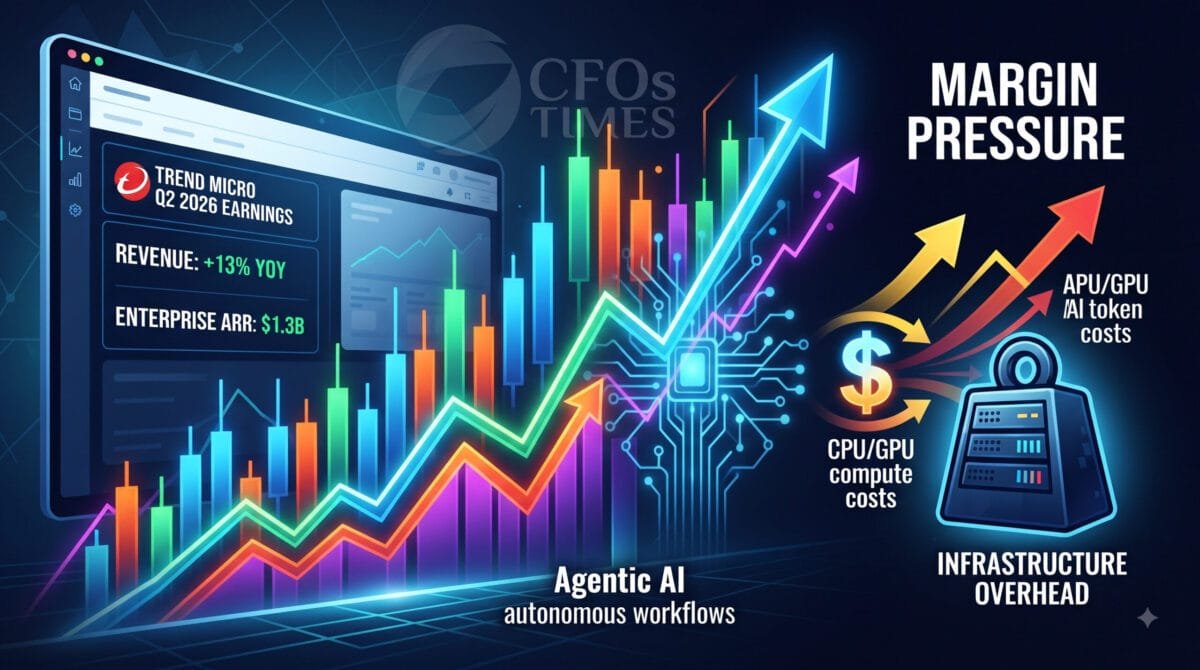
As corporate leaders push deeper into the landscape of automated operations, the intersection of technological transformation and hard fiscal discipline has reached an inflection point. Trend Micro Q2 2026 earnings have sent shockwaves through global markets, serving as a masterclass in the heavy financial trade-offs required to transition legacy business models into AI-native powerhouses. While top-line metrics demonstrate robust enterprise demand for agentic security frameworks, the ballooning costs of infrastructure scaling have exposed a brutal truth: building and running autonomous platforms at machine speed comes with unprecedented margin friction.
For institutional allocators, corporate executives, and market analysts, unpacking these financial results provides a vital lens into how operational expenses (OpEx) are shifting across the technology sector. This comprehensive analysis evaluates Trend Micro’s recent earnings performance, dissects the economics of enterprise AI token consumption, and outlines what this strategic pivot means for tech portfolios and corporate budget allocations. Trend Micro Q2 2026 Earnings
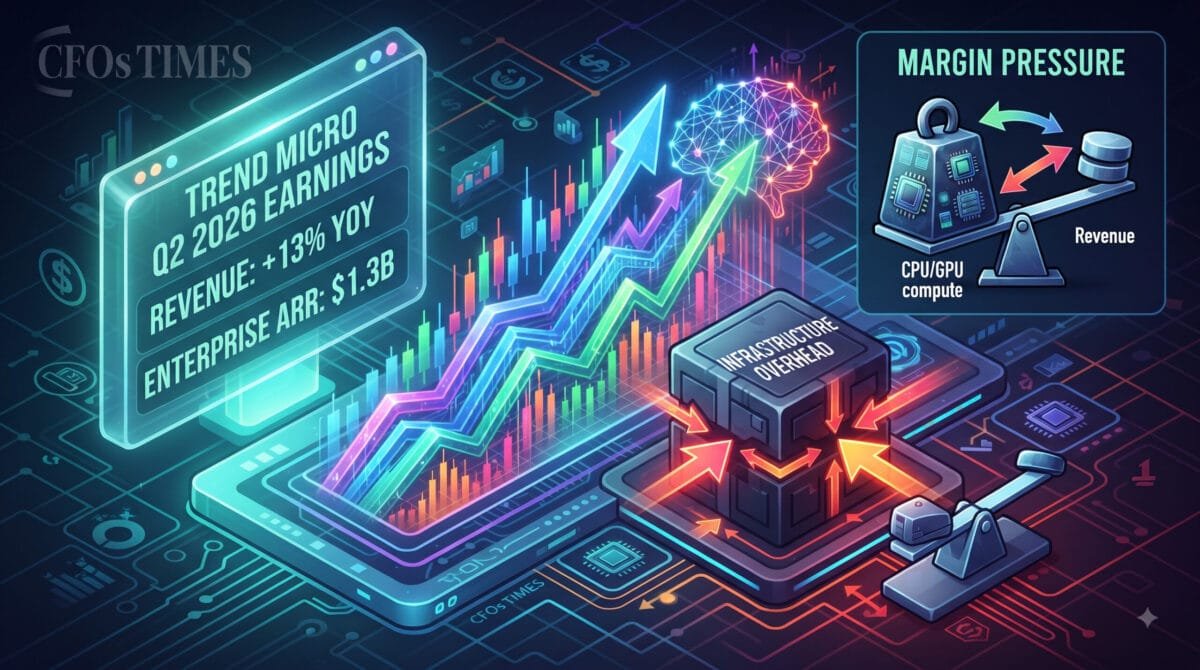
Table of Contents
1. Executive Summary of Trend Micro’s Q2 2026 Financial Results
The second-quarter financial disclosure from Tokyo-based enterprise security titan Trend Micro Incorporated (TYO: 4704) illustrates a classic corporate dichotomy: surging annual recurring revenue (ARR) paired with a steep downward revision in operating income guidance.
For the quarter ending June 30, 2026, the corporation posted consolidated net sales of 74,739 million Yen (approximately USD $468 million). Total annual recurring revenue surpassed the USD $1.7 billion threshold, marking a 5% year-over-year (YoY) increase. Enterprise ARR crossed USD $1.3 billion, propelled primarily by a 49% year-over-year explosion in adoption metrics for TrendAI Vision One. Trend Micro Q2 2026 Earnings
However, despite these strong top-line indicators, the financial reality of servicing modern workloads shifted sharply. Operating income for the quarter compressed to 6,233 million Yen (USD $39 million), dragging the consolidated operating margin down to 8%. The market reaction was swift, driven by management’s decision to cut full-year operating profit guidance by over 20%, setting off a broader debate regarding the true cost of scaling enterprise artificial intelligence.
To explore baseline industry standards on enterprise software disclosures and regulatory reporting frameworks, you can reference guidelines provided by the U.S. Securities and Exchange Commission (SEC) and international financial benchmarks via Bloomberg Markets. Trend Micro Q2 2026 Earnings
2. The Anatomy of Enterprise ARR Growth vs. Margin Compression
To understand why a company boasting a 49% growth rate in its flagship AI security segment experienced significant equity and margin pressure, one must dive deep into the underlying mechanics of modern software-as-a-service (SaaS) unit economics.
Platform Consolidation and Net Revenue Retention
Enterprise customers are actively consolidating their vendor ecosystems. Trend Micro reported that existing customers expanded their usage to an average of 4.2 integrated solutions, driving a 14% year-over-year increase in ARR per enterprise customer. Net revenue retention settled at a robust 122%, signaling that once an organization embeds itself within an AI-native security fabric, customer lifetime value (LTV) scales reliably. Trend Micro Q2 2026 Earnings
The Upstream Cost Driver: AI Token Consumption
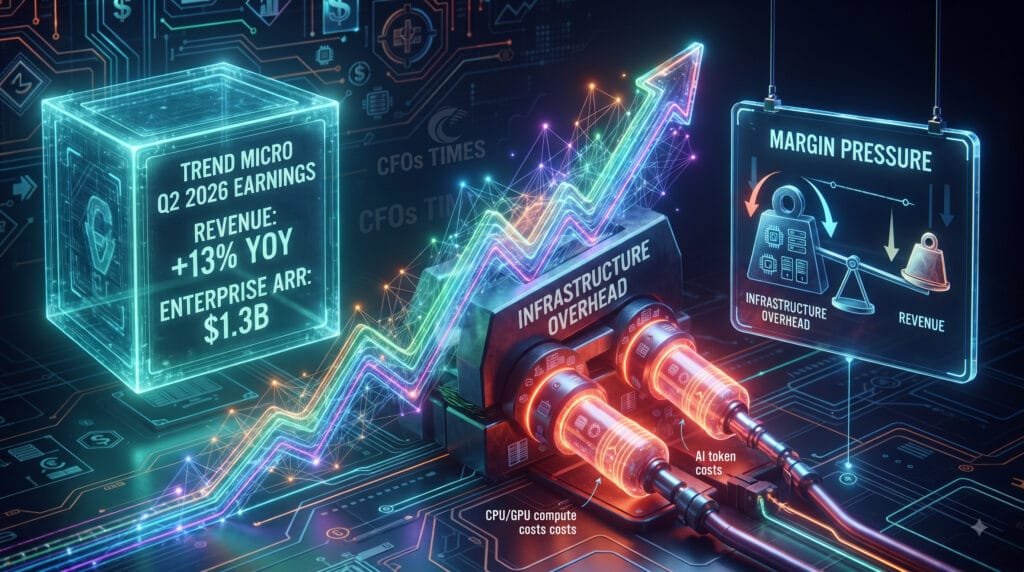
The core margin headquarter compression did not stem from weak commercial demand, but rather from structural cost inflations. Management noted that cloud-related expenses—specifically skyrocketing AI token costs required to power continuous, real-time autonomous threat detection—outpaced initial budgetary projections.
As organizations transition from static rule-based software to continuous agentic workflows, compute workloads multiply exponentially. Every automated remediation, behavioral threat analysis, and predictive audit query consumes high-priced compute cycles. Consequently, the company revised its full-year operating income expectation down by 23.2% relative to previous fiscal forecasts. Trend Micro Q2 2026 Earnings
3. Comparative Financial Breakdown Table
The following table summarizes the key financial metrics, year-over-year variations, and structural adjustments reported during the Q2 disclosure:
| Financial Metric | Q2 2026 Actual Value | YoY Change / Trend | Strategic Implication |
| Consolidated Net Sales | ¥74,739M (~$468M USD) | +13% YoY (Nominal) | Stable top-line revenue matching initial market expectations. |
| Total Company ARR | > $1.7 Billion USD | +5% YoY | Consistent recurring cash flow foundation across divisions. |
| TrendAI Vision One ARR | > $1.3 Billion Enterprise | +49% YoY | Rapid enterprise migration toward AI-native security operations. |
| Operating Margin | 8% (Quarterly) | Down ~12% from prior year | Substantial margin compression driven by infrastructure overhead. |
| Full-Year Operating Profit | ¥44.4 Billion (Revised) | -23.2% vs. Initial Guidance | Reflects heavy near-term absorption of cloud and token expenses. |
4. Strategic Lessons for Corporate Budgeting and Technology Spend
The financial narrative unfolding around these earnings reports serves as a vital case study for enterprise financial officers and strategic planners worldwide. Trend Micro Q2 2026 Earnings
Moving Beyond Seat-Based Pricing Limits
Traditional software licensing relied heavily on user-seat pricing models, where infrastructure costs scaled linearly with human headcount. In the agentic AI era, software acts autonomously on behalf of the enterprise, performing thousands of operations per second independently of human login frequency. Financial leaders must restructure enterprise resource planning (ERP) systems to forecast variable compute and token-based expenditure rather than static licensing fees. Trend Micro Q2 2026 Earnings
Balancing R&D Velocity with Operational Leverage
For executive teams, the primary takeaway is the delicate balance between capturing market share and maintaining operational leverage. Cutting R&D or artificial intelligence integration spend guarantees long-term obsolescence in a competitive market, yet letting infrastructure costs run unchecked destroys short-term profitability. Sustainable growth requires building intelligent guardrails around cloud utilization, multi-tenant efficiency, and optimized token routing.
For additional perspectives on global economic policies, monetary shifts, and cross-border tech investments, consult reports published by the International Monetary Fund (IMF) and financial tracking insights via Reuters. Trend Micro Q2 2026 Earnings
5. Frequently Asked Questions (FAQs)-Trend Micro Q2 2026 Earnings
What were the main financial highlights of Trend Micro’s Q2 2026 earnings report?
Trend Micro reported consolidated net sales of 74,739 million Yen ($468 million USD) with total annual recurring revenue exceeding $1.7 billion, representing a 5% year-over-year increase. Enterprise ARR was heavily driven by a 49% surge in adoption for its TrendAI Vision One platform. Trend Micro Q2 2026 Earnings
Why did Trend Micro lower its full-year operating profit guidance?
The company lowered its full-year operating income expectations by 23.2% due to a significant rise in cloud-related expenses, particularly higher-than-anticipated AI token costs and infrastructure investments required to support advanced agentic security features. Trend Micro Q2 2026 Earnings
How are enterprise customers reacting to AI-native security platforms?
Adoption remains strong, with net revenue retention holding at 122% and existing enterprise customers expanding their usage to an average of 4.2 integrated solutions, indicating high customer stickiness and long-term platform consolidation. Trend Micro Q2 2026 Earnings
Conclusion: Navigating the Cost of the AI Frontier
The financial results delivered by major tech and cybersecurity players illuminate the harsh economic realities of the current technological cycle. Innovation commands a steep upfront price, and transitioning enterprise infrastructure into an autonomous, AI-native model inevitably introduces margin volatility. Organizations that successfully master the balance between aggressive market capture and strict cloud cost governance will ultimately emerge as long-term industry leaders. For financial decision-makers, monitoring these operational inflection points remains essential to protecting capital efficiency in an increasingly automated global economy. Trend Micro Q2 2026 Earnings
Disclaimer
The information provided in this article—including financial figures, operational metrics, earnings analyses, and market forecasts—is for informational, educational, and analytical purposes only and does not constitute financial, investment, legal, or professional advice.
While every effort has been made to ensure the accuracy and timeliness of the data extracted from corporate financial reports, earnings disclosures, and macroeconomic trends, cfostimes.com makes no representations or warranties, express or implied, regarding the completeness, accuracy, or reliability of any information contained herein.
- Not Financial Advice: The content published on this platform should not be construed as a recommendation or solicitation to buy, sell, or hold any securities, financial instruments, or digital assets mentioned. Readers, corporate officers, and investors should conduct independent research or consult with a certified financial professional or qualified advisor before making any financial or strategic business decisions.
- Forward-Looking Statements: Certain statements within this article may constitute forward-looking statements regarding future corporate performance, market conditions, or economic trajectories. These statements are subject to risks, uncertainties, and assumptions that could cause actual results to differ materially.
- Third-Party References: Outbound links to external regulatory bodies, financial data providers, or news agencies are provided for convenience and reference only. cfostimes.com assumes no liability for the accuracy, security, or content of external third-party websites.

Dr. Dinesh Kumar Sharma is a CMA an award-winning Chief Financial Officer and Director of Finance with over 25 years of expertise in strategic planning and digital transformation. Recognized as a five-time CFO of the Year, he specializes in leveraging Generative AI and Microsoft Copilot to optimize financial forecasting and cost management. Dr. Sharma holds a Doctorate in Management (Finance) and has successfully scaled organizations from INR 1 billion to INR 7 billion. He is dedicated to providing transparent, data-driven insights for modern decision-makers at CFOs Times.