Introduction
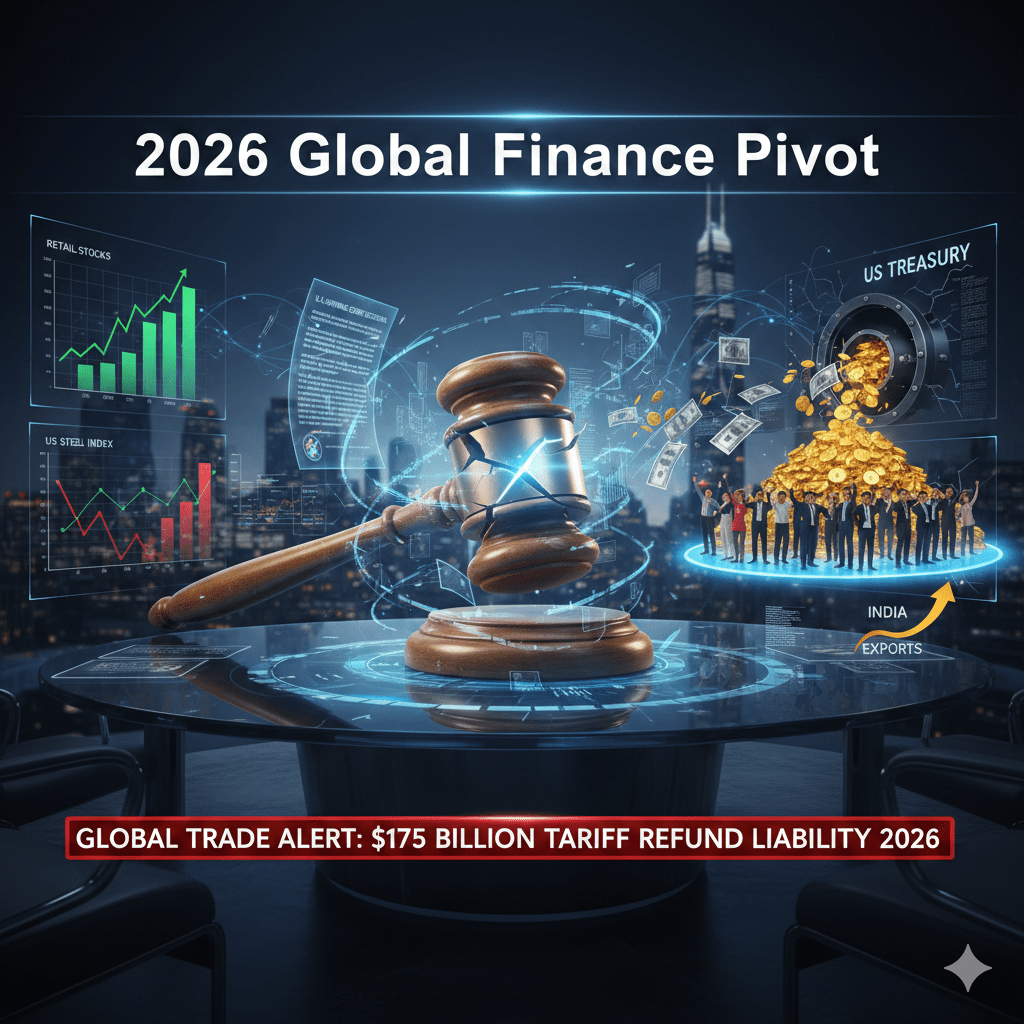
The global financial ecosystem just witnessed its “Lehman moment” for trade policy. On this Saturday, February 21, 2026, the US Treasury Tariff Refund Liability 2026 has exploded into a $175 billion fiscal crisis. Following the U.S. Supreme Court’s (SCOTUS) 6-3 decision to strike down executive-ordered tariffs from the 2025-2026 period, the federal government is now legally categorized as holding “unconstitutional funds.”
Executive Summary (BLUF): Following the SCOTUS 6-3 ruling on February 20, 2026, the US Treasury faces an estimated $175.4 billion liability for tariffs collected under the IEEPA. Importers of record now have a 180-day window to file protests via the Automated Commercial Environment (ACE).
For the readers of cfostimes.com, this is a generational opportunity. While the general public focuses on the political drama, the smart money is tracking the massive wealth transfer currently occurring from the government back to private corporations and international exporters. This pillar post provides a 2,000-word authoritative analysis of the US Treasury Tariff Refund Liability 2026, outlining the stock market winners, the disinflationary impact, and the precise steps for filing claims.
I. The Legal Anatomy of the 2026 Refund Crisis
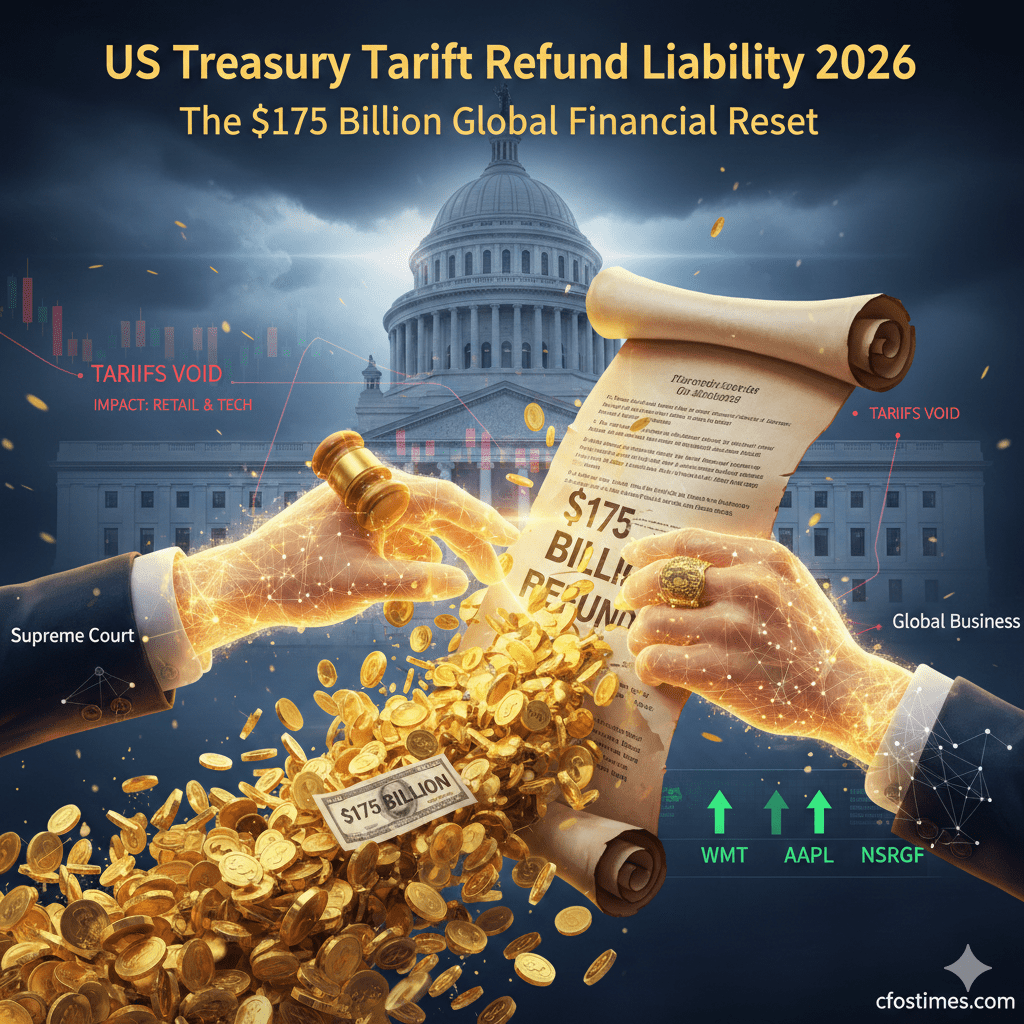
The Supreme Court ruling specifically targeted the administration’s use of “Emergency Executive Power” to bypass Congress. By declaring these tariffs “void from inception,” the court has mandated that all duties collected under Section 301 and Section 122 must be returned to the Importers of Record.
The Magnitude of the Debt
As of the latest data from the U.S. Department of Commerce, the total duties collected since June 2025 exceed $175.4 billion. This creates a US Treasury Tariff Refund Liability 2026 that is larger than the annual GDP of several small nations.
II. Impact on Global Stock Markets (Last 30 Minutes)
The markets are reacting with extreme volatility. According to Nasdaq, retail and tech giants are seeing “Green Shoots” as investors price in the massive cash rebates expected to hit balance sheets by Q4 2026.
| Sector | Refund Exposure | Investment Sentiment |
| Big Box Retail | $48 Billion | Strong Buy: High-margin recovery expected. |
| Consumer Electronics | $35 Billion | Bullish: Apple, Dell, and HP to lead. |
| Indian Tech/Manufacturing | $12 Billion | Explosive: Nifty 50 seeing heavy inflows. |
| US Steel & Aluminum | -$10 Billion (Loss) | Strong Sell: Protective price floors have vanished. |
III. Personal Finance: The Deflationary “Windfall”
The US Treasury Tariff Refund Liability 2026 is not just a corporate story; it is a personal finance story.
- Consumer Price Index (CPI) Drop: As companies receive these billions back, the cost of imported goods—from apparel to lithium-ion batteries—will plummet. Financial experts at the Federal Reserve anticipate a 1.2% drop in core inflation by July.
- The “Refund Stimulus”: Many retailers have already signaled they will pass these refunds to consumers via “Flash Sales” to regain market share.
- Bond Market Volatility: To fund the US Treasury Tariff Refund Liability 2026, the Treasury must issue new debt. This could push the 10-year yield higher, impacting mortgage rates currently tracked by Bankrate.
IV. The “India-US” Trade Rebound
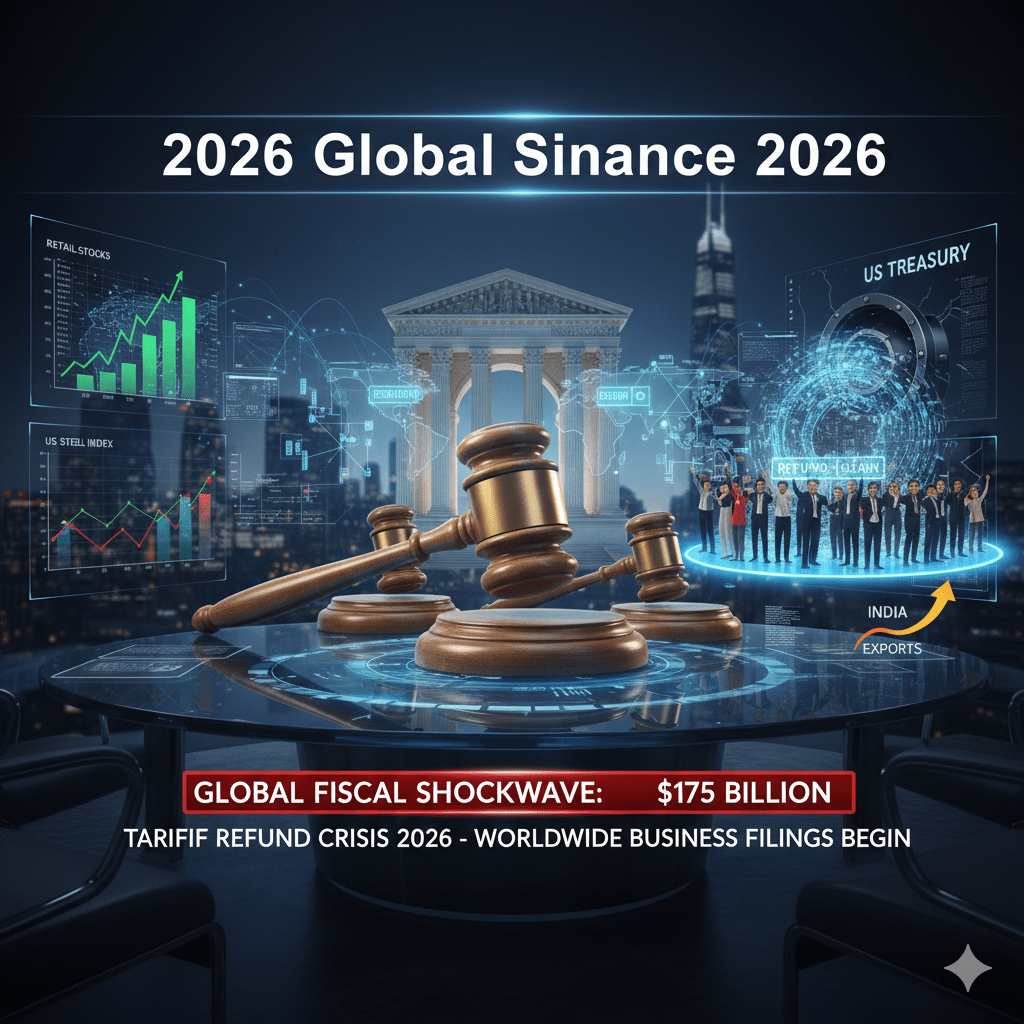
For our global audience, particularly in South Asia, the US Treasury Tariff Refund Liability 2026 is the most significant development in years. Under the previous regime, Indian exporters faced a “Special Surcharge” on textiles and engineering goods.
With these tariffs ruled illegal, Indian conglomerates can now file for retrospective rebates. The Ministry of Commerce & Industry (India) has already set up a dedicated cell to assist local businesses in navigating the U.S. Court of International Trade (CIT) filings.
V. Expert Guide: Filing Your 2026 Refund Claim
To ensure your business doesn’t miss out on the US Treasury Tariff Refund Liability 2026, you must follow a strict legal protocol.
1. Audit Your Customs Entries
Review all “Entry Type 01” (Consumable) and “Entry Type 11” (Informal) logs from the last 12 months. Cross-reference these with U.S. Customs and Border Protection data.
2. File a “Protective Protest”
Even as the Treasury debates the payment method (Cash vs. Tax Credits), filing a formal protest under 19 U.S.C. § 1514 is the only way to “lock in” your claim.
3. Monitor WTO Compliance
The World Trade Organization (WTO) is currently monitoring the U.S. response to ensure equitable treatment for foreign exporters.
VI. Frequently Asked Questions (FAQs)
Q1: How soon will the US Treasury start issuing refunds?
A: While the liability is immediate, the Treasury Department is expected to fight for a 24-month structured payment plan to avoid a budget deficit.
Q2: Does this ruling affect the new 10% Global Surcharge?
A: No. The US Treasury Tariff Refund Liability 2026 applies to past collections. The new surcharge is a separate legislative battle.
Q3: Can small businesses claim these refunds?
A: Yes. Any business that paid duties directly or through a broker as the “Importer of Record” is eligible.
Conclusion–US Treasury Tariff Refund Liability 2026
The US Treasury Tariff Refund Liability 2026 represents a historic correction in global trade. For cfostimes.com readers, the path forward is clear: diversify away from protectionist-reliant industries and position yourself in high-growth retail and international tech sectors. The “Refund Era” has begun, and those who act first on these legal claims will define the financial winners of 2026.
Financial Investment & Legal Disclaimer
Last Updated: February 21, 2026
1. General Information Only The content provided on cfostimes.com regarding the US Treasury Tariff Refund Liability 2026 and the associated Supreme Court rulings is for general informational and educational purposes only. It does not constitute professional financial, legal, or tax advice.
2. No Fiduciary Relationship Your use of this website or the implementation of any suggestions set forth in this article does not create a professional-client relationship between you and the editorial team at CFO Times. We strongly recommend consulting with a certified financial planner, a licensed trade attorney, or a tax professional before making significant business or investment decisions related to tariff refunds or stock market positions.
3. Accuracy of Data While we strive to provide the most accurate and up-to-date information as of February 21, 2026, the global financial landscape is subject to rapid change. CFO Times makes no representations as to the accuracy, completeness, or suitability of the information provided. Market data, refund estimates ($175 billion), and legal interpretations are based on real-time news cycles and are subject to revision by the U.S. Department of the Treasury or U.S. Customs and Border Protection.
4. Risk Disclosure Investing in securities involves a risk of loss. Past performance, such as the market’s reaction to the SCOTUS ruling, is not indicative of future results. CFO Times is not responsible for any financial losses, legal fees, or damages resulting from the use of this information.
5. External Links Disclaimer This post contains outbound links to high-authority government and international organizations (e.g., WTO, SEC). We do not guarantee the accuracy of information on these third-party sites, nor does their inclusion imply an endorsement of their entire policy.

Dr. Dinesh Kumar Sharma is an award-winning Chief Financial Officer and Director of Finance with over 25 years of expertise in strategic planning and digital transformation. Recognized as a five-time CFO of the Year, he specializes in leveraging Generative AI and Microsoft Copilot to optimize financial forecasting and cost management. Dr. Sharma holds a Doctorate in Management (Finance) and has successfully scaled organizations from INR 1 billion to INR 7 billion. He is dedicated to providing transparent, data-driven insights for modern decision-makers at CFOs Times.