How to Start Investing with Just $100 in 2026
Many people still believe you need a lot of money to start investing. In reality, in 2026 you can begin with as little as $100 thanks to low-cost funds, fractional shares, and easy-to-use investing apps. The hardest part is not the amount of money you start with, but understanding the basics and taking the first step.
This guide is written for complete beginners who feel nervous or confused about investing. You’ll learn simple, practical steps to start investing with just $100 in 2026—without gambling, day trading, or chasing “get rich quick” schemes.
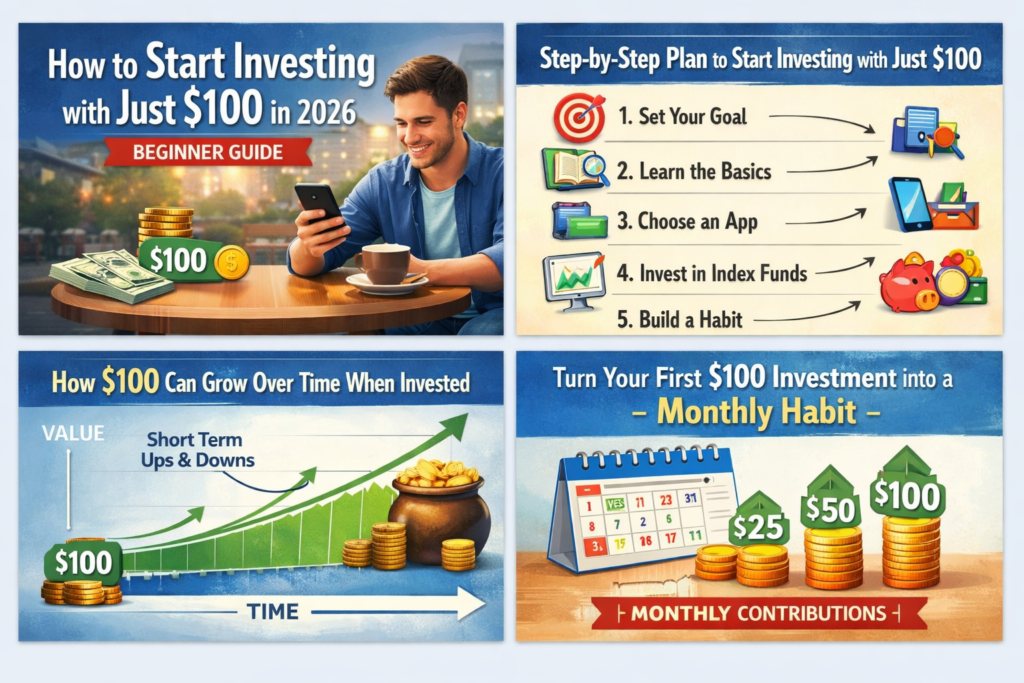
How to Start Investing with Just $100 in 2026: Step-by-Step Plan
Step 1 – Decide Your Goal for This $100
Before you invest, be clear about why you are investing. Your goal will decide how long you should keep the money invested and how much risk is acceptable.
Think about these questions in simple terms:
- Do you want to grow your money over many years (long-term)?
- Or do you want to use it within the next 1–2 years (short-term)?
If your goal is long-term (for example: retirement, future home, or just building wealth), you can accept more ups and downs in the short term because you have time to recover from market drops.
If your goal is short-term (for example: a vacation next year), you should not invest that money in risky assets like stocks. Short-term money should usually stay in a savings account or similar low-risk place.
For this guide, we will assume your $100 is for long-term investing—at least 3–5 years or more.
Write down a simple goal like:
- “I want to grow this $100 for at least 5 years and learn how investing works.”
- “I want to start my long-term investment journey with this $100.”
This may look small, but it changes how seriously you treat your decisions.
Step 2 – Understand the Basics: Risk, Return, and Time
You don’t need to become a finance expert, but you do need to understand three basic ideas: risk, return, and time.What Is Risk?
Risk in investing means the chance that the value of your investment can go down as well as up.
- Stocks and stock funds can rise a lot over time, but they can also fall sharply in the short term.
- Bonds and bond funds usually move less, but often give lower returns.
Higher potential returns usually come with higher risk. This is normal and part of investing; it is not a sign that something is “wrong.”What Is Return?
Return is how much money you make from your investment. It comes from:
- Price growth – the value of your investment increases over time.
- Dividends or interest – some funds or stocks pay regular amounts to investors.
Returns are usually shown as a percentage. For example, if your $100 becomes $110, your return is 10%.Why Time Matters Most
Time is your biggest friend in investing:
- Over a few days or months, markets can be very noisy and unpredictable.
- Over many years, long-term trends matter more than short-term jumps.
If you give your money enough time, short-term ups and downs become less important and consistent investing can build meaningful wealth, even from small amounts.
This is why starting with $100 in 2026 is valuable: you are buying time in the market, which is more important than trying to “time the market.”
For a clear, neutral explanation of risk and return, you can read this guide from Investor.gov .
Step 3 – Choose the Right Account or App
To invest, you need a place where you can buy and hold investments. This is usually called a brokerage account or investing app.What to Look For in an Investing Platform
When choosing an app or broker (especially in the US), look for:
- Regulated and reputable – make sure it is properly supervised by financial authorities and widely trusted.
- Low or zero commissions – many modern platforms now allow trading with very low or zero fees.
- Fractional shares – this lets you buy a small piece of a share or fund, which is very useful when you only have $100.
- Simple interface – as a beginner, you want something easy to understand.
Avoid platforms that:
- Promise “guaranteed returns” or “get rich quick” results.
- Push aggressive trading, complex products, or very high leverage.
- Have poor reviews or unclear regulation.
For readers outside the US, look for equivalent regulated platforms in your country that allow small starting amounts and offer broad market funds.
Step 4 – Start with Simple, Diversified Investments
With only $100, you want something simple, low-cost, and diversified. That usually means index funds or ETFs (Exchange-Traded Funds).Why Index Funds and ETFs Are Good for Beginners
An index fund or ETF:
- Holds many different companies or bonds inside one investment.
- Follows a market index like a major stock index (for example, a large market index for US or global stocks).
- Often has low fees, which helps your money grow more over time.
Instead of trying to guess which single stock will win, you can own a basket of many stocks in one fund. This reduces the risk that one bad company will hurt your portfolio. Example: How to Invest $100 (Sample Split)
This gives you diversification—instead of betting on one company, you spread your risk across many. For a quick explanation of why diversification matters, see this overview from FINRA .
Here is a simple example of how you might use your $100:
- $70 in a broad stock market index ETF or fund
- This could be a fund that tracks a large stock market index (for example, many of the biggest companies in the US or worldwide).
- $30 in a bond fund or kept as cash
- If you are nervous about risk, you might put this into a safer bond fund or even keep it as cash for now.
This is just a sample to show the idea: most money in a diversified stock fund for growth, and a smaller part in something calmer or cash for peace of mind.
You can adjust this based on your comfort:
- If you are very conservative: maybe $60 stock fund / $40 bond or cash.
- If you are more comfortable with risk: maybe $80 stock fund / $20 bond or cash.
Investments to Avoid as a Beginner
When you’re just starting with $100, it’s smart to avoid:
- Speculative cryptocurrencies you don’t understand.
- Meme coins or hype-driven assets.
- Day trading and frequent buying/selling to “time the market.”
- Complex products like options, contracts, or very high leverage.
- Investments with very high fees or unclear structures.
Your goal with this first $100 is to learn, build a habit, and protect your motivation, not to gamble. Start Investing with Just $100
Step 5 – Turn $100 into a Habit, Not a One-Time Event
Starting with $100 is powerful, but the real magic happens when you keep going.Build a Simple Monthly Investing Habit
If you can add even a small amount regularly, your investments can grow much faster over time. For example:
- $25 per month = $300 per year
- $50 per month = $600 per year
- $100 per month = $1,200 per year
You don’t need to start big. The key is consistency, not size.
Try this:
- Look at your budget and find a realistic amount you can invest every month (even $20–$30).
- Set up a recurring deposit or reminder to invest the same amount each month into your chosen fund(s).
Dollar-Cost Averaging (In Simple Words)
Dollar-cost averaging means:
- You invest the same amount regularly (for example, $50 every month),
- No matter if the market is high or low.
Sometimes you will buy at higher prices, sometimes at lower prices. Over time, this helps you avoid the stress of trying to guess the “perfect” moment and can reduce the average cost you pay per unit.
This approach is especially useful for beginners because it turns investing into a routine instead of a big scary decision.
Step 6 – Common Beginner Mistakes to Avoid
Your $100 is valuable not only as money, but as a training ground. Avoid these common mistakes so you stay in the game:
1. Checking Your Investments Constantly
Looking at your app many times a day will only increase stress. Prices always move.
- Instead, decide to check your portfolio maybe once a week or once a month.
- Focus on your long-term goal, not short-term changes.
2. Panicking When Prices Drop
At some point, the value of your investment will fall. This is normal and expected.
- A drop is not automatically a sign that you made a bad decision.
- Often, long-term investors use dips as opportunities to keep buying regularly.
Selling in fear at the first sign of red is how many beginners lose confidence.
3. Investing Money You Cannot Afford to Lose
Do not invest:
- Rent money
- Emergency funds
- Money you need in the next 6–12 months
Your first $100 should be money you can leave invested for several years without needing it back quickly.
4. Following Random Tips Without Understanding
Online, you’ll see many “hot tips” and predictions.
- Be careful with advice from strangers or influencers who don’t explain risks and basics.
- If you don’t understand how an investment works, don’t invest in it yet.
Use your first $100 to practice thoughtful, informed decisions—not copy-paste someone else’s bet.
Step 7 – Simple 2026 Investing Checklist (Summary)–How to Start Investing with Just $100 in 2026 as a Complete Beginner
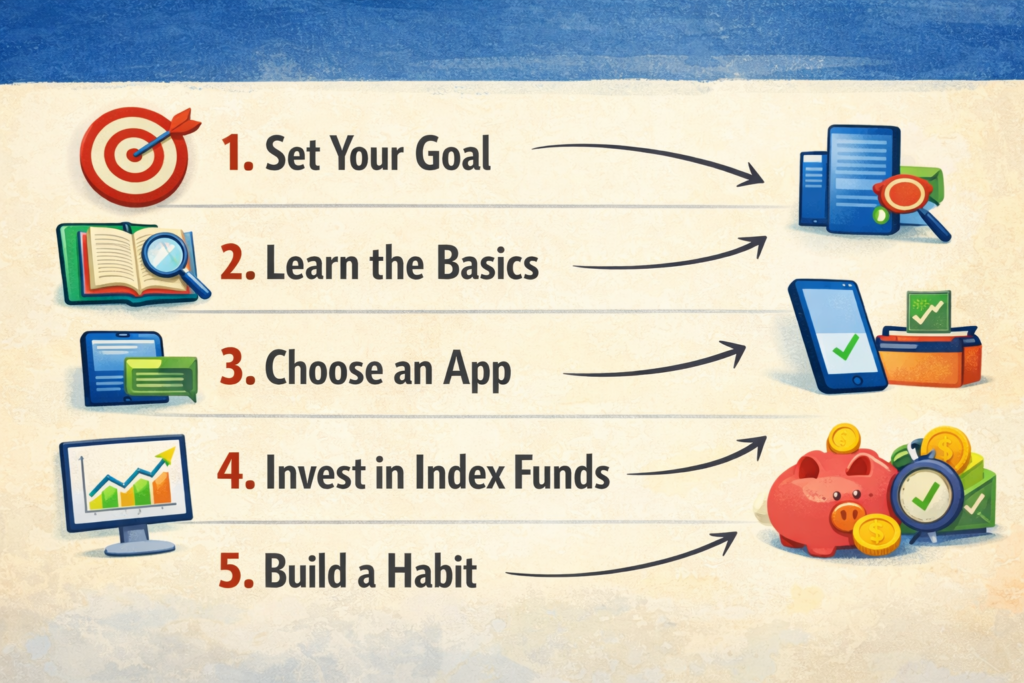
Before you invest your $100, go through this quick checklist:
- I have a clear long-term goal for this $100 (3–5+ years).
- I understand the basics of risk, return, and time.
- I chose a regulated, reputable investing app or broker.
- I plan to put most of my money into a simple, diversified index fund or ETF.
- I have decided how to split my $100 (for example, 70% in stock index fund, 30% in bond fund or cash).
- I know how much I can add each month (even a small amount).
- I accept that prices will go up and down, and I will avoid panic selling.
- I am not using money I need urgently or for emergencies.
If you can tick most of these boxes, you are ready to begin.Final Thoughts: Your First $100 Is the Start, Not the End
Starting to invest with just $100 in 2026 is less about the amount and more about the mindset you build. With this step, you:
- Learn how markets and platforms work in real life.
- Build confidence to handle ups and downs.
- Create a habit that can grow into serious wealth over the next 5, 10, or 20 years.
You don’t need to be perfect. You just need to start, stay consistent, and keep learning.
If you found this guide helpful, your next step could be to learn more about simple investment options. A natural follow-up article you can create on your site is:
> “Index Funds for Absolute Beginners in 2026: How They Work and Why They’re So Popular” Start Investing with Just $100
Frequently Asked Questions (FAQs)-Start Investing with Just $100
1. Can I really start investing with just $100 in 2026?
Yes. In 2026, many investing platforms allow fractional shares, meaning you can invest small amounts in funds or stocks without buying a full share. Low-cost index funds and ETFs make it possible to start with as little as $50–$100.
2. Is investing $100 even worth it?
Yes—because the goal isn’t just the money, it’s the habit. Starting with $100 helps you learn how investing works, build confidence, and create a routine. Over time, consistent investing matters far more than the amount you start with.
3. What is the safest investment for beginners with $100?
For most beginners, the safest option is a diversified index fund or ETF that tracks a broad market. These funds spread your money across many companies, reducing the risk of one poor performer hurting your entire investment.
4. Should I invest all $100 at once or slowly?
If you already have the $100, investing it at once is fine for long-term goals. After that, adding money regularly (monthly or biweekly) using dollar-cost averaging is often easier emotionally and helps reduce timing risk.
5. Can I lose all my money if I invest $100?
If you invest in diversified index funds, losing all your money is extremely unlikely. However, short-term drops in value are normal. The risk becomes much higher with speculative assets, day trading, or highly leveraged products.
6. How long should I keep my $100 invested?
For stock-based investments, it’s best to plan for at least 3–5 years, and ideally longer. The longer your time horizon, the more likely you are to benefit from market growth and recover from temporary declines.
7. Is investing better than saving for this $100?
It depends on your goal:
- Short-term needs (under 1 year): Saving is better.
- Long-term goals (3+ years): Investing generally offers higher growth potential than savings accounts, though with more short-term ups and downs.
8. How often should I check my investments?
Once a week—or even once a month—is enough for beginners. Checking too often can cause stress and emotional decisions. Long-term investing works best when you ignore daily market noise.
9. Do I need to pay taxes on my $100 investment?
In most countries, you may owe taxes on capital gains or dividends when you sell or receive income. Tax rules vary by location, so it’s smart to understand your local regulations or use tax-advantaged accounts when available.
10. What should beginners avoid when investing $100?
Avoid:
- “Get rich quick” promises
- Meme stocks or hype coins
- Day trading or frequent buying and selling
- Investments you don’t understand
Your first $100 should be about learning, patience, and consistency.
11. Can I add more money later?
Absolutely. Most successful investors start small and increase contributions over time. Even $20–$50 per month can make a big difference over several years.
12. What’s the best next step after investing my first $100?
A great next step is learning more about index funds, asset allocation, and long-term investing strategies. Building knowledge alongside your investments helps you stay confident during market ups and downs.
Disclaimer
1. Not Professional Financial Advice
The information provided on CFOsTimes is for general educational and informational purposes only. It is not intended as, and shall not be understood or construed as, professional financial, investment, legal, or tax advice. While we discuss strategies for “Investing with $100,” these are hypothetical examples and do not take into account your personal financial situation, risk tolerance, or investment objectives.
2. Accuracy of Information
While we strive to ensure that the information on this website is current and accurate, financial regulations (including the How to Start Investing with Just $100 are subject to frequent change. CFOsTimes makes no representations or warranties of any kind, express or implied, about the completeness, accuracy, or reliability of the data provided.
3. Assumption of Risk
Investing involves risk. The value of your investments can go down as well as up, and you may get back less than you originally invested. Past performance is not a guarantee of future results. Any actions you take based on the information found on this website are strictly at your own risk.
4. No Fiduciary Relationship
Your use of this website does not create a fiduciary or professional-client relationship between you and CFOsTimes or its authors. We strongly recommend that you consult with a licensed financial advisor or a qualified tax professional before making any significant financial decisions.
5. Third-Party Links & AdSense Disclosure
This site may contain links to third-party websites or services that are not owned or controlled by CFOsTimes. We are not responsible for the content, privacy policies, or practices of any third-party sites. Furthermore, this site uses Google AdSense. Advertisements displayed do not constitute an endorsement or recommendation by CFOsTimes.

Dr. Dinesh Kumar Sharma is an award-winning Chief Financial Officer and Director of Finance with over 25 years of expertise in strategic planning and digital transformation. Recognized as a five-time CFO of the Year, he specializes in leveraging Generative AI and Microsoft Copilot to optimize financial forecasting and cost management. Dr. Sharma holds a Doctorate in Management (Finance) and has successfully scaled organizations from INR 1 billion to INR 7 billion. He is dedicated to providing transparent, data-driven insights for modern decision-makers at CFOs Times.