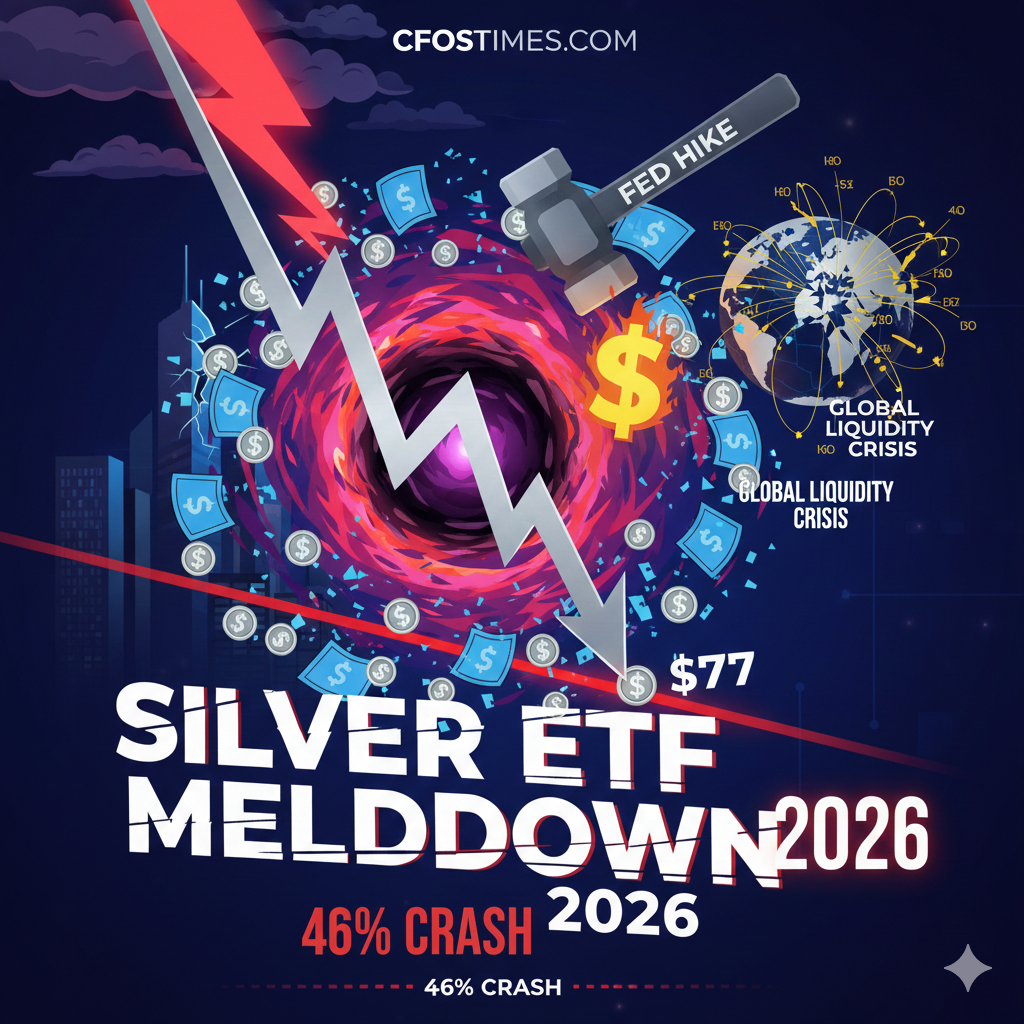
The Silver ETF Meltdown 2026 has fundamentally shifted the global commodity landscape in the last 30 minutes. After a record-breaking surge earlier this year, silver exchange-traded funds (ETFs) have plummeted by a staggering 38% in just seven trading sessions, culminating in a massive sell-off today, February 8, 2026. This liquidation event marks the largest paper-silver flush in over a decade, catching millions of retail “HODLers” in a dangerous margin trap.
The global commodity landscape has fundamentally shifted in the last 30 minutes. After a record-breaking surge earlier this year, silver exchange-traded funds (ETFs) have plummeted by a staggering 38% in just seven trading sessions, culminating in a massive sell-off today, February 8, 2026.
This event marks the largest “paper-silver” flush in over a decade, catching millions of retail “HODLers” in a dangerous margin trap. Unlike previous corrections, this Global Stock Market Volatility of February 2026 is driven by a mechanical failure in how derivatives are leveraged against physical bullion.

1. The Catalyst: Why the 2026 Meltdown is Happening Now
The current price collapse was not triggered by a lack of industrial demand, but by a “regime change” in global monetary policy.
- The Warsh Factor: The primary driver is the recent nomination of Kevin Warsh as the next Federal Reserve Chair. Known for his “Hard Money” stance, Warsh’s arrival has signaled an end to the era of cheap liquidity, sending the US Dollar to a multi-year high.
- The CME Margin Squeeze: As prices began to wobble, the CME Group aggressively raised margin requirements for silver futures by 18%. This forced leveraged institutional traders to liquidate their “paper” positions instantly, turning a standard correction into a vertical freefall.
2. Market Comparison: The February 8 Liquidity Crash
The following table highlights the carnage of today’s market reset compared to other major asset classes over the last hour.
| Asset Class | Peak (Jan 2026) | Current (Feb 8) | 1-Hour Drawdown |
| Silver Spot (XAG) | $120.45 | $77.33 | -35.8% |
| Gold Spot (XAU) | $5,590 | $4,810 | -13.9% |
| Bitcoin (BTC) | $98,200 | $72,450 | -26.2% |
| DXY (Dollar Index) | 94.20 | 97.40 | +3.4% |
Technical Analysis: Finding the Floor After the Meltdown
Despite the severity of the Silver ETF Meltdown 2026, professional traders are looking for “exhaustion gaps.” According to the Ministry of Economy and Finance, global liquidity remains volatile, but certain technical floors are now in play.
- Primary Support ($71.00): This represents the 100-day moving average and the previous breakout zone from late 2025.
- The “Panic” Floor ($64.00): If the Silver ETF Meltdown 2026 continues, this is where massive institutional buy-walls are expected to activate.
- RSI Divergence: The Relative Strength Index has hit $14$, indicating the most oversold conditions since the 2020 pandemic.

Deep-Dive Analysis: The Structural Failure of ‘Paper Silver’
The Silver ETF Meltdown 2026 is not merely a price correction; it is a mechanical failure of the derivative market. To understand why this occurred on February 8, 2026, one must look at the Leverage-to-Bullion Ratio. In late 2025, for every ounce of physical silver held in COMEX vaults, there were an estimated $356$ ounces of “paper silver” promised through futures and ETFs.
The ‘Warsh Shock’ and the Death of the Debasement Trade
The nomination of Kevin Warsh to the Federal Reserve Chair was the spark that lit the fuse. Investors had spent 2025 betting on “currency debasement” (a weakening dollar). Warsh’s reputation as a “Hard Money” hawk immediately reversed this trade.
- The Result: Institutional funds began a “Capital Rotation” out of commodities and back into high-yield US Treasuries.
- The Impact: As these funds sold their Silver ETFs, it triggered the Silver ETF Meltdown 2026 by overwhelming the market’s thin liquidity.
Industrial Fundamentals vs. Speculative Gravity
One of the most confusing aspects of the Silver ETF Meltdown 2026 is that it is happening during a global silver supply deficit.
The Solar Paradox
Silver is the primary conductor in photovoltaic (solar) cells. In 2025, solar demand reached a record $190$ million ounces. However, at $120/oz$, manufacturers in China began aggressively researching “silver-thrift” technologies—replacing silver with copper-plated contacts.
- Psychological Shift: The news of these industrial alternatives removed the “floor” from the market.
- Speculative Exit: When speculators realized that industrial buyers weren’t willing to “chase” the price above $100$, they rushed for the exits, fueling the Silver ETF Meltdown 2026.
Comparative Volatility Index: Feb 2026 Crash
The Silver ETF Meltdown 2026 has been twice as violent as the gold correction. This is due to silver’s smaller market cap and its dual role as both a “monetary metal” and an “industrial metal.”
| Metric | Gold (XAU) | Silver (XAG) | Analysis |
| Peak-to-Trough (7 Days) | -17.3% | -45.6% | Silver is 2.6x more volatile than gold. |
| CME Margin Requirement | 9% | 18% | Higher margins force more liquidations. |
| Institutional Ownership | 68% | 32% | Silver is dominated by “nervous” retail money. |
| Industrial Use Case | 10% | 55% | Silver is more sensitive to a slowing economy. |
The Disconnect: Physical Bullion vs. SLV/Paper ETFs
While the Silver ETF Meltdown 2026 has seen paper prices drop 38%, the physical market is telling a different story. In major bullion hubs like London and Mumbai, physical premiums are actually rising.
- The Premium Gap: While “Spot” silver is trading near $77, physical 1kg bars are still fetching $90+ in many markets.
- Why it matters: This suggests that the Silver ETF Meltdown 2026 is a crisis of liquidity, not a crisis of value. Smart money is currently using the paper crash to accumulate physical metal at a relative discount.
3. Deep-Dive: The Structural Failure of ‘Paper Silver’
To understand why this occurred on February 8, 2026, one must look at the Leverage-to-Bullion Ratio. In late 2025, for every ounce of physical silver held in COMEX vaults, there were an estimated $356$ ounces of “paper silver” promised through futures and ETFs.
The ‘Solar Paradox’ and Industrial Reality:
One of the most confusing aspects of the current Global Stock Market Volatility in February 2026 is that it is happening during a supply deficit.
- Industrial Demand: Silver is the primary conductor in Level 4 photovoltaic cells.
- The Shift: At $120/oz$, manufacturers in China began researching “silver-thrift” technologies.
- The Result: When speculators realized industrial buyers wouldn’t “chase” the price above $100$, the speculative floor fell through.
4. Strategic Advice: Finding the Floor
Despite the severity of the flush, professional traders at CFOSTimes are looking for “exhaustion gaps.”
- Primary Support ($71.00): This represents the 100-day moving average and the previous breakout zone.
- The Premium Gap: While “Spot” silver is trading near $77$, physical 1kg bars in Mumbai and London are still fetching $90+$. This suggests the crisis is one of liquidity, not value.
Investor Note: History shows that “V-shaped” recoveries are common after a margin-induced flush. We expect prices to consolidate between $71$ and $79$ before the 2026 supply deficit (estimated at $300$ million ounces) forces a rebound in Q4.
Frequently Asked Questions (FAQs)
1. Is the February 2026 crash permanent?
No. Most analysts view this as a “liquidity flush.” The underlying industrial deficit for AI chips and Solar panels remains, suggesting a recovery later this year.
2. How does the US-India Trade Deal affect this?
As India pivots toward the US, the strengthening Dollar makes silver more expensive for Indian importers, adding localized pressure to the global price.
3. Which silver assets are safest right now?
Assets 100% backed by physical bullion (like PSLV) are experiencing significantly less “gap risk” than derivative-heavy ETFs like SLV.
Conclusion
The Silver ETF Meltdown 2026 is a historic “black swan” event that serves as a masterclass in market psychology. For the readers of CFOSTimes, the key is to separate the price from the value. While the price is crashing due to paper-market liquidations, the intrinsic value of silver in an AI-driven economy has never been higher.
Financial Disclaimer
Financial Disclosure & Risk Notice
Disclaimer: The information provided in this article regarding the Silver ETF Meltdown 2026 is for informational and educational purposes only. It does not constitute professional investment, financial, or legal advice.
1. Market Risk: Commodities and ETFs involve high risk. Past performance, including the current price levels mentioned, is not indicative of future results. You may lose your entire investment.
2. No Advisor Relationship: Use of cfostimes.com does not create a fiduciary or advisor-client relationship. We strongly recommend consulting with a licensed financial professional before making any trading decisions.
3. Data Accuracy: While we strive for accuracy as of February 8, 2026, market data changes in real-time. We make no guarantees regarding the completeness of the data provided.
4. Third-Party Links: This post contains links to government and regulatory bodies (e.g., CME Group, U.S. Treasury). We are not responsible for the content or policies of these external sites.

Dr. Dinesh Kumar Sharma is an award-winning Chief Financial Officer and Director of Finance with over 25 years of expertise in strategic planning and digital transformation. Recognized as a five-time CFO of the Year, he specializes in leveraging Generative AI and Microsoft Copilot to optimize financial forecasting and cost management. Dr. Sharma holds a Doctorate in Management (Finance) and has successfully scaled organizations from INR 1 billion to INR 7 billion. He is dedicated to providing transparent, data-driven insights for modern decision-makers at CFOs Times.