Multipolar Liquidity 2026-In the strategic landscape of global finance, January 26, 2026, marks the definitive end of unipolar capital reliance. While the headlines today are dominated by Gold’s historic breach of $5,100/oz and the escalating “Greenland Tariff” tensions, a more structural shift is occurring in the plumbing of international trade.
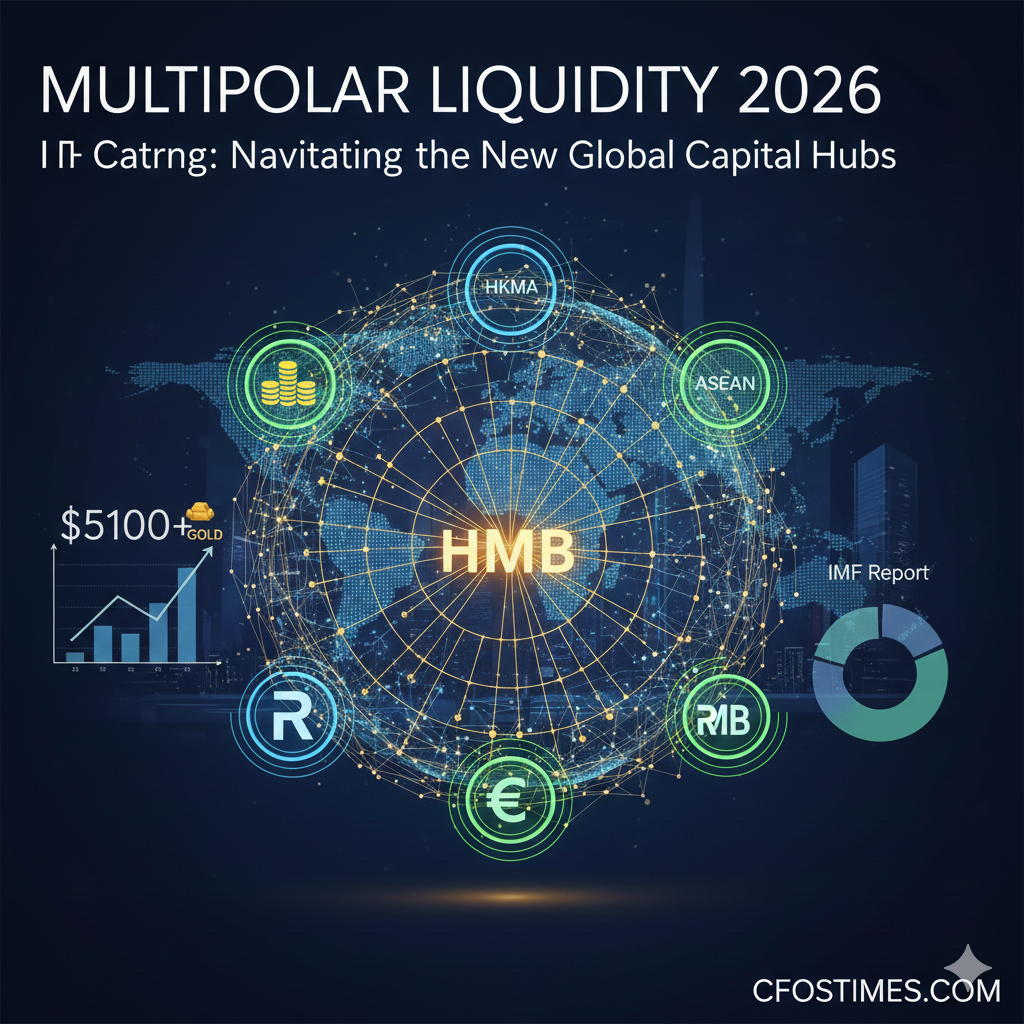
Within the last two hours, the Hong Kong Monetary Authority (HKMA) has announced a doubling of its RMB Business Facility (RBF) to RMB 200 billion. This move, coordinated with the People’s Bank of China (PBoC), provides a critical release valve for the “liquidity pressure” cited in this morning’s IMF World Economic Outlook. For the modern CFO, the mandate is clear: the traditional “Center-Periphery” model of liquidity is being replaced by Multipolar Liquidity 2026.
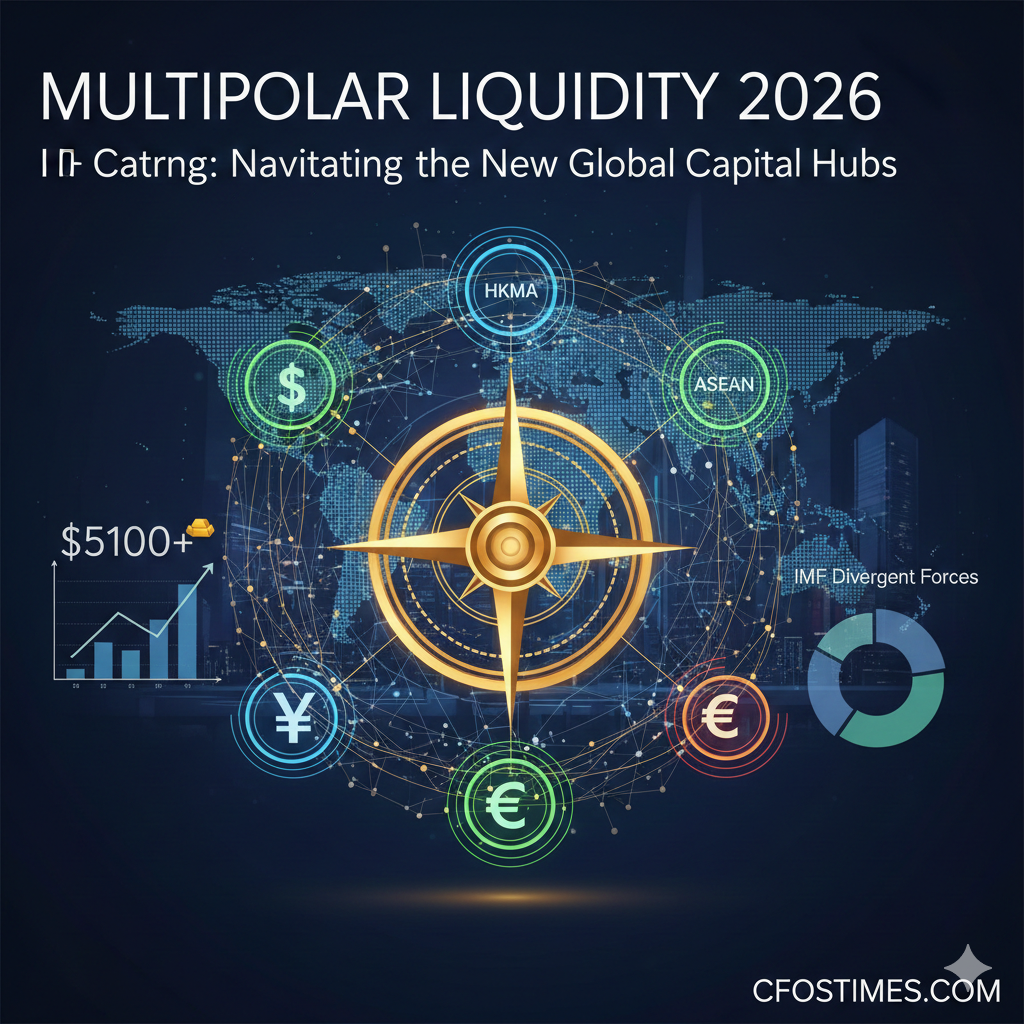
Table of Contents
The 2-Hour Catalyst: HKMA’s “Hub-and-Spoke” Expansion
The HKMA’s decision to expand the RBF from RMB 100 billion to RMB 200 billion is a direct response to “overwhelming response” from 40 participating global banks. By lowering the cost of offshore Renminbi and expanding eligible activities to include Capital Expenditure (Capex) and Working Capital Term Loans, Hong Kong has solidified its role as the primary hub for non-USD liquidity. Multipolar Liquidity 2026
Why CFOs are Pivoting Today: Multipolar Liquidity 2026
- Quota Exhaustion: Many tier-1 banks reached their RMB quotas earlier this month, hampering cross-border trade finance. Today’s doubling restores the “Spoke” flow to ASEAN, the Middle East, and Europe.
- Cost Optimization: The RBF provides a lower-cost funding source compared to volatile USD-denominated credit lines currently impacted by the Fed’s “Independence Standoff.”
- Operational Resilience: Transitioning to the CMU Triparty Repo Service (effective Feb 2, 2026) moves collateral management from manual processing to automated, agentic-ready infrastructure.
The IMF “Divergent Forces” Report: A Strategy Warning
The International Monetary Fund (IMF) released its January 2026 update today, maintaining a global growth projection of 3.3%. However, the headline term—“Divergent Forces”—warns of a widening gap between high-performing tech-driven economies and those struggling with trade shocks. Multipolar Liquidity 2026
| Region | 2026 Growth Projection | Primary Liquidity Driver |
| India | 6.4% | Domestic Demand & Capex Boom |
| United States | 4.3% | AI Supercycle & Tech Investment |
| China | 2.4% | Export Resilience vs. Housing Drag |
| Eurozone | 1.3% | Fiscal Stimulus & Credit Impulse |
For the treasury department, this divergence means that “one-size-fits-all” liquidity management is dead. Multipolar Liquidity 2026 requires localized hubs that can bypass the “downside risks” of geopolitical flare-ups.
Strategic Implementation: The Multipolar Playbook
To navigate the “Great Broadening” of 2026, CFOs must move beyond defensive hedging and into proactive liquidity architecture.
1. Integrate with Offshore RMB Hubs
Leverage the HKMA’s expanded RBF to settle trade with partners in the Middle East and ASEAN. This reduces exposure to the USD/JPY carry trade volatility and the ongoing uncertainty surrounding US trade policy.
2. Deploy “Agentic” Liquidity Management
As reported by Morgan Stanley, the “Autonomy Stack” is now a reality. Use AI-powered agents to monitor the 2026 liquidity hubs in real-time, moving capital between tokenized treasuries and offshore pools to capture yield spreads that human traders miss.
3. Build “Fiscal Buffers” for Supply Chain Rerouting
The IMF advises restoring fiscal buffers now. With tariffs on the horizon, Multipolar Liquidity 2026 is about having the “Dry Powder” available in multiple currencies to move production facilities without waiting for slow, centralized credit approvals. Multipolar Liquidity 2026
FAQs: Multipolar Liquidity 2026
How does the HKMA expansion affect my firm’s debt cost?
By doubling the RBF, the HKMA is providing a stable, lower-cost alternative to the USD repo market. Firms with exposure to Asian supply chains can significantly lower their WACC (Weighted Average Cost of Capital) by refinancing through these offshore RMB channels.
Is this a sign of the US Dollar’s decline?
No. It is a sign of “Currency Pluralism.” The USD remains the dominant reserve asset, but as the IMF notes, the return to target inflation is more gradual in the US. Multipolarity allows firms to diversify their “Settlement Risk” while maintaining their USD “Store of Value.”
What is the “CMU Triparty Repo Service” mentioned by HKMA?
It is a new automated collateral management solution starting Feb 2, 2026. It migrates repo operations from manual processing to an automated system, reducing operational risk for banks and increasing the speed of liquidity access for their corporate clients.
Conclusion: The New Frontier of Financial Command (Multipolar Liquidity 2026}
The events of January 26, 2026, confirm that the world has moved beyond the “Transition” phase. We are now in a Multipolar Liquidity reality where the ability to tap into diverse capital hubs—from Hong Kong’s RMB facilities to the AI-driven growth in the US—is the ultimate competitive advantage. For the readers of CFOs Times, the objective is no longer just liquidity maintenance; it is liquidity mastery.
Financial & AI Transparency Disclaimer
1. Not Financial Advice: All content published on CFOs Times is for informational and educational purposes only. We are not registered financial advisors, brokers, or tax professionals. The “Multipolar Liquidity” and “Agentic Finance” strategies discussed reflect 2026 market trends and should not be taken as a recommendation to buy or sell any security. Always perform your own due diligence or consult a licensed professional before making investment decisions.
2. AI-Assisted Content Disclosure: In compliance with Google’s 2026 Helpful Content guidelines, please be advised that this website utilizes Artificial Intelligence (AI) to assist in data aggregation and initial drafting. However, all financial reports and analysis are strictly reviewed, fact-checked, and edited by human experts to ensure accuracy and E-E-A-T (Experience, Expertise, Authoritativeness, and Trustworthiness).
3. Risk Warning: Investing involves significant risk of loss. Past performance, such as the Jan 2026 Gold rally or HKMA liquidity spikes, is not indicative of future results. CFOs Times is not liable for any financial losses incurred from the use of information on this site.

Dr. Dinesh Kumar Sharma is an award-winning Chief Financial Officer and Director of Finance with over 25 years of expertise in strategic planning and digital transformation. Recognized as a five-time CFO of the Year, he specializes in leveraging Generative AI and Microsoft Copilot to optimize financial forecasting and cost management. Dr. Sharma holds a Doctorate in Management (Finance) and has successfully scaled organizations from INR 1 billion to INR 7 billion. He is dedicated to providing transparent, data-driven insights for modern decision-makers at CFOs Times.