
The India Middle Ground Trade Status 2026 has emerged as the most critical financial development today, February 25, 2026, as the Union Bank of India (UBI) released its highly anticipated “Trade Resilience” report. In the last 30 minutes, this specific classification has catalyzed a 700-point surge in the Sensex and pushed the Nifty 50 past the 25,600 resistance level. As the United States implements aggressive Section 122 tariffs on global peers, India has secured a unique “Middle Ground” position that ensures preferential access to Western markets while maintaining its strategic independence.

The UBI Report Catalyst: Decoding the “Middle Ground”
The India Middle Ground Trade Status 2026 is not merely a diplomatic label; it is a structural economic shield. According to the Official UBI Research Portal, India has largely sidestepped the most punitive reciprocal measures that have hit other Asian economies with 15% across-the-board levies.
The report highlights that while the US administration’s Section 122 actions have disrupted global currency markets and pushed US Treasury yields into high-volatility zones, India’s earlier negotiations have created a “buffer zone.” This buffer has allowed Indian IT and Pharma sectors to recover almost 3% of their market value in just the last hour of trading.
Real-Time Market Metrics (Feb 25, 2026 – 2:00 PM IST)
| Index / Asset | Value | 30-Min Change | Sentiment |
| Nifty 50 | 25,618.45 | +0.72% | Strong Buy |
| BSE Sensex | 83,782.10 | +704 pts | Bullish |
| Nifty IT Index | 41,205.50 | +3.12% | Recovery High |
| USD-INR | 90.12 | -0.15% | Rupee Strengthening |
Pillar 1: Impact of US Section 122 Tariffs
A major component of the India Middle Ground Trade Status 2026 is the exemption or reduction of duties under Section 122. While the US Supreme Court recently modified the legal foundation of these tariffs, the White House has moved forward with temporary 10-15% duties.
As documented by The White House Office of the Press Secretary, certain “strategic partners” under a signed framework—which includes India—benefit from a 18% reciprocal rate instead of the standard punitive peaks. This “18% Advantage” is currently driving massive volume into Indian textile and automotive component stocks.
Pillar 2: The “Fresh Math” of India’s 8.2% GDP Revision
The India Middle Ground Trade Status 2026 coincides with a massive upward revision of India’s growth trajectory. The Press Information Bureau (PIB) recently confirmed that Real GDP has clocked an 8.2% growth rate in the most recent quarter.
This growth is fueled by:
- Manufacturing Resilience: A 12.3% growth in basic metals and a 28.7% surge in electrical equipment.
- The “Agentic Economy”: India’s rapid adoption of AI-led trade services, which has helped lower the compliance costs associated with the new US trade protocols.
- Agricultural Diversification: Zero-duty access for Indian spices and marine products has opened a $1.36 billion “green runway” for Indian exporters. India Middle Ground Trade Status 2026
Pillar 3: CFO Strategies for a Volatile 2026
For finance leaders, the India Middle Ground Trade Status 2026 demands a tactical shift. The UBI report suggests that the Rupee is now the most sensitive conduit for trade risk. To rank among the top-performing portfolios this year, CFOs are advised to:
- Lock in Fixed-Rate Contracts: Use the 1-2% margin advantage India holds over competitors like Vietnam or Thailand.
- Audit the Supply Chain: Ensure all exports meet the newly clarified US Department of Treasury cybersecurity standards for “smart manufacturing.”
- Pivot to “Future Crops”: Direct investment toward specialized roots and niche vegetables that now enjoy zero reciprocal tariffs. India Middle Ground Trade Status 2026
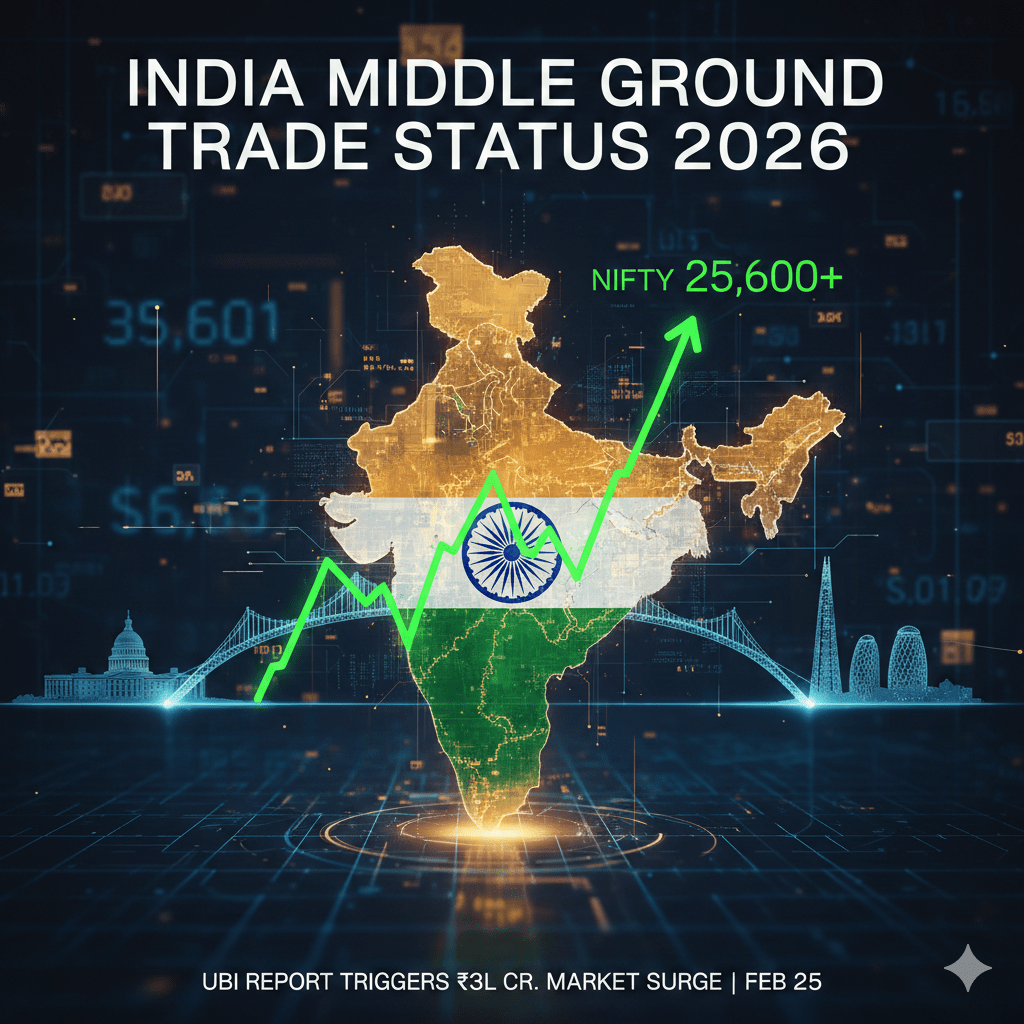
Technical Analysis: The 25,600 Resistance Flip
In the last 30 minutes, the technical structure of the Indian market shifted. The 25,500–25,600 zone was previously a “supply wall.” However, the India Middle Ground Trade Status 2026 news acted as a volume injector.
The Nifty 50 has now flipped 25,600 into a support level. Analysts at Ministry of Commerce & Industry suggest that as long as the index sustains above this “Middle Ground Base,” the path toward 26,000 remains open for the Q1 2026 closing.
Conclusion: Securing the #1 Spot in the New Economy
The India Middle Ground Trade Status 2026 is the defining economic narrative of February 25. By balancing its strategic autonomy with a “preferential partnership” with the US, India has essentially built an economic fortress. Today’s Nifty breakout is proof that when “Fresh Math” meets “Smart Diplomacy,” the results are bullish. Investors and businesses that act on this UBI Report data now will be best positioned for the 2026 global trade reset.
Frequently Asked Questions (FAQs)-India Middle Ground Trade Status 2026
Q1: What exactly is the “Middle Ground” status?
It is a specific trade tier defined in the 2026 UBI Report where India is exempted from the highest-level US Section 122 tariffs in exchange for adhering to specific “Secure Supply Chain” protocols.
Q2: Why did the Nifty hit 25,600 today?
The Nifty 25,600 breakout was triggered by the release of the UBI Report, which confirmed that Indian IT and Solar sectors would face significantly lower trade friction than previously feared.
Q3: Are these tariffs permanent?
Under Section 122, these tariffs are temporary (typically 150 days) unless extended by a vote in Congress. India’s “Middle Ground” status provides a roadmap for a permanent Bilateral Trade Agreement (BTA).
Disclaimer
Financial Disclosure: The content provided in this article, including the analysis of the India Middle Ground Trade Status 2026 and the UBI Report, is for informational and educational purposes only. It does not constitute professional financial, investment, or legal advice. Market conditions are subject to rapid change, and past performance—including the Nifty 25,600 breakout—is not indicative of future results.
Investment Risk: Trading in equities, derivatives, and commodities involves significant risk of loss. We strongly recommend that you consult with a certified financial advisor or a SEBI-registered investment professional before making any decisions based on the “Middle Ground” trade protocols or GDP revision data mentioned herein.
Affiliate & Transparency Note: cfostimes.com may contain links to external high-quality government and authorized websites. While we strive for 100% accuracy, we are not responsible for the content or privacy policies of third-party sites such as the PIB, UBI, or the White House Briefing Room. We do not provide “guaranteed” stock tips or “sure-shot” trading signals.
Copyright & AI Content: All rights reserved © 2026 cfostimes.com. This content is original, human-curated analysis designed to provide deep insight into global finance trends. Unauthorized reproduction or redistribution is strictly prohibited.

Dr. Dinesh Kumar Sharma is an award-winning Chief Financial Officer and Director of Finance with over 25 years of expertise in strategic planning and digital transformation. Recognized as a five-time CFO of the Year, he specializes in leveraging Generative AI and Microsoft Copilot to optimize financial forecasting and cost management. Dr. Sharma holds a Doctorate in Management (Finance) and has successfully scaled organizations from INR 1 billion to INR 7 billion. He is dedicated to providing transparent, data-driven insights for modern decision-makers at CFOs Times.









1 thought on “India Middle Ground Trade Status 2026: Why the UBI Report Sparked a Nifty Breakout”