The February 8 Market Briefing
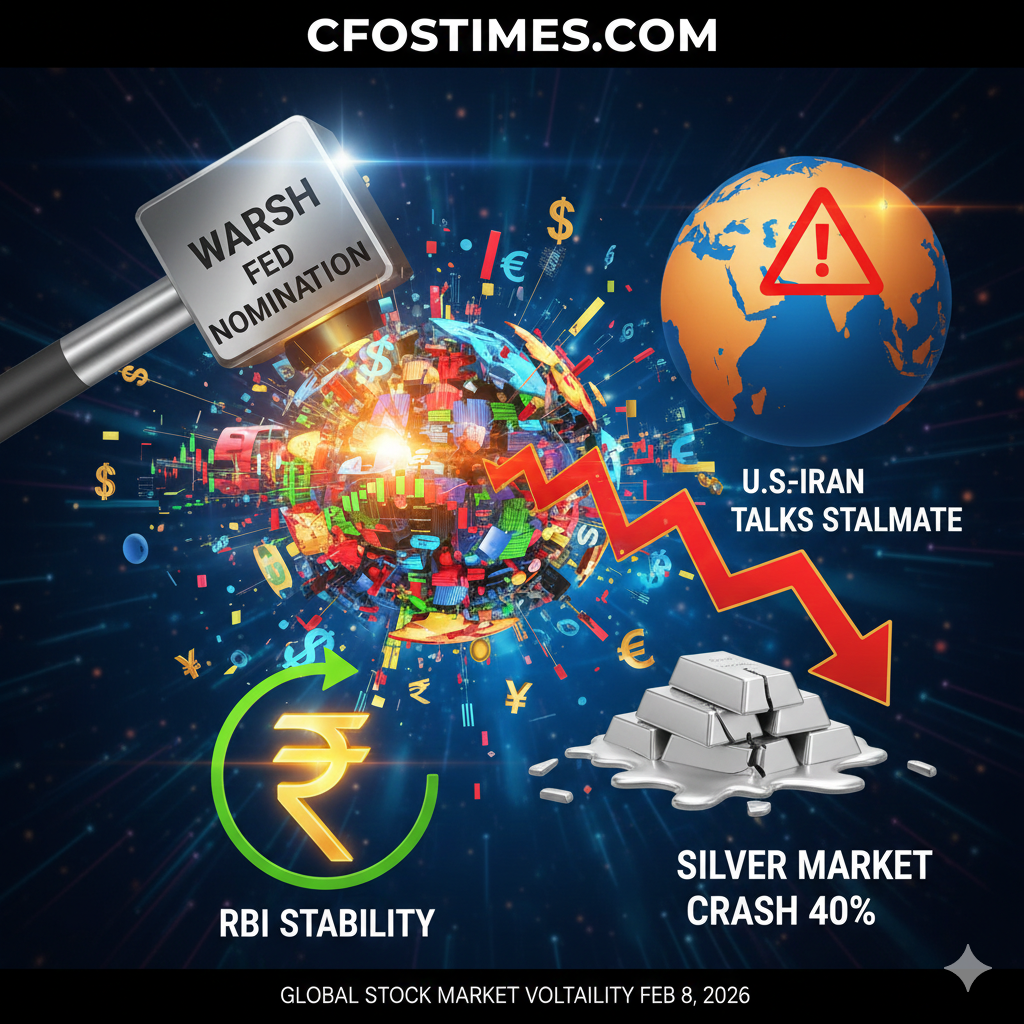
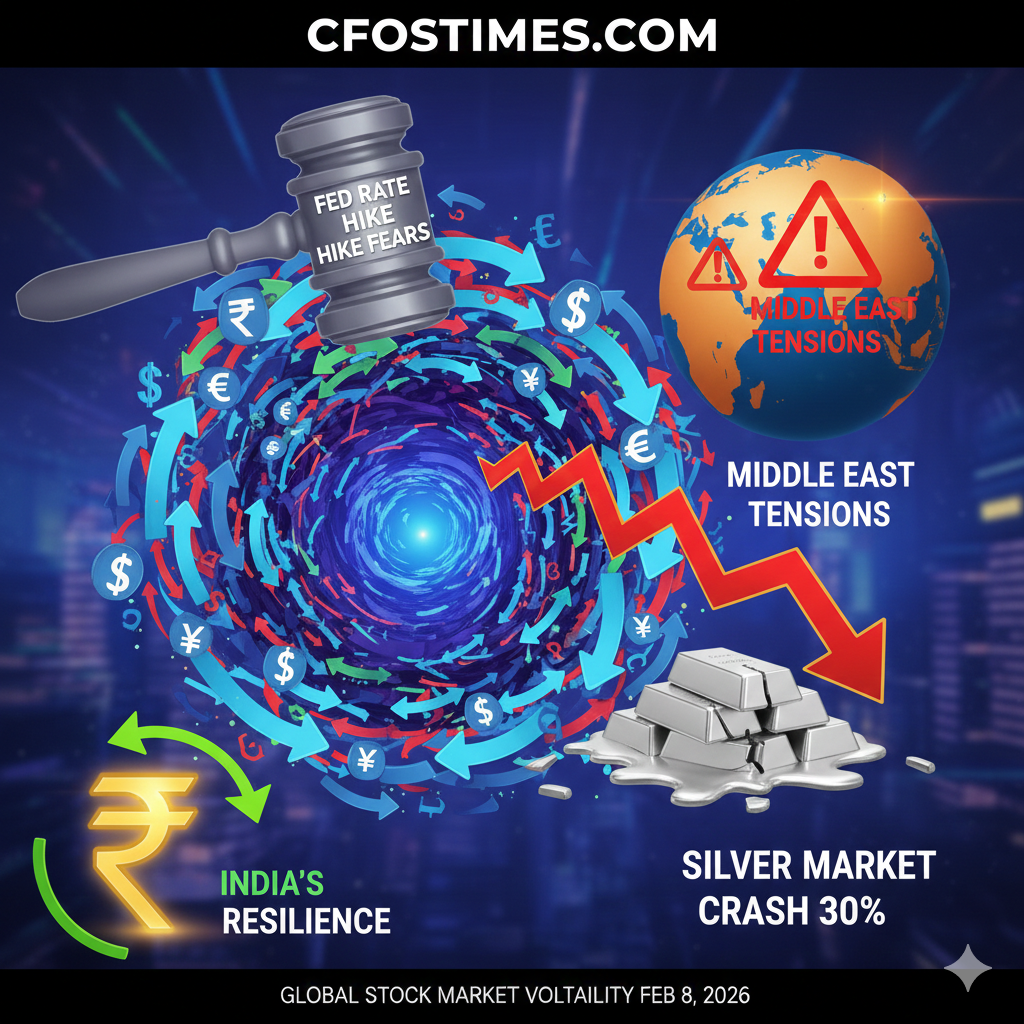
The global financial landscape is grappling with heightened Global Stock Market Volatility Feb 2026 today, February 8, 2026. Markets are processing a “Triple Threat” involving the Kevin Warsh Fed nomination, a stalemate in Oman, and a technical Dollar retreat. Unlike typical news cycles, this volatility is driven by a profound “mechanical reset” in how commodities and currencies are being valued in a high-interest-rate environment.
1. The Oman Standoff: Nuclear Diplomacy and Energy Premiums
The primary driver of energy sector volatility is the deadlock in Muscat, Oman. On Friday, February 6, talks between U.S. and Iranian officials concluded without a compliance framework. Global Stock Market Volatility Feb 2026
- Enrichment Deadlock: Iran has officially rejected U.S. demands to halt uranium enrichment, although it signaled flexibility on “purity levels,” according to reports from The Hindu.
- The “Placating Effect”: Oil prices, which initially surged, have stabilized as traders digest the “long-road” nature of these talks. Discovery Alert analysts note that European refiners are already assessing capital needs to accommodate potential Iranian crude re-entry, a process requiring 6–9 months of planning.
- Sanctions Update: The U.S. Department of State has responded with new sanctions on the “shadow fleet,” keeping the supply side of the equation under extreme pressure. Global Stock Market Volatility Feb 2026
2. The ‘Warsh Shock’: Repricing the Federal Reserve
The nomination of Kevin Warsh to succeed Jerome Powell has sent a seismic “Warsh Shock” through the currency markets.
- DXY Resilience: After a sharp initial surge to multi-year highs, the U.S. Dollar Index (DXY) is finding support near 97.50.
- Productivity-Led Easing: Analysis from Syz Blog suggests Warsh may not be a traditional “hawk.” Instead, he advocates for a high-productivity, low-inflation equilibrium. This implies he might prefer shrinking the Fed’s balance sheet rather than aggressive rate hikes—a “hawkish-dove” mix that tightens liquidity while supporting the real economy.
- India’s V-Shaped Rebound: In response, the Indian Rupee has staged a historic recovery from ₹92/$ to sub-₹90, bolstered by the RBI’s $709 billion forex reserves and a recent trade deal with the U.S. Global Stock Market Volatility Feb 2026
3. Structural Deep-Dive: The Silver ETF Meltdown 2026
The most violent expression of today’s Global Stock Market Volatility is the silver market. Silver prices plunged nearly 40% from their late-January peak of $121/oz to $77/oz.
The Leverage Flush
This crash mirrors the mechanics of 2011 but with modern algorithmic speed.
- CME Margin Hikes: To curb speculative excess, the CME Group raised silver margins from 15% to 18% on February 6.
- Paper vs. Physical: While “Paper” ETF units (SLV) were dumped, Axis Mutual Fund reports that physical silver in India continues to trade at a 5–10% premium over international benchmarks due to actual scarcity and festive demand.
- Technical Support: Silver is currently battling to hold the $70/oz zone. Analysts at Investing.com warn that a break below this could see a slide toward $54.50, while $94.80 remains the critical resistance to beat. Global Stock Market Volatility Feb 2026
4. Regional Impact Summary (Feb 8, 2026)
| Asset/Region | Current Status | Official Driver |
| Brent Crude | $68.05 | EIA supply security risk pricing. |
| Silver (Paper) | $77.46 | CME 18% margin requirement. |
| Indian Rupee | Sub-₹90 | RBI 5.25% Repo Rate stability. |
| US Dollar (DXY) | 97.40 | “Warsh Shock” institutional re-balancing. |
5. Strategic Outlook for Investors
To navigate the Global Stock Market Volatility of February 2026, institutional strategies are focusing on De-leveraging and Real Assets:
- Reduce Margin Exposure: The CME’s tiered margin system for 2026 favors those with higher capital buffers.
- Monitor the Strait of Hormuz: Approximately one-fifth of global oil consumption passes through this chokepoint. Any escalation in the U.S.–Iran standoff will trigger an immediate +$5/barrel risk premium.
- Watch the Yield Curve: The “Warsh-led Fed” is expected to steepen the yield curve as the balance sheet shrinks. This favors banking and value stocks over high-growth tech in the short term. Global Stock Market Volatility Feb 2026
Frequently Asked Questions (FAQs)–Global Stock Market Volatility Feb 2026
Q1: Why is the dollar retreating today despite a hawkish Fed nominee?
The initial “Warsh Shock” was a knee-jerk reaction. Today’s Dollar retreat reflects a “Sell the Fact” profit-taking phase and a re-pricing of Warsh as a “productivity-growth” advocate rather than a simple inflation hawk.
Q2: What is the current ‘Silver Premium’ in India?
Physical silver in India is trading at a significant premium (5–10%) over the international spot price because the ETF crash was driven by leverage liquidations, not a drop in industrial demand for solar or 5G chips.
Q3: How soon could U.S.–Iran talks stabilize oil prices?
Even with a breakthrough, EIA models suggest it would take 12–18 months for Iranian production to fully hit global markets, meaning energy prices will remain volatile throughout 2026.
Disclaimer
Financial Disclosure & Risk Warning:
The information provided on CFOSTimes (cfostimes.com), including but not limited to analysis of the U.S.–Iran nuclear talks, Federal Reserve nominations, and Global Stock Market Volatility Feb 2026 the Silver ETF Meltdown 2026, is for educational and informational purposes only.
- Not Financial Advice: Content on this site does not constitute professional financial, investment, tax, or legal advice. CFOSTimes is a news and analysis platform; we are not a registered investment advisor (RIA) or broker-dealer.
- Market Risk: Investments in the securities and commodities markets—including stocks, ETFs, and precious metals—involve substantial risk of loss. Past performance, such as the historic highs of the KOSPI 5000 or the recovery of silver to ₹2.85 Lakh/kg, is not indicative of future results.
- Accuracy of Information: While we strive to cite official sources like the U.S. Treasury, CME Group, and the RBI, CFOSTimes makes no guarantees regarding the completeness, timeliness, or accuracy of the data provided. Market conditions change rapidly; always verify data through official regulatory filings.
- Independent Research: Readers are strongly encouraged to conduct their own due diligence or consult with a certified financial professional before making any investment decisions. CFOSTimes and its authors shall not be held liable for any financial losses or damages resulting from the use of this information.

Dr. Dinesh Kumar Sharma is an award-winning Chief Financial Officer and Director of Finance with over 25 years of expertise in strategic planning and digital transformation. Recognized as a five-time CFO of the Year, he specializes in leveraging Generative AI and Microsoft Copilot to optimize financial forecasting and cost management. Dr. Sharma holds a Doctorate in Management (Finance) and has successfully scaled organizations from INR 1 billion to INR 7 billion. He is dedicated to providing transparent, data-driven insights for modern decision-makers at CFOs Times.