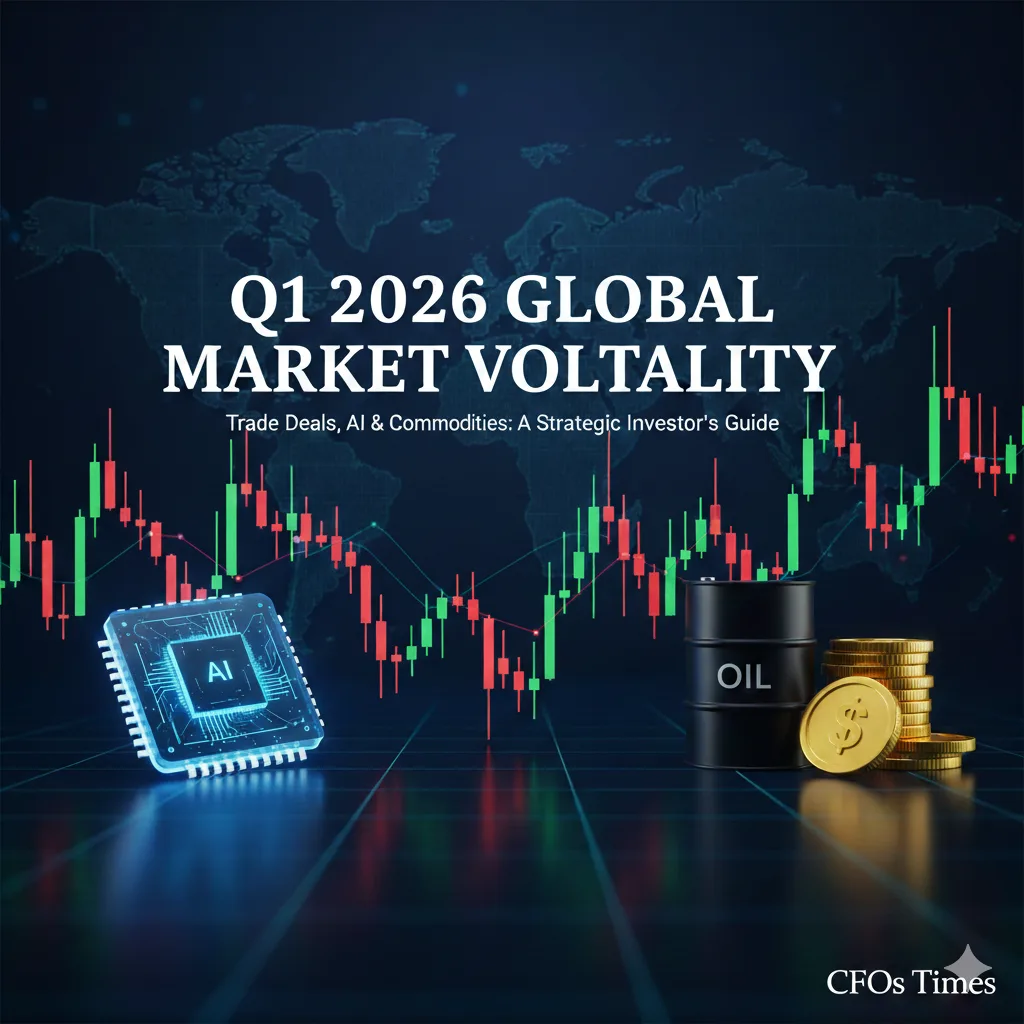
The Q1 2026 global market volatility has emerged as the defining characteristic of this year’s financial landscape. As investors navigate a complex intersection of AI-driven corporate earnings, shifting commodity prices, and high-stakes international trade agreements, the need for a data-driven perspective has never been greater.
Unlike previous cycles, the current market environment is not merely reacting to interest rate speculation. Instead, we are witnessing a fundamental “re-baselining” of global trade routes and industrial productivity. This article provides an in-depth analysis of the factors driving Q1 2026 global market volatility and offers a roadmap for institutional and retail investors alike.
Table of Contents
1. The Anatomy of Q1 2026 Global Market Volatility
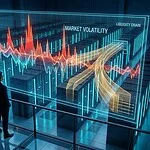
The first quarter of 2026 has been marked by a significant uptick in the VIX and other risk indicators. This Q1 2026 global market volatility is primarily fueled by three converging “super-themes”:
- The AI Capex Cycle: Massive investments in data centers and sovereign AI clouds.
- Trade Protectionism: A surge in unilateral tariffs and the implementation of “Friend-shoring” policies.
- Monetary Divergence: While the Federal Reserve remains on hold, the European Central Bank and the Bank of Japan are pursuing divergent paths.
Quarterly Volatility Comparison (2024–2026)
| Year | Q1 Avg VIX | Primary Driver | Market Sentiment |
| 2024 | 14.2 | Inflation cooling | Optimistic |
| 2025 | 16.8 | Rate cut speculation | Cautious |
| 2026 | 21.5 | Trade deals & AI earnings | Highly Volatile |
2. Corporate Earnings: The Engine of Uncertainty
At the heart of Q1 2026 global market volatility is the most anticipated earnings season in a decade. Markets are currently rewarding companies that demonstrate tangible ROI from their 2024-2025 AI investments.
The “Winner-Takes-All” Dynamic
According to latest reports from the U.S. Bureau of Economic Analysis (BEA), corporate profits in the tech sector have grown by 14% year-over-year, yet the broader S&P 500 remains strained. This concentration of wealth within a few “AI Super-winners” has created a fragile equilibrium. When a lead tech firm misses an earnings target by even 1%, the spillover effect triggers massive sell-offs across the index.
3. Global Trade Deals: Redefining the Map
International commerce is undergoing a radical transformation. The World Trade Organization’s 14th Ministerial Conference has highlighted a shift toward “Transactional Trade.”
Q1 2026 global market volatility is often a direct reflection of “Tariff Headlines.” For instance, the recent US-China trade adjustments have led to a 14% decrease in direct bilateral trade, forcing companies to move supply chains to Vietnam and Mexico.
Key Fact: UN Trade and Development (UNCTAD) reports that trade-distorting measures have hit a record high in 2026, affecting over $3.4 trillion in global goods.
4. Commodities and Energy: The New Inflation Hedge
As geopolitical tensions persist, commodities have regained their status as a primary portfolio stabilizer. Gold and Crude Oil are no longer just speculative plays; they are essential hedges against Q1 2026 global market volatility.
2026 Commodity Price Outlook
- Gold: Benefiting from a 1.4% price lift for every 1bp increase in institutional portfolio allocation.
- Lithium & Cobalt: Oversupply issues in 2025 have stabilized, leading to a renewed M&A interest in the mining sector.
- Crude Oil (Brent): Trading in a tight $85–$95 range due to supply-side constraints and increased defense spending in Europe.
5. Strategic Investor Playbook for 2026
To mitigate the risks associated with Q1 2026 global market volatility, investors are shifting toward “Barbell Strategies”:
- The Growth Side: Allocating to “AI Utilities”—companies that provide the power, cooling, and physical infrastructure for the digital revolution.
- The Defensive Side: High-yield government bonds and “Quality-factor” equities with low debt-to-equity ratios.
- Alternative Assets: Increasing exposure to private credit and secondaries, which have stabilized after the 2025 rebound.
Conclusion
The Q1 2026 global market volatility is not a sign of a failing system, but rather a symptom of a world in transition. By focusing on high-quality data from authorized sources like the International Trade Administration and maintaining a diversified approach, investors can turn these fluctuations into opportunities. The key for the remainder of 2026 will be “Micro-Analysis”—looking past the broad headlines to find value in specific sectors that are successfully navigating the new trade and technology reality.
Frequently Asked Questions (FAQs)
What is causing the Q1 2026 global market volatility?
The primary causes include the “collision” of uneven monetary policies, the relentless expansion of AI capital expenditures, and intensifying trade protectionism among major economies.
Is a recession likely in 2026?
Current forecasts from J.P. Morgan and Morgan Stanley estimate a 35% probability of a global recession, cited primarily due to “sticky” inflation and high labor costs.
How should I protect my portfolio from Q1 2026 global market volatility?
Consider a “Quality” focus: look for companies with strong cash flows and minimal exposure to high-tariff trade routes. Commodities like gold continue to act as a strong hedge.
How do trade deals affect the stock market?
Trade deals can create “winners and losers” overnight. In 2026, deals focusing on “Critical Minerals” and “Digital Services” are the most influential on stock valuations.
Financial Disclosure & Disclaimer:
The information provided in this article, “Q1 2026 Global Market Volatility: A Strategic Guide,” is for informational and educational purposes only. It does not constitute professional financial, investment, or legal advice.
While we strive to provide accurate and up-to-date analysis, market conditions are subject to rapid change. CFOs Times and its authors are not licensed financial advisors. We highly recommend consulting with a certified financial planner or qualified professional before making any investment decisions based on the content of this site.
Investments involve risk, including the possible loss of principal. Past performance is not indicative of future results.

Dr. Dinesh Kumar Sharma is a CMA an award-winning Chief Financial Officer and Director of Finance with over 25 years of expertise in strategic planning and digital transformation. Recognized as a five-time CFO of the Year, he specializes in leveraging Generative AI and Microsoft Copilot to optimize financial forecasting and cost management. Dr. Sharma holds a Doctorate in Management (Finance) and has successfully scaled organizations from INR 1 billion to INR 7 billion. He is dedicated to providing transparent, data-driven insights for modern decision-makers at CFOs Times.