Economic Survey 2026 PDF Download: India’s 7.4% GDP Growth & Strategic Analysis
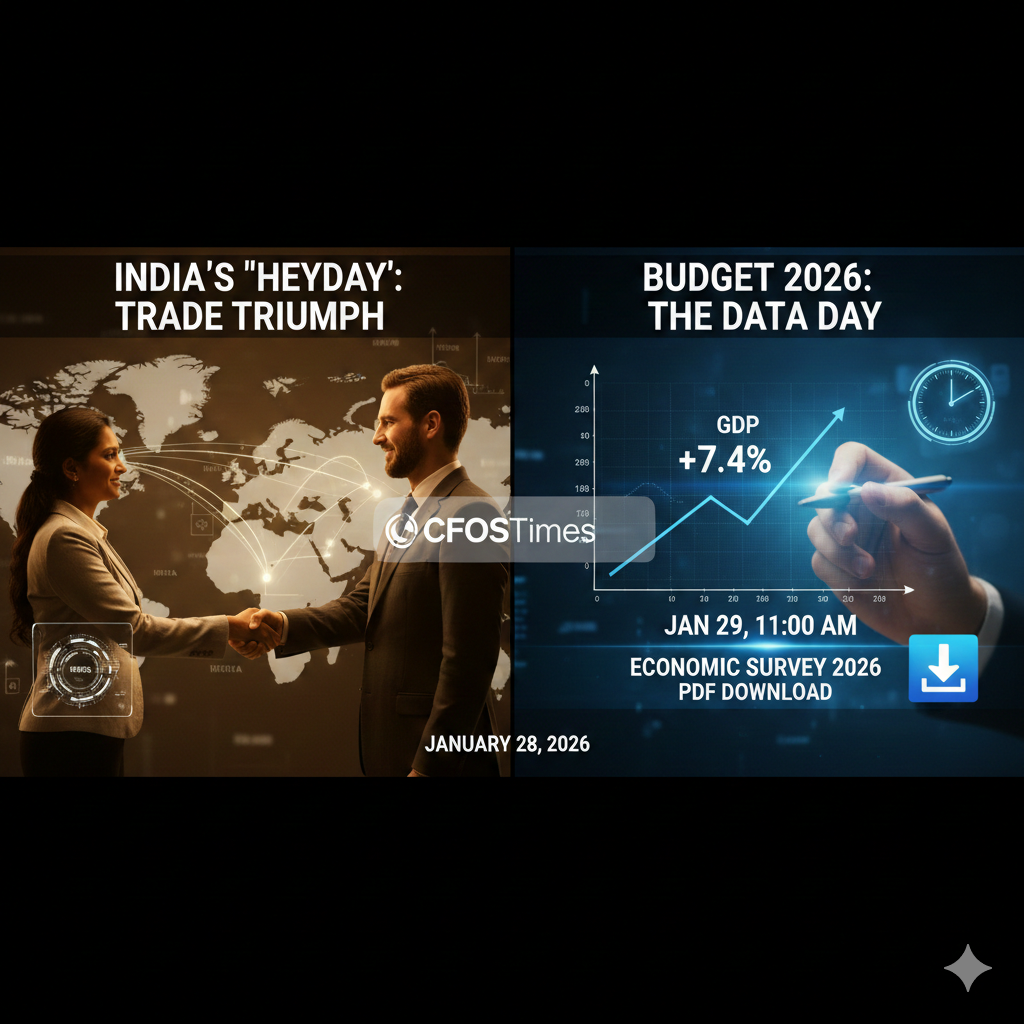
The Economic Survey 2026 was officially tabled in the Lok Sabha by Union Finance Minister Nirmala Sitharaman on January 29, 2026. As the definitive “report card” of the Indian economy, this year’s document arrives at a critical juncture. While India remains the world’s fastest-growing major economy with a projected 7.4% Real GDP growth for FY26, it must navigate a global environment characterized by trade fragmentation and geopolitical realignments.
For the audience at CFOSTimes, this document is more than a data dump—it is a strategic blueprint for capital allocation and risk management in the coming fiscal year.
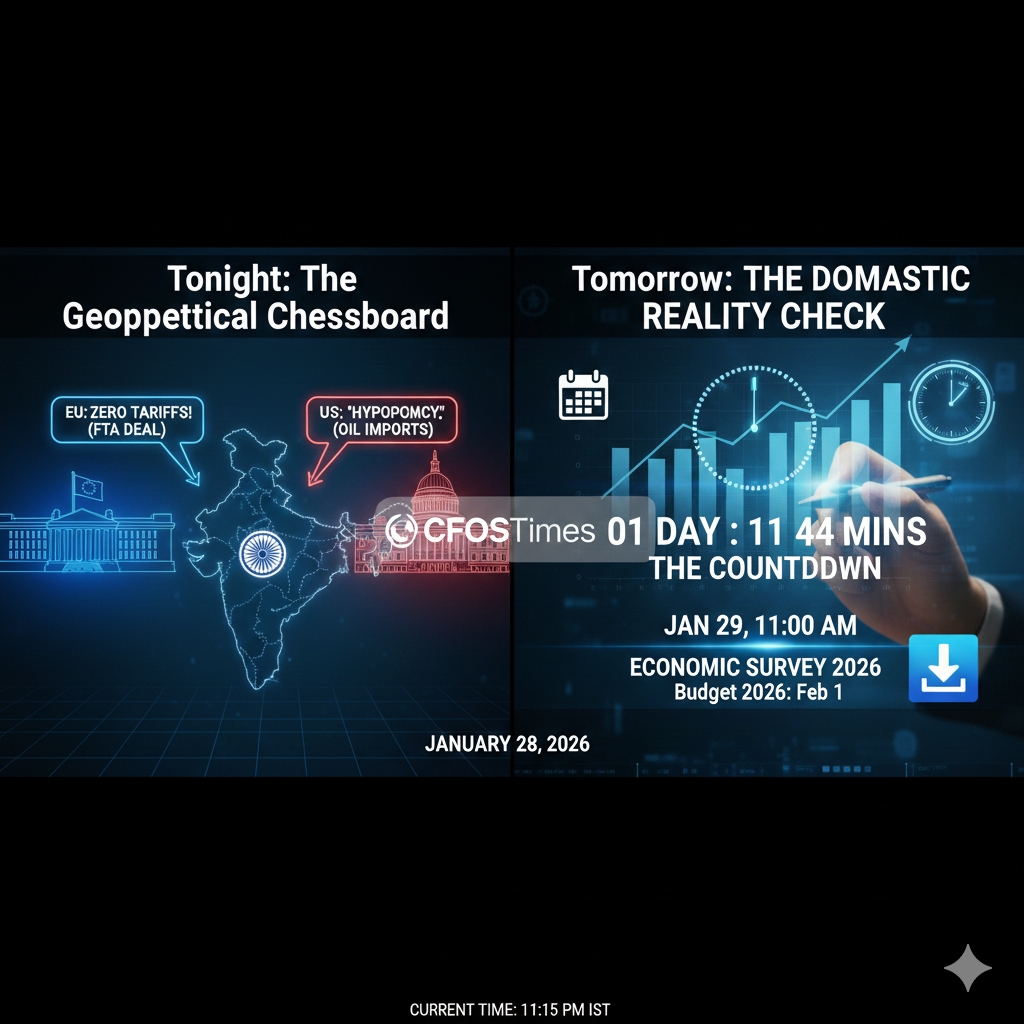
1. Official Economic Survey 2026 PDF Download Links
To ensure data integrity, users should only access the document via authorized government portals. Below are the primary sources for the full report and highlights:
- Download Full Report: Indiabudget.gov.in/economicsurvey
- Download Highlights & Statistical Appendix: PIB.gov.in/PressRelease
- Official Infographics (English): Direct PDF Link
Note: If you encounter a 404 error on the main budget site, use the PIB (Press Information Bureau) mirror links, which typically have higher uptime during the first 24 hours of release.
pan and So2. Macroeconomic Snapshot: The “Oasis of Stability”
Chief Economic Advisor (CEA) V. Anantha Nageswaran describes India as an “oasis of macro stability.” Despite global headwinds, India’s fundamentals have remained anchored.
Key Performance Indicators (KPIs)-Economic Survey 2026 PDF Download
| Indicator | Data Point (FY26) | Outlook (FY27) |
| Real GDP Growth | 7.4% | 6.8% – 7.2% |
| Headline Inflation | 1.7% (Apr-Dec 2025) | Tamed within 4% target |
| Fiscal Deficit | 4.4% | Consolidation continues |
| Forex Reserves | $701.4 Billion | Strong 11-month cover |
3. Deep Dive: “Disciplined Swadeshi” and Trade Policy
A central theme of the Economic Survey 2026 is the “Paradox of 2025.” The Survey notes that India’s strongest macroeconomic performance in decades is colliding with a global system that is becoming increasingly protectionist.
The “Paradox” for CFOs
The Survey makes a bold claim: The Indian Rupee is “punching below its weight.” While external geopolitical churn has caused volatility, the underlying “Real Effective Exchange Rate” (REER) indicates India remains highly competitive for exports. For a CFO, this suggests that while currency volatility remains a risk, the domestic economy is fundamentally shielded.
The “Disciplined Swadeshi” Framework
The government has introduced a three-tiered policy framework to move India from simple “import substitution” to “strategic indispensability” in global value chains:
Cost-Effectiveness: Ensuring domestic production doesn’t lead to inefficient pricing for consumers.
4. Sectoral Analysis: Manufacturing and the AI Revolution
I. Manufacturing & Industry (9.13% Growth)
Manufacturing has seen a structural recovery. The PLI (Production Linked Incentive) schemes across 14 sectors have now attracted over ₹2.0 Lakh Crore in actual investment. The Survey highlights a sharp uptick in the steel and cement sectors, driven by the government’s sustained public capex (now at 4% of GDP).
II. The “Invisible” AI Revolution (Chapter 14)
Chapter 14 of the Economic Survey 2026 is dedicated to the Evolution of the AI Ecosystem.
- The Opportunity: AI is viewed as “Digital Public Infrastructure 2.0.”
- The Warning: The Survey warns of “delayed gratification”—meaning the full productivity gains of AI will take years to manifest, while the labor market risks are immediate. CFOs are advised to look at AI as a long-term efficiency play rather than a short-term cost-cutting tool.
.
5. Strategic Advice for Finance Leaders
Based on the data within the Economic Survey 2026, here are the action items for FY27 planning:
- Lock in Financing: With inflation at a historic low of 1.7%, the cost of debt is currently at a floor. As the RBI targets a 4% anchor for FY27, interest rates are unlikely to drop significantly further.
- Focus on “Disciplined Swadeshi”: Align your procurement with PLI-backed sectors to leverage government incentives.
- Human Capital Investment: The Survey emphasizes “well-being” (physical and mental health) as a driver of labor productivity. Expect future policy shifts toward corporate wellness mandates.
6. FAQ: Economic Survey 2026 PDF Download
Q1: What is the projected GDP for FY27? The Survey projects a growth range of 6.8% to 7.2% for FY27, assuming normal monsoon conditions and stable global oil prices.
Q2: Why is the Survey released before the Budget? The Survey provides the economic context and data that justify the policy decisions and spending allocations announced in the Union Budget on February 1.
Final Thoughts
The Economic Survey 2026 PDF Download confirms that India has built a “fortress balance sheet.” With record-high forex reserves and a banking sector with NPAs at multi-decadal lows, the country is prepared for external shocks. However, for the CFO, the “marathon” of productivity-led growth is just beginning.
Conclusion: Leveraging the Economic Survey 2026 PDF Download
The Economic Survey 2026 PDF Download is more than a collection of charts; it is the blueprint for India’s journey toward “Viksit Bharat 2047.” For the audience at CFOSTimes, this document is the ultimate tool for strategic planning. Whether you are analyzing the “Heyday” of Indian trade or the new “Pathway” for U.S. tariffs, the data starts here.
Disclaimer:
The information regarding the Economic Survey 2026 PDF Download is for informational purposes only. CFOSTimes does not host the official PDF files; we provide links to authorized government sources for user convenience. Please consult a financial advisor before making investment decisions based on this data. We participate in the Google AdSense program, which uses cookies to serve personalized ads.

Dr. Dinesh Kumar Sharma is a CMA an award-winning Chief Financial Officer and Director of Finance with over 25 years of expertise in strategic planning and digital transformation. Recognized as a five-time CFO of the Year, he specializes in leveraging Generative AI and Microsoft Copilot to optimize financial forecasting and cost management. Dr. Sharma holds a Doctorate in Management (Finance) and has successfully scaled organizations from INR 1 billion to INR 7 billion. He is dedicated to providing transparent, data-driven insights for modern decision-makers at CFOs Times.