Introduction: From Uncertainty to Instability
2026 market outlook-As investors look ahead to 2026, portfolio managers across the world’s largest financial institutions are united in one belief: the global economy is no longer merely uncertain—it is structurally unstable. While uncertainty implies a lack of clarity, instability reflects a deeper shift in how markets, policy, and capital flows function.
This distinction is central to how professional investors are planning portfolios for 2026. Rather than preparing for a short-term cycle or policy pivot, they are repositioning for a world shaped by persistent inflation, geopolitical fragmentation, an artificial intelligence supercycle, and uneven economic performance across sectors and regions.
Drawing on insights reflected in reporting from Reuters and Bloomberg, outlooks from BlackRock, Vanguard, and Fidelity, guidance from the IMF, World Bank, and OECD, and views expressed in global portfolio manager surveys, this article explores how the investment landscape is evolving—and how portfolio managers are preparing for what comes next.
Table of Contents
The Global Macro Backdrop Entering-2026 market outlook
Growth: Slower, Uneven, but Resilient
Global growth expectations for 2026 remain modest but stable. Multilateral institutions project that the world economy will continue expanding, albeit at a slower pace than in the pre-pandemic era. The IMF and OECD consistently highlight a key theme: resilience without acceleration.
Developed economies are expected to avoid deep recessions, while emerging markets show divergent outcomes depending on fiscal discipline, demographics, and exposure to global trade. For portfolio managers, this reinforces the need for geographic and sectoral selectivity rather than blanket exposure.
The United States: A Two-Speed Economy-2026 market outlook
Within this global framework, the U.S. stands out as the primary engine of growth—but one operating at two distinct speeds.
Major investment banks and asset managers describe an economy where technology, energy, and capital-intensive industries are accelerating, while labor-intensive and traditional sectors lag behind. This “K-shaped” dynamic has become central to portfolio construction.
Forecasts from leading institutions suggest U.S. GDP growth in the 2.2%–2.5% range through 2026—remarkably strong given the high interest rate environment of recent years. However, much of that growth is concentrated in a narrow set of industries.
Inflation: The Sticky Reality-2026 market outlook
Why Inflation Isn’t Going Away
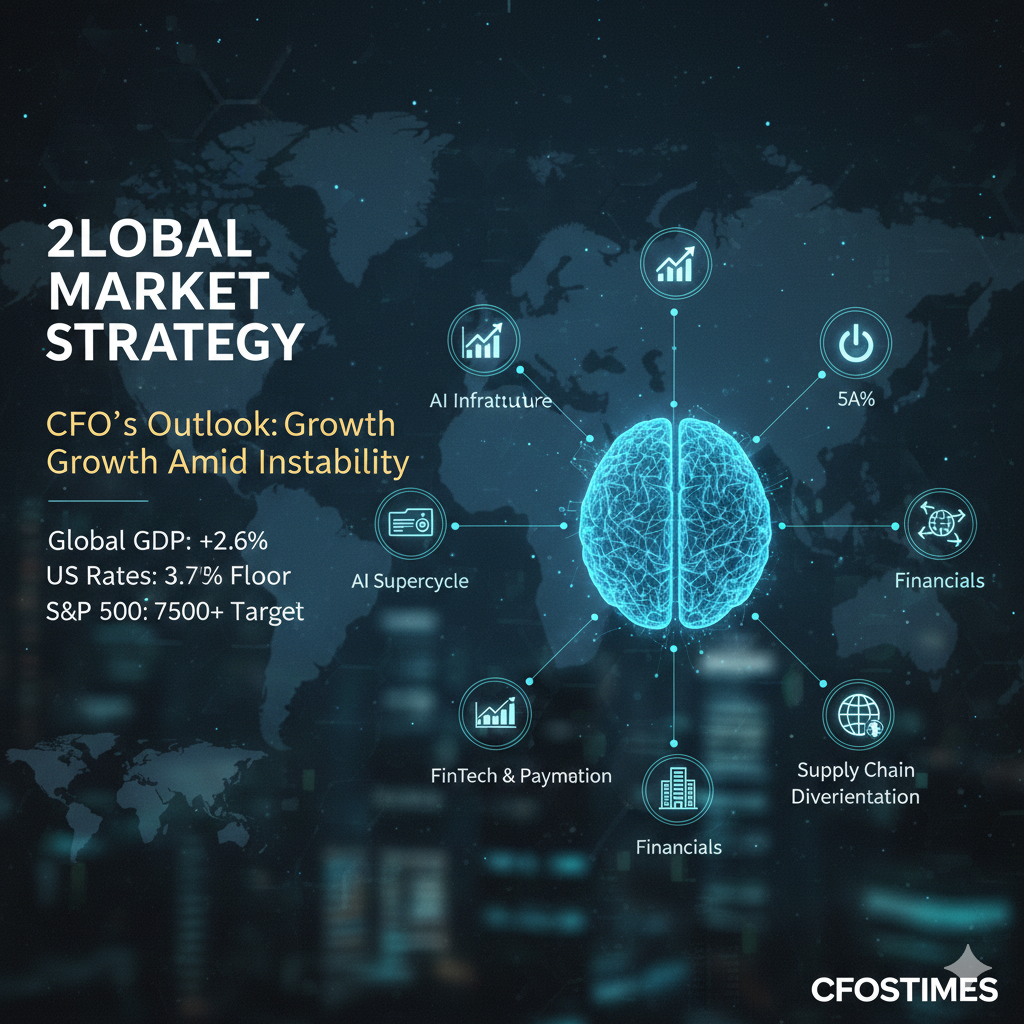
One of the most important assumptions shaping 2026 investment strategies is that inflation will remain structurally higher than the pre-2020 norm. While inflation has moderated from its peak, most portfolio managers now expect a floor near 3%, particularly in the U.S.
Several factors underpin this outlook:
- Persistent tariffs that raise input and consumer prices
- Healthcare and insurance costs rising faster than wages
- Large fiscal programs, including tax rebates and infrastructure spending
- Deglobalization, which reduces efficiency and raises production costs
This reality has forced investors to rethink traditional hedges and to prioritize assets with pricing power.
Monetary Policy: Higher for Longer, Revisited
The End of Rate-Cut Optimism–2026 market outlook
In 2025, markets anticipated aggressive interest rate cuts. By 2026, that optimism has faded. Portfolio managers now largely expect a pause-and-hold environment, with only shallow easing—if any.
Major institutions project:
- A Fed funds rate stabilizing around 3.5%–3.75%
- Limited tolerance for overheating growth
- Heightened sensitivity to inflation re-acceleration
The expected appointment of a new Federal Reserve Chair in mid-2026 adds another layer of uncertainty. Some managers believe a more debt-conscious leadership could lean toward modest easing, while others warn of renewed volatility if policy independence is questioned.
Equity Markets: Opportunity with Concentration Risk
Broadly Bullish, Selectively Cautious–2026 market outlook
Despite macro headwinds, portfolio managers remain broadly constructive on equities heading into 2026. Many project the S&P 500 reaching the 7,500–8,000 range, supported by earnings growth and structural investment themes.
However, optimism is tempered by concern over market concentration. A small number of mega-cap technology firms continue to account for an outsized share of index performance, increasing downside risk if expectations are missed.
As a result, portfolio managers are increasingly favoring active management over passive indexing.
The AI Supercycle Enters Its Next Phase–2026 Market outlook
Artificial intelligence has moved from experimentation to core operations. By 2026, portfolio managers expect AI spending to be embedded across industries rather than confined to technology firms.
Capital expenditure on AI infrastructure—data centers, semiconductors, cloud networks—is projected to exceed hundreds of billions of dollars annually. This has shifted investor focus toward what many describe as the “picks and shovels” of the AI revolution.
Beyond software, investors are targeting:
- Semiconductor equipment and materials
- Power generation and grid infrastructure
- Industrial automation and logistics
This broadening of AI beneficiaries is expected to reduce—but not eliminate—concentration risk.
Sector Rotation: Where Capital Is Moving-2026 market outlook
Utilities and Energy: Unexpected Winners
One of the most notable shifts in portfolio strategy is the re-rating of utilities and energy infrastructure. The explosion in data center demand has dramatically increased electricity consumption, turning power providers into growth assets.
Portfolio managers are focusing on:
- Renewable energy developers
- Natural gas infrastructure
- Nuclear and next-generation reactor technologies
These assets offer a rare combination of growth, income, and inflation protection.
Financials: A Potential Comeback–2026 market outlook
After years of underperformance, financial stocks are regaining attention. Expectations of a more relaxed regulatory environment, combined with higher net interest margins, have improved the outlook for banks.
Portfolio managers also expect a revival in:
- Mergers and acquisitions
- IPO activity
- Corporate restructuring
This could significantly boost investment banking and capital markets revenues through 2026.
Healthcare and Demographics
Healthcare remains a cornerstone of long-term portfolios. Aging populations, rising chronic disease prevalence, and innovation in biotechnology continue to support demand regardless of economic cycles.
Pharmaceuticals, medical devices, and healthcare services are increasingly viewed as defensive growth plays with stable cash flows.
Fixed Income: The Return of Income-2026 market outlook
Bonds Matter Again
After a decade of disappointment, fixed income has re-entered the spotlight. With yields meaningfully higher, bonds once again provide income and diversification.
Portfolio managers are prioritizing:
- Investment-grade corporate bonds
- Short- to intermediate-duration strategies
- Selective credit exposure over long-duration bets
Rather than betting aggressively on falling rates, investors are focusing on issuer quality and balance sheet strength.
Emerging Markets: A Selective Opportunity
Emerging markets remain part of the 2026 strategy, but with greater differentiation than in the past. Portfolio managers favor countries with:
- Stable monetary policy
- Growing domestic demand
- Beneficiaries of supply chain diversification
Local currency assets and consumer-driven economies are preferred over export-dependent models vulnerable to global slowdowns.
Alternatives, Real Assets, and Digital Assets
Hedging Instability–2026 market outlook
As concerns over currency stability and fiscal sustainability grow, portfolio managers are increasingly allocating to real assets and select digital assets.
These include:
- Commodities and infrastructure
- Real estate with structural demand (logistics, data centers)
- Digital assets viewed as non-sovereign stores of value
While still volatile, these assets are seen as potential hedges against systemic instability.
Key Risks Facing the 2026 market outlook
No portfolio strategy is complete without acknowledging downside risks. Portfolio managers consistently highlight several key threats:
- Policy shocks, particularly around tariffs and regulation
- A misstep by central banks, especially during leadership transitions
- Global decoupling, with slower growth in Europe or China impacting multinationals
- Market concentration, leaving indices vulnerable to sharp corrections
Risk management, rather than return maximization, is becoming the defining feature of portfolio construction.
The Bottom Line: How Portfolio Managers Are Planning for 2026
The “Plan for 2026” is not about chasing the next speculative trend. It is about adapting to a world where volatility is persistent, growth is uneven, and policy uncertainty has become structural.
Portfolio managers are responding with:
- Broader diversification
- Greater emphasis on quality and cash flow
- Increased use of active management
- Long-term exposure to AI, energy, and infrastructure
In this environment, success will depend less on timing the market and more on building resilient portfolios capable of compounding through instability.
For investors, CFOs, and asset allocators alike, 2026 represents not just another forecast year—but a strategic inflection point in how capital is deployed in a changing global economy.
1. The CFO’s Strategic Checklist for 2026
Add this section before your conclusion to boost “Helpful Content” signals.
- [ ] Stress-Test the “Higher-for-Longer” Reality: Model your 2026 capital allocation assuming the Fed funds rate stabilizes at 3.5%–3.75% rather than returning to zero.
- [ ] Audit the “AI Supercycle” ROI: Shift from speculative AI pilots to “Picks and Shovels”—invest in data center power, grid infrastructure, and industrial automation.
- [ ] Recalibrate the 60:40 Portfolio: Consider moving toward a 60:20:20 model, diversifying with 20% in uncorrelated alternative assets (infrastructure, private debt, and commodities) to hedge against structural instability.
- [ ] Implement Predictive Cash Management: Transition from reactive bank balancing to AI-driven rolling forecasts that update daily to capture early payment discounts and optimize working capital.
- [ ] Review Supply Chain “Fragmentation”: Identify regional hubs (e.g., Vietnam, Mexico, or India) that benefit from the global decoupling and tariff-driven reshoring.
2. 2026 Market Outlook Dashboard
Use this table to make your post highly “scannable”—a key ranking factor for professional readers.
| Metric | 2026 Target / Forecast | Institutional Sentiment |
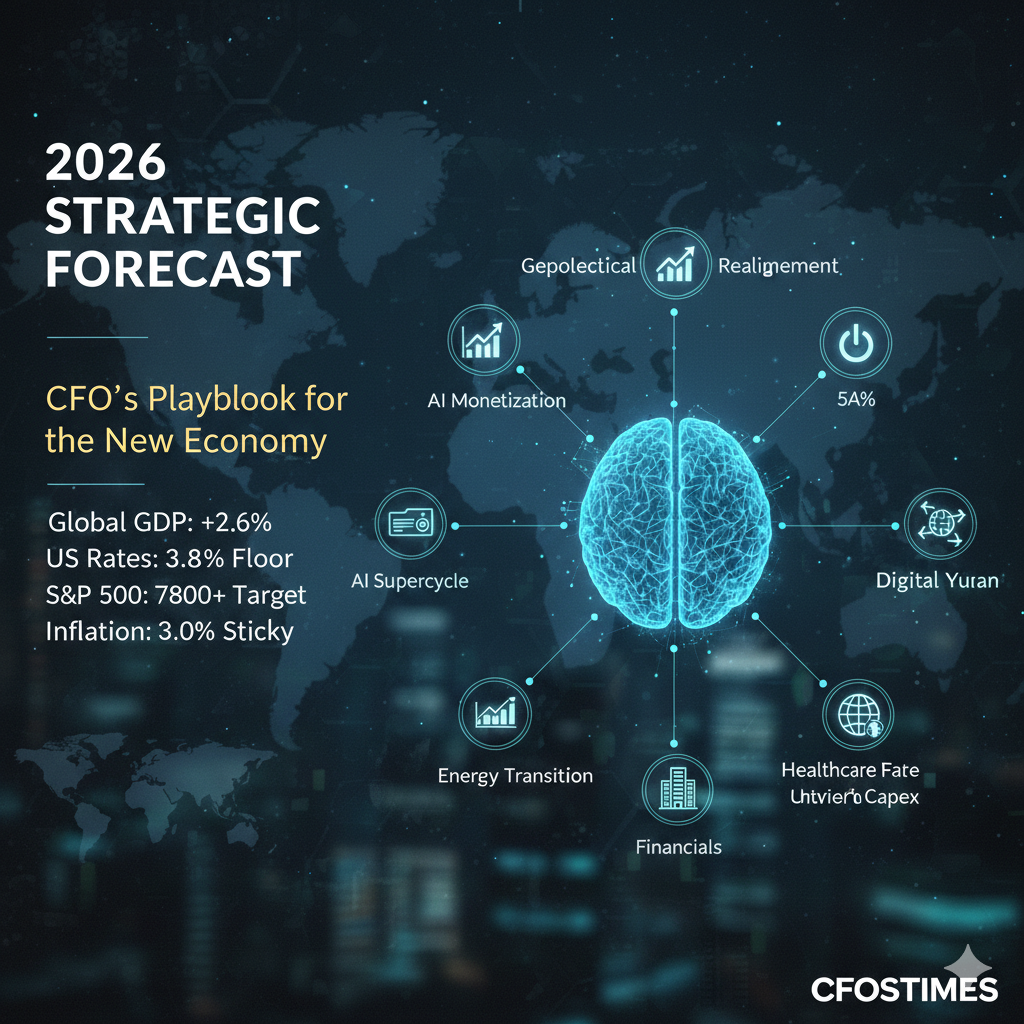
| S&P 500 Year-End | 7,500 – 8,100 | Broadly Bullish (Earnings-led) |
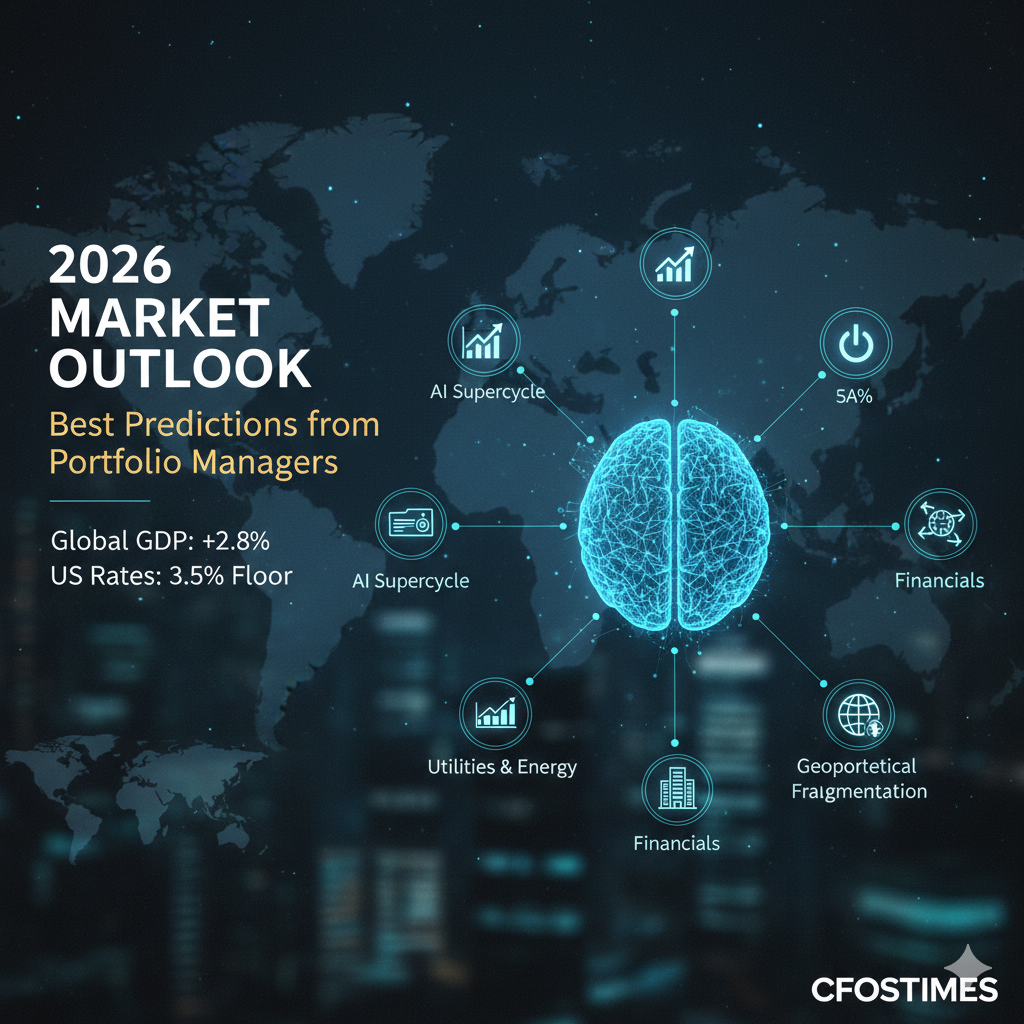
| Global GDP Growth | 2.8% (Goldman Sachs) | Resilient but Uneven |
| U.S. GDP Growth | 2.2% – 2.6% | Outperforming Global Peers |
| Fed Terminal Rate | 3.5% – 3.75% | Pause-and-Hold Strategy |
| Top Sector | AI Infrastructure & Utilities | High Conviction |
FAQs
1. What is the Plan for 2026 according to portfolio managers?
The Plan for 2026 reflects how institutional investors are positioning portfolios amid persistent inflation, higher interest rates, AI-driven growth, and geopolitical instability. It focuses on diversification, quality assets, and active management.
2. Will the U.S. economy remain strong in 2026?
Most portfolio managers expect the U.S. economy to remain resilient, with GDP growth around 2.2%–2.5%. However, growth is expected to be uneven, with technology and energy outperforming traditional sectors.
3. Are interest rates expected to fall in 2026?
Portfolio managers largely expect a “higher for longer” environment. While modest easing is possible, most forecasts see the Fed funds rate stabilizing around 3.5%–3.75 rather than returning to ultra-low levels.
4. Which sectors are expected to outperform in 2026?
High-conviction sectors include technology (especially AI infrastructure), utilities and energy, healthcare, financials, and selective industrials tied to data centers and reshoring trends.
5. Is artificial intelligence still a good investment for 2026?
Yes, but portfolio managers emphasize a shift from speculative AI plays to companies enabling AI adoption, such as semiconductors, utilities powering data centers, and industrial infrastructure providers.
6. What are the biggest risks to the 2026 market outlook?
Key risks include policy uncertainty, changes in Federal Reserve leadership, persistent inflation, market concentration, and a deeper slowdown in Europe or China affecting global earnings.
7. Are bonds attractive again for investors in 2026?
Yes. With higher yields, bonds have regained their role as income-generating and stabilizing assets. Portfolio managers favor investment-grade credit and short- to intermediate-duration bonds.
8. How are portfolio managers hedging against instability?
Investors are increasing exposure to real assets, infrastructure, selective commodities, and digital assets, while maintaining higher liquidity and stronger risk controls.
Disclaimer:
This 2026 Market Outlook is published by CFOs Times for educational purposes. It incorporates real-time analysis from January 26, 2026, including data from J.P. Morgan, Goldman Sachs, and the IMF. This does not constitute financial advice. Given the volatility of 2026 interest rates and geopolitical events, readers should consult a licensed financial advisor.
While every effort has been made to ensure accuracy, CFOSTimes makes no representations or warranties regarding the completeness, reliability, or timeliness of the information. Market conditions and economic forecasts are subject to change without notice.
Readers are encouraged to conduct their own research and consult with qualified financial or professional advisors before making any investment or business decisions. CFOSTimes shall not be held liable for any losses or damages arising from the use of, or reliance on, the information contained in this article.

Dr. Dinesh Kumar Sharma is a CMA an award-winning Chief Financial Officer and Director of Finance with over 25 years of expertise in strategic planning and digital transformation. Recognized as a five-time CFO of the Year, he specializes in leveraging Generative AI and Microsoft Copilot to optimize financial forecasting and cost management. Dr. Sharma holds a Doctorate in Management (Finance) and has successfully scaled organizations from INR 1 billion to INR 7 billion. He is dedicated to providing transparent, data-driven insights for modern decision-makers at CFOs Times.