🧭 Introduction: A Setback or a Strategic Pause?
Why did the RBI return Jana Small Finance Bank’s universal bank application? On October 28, 2025, the RBI returned the application because Jana SFB did not meet specific voluntary transition criteria established in the April 2024 circular. While Jana meets the ₹1,000 crore net worth requirement, the “return” (not rejection) likely stems from inconsistencies in Net NPA sustainability or Governance disclosure standards.
RBI Returns Jana SFB’s Universal Bank Bid-In a surprising move that rippled through India’s financial sector, the Reserve Bank of India (RBI) recently returned Jana Small Finance Bank’s (Jana SFB) application to transition into a universal bank. While the news sparked speculation and a dip in stock price, the bank’s leadership insists this is not a rejection — but a return for revision. So, what went wrong, and what does this mean for Jana SFB, its investors, and India’s evolving banking landscape?
This post dives deep into the regulatory backdrop, strategic implications, and future outlook for Jana SFB — with fresh updates and expert context.
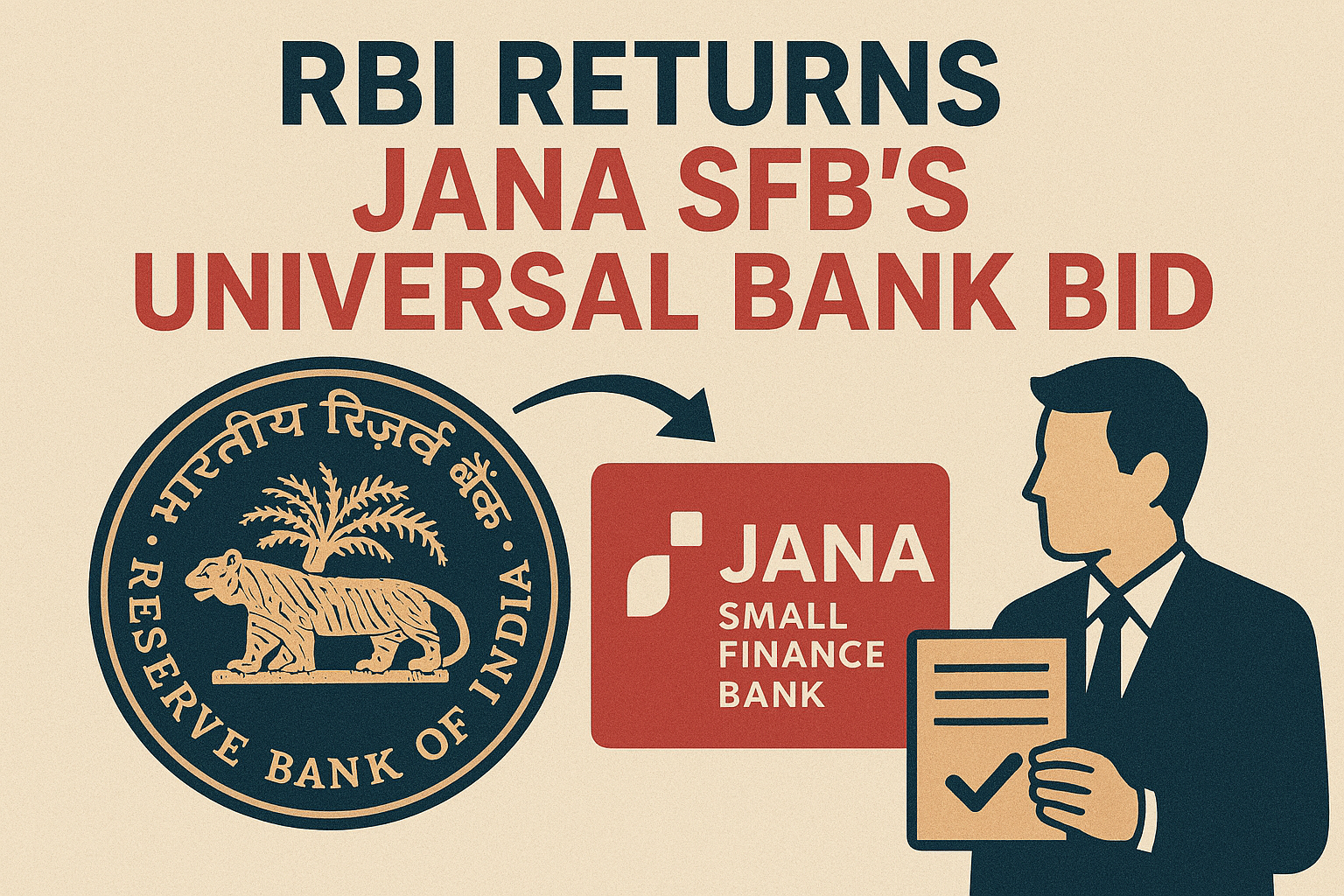
Table of Contents
1. The 2026 Universal Banking Eligibility Gap
Under the RBI’s 2024 ‘On-Tap’ Licensing Framework, the transition from a Small Finance Bank (SFB) to a Universal Bank is the highest hurdle in Indian finance.
The Core Conflict:
Jana SFB’s leadership, led by CEO Ajay Kanwal, confirmed the return was due to “technical gaps.” In 2026, the RBI has tightened oversight on unsecured microfinance exposure, which still forms a significant part of Jana’s legacy book.
2. Financial Benchmarks: Jana SFB vs. RBI 2026 Norms
To qualify for a Universal License in 2026, a bank must demonstrate “Satisfactory Track Record” over 5 years.
| Metric | RBI Mandatory Limit | Jana SFB (Sept 2025) | Status |
| Net Worth | Min ₹1,000 Crore | ₹3,900+ Crore | ✅ Exceeded |
| Gross NPA | $\leq$ 3.0% | 2.87% | ⚠️ Borderline |
| Net NPA | $\leq$ 1.0% | 0.94% | ⚠️ Borderline |
| Profitability | 3 Consecutive Years | Yes | ✅ Met |
The “Hidden” Hurdle: Even if a bank meets the $1.0\%$ Net NPA cap, the RBI often requires a “buffer” to ensure that the transition to a Universal Bank—which involves taking on larger corporate liabilities—doesn’t lead to systemic risk.
3. Strategic Impact on the Banking Landscape
The “Return” of the application has three immediate consequences:
- Cost of Funds: Jana must continue to pay higher interest on deposits compared to Universal Banks like HDFC or ICICI, who have deeper CASA (Current Account Savings Account) penetration.
- Market Sentiment: The Nifty Bank Index saw specialized volatility in SFB stocks following this news, signaling that investors are now demanding “Regulatory Perfection” before pricing in a license.
- Operational Continuity: Per Section 22 of the Banking Regulation Act, Jana remains fully licensed as an SFB and can continue its aggressive push into Secured MSME Lending.
4. CEO Outlook & Reapplication Timeline
Ajay Kanwal stated that the bank will “rectify as per expectations.” Historically, a “returned” application can be resubmitted once the bank demonstrates two consecutive quarters of stabilized asset quality.
- Earliest Reapplication: Q1 FY2026-27 (Estimated).
- Focus Area: Reducing the microfinance-to-secured-loan ratio further.
🏦 What Is a Universal Bank — and Why Does It Matter?
A universal bank is a financial institution that offers a full suite of banking services — from retail and corporate banking to investment and asset management. Unlike small finance banks (SFBs), universal banks enjoy:
- Lower cost of funds due to broader access to deposits
- Fewer regulatory restrictions on lending and co-lending
- Greater brand credibility and investor confidence
- Expanded product offerings, including credit cards, forex, and wealth management
For Jana SFB, transitioning to a universal bank would unlock scale, reduce liabilities, and position it alongside peers like HDFC Bank and ICICI Bank. (RBI Returns Jana SFB’s Universal Bank Bid)
📉 RBI’s Decision: What Happened?
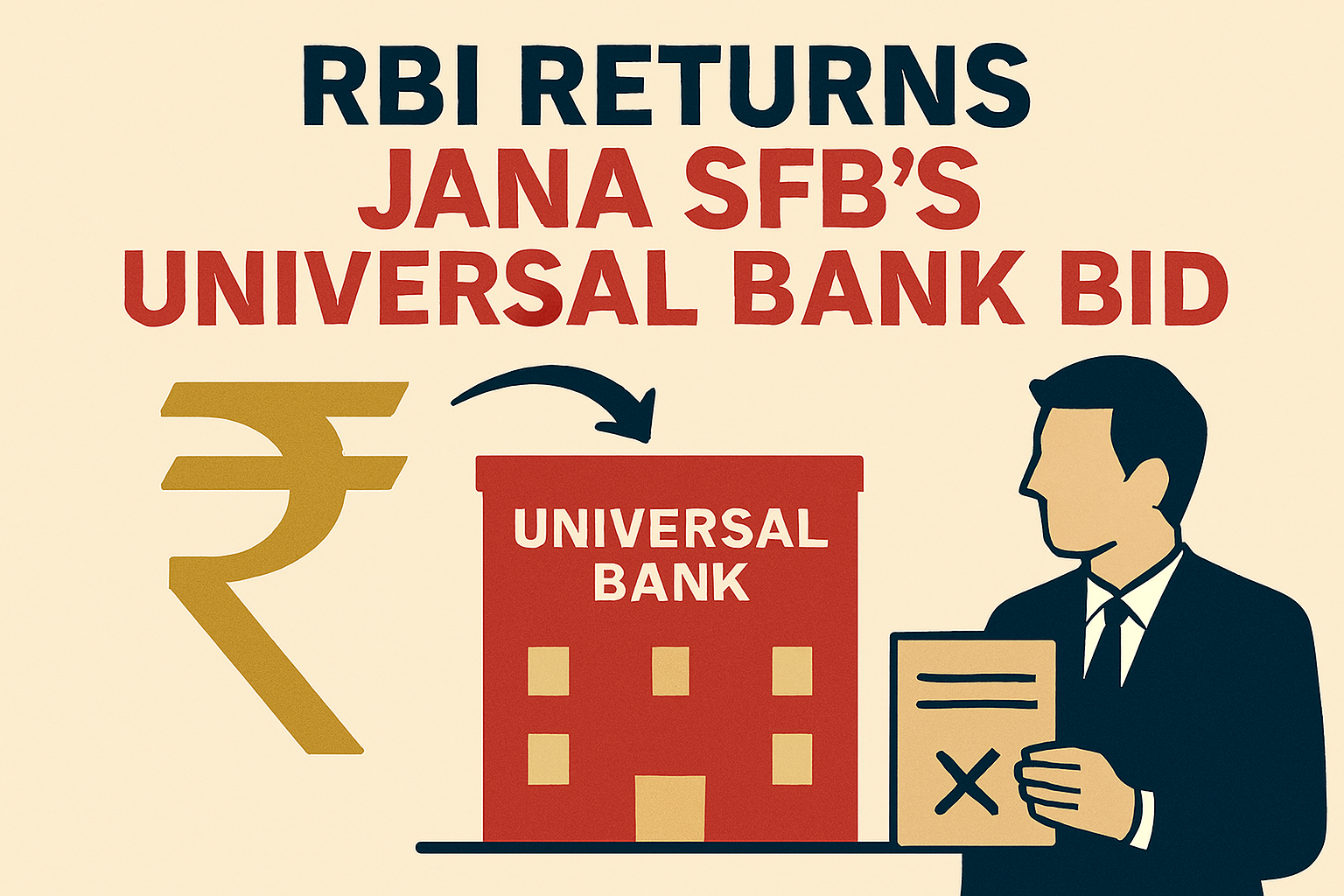
On October 28, 2025, Jana SFB disclosed that the RBI had returned its application for a universal banking licence. The application, submitted in June 2025, was returned due to non-fulfilment of criteria outlined in the RBI’s circular on voluntary transition.
Key Points:
- No specific reasons disclosed: The RBI’s communication did not detail which criteria were unmet.
- CEO Ajay Kanwal’s response: He emphasized that this was a “return” and not a “rejection,” and the bank intends to reapply after clarifying the gaps.
- Stock impact: Jana SFB’s shares dipped 2.79% following the announcement, reflecting investor disappointment.
It’s likely that Jana SFB fell short on one or more of these metrics — possibly around net NPA or governance disclosures. (RBI Returns Jana SFB’s Universal Bank Bid)
🧮 Jana SFB’s Financial Snapshot
Since receiving its small finance bank licence in 2017, Jana SFB has built a strong presence in retail and MSME lending. However, its financials reveal a mixed picture:
- Assets: Robust growth, with diversified loan book
- Liabilities: Higher cost of funds compared to universal banks
- Profitability: Margins under pressure due to regulatory constraints
- Co-lending: Restricted under current SFB licence
Ajay Kanwal noted that while the asset side remains unaffected, the inability to co-lend and access cheaper funds hampers growth.
🔍 Strategic Implications for Jana SFB
1. Short-Term Setback
The return delays Jana’s ambitions to scale and compete with larger banks. It also affects investor sentiment and fundraising potential.
2. Operational Continuity
Jana can still perform most functions of a universal bank — except co-lending and certain liability-side operations.
3. Regulatory Dialogue
The bank plans to engage with RBI officials to understand the gaps and reapply. This opens a window for strategic realignment.
4. Investor Confidence
The initial excitement around the licence had boosted stock prices. The return may cause volatility, but clarity and reapplication could restore momentum.
🏁 Comparison: AU SFB vs Jana SFB
AU Small Finance Bank, a peer in the sector, received an in-principle nod from RBI earlier this year to transition into a universal bank. Here’s how they compare: (RBI Returns Jana SFB’s Universal Bank Bid)
| Metric | AU SFB | Jana SFB |
|---|---|---|
| Net NPA | <2% | ~3.5% (est.) |
| Profitability | Consistent | Mixed |
| Governance | Strong | Improving |
| Application Status | Approved | Returned |
| Investor Sentiment | Positive | Cautious |
AU’s approval sets a benchmark — and a roadmap — for Jana to follow. (RBI Returns Jana SFB’s Universal Bank Bid)
🧠 Expert Take: Why RBI Is Cautious
RBI’s cautious stance reflects its broader regulatory philosophy:
- Prevent systemic risk: Universal banks have wider reach; weak governance could amplify risks.
- Ensure financial stability: Only banks with strong fundamentals should scale.
- Protect depositors: Transitioning banks must prove they can manage larger liabilities.
In this context, returning Jana’s application is a prudent move — not a punitive one.(RBI Returns Jana SFB’s Universal Bank Bid)
🔮 What’s Next for Jana SFB?
✅ Reapplication Strategy
Jana will likely:
- Conduct internal audits
- Strengthen governance disclosures
- Improve asset quality
- Engage with RBI for clarity
📅 Timeline
While no date is set, reapplication could happen within 6–12 months, depending on regulatory feedback.
💬 CEO’s Statement
Ajay Kanwal remains optimistic: “We will figure out what the answer really is, and we will rectify as per expectations.”
📊 Impact on India’s Banking Landscape
Jana’s journey reflects a broader trend in Indian banking: (RBI Returns Jana SFB’s Universal Bank Bid)
- SFBs maturing into full-service banks
- Regulators tightening norms
- Investors seeking clarity and compliance
As more SFBs eye universal status, RBI’s framework will shape the future of financial inclusion and banking innovation.
🧩 Final Thoughts: A Pause, Not a Full Stop
Jana Small Finance Bank’s returned application is a moment of reflection — not rejection. It underscores the importance of regulatory readiness, financial discipline, and strategic clarity. For investors and industry watchers, it’s a reminder that in banking, growth must be earned — not granted.
As Jana recalibrates, the sector watches closely. The next move could redefine its trajectory — and set a precedent for others. (RBI Returns Jana SFB’s Universal Bank Bid)
📌 Disclaimer
Editorial Disclosure & Professional Disclaimer
Financial Disclaimer: Investing in Small Finance Banks involves high market risk. This content is for educational purposes only and does not constitute a “Buy/Sell” recommendation. Always verify with theSEBI Registered Investment Advisorbefore making portfolio changes.
Notice: This analysis on cfostimes.com is based on 2025-2026 regulatory filings and publicly available RBI master directions.

Dr. Dinesh Kumar Sharma is a CMA an award-winning Chief Financial Officer and Director of Finance with over 25 years of expertise in strategic planning and digital transformation. Recognized as a five-time CFO of the Year, he specializes in leveraging Generative AI and Microsoft Copilot to optimize financial forecasting and cost management. Dr. Sharma holds a Doctorate in Management (Finance) and has successfully scaled organizations from INR 1 billion to INR 7 billion. He is dedicated to providing transparent, data-driven insights for modern decision-makers at CFOs Times.