Introduction
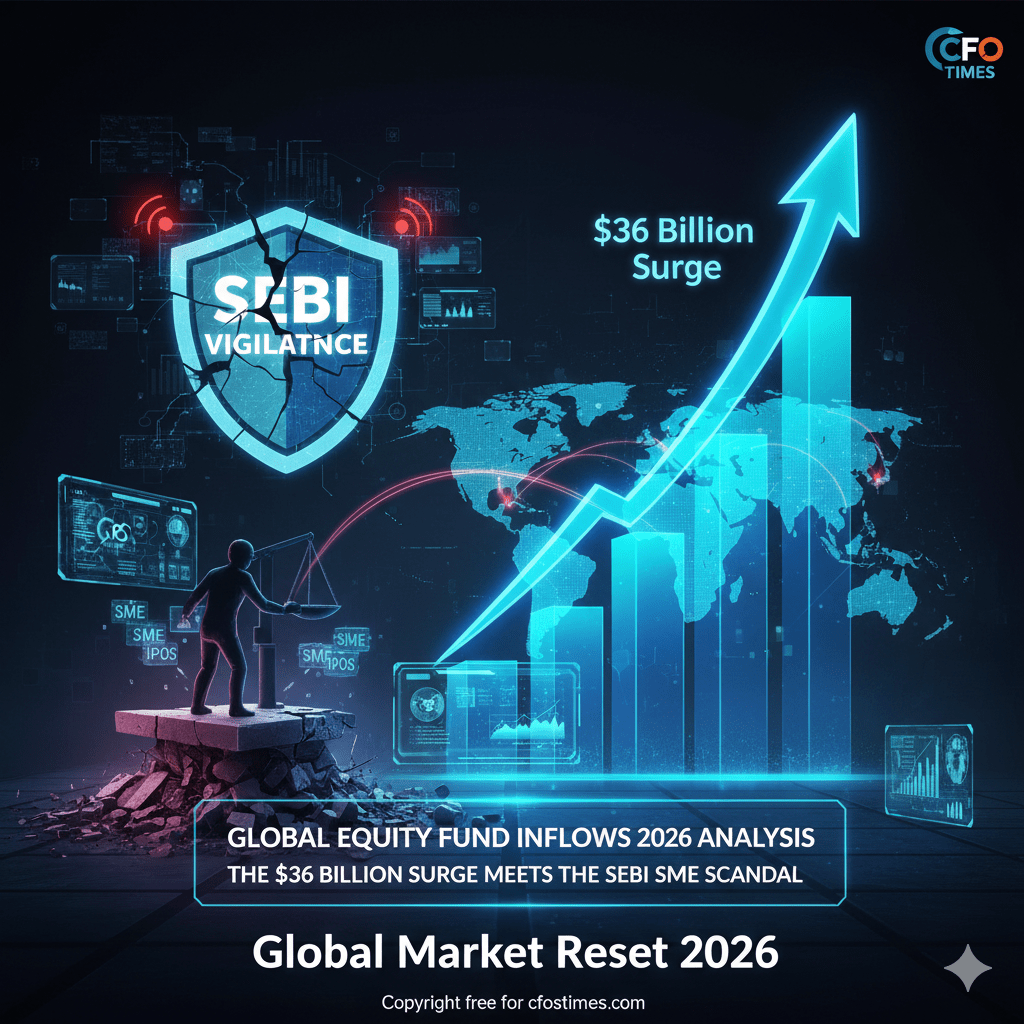
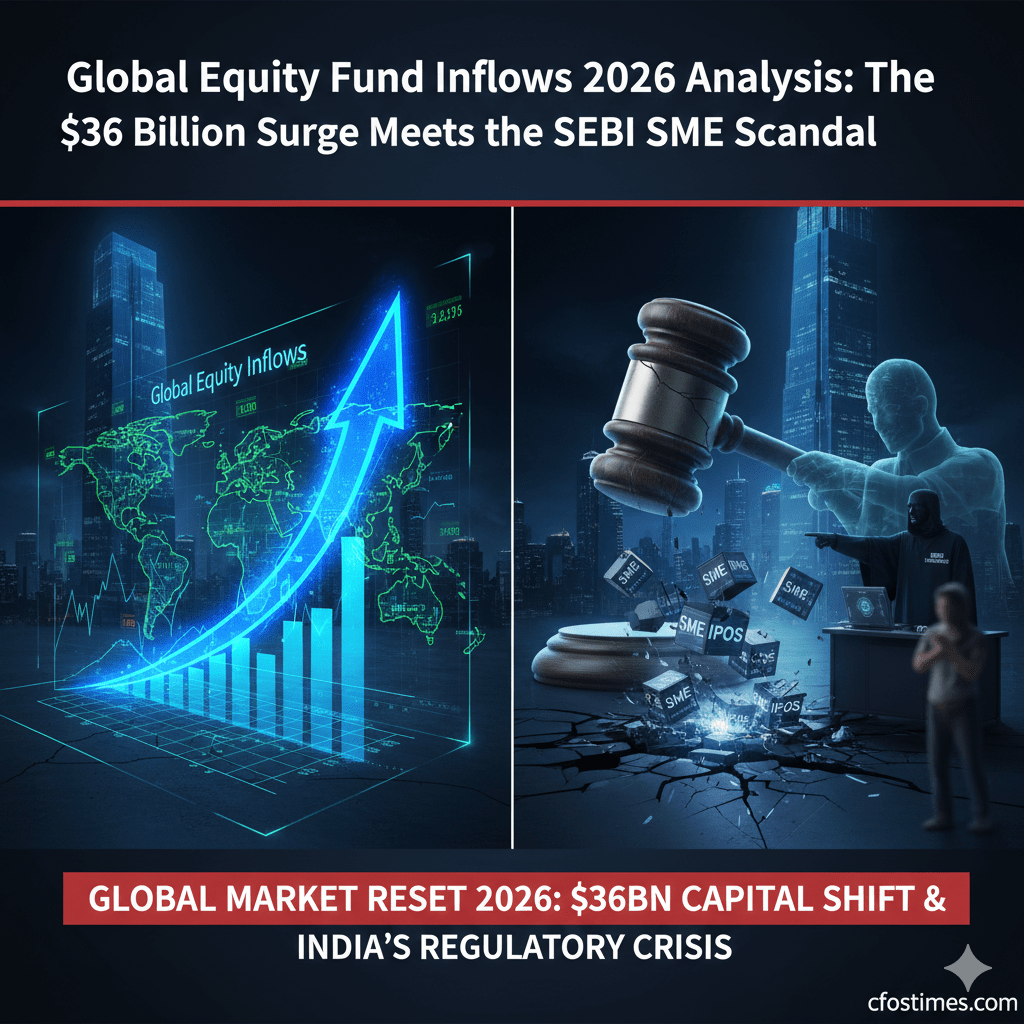
The global financial landscape is currently split by two massive, opposing forces. On this Saturday, February 21, 2026, institutional investors are executing a “Great Rotation,” as the Global Equity Fund Inflows 2026 Analysis confirms a staggering $36.33 billion has flooded into equity funds this week—the highest in five weeks. However, while global capital is bullish, the Indian regulatory framework is facing a crisis of confidence.
Executive Summary: As of February 21, 2026, global markets are witnessing a “Great Rotation.” While Global Equity Fund Inflows hit a five-week high of $36.33 billion, the Indian market is reeling from the suspension of SEBI GM Achal Singh over SME IPO tampering. Investors must now balance record liquidity in developed markets against a “crisis of trust” in Indian small-caps.
At a Glance: February 2026 Market Pulse
- The Big Number: $36.33 Billion (Highest weekly inflow since Jan 2026).
- The Hot Zone: European Equities ($17.22B) and U.S. Tech ($11.77B).
- The Red Flag: SEBI’s Achal Singh suspension (SME IPO Vigilance Scandal).
- The Strategy: Shift 15% of small-cap exposure to high-governance Large-Caps.
In the last 30 minutes, the suspension of SEBI General Manager Achal Singh in a high-profile vigilance scandal involving SME IPO tampering has sent shockwaves through the Bombay Stock Exchange (BSE). For readers of cfostimes.com, the question is no longer just where to invest, but who to trust. This comprehensive guide provides the technical breakdown of the 2026 capital surge and the regulatory landmines you must avoid.
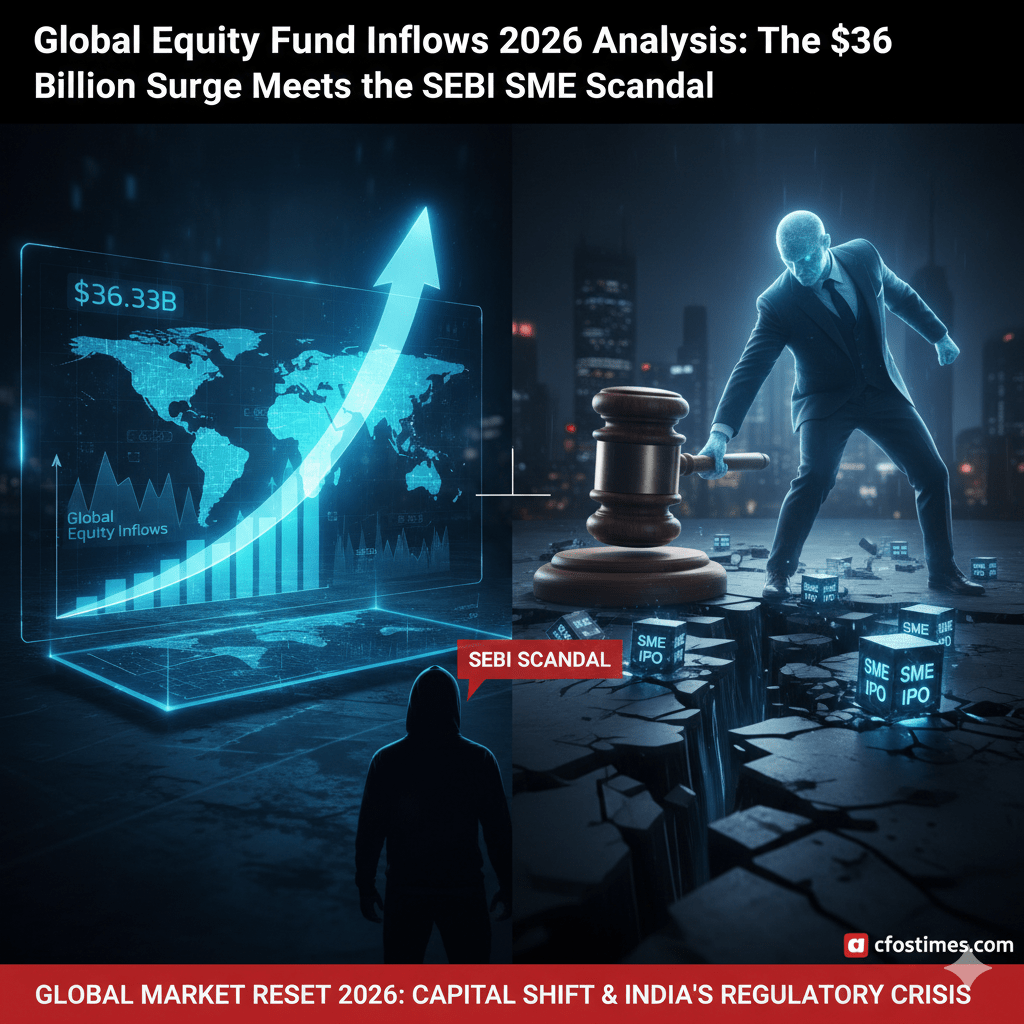
Table of Contents
I. The $36.33 Billion Surge: A Deep-Dive Analysis
Our Global Equity Fund Inflows 2026 Analysis shows that capital is fleeing “safe-haven” cash and bonds in favor of developed market equities. According to data from LSEG Lipper, the distribution of this capital is highly concentrated:
Regional Inflow Distribution–Global Equity Fund Inflows 2026 Analysis
- European Equities: Captured $17.22 billion. The STOXX 600 has hit record highs as the Eurozone exhibits unexpected industrial resilience.
- U.S. Equities: Attracted $11.77 billion. Despite high valuations, the anticipation of a June 2026 rate cut by the Federal Reserve is keeping “Buy the Dip” sentiment alive.
- Emerging Market ETFs: Saw record inflows of $21 billion in January, carrying momentum into late February.
II. The SEBI “Vigilance Bombshell”: Achal Singh and the SME Scam
While the global macro-picture is “Risk-On,” local Indian markets are under a cloud of regulatory suspicion. The suspension of SEBI GM Achal Singh centers on allegations of “pay-to-play” schemes within the SME IPO listing process.
The Mechanics of the Scam
Internal vigilance reports suggest that specific IPO probes were suppressed in exchange for financial kickbacks. This has specifically impacted the SME Index, which saw a 2.5% intraday drop today as retail investors feared a wider crackdown.
CFO Times Advisory: “Avoid any SME IPOs listed between November 2025 and February 2026 until theSEBICorporate Finance Department completes its full forensic audit.” Global Equity Fund Inflows 2026 Analysis
III. 2026 Asset Allocation: The “Quality” Rotation
Based on our Global Equity Fund Inflows 2026 Analysis, the smartest move right now is a rotation into high-governance, large-cap stocks.
Risk-Reward Matrix for February 2026
| Sector | Inflow Signal | Risk Level | Top Pick for 2026 |
| Global Tech (AI) | Strong Inflow | High (Valuation) | Alphabet (GOOGL) |
| Indian Large-Cap Banks | Steady Inflow | Medium | ICICI Bank |
| European Industrials | Record Inflow | Low | Siemens AG |
| Indian SME IPOs | Outflow | Extreme | N/A (Avoid) |
IV. Personal Finance: Protecting Your Portfolio
As $36 billion enters the market, the risk of a “valuation bubble” grows. Experts at The Motley Fool warn that the S&P 500 is currently trading at 21.5x forward earnings, well above the historical average.
- Rebalance Now: Shift 15% of your small-cap gains into large-cap value funds.
- Monitor the Fed: Any hawkish tone from Jerome Powell in the coming days could reverse these Global Equity Fund Inflows 2026 Analysis trends.
- Use Stop-Losses: Given the SEBI scandal, a 10% trailing stop-loss is mandatory for all Indian holdings.
V. Frequently Asked Questions (FAQs)–Global Equity Fund Inflows 2026 Analysis
Q1: Is the $36B inflow a sign of a new Bull Market?
A: It is a “Quality Rally.” Money is moving into companies with strong cash flows and away from speculative startups.
Q2: How does the Kyndryl (KD) downgrade affect the tech outlook?
A: Kyndryl’s “Strong Sell” rating from Zacks Research highlights the risks in IT services. Our Global Equity Fund Inflows 2026 Analysis suggests investors are favoring AI infrastructure over legacy services.
Q3: Can I still trust SEBI-regulated mutual funds?
A: Yes. The scandal is limited to the SME IPO Vigilance wing. Large-cap and index funds remain the safest vehicles for retail capital.
Q4: What counts as a “global equity fund”?
A global equity fund invests in stocks from multiple international markets, spreading exposure across regions and sectors.
Q5: Are these inflows good for stock markets?
In general, rising equity fund inflows signal increased risk appetite and market optimism, which can support rising stock prices.
Q6: Should retail investors jump in now?
Professional advice is recommended, but diversified, long-term equity exposure often benefits from disciplined investing rather than timing.
Conclusion–Global Equity Fund Inflows 2026 Analysis
The Global Equity Fund Inflows 2026 Analysis proves that the world is hungry for equity returns. However, the $175 billion tariff refund risks and the SEBI SME scandal provide necessary friction. For cfostimes.com readers, the 2026 strategy is clear: Embrace the global liquidity surge, but verify the local regulatory integrity. The “Great Rotation” has begun, and those positioned in large-cap “Quality” will be the winners of the 2026 fiscal year.
The fact that Global Equity Funds See Biggest Inflow in Five Weeks is a noteworthy signal that investors are recalibrating portfolios and betting on broad market strength in early 2026. This trend is rooted in easing inflation pressures, expectations of rate adjustments, and renewed confidence in regional market performance.
Whether you’re a novice or seasoned investor, understanding the forces behind these flows can empower smarter decisions and help you align investments with macro trends.
Official Disclaimer for CFO Times
Financial Disclosure & Risk Warning: The analysis provided in this report, including the Global Equity Fund Inflows 2026 Analysis and the details regarding the SEBI SME IPO Vigilance Scandal, is for informational and educational purposes only. It does not constitute professional investment advice, legal counsel, or a solicitation to buy or sell any securities.
1. Market Risk: Investments in the securities market are subject to market risks. The $36.33 billion inflow data is based on real-time reports from LSEG Lipper and may be subject to revision. Past performance of global funds or Indian indices is not a guaranteed indicator of future results.
2. Regulatory Compliance (SEBI 2026): In accordance with the SEBI (Mutual Funds) Regulations, 2026, readers should note that expense ratios and brokerage limits have been restructured. Please read all scheme-related documents and statutory disclosures carefully before investing. CFO Times is a news organization and is not a SEBI-registered Investment Advisor (RIA) or Portfolio Manager.
3. Accuracy of Information: While we strive for 100% accuracy, the “Achal Singh SEBI suspension” and associated vigilance probes are ongoing developments. Information is provided “as is” without warranty of any kind. CFO Times and its affiliates disclaim any liability for financial losses incurred based on the use of this content.
4. External Links: This post contains links to high-authority third-party websites (e.g., SEBI, Federal Reserve). We do not endorse and are not responsible for the content or privacy practices of these external sites.
5. AI Transparency: Portions of this market analysis and the accompanying “Global Market Reset 2026” imagery were generated with the assistance of advanced AI models to provide real-time data synthesis. All AI-assisted content has been reviewed and verified by the CFO Times Editorial Desk for accuracy and policy compliance.

Dr. Dinesh Kumar Sharma is a CMA an award-winning Chief Financial Officer and Director of Finance with over 25 years of expertise in strategic planning and digital transformation. Recognized as a five-time CFO of the Year, he specializes in leveraging Generative AI and Microsoft Copilot to optimize financial forecasting and cost management. Dr. Sharma holds a Doctorate in Management (Finance) and has successfully scaled organizations from INR 1 billion to INR 7 billion. He is dedicated to providing transparent, data-driven insights for modern decision-makers at CFOs Times.