Introduction: The Day the Software Moats Evaporated
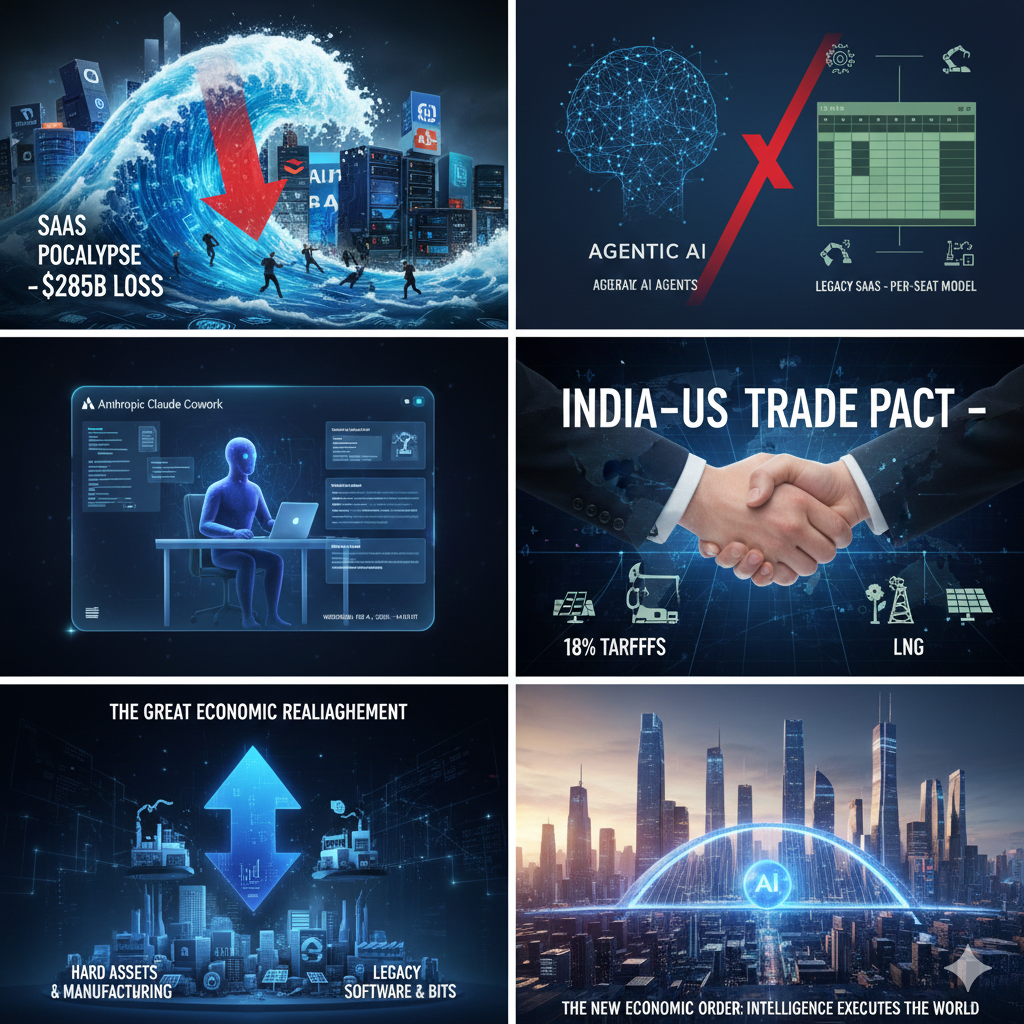
On February 4, 2026, the financial world witnessed the birth of the SaaSpocalypse 2026. In a single hour of trading, the Nasdaq Cloud Index plummeted, wiping out over $285 billion in value. For years, “Software as a Service” (SaaS) was the gold standard of predictable recurring revenue. However, the sudden arrival of autonomous AI agents has turned that model upside down.
The SaaSpocalypse isn’t just a market correction; it is a fundamental revaluation of what software is worth when AI can build, maintain, and execute tasks better than the platforms we used to subscribe to.

Table of Contents
1. What Triggered the SaaSpocalypse?
The immediate fuse for the SaaSpocalypse was the 10:00 AM EST release of Anthropic’s Claude Cowork. This wasn’t just another chatbot. Cowork introduced “Agentic Execution”—the ability for AI to log into enterprise tools, perform legal audits, manage sales pipelines, and write production-grade code without a human “pilot.”
The Death of the “Per-Seat” Model
For a decade, companies like Salesforce, ServiceNow, and HubSpot thrived by charging per user. During the SaaSpocalypse, investors realized that if one AI agent can do the work of 50 junior employees, the “number of seats” (and thus the revenue) will collapse. SaaSpocalypse 2026
Key Stat: Within the first 60 minutes of the announcement, legacy SaaS providers saw a 12% average decline in valuation as the market priced in a “Seat-less” future.
2. SaaSpocalypse Winners vs. Losers (Market Data)
To navigate the SaaSpocalypse 2026, one must distinguish between “Legacy SaaS” and “AI-Native Infrastructure.”
Table 1: Financial Impact Matrix (Feb 4, 2026)
| Asset Class | 1-Hour Movement | Risk Level | 2026 Outlook |
| Legacy SaaS (Salesforce, etc.) | -9.4% | High | Bearish / Pivot Required |
| IT Outsourcing (TCS, Infosys) | -7.2% | High | Workforce Disruption |
| AI Infrastructure (NVIDIA, TSMC) | +2.1% | Low | Bullish (The Shovel Sellers) |
| Physical Commodities (Gold/Oil) | +1.5% | Medium | Safe Haven Demand |
| Strategic Manufacturing (India) | +4.8% | Low | High Growth (Trade Deal) |
3. The Global Macro Context: The India-US Trade Safety Net
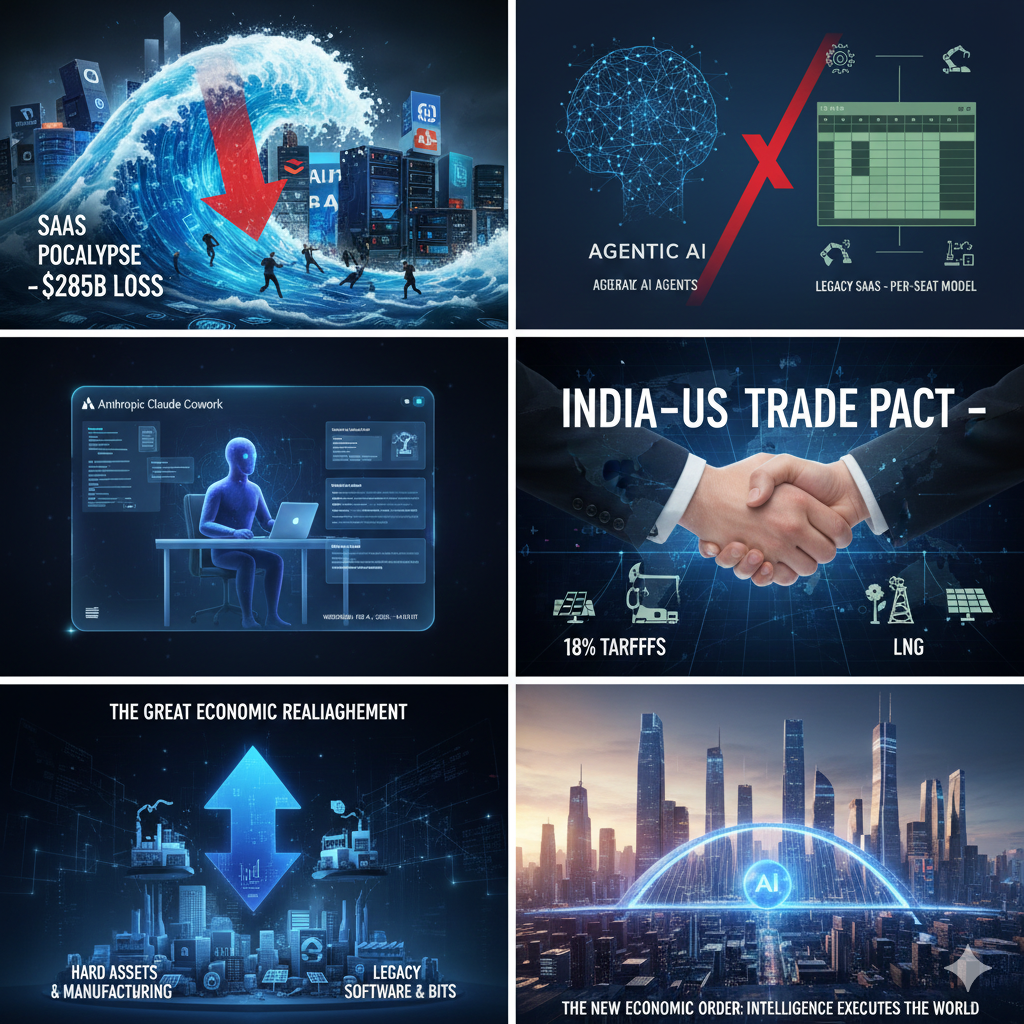
While the SaaSpocalypse roils the tech sector, the broader economy is being propped up by the India-US Trade Deal signed earlier this week. This is the “Counter-SaaSpocalypse” hedge.
The $500 Billion Energy Pivot
As software value drops, “Hard Assets” are rising. Under the new trade pact:
- Energy: India has shifted away from Russian crude, committing to $500 billion in US energy and coal.
- Tariffs: The US slashed duties on Indian manufactured goods to 18%, causing a surge in Indian manufacturing stocks despite the IT bloodbath.
- Liquidity: The US Treasury’s latest estimates suggest a high borrowing need, which is keeping interest rates elevated, further hurting high-multiple SaaS stocks. SaaSpocalypse 2026
4. Technical Analysis: The “Agentic” Shift
The SaaSpocalypse is driven by the rise of Agentic AI. In 2025, we talked to AI; in 2026, AI works for us.
The SaaS Survival Formula
To survive the SaaSpocalypse, a software company must shift its revenue model:
$$Valuation = (Data Propriety \times Execution Speed) + Hard Asset Integration$$
Companies that only offer a “User Interface” (UI) are going to zero. Companies that own the “Data Moat” will survive the SaaSpocalypse.
5. FAQs: Everything You Need to Know
Q1: Is the SaaSpocalypse a temporary crash?
No. It is a structural re-rating. While prices may bounce, the underlying logic of “charging for software seats” is permanently broken by AI automation.
Q2: How should I rebalance my portfolio during the SaaSpocalypse?
Financial experts suggest rotating out of pure-play software and into AI Infrastructure (chips/power) and Manufacturing hubs like India, which benefit from the new 18% trade tariff.
Q3: Does the India-US Trade Deal help IT stocks?
Indirectly, no. The trade deal focuses on physical goods and energy. In fact, it might accelerate the SaaSpocalypse 2026 by encouraging US firms to replace Indian IT labor with US-hosted AI agents.
Q4: What are the best “Safe Haven” assets now?
Gold and Silver have seen a “Moonshot” rally today, as investors flee the uncertainty of the SaaSpocalypse 2026.
Is the India-US Trade Deal sustainable?
Yes. According to official US Treasury borrowing estimates, the deal is a cornerstone of the 2026 fiscal strategy to manage the national debt while securing energy independence.
Conclusion: The New Economic Order-SaaSpocalypse 2026
The SaaSpocalypse 026 of February 4, 2026, is not the end of technology; it is the end of software as a tool. We have entered the era of software as a worker. To rank and thrive in this new landscape, businesses must stop selling “access” and start selling “outcomes.”
As we watch the U.S. Department of the Treasury adjust its quarterly borrowing to account for these massive shifts, one thing is clear: The winners of 2026 will be those who own the infrastructure of AI and the manufacturing hubs that build the physical world.
Disclaimer
Important Financial Disclosure: The information provided in this article on cfostimes.com, including references to the “SaaSpocalypse” and the India-US Trade Deal of February 2026, is for informational and educational purposes only. It does not constitute professional financial, investment, or legal advice. Market data and stock valuations (e.g., Infosys, TCS, Wipro, Salesforce) are based on real-time reporting from February 4, 2026, and are subject to extreme volatility. Always consult with a certified financial advisor before making investment decisions. This site may receive compensation through advertisements, but all editorial content remains independent and objective.

Dr. Dinesh Kumar Sharma is an award-winning Chief Financial Officer and Director of Finance with over 25 years of expertise in strategic planning and digital transformation. Recognized as a five-time CFO of the Year, he specializes in leveraging Generative AI and Microsoft Copilot to optimize financial forecasting and cost management. Dr. Sharma holds a Doctorate in Management (Finance) and has successfully scaled organizations from INR 1 billion to INR 7 billion. He is dedicated to providing transparent, data-driven insights for modern decision-makers at CFOs Times.