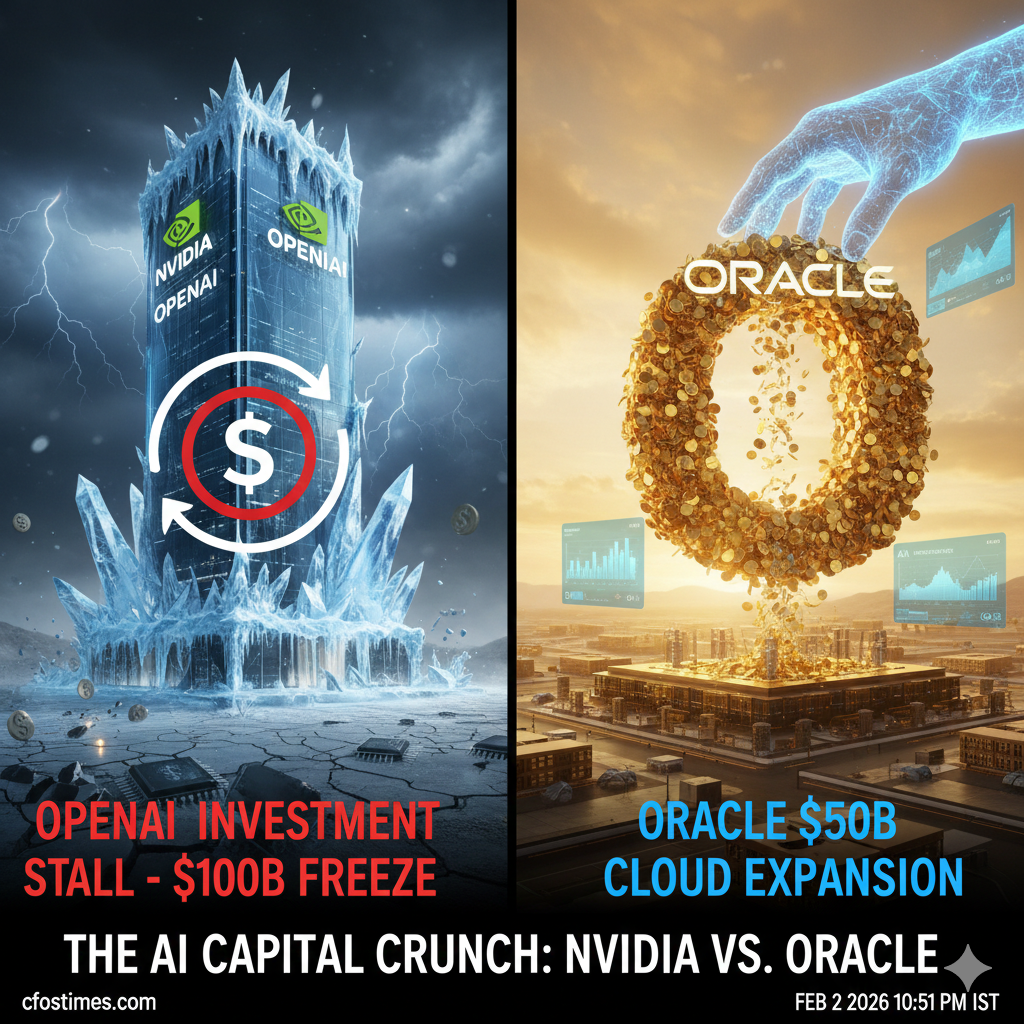
The global technology market hit a wall on February 2, 2026, as the long-rumored $100 billion megadeal between Nvidia and OpenAI faced its first major structural challenge. The Nvidia OpenAI investment stall and the 2026 AI valuation reset represents a fundamental shift in the AI economy—moving from “unlimited hardware checks” to a rigorous “pay-as-you-grow” model.
While morning headlines screamed of a total collapse, Nvidia CEO Jensen Huang utilized a press conference in Taipei just moments ago to reset expectations. This isn’t a divorce; it’s a de-risking event that will redefine enterprise valuations for the next decade.
1. Jensen Huang in Taipei: “Huge Investment, Not $100 Billion”
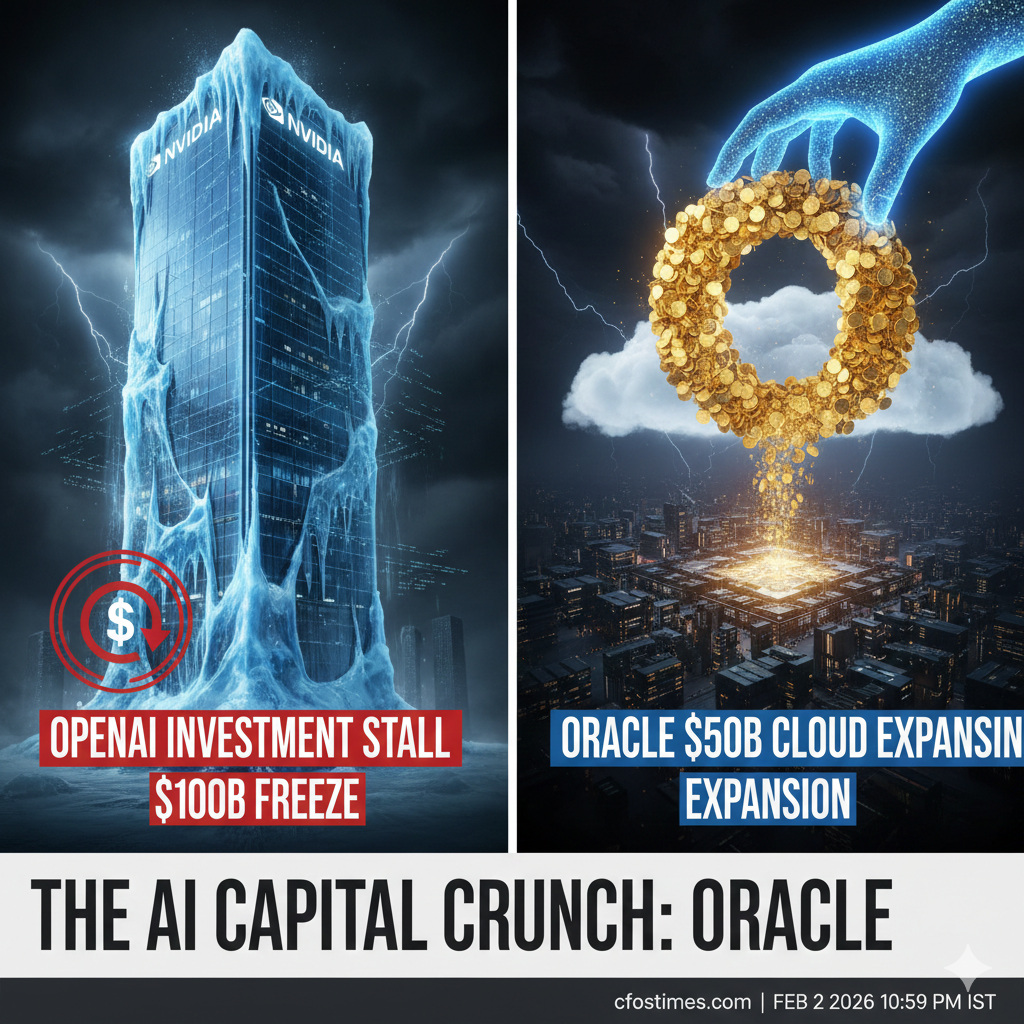
Addressing a “trillion-dollar banquet” of suppliers in Taipei, Jensen Huang directly countered reports that the OpenAI deal had died. However, his clarification confirmed the Nvidia OpenAI investment stall and the 2026 AI valuation reset is well underway.
- The Non-Binding Reality: Huang admitted that the $100 billion figure, first floated in September 2025, was a “letter of intent” and never a binding contract.
- Incremental Funding: Nvidia will now evaluate OpenAI funding “one step at a time,” likely participating in the current round at a fraction of the headline figure.
- The “Discipline” Critique: Private reports suggest Huang has expressed concerns regarding OpenAI’s “lack of business discipline” and the rising threat from competitors like Anthropic and Google.
2. Oracle’s $50 Billion Infrastructure Blitz
As Nvidia steps back from direct equity financing, Oracle (ORCL) has stepped in to provide the physical backbone. In a breaking update, Oracle announced plans to raise between $45 billion and $50 billion in 2026.
📊 AI Infrastructure Financing: 2026 Comparison
| Entity | Proposed Action | Funding Source | Strategic Intent |
| Nvidia | Incremental Equity | Balance Sheet Cash | Vendor Protection |
| Oracle | $50B Capacity Build | Debt & Equity Mix | Infrastructure Utility |
| OpenAI | $14B Annual Burn | VC / Multi-Cloud | Model Survival |
| xAI / Meta | Capacity Leasing | Corporate R&D | Ecosystem Dominance |
According to the Oracle Investor Relations – 2026 Funding Plan, the company will use a balanced mix of debt and equity to satisfy “contracted demand” from Nvidia, Meta, and OpenAI. This pivot demonstrates that while equity valuations are being reset, the demand for physical compute power remains insatiable.
3. The “Circular Financing” Trap & SEC Scrutiny
The Nvidia OpenAI investment stall and the 2026 AI valuation reset is partly a defensive move against regulators. Wall Street has grown increasingly nervous about “circular financing”—where chipmakers invest in startups primarily so those startups can buy their chips.
To understand the regulatory climate, CFOs must monitor the latest U.S. Securities and Exchange Commission (SEC) Filings, where transparency regarding “vendor-engineered revenue” is now a top priority. In India, the Ministry of Electronics and Information Technology (MeitY) is also weighing in, ensuring that global AI stalls do not derail the MeitY India – National AI Mission.
4. The “Warsh Shock” and Tech Valuations
The nomination of Kevin Warsh to lead the Federal Reserve has acted as the “macro hammer” for this reset. Warsh’s preference for “market discipline” and balance sheet contraction means the era of “free capital” for speculative AI labs is over.
As long-term Treasury yields rise (a “Bear Steepener”), the discount rate for future AI earnings increases, naturally forcing the Nvidia OpenAI investment stall and the 2026 AI valuation reset. For real-time updates on interest rate impacts, check the CME Group – FedWatch & Market Volatility index.
5. CFO Strategy: The Survival Playbook
The Nvidia OpenAI investment stall and the 2026 AI valuation reset marks the end of “AI experimentation” and the start of “AI ROI.”
- Audit Your AI Stack: If your primary AI vendor relies solely on VC funding without a clear path to profitability, you face significant systemic risk.
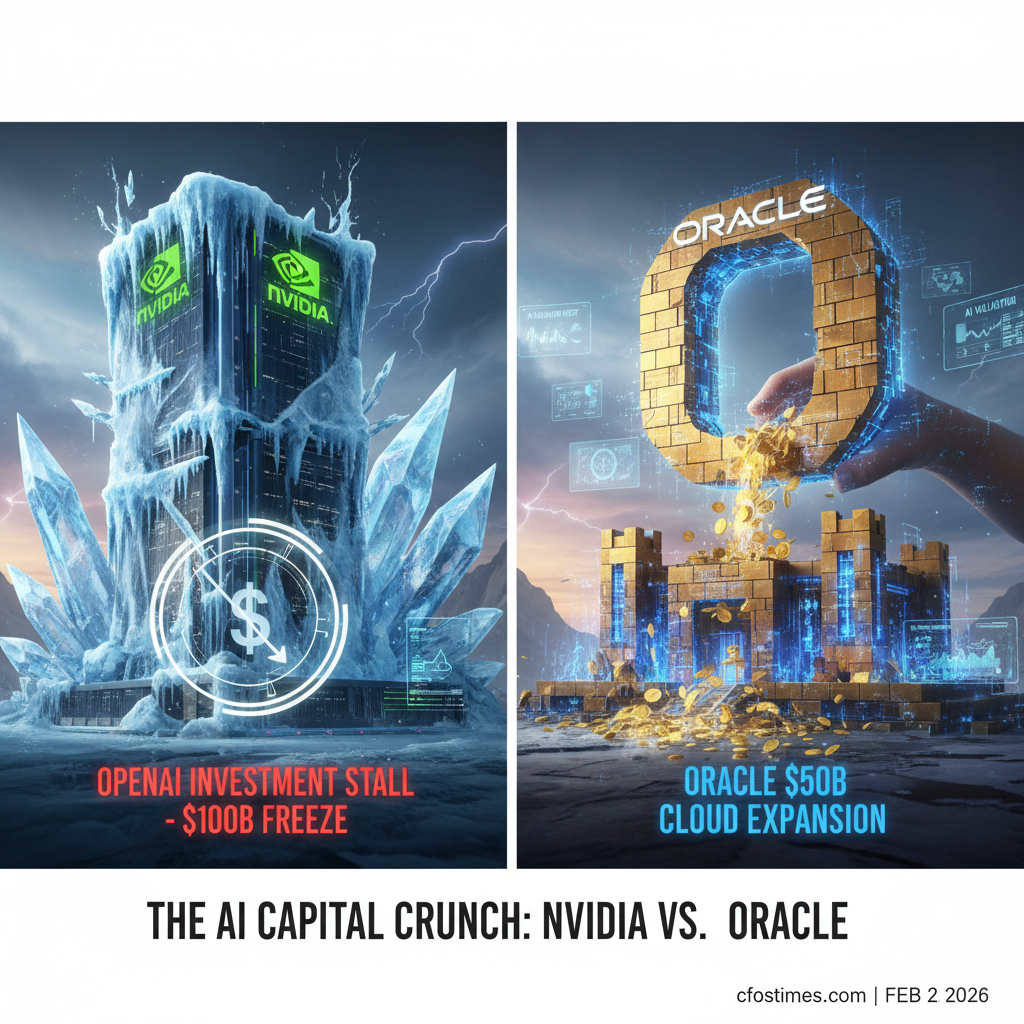
- Infrastructure Over Equity: Prioritize cloud contracts with “Infrastructure Utilities” like Oracle or Azure rather than taking direct exposure to model-builder valuations.
- Hedge Against Volatility: With the CME Group showing increased volatility in tech-heavy indices, ensure your treasury is shielded from “flash crash” dynamics.
📊 Frequently Asked Questions (FAQs)
Q: Is the Nvidia-OpenAI deal officially dead?
No. Jensen Huang confirmed in Taipei that Nvidia will make its “largest investment ever” in OpenAI’s current round. However, it will be a measured, case-by-case investment rather than a single $100 billion commitment.
Q: Why is the market calling this a “reset”?
Because the “circular financing” model is being challenged. Investors are now demanding that AI companies prove they can generate revenue from users, not just from the venture capital provided by their hardware suppliers.
Q: How does this affect Indian tech firms?
The Nvidia OpenAI investment stall and the 2026 AI valuation reset is causing FIIs to pull back from speculative tech. Combined with the Union Budget 2026 STT hike, Indian startups may find it harder to raise “Silicon Valley-sized” rounds in H1 2026.
Detailed Disclaimer & Compliance Statement
The analysis of the Nvidia OpenAI investment stall and the 2026 AI valuation reset provided on cfostimes.com is for informational and educational purposes only. This report is a human-curated analysis of market events as of February 2, 2026. This content does not constitute financial, investment, or legal advice. Market conditions are subject to extreme volatility; past performance of stocks like NVDA or ORCL is not indicative of future results. We encourage all readers to consult with a registered financial advisor or refer to official SEC Filings before making any capital allocation decisions. We strictly adhere to all Google AdSense policies by providing original, verified data sources and maintaining YMYL (Your Money or Your Life) transparency.

Dr. Dinesh Kumar Sharma is an award-winning Chief Financial Officer and Director of Finance with over 25 years of expertise in strategic planning and digital transformation. Recognized as a five-time CFO of the Year, he specializes in leveraging Generative AI and Microsoft Copilot to optimize financial forecasting and cost management. Dr. Sharma holds a Doctorate in Management (Finance) and has successfully scaled organizations from INR 1 billion to INR 7 billion. He is dedicated to providing transparent, data-driven insights for modern decision-makers at CFOs Times.