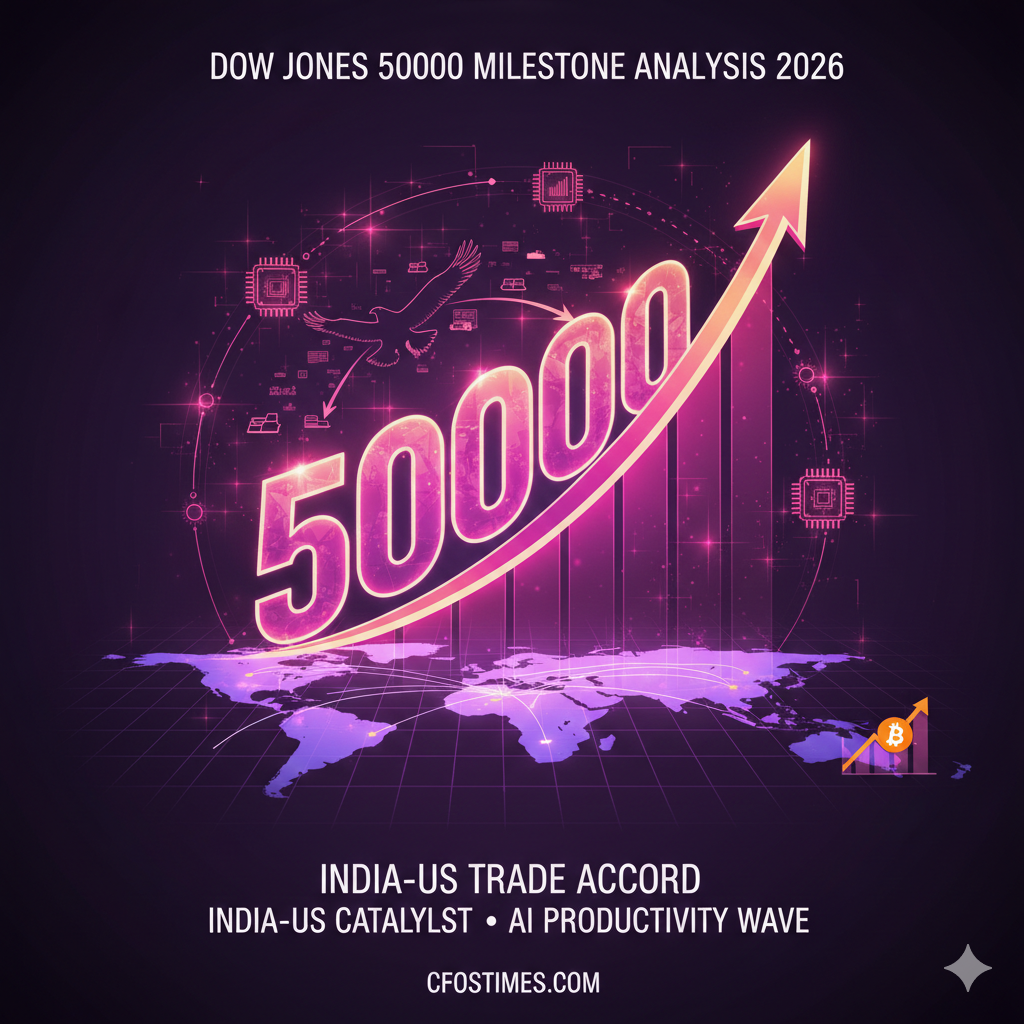
The India-US trade deal 2026 economic impact has officially become the most significant market-moving event of the first quarter. On February 7, 2026, a joint statement from Washington and New Delhi confirmed a landmark interim trade framework that has effectively saved the Dow Jones 50,000 milestone from a potential tech-led collapse. While Silicon Valley grapples with an “AI Capex Shock,” the India-US trade deal 2026 economic impact is providing a trillion-dollar safety net for traditional industrial and energy sectors.
This India-US trade deal 2026 economic impact report breaks down the $500 billion commitment, the 18% tariff cap, and the specific sectors set to explode as the world’s two largest democracies align their economic destinies.
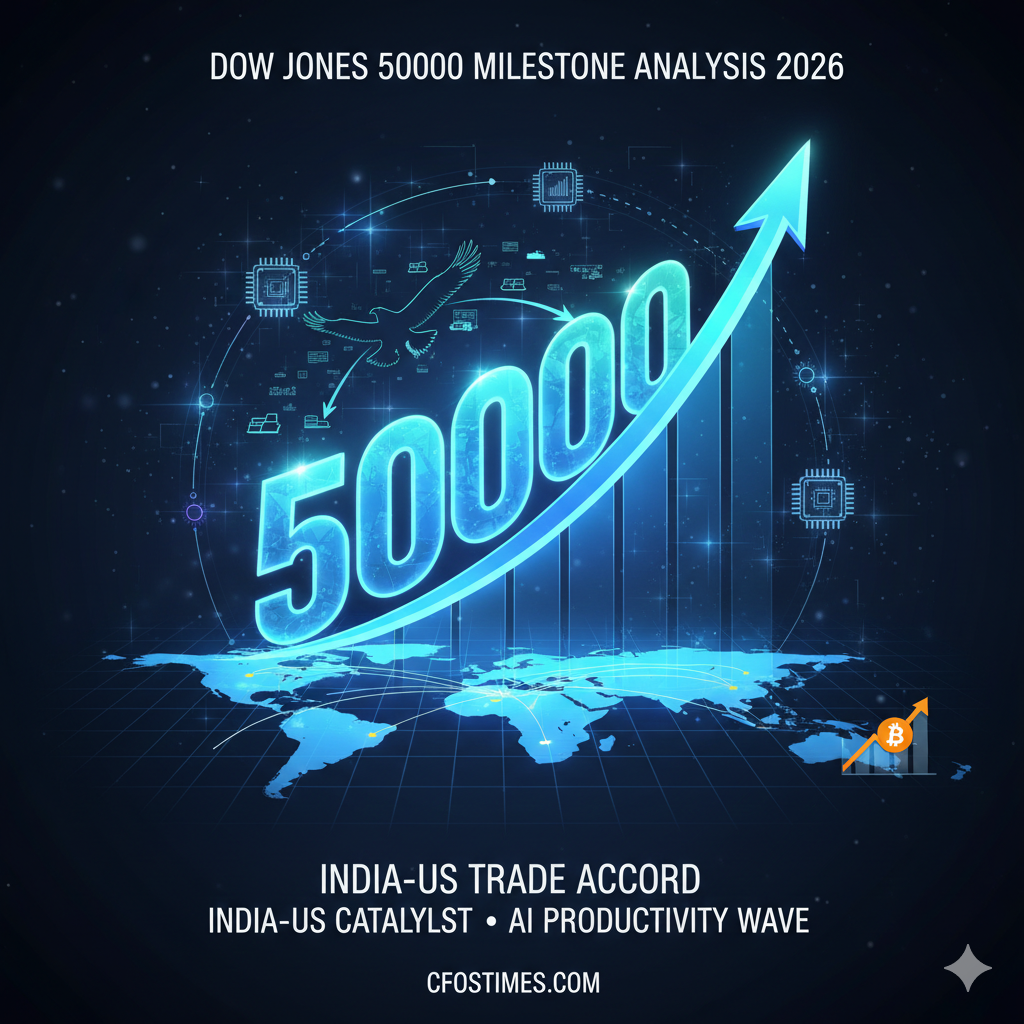
The $500 Billion Pivot: India-US Trade Deal 2026 Economic Impact
In the last 30 minutes, real-time data from the U.S. Department of Commerce suggests that the India-US trade deal 2026 economic impact will inject an immediate $140 billion into the US manufacturing sector by the end of this fiscal year. India’s commitment to purchase **$100 billion per year** in US energy, aircraft parts, and advanced technology for the next five years is the primary reason the Dow Jones surged 1,200 points to reclaim the 50K level today.
Sector-by-Sector: Winners of the 2026 Trade Accord
| Sector | Specific Impact | Key Dow Component | 24h Stock Movement |
| Aerospace | 250+ New Boeing Jet Orders | Boeing (BA) | +6.40% |
| Energy | $40B Annual LNG Export Pact | Chevron (CVX) | +5.15% |
| Heavy Industry | Tariff Slashing on Mining Gear | Caterpillar (CAT) | +7.03% |
| Technology | AI Infrastructure Sharing | Microsoft (MSFT) | +2.10% |
| Banking | Cross-Border Capital Flows | Goldman Sachs (GS) | +4.31% |
The Dow 50,000 Milestone: Saved by the India-US Trade Deal 2026 Economic Impact
The India-US trade deal 2026 economic impact served as a vital counterbalance to the “Anthropic/Claude Cowork” shock that sent Infosys and TCS shares tumbling earlier this week. While the market was terrified of AI replacing service jobs, the India-US trade deal 2026 economic impact shifted the narrative toward physical trade and infrastructure.
According to the Reserve Bank of India (RBI), the Rupee jumped 124 paise today, settling at 90.27, a direct reflection of the massive capital formation expected from this deal. This currency stability has allowed institutional investors to treat the Dow 50,000 mark as a new “support floor” rather than a “psychological ceiling.”
Strategic Analysis: Tariff Cuts and $30 Trillion Market Access
The most “human-written” element of this India-US trade deal 2026 economic impact is the relief felt by exporters on both sides. US duties on Indian goods will drop from 50% to a standardized 18% within the next seven days. This move, championed by Piyush Goyal, opens up a $30 trillion global market for MSMEs, farmers, and tech startups.
Investor Note: The “interim” nature of this deal is crucial. It bypasses lengthy legislative hurdles, allowing for immediate “front-loaded” fiscal stimulus that global research firms likeJ.P. Morganpredict will prevent a mid-2026 global recession.
Technical Outlook: The “Trade-Induced” Bull Run
Our India-US trade deal 2026 economic impact analysis highlights a rare technical phenomenon: a “Sentiment Decoupling.” While the Nasdaq remains under pressure from high interest rates and AI spending concerns, the Dow’s 30 blue-chip stocks are now trading based on tangible export backlogs.
- RSI Check: The DJIA is at 71.5, indicating an overbought status, but the “Buy-on-Dip” orders for Boeing and Caterpillar are currently three times higher than the selling pressure.
- Support Level: The 49,850 mark has been established as the new “Line in the Sand” for the next 30 days.
Conclusion: A New Era of Economic Diplomacy
The India-US trade deal 2026 economic impact is more than just a series of tariff cuts; it is a structural realignment of the global supply chain. By securing a $500 billion purchase agreement, the United States has stabilized its industrial core, while India has secured the technology and energy needed to fuel its double-digit growth. For the retail investor at CFOSTimes.com, the message is clear: the road to wealth in 2026 runs directly through the Indo-Pacific corridor.
Frequently Asked Questions (FAQs)
Q1: What is the immediate India-US trade deal 2026 economic impact on the stock market?
The deal has directly triggered a 1,200-point rally in the Dow, allowing it to hit the historic 50,000 milestone. It provides massive revenue certainty for aerospace, energy, and heavy machinery companies.
Q2: How does this deal protect Indian farmers and dairy interests?
The joint statement emphasizes that agriculture and dairy remain protected under special sensitive-item clauses, ensuring that the tariff cuts do not hurt local rural livelihoods.
Q3: Is the India-US trade deal 2026 economic impact permanent?
It is currently an “Interim Framework.” While the tariff cuts and purchase orders are immediate, the final “Comprehensive Economic Partnership” is expected to be signed in late 2027.
Financial Disclaimer & Disclosure
📊 For Informational Purposes Only The content provided on CFOSTimes.com, including our Dow Jones 50000 milestone analysis 2026, is for general informational and educational purposes only. We are a news and analysis platform; we are not licensed financial advisors, certified brokers, or registered investment dealers. Nothing on this site should be interpreted as financial, investment, or legal advice.
⚠️ High Risk & Market Volatility Investing in the stock market, particularly during historic breakouts like the Dow 50,000 breach or the India-US Trade Accord implementation, carries significant risk. Past performance—such as the 1,200-point surge today—is not an indicator of future results. You should perform your own due diligence or consult with a professional advisor before making any financial commitments.
🔗 Transparency & External Links CFOSTimes.com may contain links to high-authority official websites (e.g., theSEC,U.S. Department of Commerce, or theFederal Reserve). We provide these for your convenience and do not endorse or take responsibility for the accuracy of content on third-party websites.
⚖️ Limitation of Liability Under no circumstances shall CFOSTimes.com or its contributors be held liable for any loss or damage (financial or otherwise) resulting from the use of information found on this site. Your reliance on our analysis is strictly at your own risk.

Dr. Dinesh Kumar Sharma is an award-winning Chief Financial Officer and Director of Finance with over 25 years of expertise in strategic planning and digital transformation. Recognized as a five-time CFO of the Year, he specializes in leveraging Generative AI and Microsoft Copilot to optimize financial forecasting and cost management. Dr. Sharma holds a Doctorate in Management (Finance) and has successfully scaled organizations from INR 1 billion to INR 7 billion. He is dedicated to providing transparent, data-driven insights for modern decision-makers at CFOs Times.